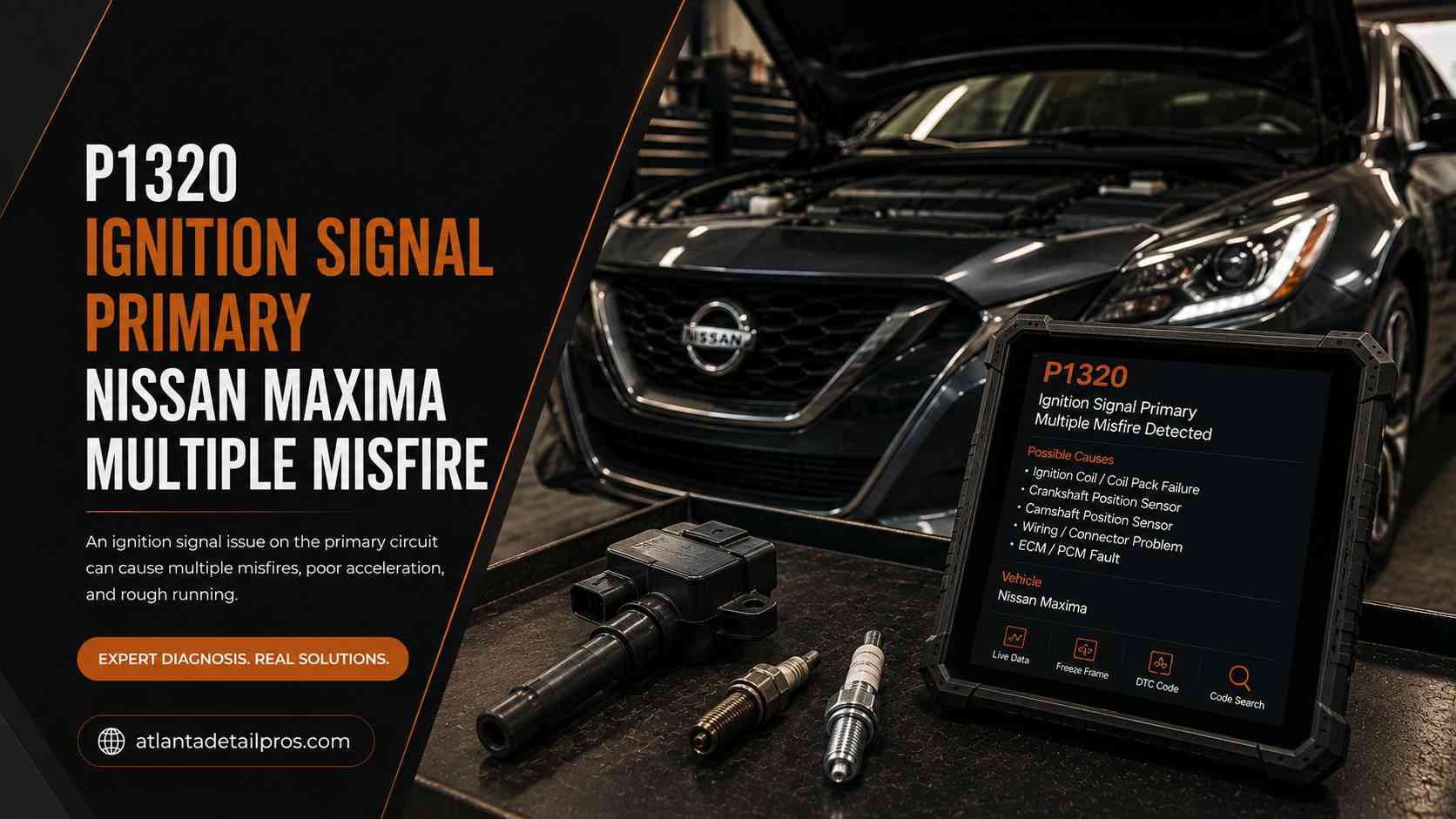
P1320 on a Nissan Maxima is a manufacturer-specific code that means the ECM is not receiving the ignition confirmation signal from one or more of the power transistors integrated into the coil-on-plug assemblies: and on the VQ35DE and VQ35HR engines, this code almost always appears alongside random misfire codes P0300 through P0306 because the same failed igniter that triggers P1320 is also preventing that cylinder from firing.
Unlike a simple coil failure on other platforms, the Nissan VQ35 igniter is built into the coil assembly, which means testing and replacing it requires understanding that the coil and igniter are a single unit.
“I spent two weeks thinking P1320 on my 2007 Maxima was an ECM problem because every forum post I read said something different. Finally found a Nissan tech who told me to just swap the coil packs one by one until the misfire moved. Turned out coils on cylinders 3 and 6 were dead. Two new OEM coil packs later and everything cleared. P1320 gone.”: Ryan Castellano, 2007 Maxima SE owner
What P1320 Means on a Nissan Maxima
Understanding the Ignition Signal Primary Circuit
P1320 is a Nissan-proprietary diagnostic trouble code that is not shared with other OBD-II platforms. It defines a fault in the “Ignition Signal Primary” circuit: the feedback confirmation that the ECM uses to verify each cylinder’s ignition event occurred. On the Nissan VQ35 engine, the coil-on-plug assembly contains not just the coil but also an integrated power transistor (igniter). When the ECM commands an ignition event, it sends a trigger signal to the igniter transistor. The transistor fires the coil and simultaneously sends a confirmation signal back to the ECM. P1320 stores when one or more of these confirmation signals is absent or erratic.
Why P1320 Appears With Misfire Codes on the VQ35 Maxima
Because the confirmation signal failure and the misfire are caused by the same component: the failed igniter/coil assembly: P1320 and specific cylinder misfire codes appear together. A common presentation is P1320 alongside P0300 (random misfire), P0303 (cylinder 3 misfire), and P0306 (cylinder 6 misfire) simultaneously, indicating two failed coil assemblies.
VQ35DE vs. VQ35HR: Which Maxima Generations Are Affected
- 2004 to 2006 Nissan Maxima (VQ35DE): the 3.5L DE engine uses coil-on-plug assemblies that have a documented failure pattern, particularly on units with over 80,000 miles
- 2007 to 2008 Nissan Maxima (VQ35DE revised): same engine architecture; coil assemblies remained the same design
- 2009 to 2014 Nissan Maxima (VQ35DE): similar pattern; aftermarket coil quality became a larger issue as vehicles aged
Diagnosing P1320 on the Nissan Maxima VQ35
Step 1: Identify Which Cylinders Are Misfiring
Reading All Stored Codes Together
Connect a scan tool and read all stored and pending codes before clearing anything. P1320 on its own does not tell you which cylinder’s igniter has failed. The accompanying misfire codes (P0301 through P0306) identify which specific cylinders are affected. Example code combination and what it means:
- P1320 + P0303 + P0306: cylinder 3 and cylinder 6 igniters have failed
- P1320 + P0300 only: random misfire with no cylinder-specific code yet; failure may be intermittent or just beginning
- P1320 alone (no misfire codes): the confirmation circuit is intermittently failing before a full misfire has been detected; suspect a coil beginning to fail
Step 2: The Coil Swap Test for VQ35 Maxima
Why the Coil Swap Test Is Especially Effective on the VQ35
All six coil-on-plug assemblies on the VQ35 are identical and interchangeable. Swapping a suspected cylinder’s coil with a known-good cylinder’s coil and clearing the codes confirms or rules out coil failure: Procedure:
- Identify the cylinder number corresponding to the misfire code (VQ35 cylinder numbering: cylinders 1-3 are the front bank, cylinders 4-6 are the rear bank)
- Swap the coil from the misfiring cylinder to a cylinder that is not misfiring (for example, swap cylinder 3’s coil to cylinder 1’s position)
- Clear all codes
- Test drive until codes set or the engine returns to steady operation
- If the misfire code follows the coil to the new cylinder (P0301 instead of P0303), the coil assembly is the confirmed failed component
Step 3: Spark Plug Inspection
When to Check Spark Plugs Alongside Coils
On the VQ35 Maxima, it is common practice to replace spark plugs at the same time as coil packs because accessing the rear bank cylinders (4, 5, 6) requires removing the intake plenum, making it labor-inefficient to service one without the other. VQ35DE spark plug specification: NGK PFR6B-11 or equivalent iridium plug. Torque to 18 ft-lb. Gap: 1.1mm (0.043 inch). Rear bank access: cylinders 4, 5, and 6 require removing the upper intake manifold (plenum). Budget 3 to 4 hours for a complete six-cylinder coil and plug service.
Primary Causes of P1320 on Nissan Maxima
Cause 1: Failed Coil-On-Plug Assembly (Integrated Igniter)
The coil-on-plug assembly is the definitive P1320 cause in the vast majority of cases. The integrated igniter transistor inside the assembly fails from heat cycling and age. No separate igniter is sold: the entire coil assembly must be replaced. OEM coil assembly (Hitachi, as supplied to Nissan): $50 to $90 each. Six-cylinder complete set: $300 to $540. Aftermarket alternatives: quality varies significantly on VQ35 coils. Units from Delphi and Standard Motor Products have acceptable track records; generic no-name coils are frequently reported to fail prematurely on the VQ35. Labor for all six coils with spark plugs (rear plenum removal required): 4 to 5 hours at an independent shop. Total shop cost for full coil and plug service: $600 to $1,000.
Cause 2: Ignition Confirmation Signal Wiring Fault
When Wiring Causes P1320 Without a Failed Coil
If the coil swap test confirms the coil itself is not the issue: the misfire code does not follow the coil: the ignition signal wire between the ECM and the coil connector may be damaged. On VQ35 Maximas, the wiring harness that runs to the rear bank coils near the firewall is exposed to heat from the engine and can develop insulation cracks or broken conductors. How to test: with the coil connector disconnected, check continuity of the signal wire from the coil connector back to the ECM connector. Resistance should be near zero ohms. Any break or high resistance indicates a harness fault. Wiring repair cost: $80 to $250 at a shop depending on the extent of the damage.
Cause 3: Faulty Crankshaft Position Sensor
How the CKP Sensor Causes P1320
A crankshaft position sensor that is providing a weak or intermittent signal can generate P1320 because the ECM cannot correlate the ignition trigger commands with reliable crankshaft position data. In this scenario, P1320 appears without cylinder-specific misfire codes, and the engine may crank without starting or start and run rough without a clear single-cylinder issue. CKP sensor location on VQ35: behind the rear bank, accessible from underneath. Replacement cost: $100 to $250 at an independent shop.
| Cause | Codes Alongside P1320 | Coil Swap Result | First Action |
|---|---|---|---|
| Failed coil assembly (one or more) | P030X cylinder-specific misfires | Misfire code follows the coil | Replace identified coil assemblies |
| Wiring harness fault | P1320 only or intermittent misfires | Misfire does not follow coil | Test signal wire continuity |
| CKP sensor fault | P1320 without cylinder-specific codes | Not applicable | Test CKP signal; replace if weak |
| Multiple failed coils | P0300 + multiple P030X codes | Multiple coils confirmed bad | Full set coil replacement recommended |
Frequently Asked Questions
What Does P1320 Mean on a Nissan Maxima?
P1320 is a Nissan-specific code indicating the ECM is not receiving the ignition confirmation signal from one or more coil-on-plug igniters. On the VQ35 Maxima, it almost always means one or more coil-on-plug assemblies have failed, and it typically appears alongside cylinder-specific misfire codes identifying which coils are involved.
Can I Drive a Nissan Maxima With P1320?
If the engine is misfiring actively (flashing check engine light or severe rough running), driving is not recommended because catalytic converter damage can occur rapidly from unburned fuel. If the check engine light is steady and the engine runs only slightly rough, driving to a shop is acceptable for a short distance.
How Do I Fix P1320 on a Nissan Maxima?
Identify the misfiring cylinders using the accompanying P030X codes, perform the coil swap test to confirm the coil assembly is the fault source, and replace the identified coil assemblies. Replacing all six simultaneously with OEM-quality units and fresh spark plugs is the most efficient solution on high-mileage VQ35 engines where multiple coils are likely approaching failure.
How Much Does It Cost to Fix P1320 on a Nissan Maxima?
Individual coil assembly: $50 to $90. Full six-coil set with OEM-quality parts: $300 to $540. Labor for full coil and spark plug replacement including rear plenum removal: $300 to $500. Total at an independent shop: $600 to $1,000 for a complete service.
The Bottom Line
P1320 on the Nissan Maxima VQ35 is one of the most systematically diagnosable codes on this platform. The coil swap test confirms which cylinders are affected in under 30 minutes. The repair is straightforward once the failed coils are identified. The primary mistake to avoid is replacing only the coil on the cylinder currently showing a misfire code while leaving the remaining high-mileage coils in place: on a VQ35 over 100,000 miles, the adjacent coils are typically close behind in the failure sequence.