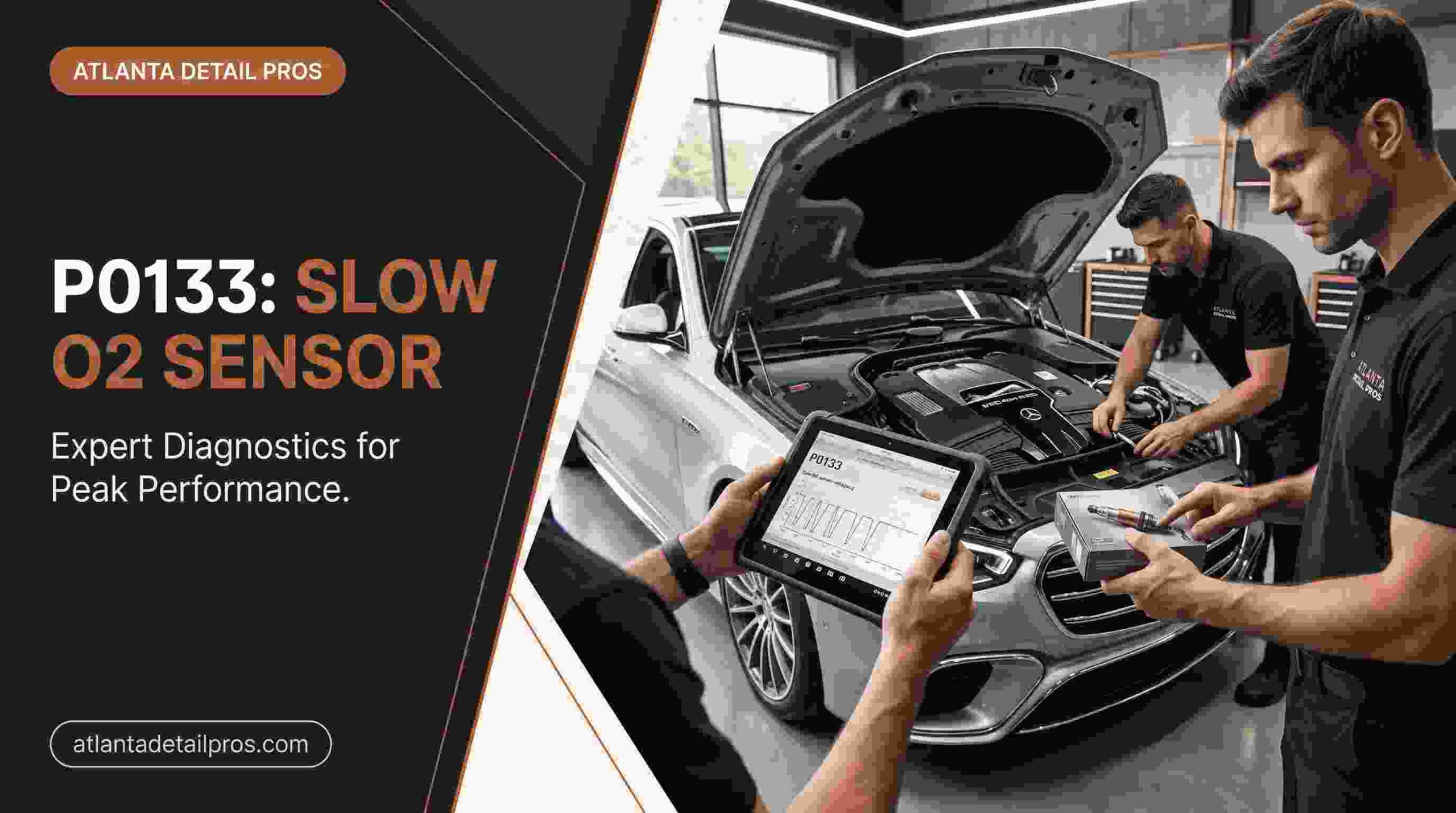
The P0133 code indicates that the upstream oxygen sensor on Bank 1 is cycling between rich and lean signals at a rate too slow to meet the OBD-II minimum threshold for adequate closed-loop fuel control. A healthy upstream O2 sensor switches between approximately 0.1 volts (lean) and 0.9 volts (rich) at least 8 times per 10 seconds during normal closed-loop operation. A sensor producing P0133 switches fewer times per 10 seconds than this minimum, indicating that the sensor’s electrochemical response has slowed due to age, contamination, or damage. The PCM monitors switch frequency during a specific oxygen sensor monitor cycle and sets P0133 when the switch rate falls below the acceptable threshold on the Bank 1 upstream sensor.
How Oxygen Sensors Work and Why They Slow Down
Upstream oxygen sensors use a zirconia electrochemical cell that generates a voltage based on the difference between oxygen concentration in the exhaust stream and the reference oxygen level in the ambient air. When combustion is rich, the exhaust contains little free oxygen and the sensor generates approximately 0.9 volts. When combustion is lean, more free oxygen is present in the exhaust and the sensor generates approximately 0.1 volts. The PCM monitors these voltage swings and uses them to continuously adjust fuel delivery in closed-loop operation, maintaining combustion near the stoichiometric ratio that optimizes both efficiency and catalyst performance.
Oxygen sensor response time degrades with age and exposure for several reasons. The zirconia ceramic element heats to operating temperature (above 600 degrees Fahrenheit) on every start cycle and cools on every shutdown, subjecting the element to thousands of thermal stress cycles over the sensor’s service life. The porous reference air path through the sensor body can become contaminated with oil vapor if the engine consumes oil, coating the reference surface and slowing electrochemical response. The exhaust-side sensing element can accumulate deposits from fuel additives, silicon from coolant leaks, and phosphorus from engine oil that coat the sensing surface and slow the chemical reaction that produces the voltage signal. Most O2 sensor manufacturers rate upstream sensor service life at 60,000 to 100,000 miles under normal conditions.
Bank 1 Location: Which Sensor Is Involved
Bank 1 in OBD-II terminology refers to the engine bank containing cylinder 1. On inline 4-cylinder and inline 6-cylinder engines, there is only one bank and all sensors are Bank 1. On V6, V8, and V10 engines, Bank 1 is the bank containing the number 1 cylinder, and Bank 2 is the opposite bank. The upstream sensor (Sensor 1) on Bank 1 is located before the catalytic converter in the exhaust flow, typically within the first 12 to 18 inches of the exhaust manifold or exhaust pipe. Confirm the location in your vehicle’s service manual before replacing the sensor.
Symptoms of P0133
Mild fuel economy reduction is the most common symptom of a slow-responding O2 sensor. When the upstream sensor switches slowly, the PCM’s closed-loop fuel corrections lag behind the engine’s actual combustion state, causing brief periods of rich running where excess fuel is burned without full efficiency gains. The delay in fuel correction also means the catalytic converter operates with a slightly less optimal feed gas mixture, which reduces catalyst efficiency over time. Many drivers notice no driveability symptoms at all with P0133 as the only active code, since the PCM compensates for the slow sensor with its adaptive fuel trim strategy.
Diagnosing P0133
Confirm P0133 with an OBD-II scanner and check whether the fault is pending or confirmed. A confirmed fault indicates the monitor ran and failed. Use a scanner with live data capability to watch the Bank 1 Sensor 1 voltage reading while the engine is at normal operating temperature in closed-loop fuel control. Count the voltage switches from low to high and high to low over a 10-second period. Fewer than 8 full switches in 10 seconds confirms the sensor is responding slowly. A sensor that shows no switching at all, holding steady near 0 or near 1 volt, may have failed completely rather than degraded slowly.
Check the sensor heater circuit as a preliminary step. Most modern O2 sensors use an integrated electric heater to reach operating temperature quickly. A failed heater element causes the sensor to reach operating temperature more slowly and contributes to slow response during warm-up. The heater circuit has its own code (P0135 for Bank 1 Sensor 1 heater circuit malfunction) but can affect response time even without a separate heater code if the heater is partially functional.
Repair: Replacing the Bank 1 Upstream O2 Sensor
Replacing the upstream O2 sensor on Bank 1 is the correct repair when live data confirms slow switching and the sensor is at or near its service interval. The sensor is typically accessible with an O2 sensor socket, a specialized tool with a side slot for the sensor wire that allows it to thread over the wire and onto the sensor hex. Apply penetrating oil to the sensor threads 24 hours before removal on vehicles with significant mileage, as O2 sensors thread into the exhaust manifold and can seize from corrosion and heat cycling. A seized sensor that rounds off under improper force requires an exhaust shop with a torch and proper extraction tools.
P0133 Diagnostic and Repair Reference
Diagnostic Step | Tool Required | Confirms Fault | Next Action |
|---|---|---|---|
Read live O2 switch frequency | OBD-II scanner with live data | Under 8 switches in 10 sec | Replace Bank 1 Sensor 1 |
Check sensor heater function | Multimeter, service manual | Open heater circuit | Replace sensor (heater is internal) |
Inspect sensor wire for damage | Visual inspection | Cut, chafed, or burned wire | Repair wiring, replace sensor |
Check for oil or coolant consumption | Visual inspection, oil level check | Blue smoke, coolant loss | Address root cause before sensor replacement |
Verify correct sensor part number | Part catalog by VIN | Wrong sensor type for vehicle | Install correct sensor |
Frequently Asked Questions About P0133
How much does it cost to replace the Bank 1 upstream O2 sensor?
An OEM replacement upstream O2 sensor costs $60 to $200 depending on the vehicle make and model. Quality aftermarket sensors from Bosch, Denso, and NTK cost $30 to $100 and perform equivalently to OEM sensors in most applications. Professional labor for O2 sensor replacement runs $60 to $150, making the total professional repair cost $90 to $350. DIY replacement with an O2 sensor socket is accessible for most vehicles without special equipment beyond the socket and a breaker bar with penetrating oil preparation.
Will P0133 damage the catalytic converter?
A slow-responding upstream O2 sensor that causes prolonged periods of rich running sends excess fuel to the catalytic converter. Sustained rich conditions overheat the catalytic substrate and accelerate converter degradation over thousands of miles. P0133 alone with mild symptoms does not immediately destroy the converter, but delaying repair for many months allows the progressively degraded fuel control to accumulate converter-damaging heat exposure cycles. Address P0133 within a few weeks of discovery rather than treating it as a non-urgent maintenance item.
Can I replace just the downstream sensor if both are showing slow response?
Upstream and downstream O2 sensors have different roles and should be addressed separately based on which codes are active. P0133 specifically involves the upstream sensor. The downstream sensor on Bank 1 produces P0136 or P0141 for its own faults. If both sensors are approaching their service interval on a high-mileage vehicle, replacing both during the same service is more cost-effective than replacing them in two separate appointments, since the vehicle is already raised and the exhaust hot or cool for one replacement.
Is there a way to clean an O2 sensor instead of replacing it?
Commercial O2 sensor cleaners applied by spraying a cleaner into the exhaust with the sensor removed temporarily do show some effectiveness in restoring response time on lightly contaminated sensors. However, sensors producing P0133 typically have degraded zirconia elements from thermal aging rather than surface contamination alone, and cleaning does not reverse the electrochemical degradation of the ceramic element. For a sensor at or past its service interval producing a confirmed slow response code, replacement provides a reliable solution where cleaning provides an uncertain temporary improvement at best.
What is the difference between P0133 and P0135?
P0133 is a performance code indicating that the Bank 1 upstream O2 sensor’s voltage is switching too slowly during normal closed-loop operation. P0135 is a circuit code indicating a fault in the heater circuit of the same sensor. Both codes can appear simultaneously because a failed heater element causes the sensor to reach operating temperature slowly, contributing to slow switching. When both codes appear, confirm the heater circuit is functioning before concluding that the sensor element itself is slow. A new sensor with an internal heater resolves both codes when the heater failure was causing the performance degradation.
Bottom Line
P0133 confirms that the Bank 1 upstream O2 sensor is switching between rich and lean too slowly for adequate closed-loop fuel control. Confirm with live data by counting voltage switches over 10 seconds. Replace the sensor when switching falls below 8 per 10 seconds and the sensor is at or near its service interval. Apply penetrating oil to the sensor threads before removal on high-mileage vehicles. Use a quality aftermarket sensor from Bosch, Denso, or NTK if OEM cost is prohibitive. Address P0133 within a few weeks of discovery to prevent progressively degraded fuel control from accumulating heat damage in the catalytic converter.