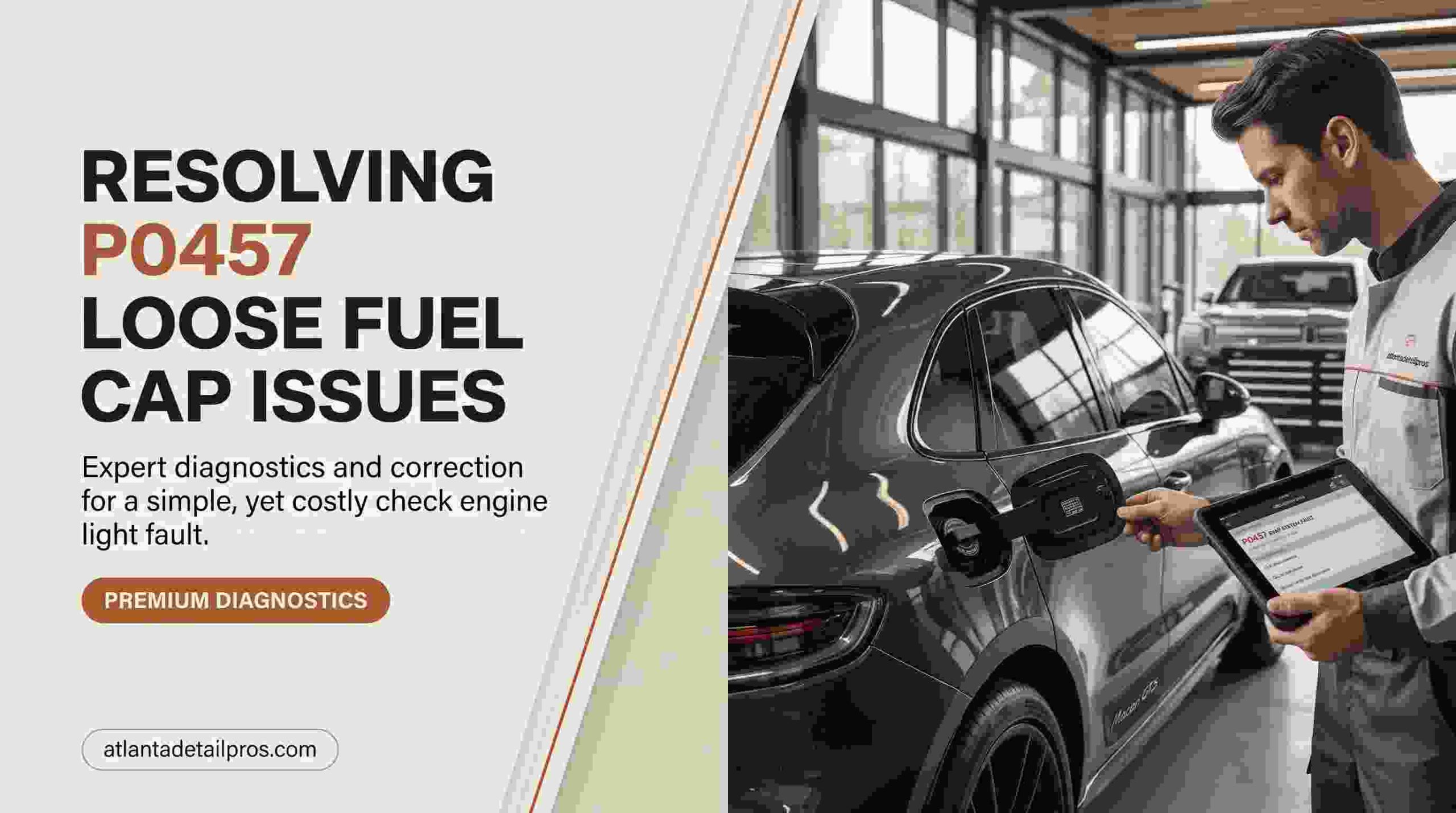
The P0457 code is one of the most straightforward OBD-II trouble codes to diagnose and repair because its most common cause is a loose or missing fuel cap that allows fuel vapors to escape from the gas tank rather than being retained in the sealed EVAP system. The ECM detects this vapor loss through a pressure or vacuum decay test that the EVAP system monitor runs during specific driving conditions. When the test reveals that the EVAP system cannot maintain the expected pressure or vacuum because vapors are escaping, the ECM sets P0457 and illuminates the check engine light. In the majority of P0457 cases, tightening or replacing the fuel cap resolves the code entirely. However, P0457 can also indicate a more significant EVAP system leak that a gas cap fix will not address.
What the EVAP System Does and Why the Fuel Cap Matters
The evaporative emission control (EVAP) system is a sealed network that captures fuel vapors from the gas tank and routes them through a charcoal canister to the engine intake for combustion, preventing the vapors from venting to the atmosphere. The system operates as a sealed unit during normal operation, with the fuel cap forming the final seal at the fill point. The ECM periodically tests the system’s integrity by commanding the EVAP canister vent valve closed and monitoring whether the system holds the expected pressure or vacuum. A leak anywhere in the system, including a loose fuel cap, allows pressure or vacuum to escape and causes the test to fail.
P0457 specifically indicates a large leak detected in the EVAP system, defined as a leak at or above 0.040 inch diameter under the OBD-II standard. The fuel cap is the most common source of a leak this large because its rubber gasket compresses and cracks with age, and because a fuel cap that was not clicked into the locked position after the last refueling leaves the entire fill neck open to atmospheric pressure. Smaller leak codes (P0456 for small leaks, P0455 for very large leaks) follow the same diagnostic process but with different probability distributions of causes.
Step One: Check and Tighten the Fuel Cap
Remove the fuel cap completely and inspect the rubber sealing gasket on the underside of the cap. The gasket should be uniform in thickness, flexible, free of cracks, and free of deformation that would prevent uniform contact around the full circumference of the fill neck. A gasket that is visibly cracked, deformed, or missing sections needs a new cap rather than just tightening.
If the gasket appears intact, reinstall the cap by threading it clockwise until it clicks. Most modern fuel caps use a ratcheting mechanism that clicks when the cap is properly seated and prevents over-tightening. Confirm the cap is fully engaged by attempting to turn it further after the click without force. Clear the P0457 code with an OBD-II scanner and drive the vehicle for several days under normal conditions. The EVAP monitor runs during a cold start and warm-up sequence, so the system needs several cold-to-warm drive cycles to complete the monitor and confirm the code is resolved.
Step Two: Replace the Fuel Cap if the Gasket Is Damaged
Replace the fuel cap when the gasket is cracked, hardened, or visibly deformed. A replacement fuel cap for most vehicles costs $15 to $40 at an auto parts store, and in many cases a universal-fit cap at the lower end of this range seals adequately. However, using the OEM-specified cap for the vehicle ensures the correct pressure rating and fit for the fill neck dimensions. Some modern vehicles have capless fuel systems where an internal valve replaces the traditional cap, and these systems require professional inspection when P0457 appears because there is no cap to tighten or replace.
After installing the replacement cap, clear the P0457 code and drive through several complete cold-start and warm-up cycles to allow the EVAP monitor to run and confirm the code does not return. If the code returns within one to three drive cycles after replacing the cap, the fuel cap was not the cause or there is a second leak source in addition to the cap.
When P0457 Is Not a Gas Cap Problem
When P0457 returns after a new fuel cap is installed, the large EVAP leak is coming from somewhere else in the system. Common non-cap sources for a large EVAP leak include a cracked or split EVAP hose between the gas tank and the charcoal canister, a failed canister vent valve that is stuck open and cannot seal the system for the monitor test, a cracked or damaged charcoal canister body, a failed filler neck seal where the filler tube enters the gas tank, and on some vehicles a faulty fuel tank pressure sensor that gives false readings during the EVAP monitor test.
Diagnosing non-cap EVAP leaks typically requires a smoke test performed with a professional EVAP smoke machine that pressurizes the system with smoke and reveals leak points visually. This test is performed at most shops and dealerships for a diagnostic fee of $75 to $150 and identifies the specific leak source that a cap replacement did not address. Attempting to diagnose a non-cap EVAP leak without the smoke machine by visual inspection alone is rarely productive because the hoses and canister connections are routed under the vehicle in locations where visual access is limited.
P0457 Diagnosis and Repair Reference
Cause | Likelihood | DIY Fix | Cost |
|---|---|---|---|
Loose fuel cap (not fully tightened) | Very High | Tighten cap, clear code, monitor | $0 |
Cracked fuel cap gasket | High | Replace fuel cap | $15 to $40 |
Cracked EVAP hose | Moderate | Replace hose if accessible | $20 to $60 parts |
Stuck-open canister vent valve | Moderate | Replace vent valve | $30 to $100 parts |
Cracked charcoal canister | Low to Moderate | Replace canister | $50 to $200 parts |
Filler neck seal failure | Low | Professional repair | $100 to $400 parts and labor |
Capless fuel system fault | Low | Professional inspection required | Varies by component |
Frequently Asked Questions About P0457
Is it safe to drive with a P0457 code?
P0457 does not indicate a mechanical problem with the engine, the transmission, or any safety system. The vehicle will drive and perform normally with an active P0457 code. The primary concern is that the EVAP leak causing P0457 releases fuel vapors to the atmosphere rather than routing them to the engine for combustion. In most cases this is a fuel smell rather than a safety hazard. However, if you can smell a strong fuel odor inside or near the vehicle at any time, investigate the cause before driving, as a significant fuel system leak presents a fire risk that P0457 alone does not describe.
How many miles do I need to drive after fixing P0457 before the check engine light goes off?
The check engine light does not automatically go off after the repair without clearing the code with an OBD-II scanner first. Clear the code after the repair, then drive through 1 to 3 complete cold-start and warm-up cycles to allow the EVAP monitor to run successfully. The light will stay off if the repair resolved the leak. On some vehicles, the EVAP monitor requires a very specific drive cycle sequence that the manufacturer documents; look for your vehicle’s specific EVAP monitor drive cycle conditions if the monitor is not completing after several normal drive cycles.
Will a P0457 code cause a failed emissions test?
Yes. P0457 illuminates the check engine light, and any illuminated check engine light fails an emissions inspection in states that test OBD-II readiness. Additionally, P0457 causes the EVAP monitor to show as failed or incomplete in the readiness status test that emissions stations check. Resolve the P0457 code, complete the required drive cycles to pass the EVAP monitor, and verify the monitor shows as complete before presenting the vehicle for an emissions test.
Can I use a generic gas cap instead of my car’s specific cap?
Universal-fit gas caps from auto parts stores work adequately for most vehicles when selected by the fuel cap application guide at the counter. The critical specifications are the thread diameter and pitch of the fill neck and the required sealing pressure for the EVAP system. An undersized cap that does not fully engage the fill neck threads is worse than no cap at all because it may create a false sense of security while leaving the system unsealed. Use an OEM cap or a reputable aftermarket cap with confirmed compatibility for the specific make, model, and year rather than a universal cap that does not list your vehicle in its application guide.
Why did P0457 come back after I already replaced the gas cap?
P0457 that returns after a new gas cap is installed indicates either that the replacement cap is also not sealing correctly due to a manufacturing defect or incorrect fit, or that the code was never caused by the gas cap and the leak source is elsewhere in the EVAP system. Try a second replacement cap, ideally an OEM cap from the dealership, to rule out a defective replacement part. If P0457 returns with the second cap installed and properly tightened, the leak is coming from another component and the vehicle needs an EVAP smoke test to identify the specific leak location.
Bottom Line
P0457 most commonly results from a loose or damaged fuel cap that allows fuel vapors to escape from the EVAP system during the monitor test. Start by removing the cap, inspecting the gasket for cracks or deformation, reinstalling it with a firm click, and clearing the code. If the gasket is damaged, replace the cap for $15 to $40. If P0457 returns after a new cap is installed and confirmed properly seated, the large EVAP leak is coming from another system component and requires an EVAP smoke test at a shop to pinpoint the specific leak location. The vehicle is safe to drive with P0457 unless you detect a strong fuel smell, which warrants immediate inspection before further driving.