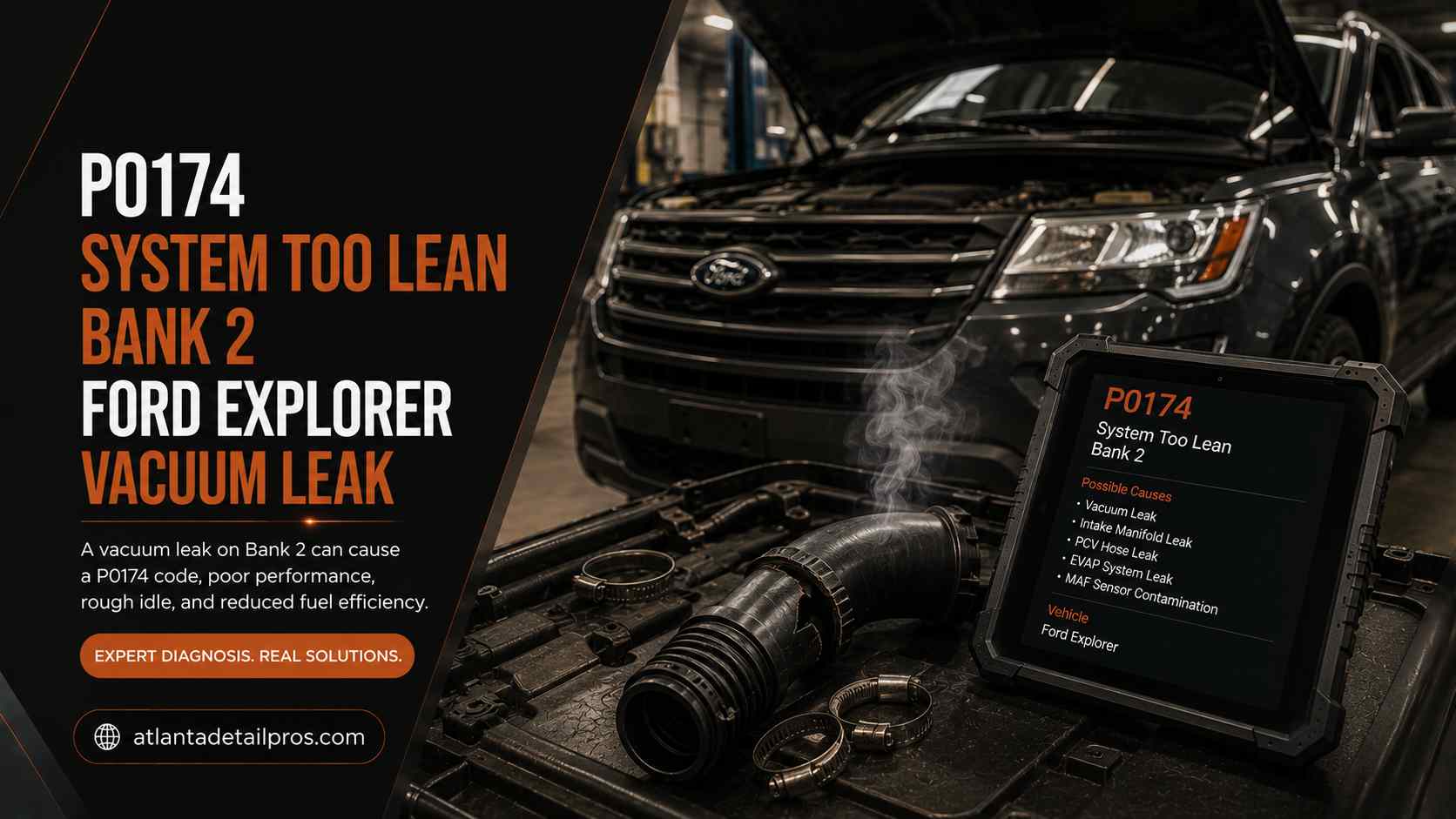
P0174 on a Ford Explorer means the ECM has detected that the air-fuel mixture on Bank 2 (the passenger side of the engine) is running lean: there is too much air or too little fuel: and the most common cause on Explorer trucks is a cracked or disconnected PCV hose, an intake manifold gasket leak, or a vacuum hose that has pulled away from its fitting on the passenger side of the engine.
The Bank 2-only pattern is the critical diagnostic detail: when only one bank is lean rather than both, the leak is typically located on the passenger side of the engine or the MAF sensor is reporting incorrect airflow.
“I chased P0174 on my 2017 Explorer Sport for two weeks. Cleaned the MAF, replaced the PCV valve, checked every hose I could reach. Finally found it: there was a tiny crack in the rear PCV hose on the driver’s side that was sucking air into the passenger bank. Once I replaced that hose the code never came back.”: Tom Briggs, Explorer 3.5L EcoBoost owner
Understanding P0174 on the Ford Explorer
What Bank 2 Means on the Explorer
On V6 Ford Explorers, the engine is mounted transversely. Bank assignments depend on the specific engine:
- 3.5L Ti-VCT (naturally aspirated): Bank 1 is the front cylinder bank (facing the radiator); Bank 2 is the rear bank (facing the firewall)
- 3.5L EcoBoost (twin-turbocharged): same banking convention; Bank 2 is the rear/firewall-facing bank
- 2.3L EcoBoost (4-cylinder, 2020+ Explorer): only one bank; P0174 applies to the single bank When only Bank 2 is lean (P0174 without P0171), the cause is either on the Bank 2 side of the engine or is a shared component that is affecting Bank 2 more severely.
How the ECM Detects a Lean Condition
The ECM monitors the oxygen sensors on each bank and uses their voltage signals to calculate how much fuel correction is being applied (long-term fuel trim, LTFT). When LTFT on Bank 2 rises above approximately +10 percent, the ECM stores P0174 to flag that the system has been adding fuel to compensate for an unmetered air source.
Primary Causes of P0174 on the Ford Explorer
Cause 1: Cracked or Disconnected PCV System Hose: Most Common
Why the PCV System Causes P0174 on the Explorer
The positive crankcase ventilation (PCV) system routes blow-by gases from the crankcase back into the intake manifold for combustion. On the 3.5L Ti-VCT and 3.5L EcoBoost Explorer engines, the PCV hoses route through tight spaces near the firewall and across the engine. The combination of heat, age, and vibration causes the hose material to crack, particularly at the ends where the hose connects to the valve cover and intake manifold fittings. A crack in the PCV hose on the Bank 2 side introduces unmetered air into the intake stream. The oxygen sensor sees excess oxygen (lean mixture), LTFT rises, and P0174 is stored.
Tom Briggs’s experience above illustrates a common pattern: the crack is often in the rear PCV hose section that runs from the valve cover toward the rear of the engine near the firewall: an area that is difficult to see without removing intake components or using a mirror and flashlight.
How to Find a PCV Hose Crack
Method 1: Smoke test: a shop uses a smoke machine to introduce inert smoke into the intake system. Any leak point shows smoke escaping, including small PCV hose cracks that are invisible to the naked eye.
Method 2: Propane enrichment test: while the engine is at idle, hold a propane hose (unlit) near suspected vacuum leak areas. If engine RPM momentarily increases when propane is near a specific location, the propane is being drawn into the engine through the leak at that point.
Method 3: Visual inspection: with the engine off and cold, inspect all PCV hoses from end to end. Pay particular attention to the hoses immediately at the connection points to the valve cover and the intake manifold. Squeeze each hose gently: a cracked hose may open slightly under compression.
PCV hose replacement cost on Explorer: $20 to $80 for the specific hose depending on routing. Labor: 30 to 90 minutes. Total at a shop: $80 to $200.
Cause 2: Intake Manifold Gasket Leak on Bank 2
How Intake Gasket Failure Causes a Lean Code
The intake manifold on the Explorer’s V6 engines seals against both cylinder heads with gaskets. When the gasket on the Bank 2 (rear) cylinder head face deteriorates, ambient air is drawn into the intake manifold between the gasket and the head, bypassing the MAF sensor.
This unmetered air creates a lean mixture specifically on Bank 2. Intake manifold gasket leaks are more common on higher-mileage Explorers (100,000+ miles) and may be preceded by a rough idle that gets worse as the engine warms up (the manifold expands with heat, sometimes worsening the leak; other times heat softens the gasket slightly and the idle improves).
Intake manifold gasket replacement cost on 3.5L Explorer: $300 to $600 at an independent shop including parts and labor. On the EcoBoost with turbocharged intake plumbing, access is more complex: $400 to $800.
Cause 3: MAF Sensor Contamination or Failure
Why the MAF Can Cause a Bank 2-Specific Lean Code
A mass airflow (MAF) sensor that is partially contaminated with oil film or debris reports lower airflow than is actually entering the engine. The ECM, believing less air is entering, adds less fuel, and both banks may run lean. However, a contaminated MAF more commonly appears as P0171 and P0174 simultaneously rather than only P0174. A Bank 2-only lean code with a clean fuel trim on Bank 1 is less likely to be a MAF issue but should be included in the diagnosis.
MAF sensor cleaning: use mass airflow sensor cleaner spray on the sensor wire elements. Allow to dry completely before reinstalling. Cost: $8 to $15 for cleaner. This can eliminate MAF contamination as a variable before buying parts.
MAF sensor replacement cost: $100 to $300 for the sensor. Labor: 15 to 30 minutes. Confirm MAF failure with live data comparison before replacing.
Cause 4: Vacuum Line Disconnection or Crack
Common Vacuum Line Locations on the Explorer
Beyond the PCV system, the Explorer has several vacuum lines serving the brake booster, EVAP canister, VVT actuators, and various sensors. A vacuum line that has pulled from its barbed fitting introduces unmetered air. On the rear-bank (Bank 2) side of the 3.5L engine, the area near the firewall has multiple vacuum connections that are difficult to access and inspect. Quick check: with the engine idling, spray carburetor cleaner or brake cleaner (small amounts) near suspected vacuum line ends. Any change in RPM indicates the spray was drawn in through a leak at that location.
| Cause | Bank 2 Only Pattern? | Best Diagnostic Method | Repair Cost |
|---|---|---|---|
| PCV hose crack | Yes: if on Bank 2 side | Smoke test; propane enrichment; visual inspection | $80 to $200 |
| Intake manifold gasket leak | Yes: if Bank 2 face | Smoke test; vacuum gauge | $300 to $800 |
| MAF contamination or failure | Usually both banks | Clean MAF; compare live data | $8 to $300 |
| Vacuum line disconnection | Yes: if near Bank 2 | Smoke test; propane enrichment | $20 to $150 |
| Fuel injector fault (Bank 2) | Yes | Injector balance test; scan tool | $150 to $400 |
Frequently Asked Questions
What Does P0174 Mean on a Ford Explorer?
P0174 means the ECM has detected a lean condition on Bank 2: the passenger-side/rear cylinder bank. The engine is adding extra fuel to compensate for excess air entering the intake. On Ford Explorer, the most common cause is a cracked PCV hose, an intake manifold gasket leak, or a contaminated MAF sensor.
What Is the Difference Between P0171 and P0174 on a Ford Explorer?
P0171 indicates Bank 1 (front/driver-side bank) is lean. P0174 indicates Bank 2 (rear/passenger-side bank) is lean. When only one code is present, the leak is typically on that specific bank’s side of the engine. When both codes are present simultaneously, a shared component (MAF sensor, EVAP system, or a central air leak) is more likely.
How Do I Fix P0174 on a Ford Explorer?
Start with inspecting and testing all PCV system hoses: this is the most common fix on Explorer trucks and costs $80 to $200. Use a smoke test if the leak cannot be found visually. Clean the MAF sensor and observe whether long-term fuel trim on Bank 2 improves. If both the PCV system and MAF are confirmed healthy, the intake manifold gasket on Bank 2 is the next suspect.
Can I Drive an Explorer With P0174?
The vehicle will run but with reduced fuel economy and potentially rough idle from the lean mixture. Prolonged lean operation can damage oxygen sensors and catalytic converters. Address P0174 within two weeks.
The Bottom Line
P0174 on the Ford Explorer is a Bank 2 lean code with a consistent cause hierarchy: PCV hose first, MAF sensor second, intake manifold gasket third. The smoke test is the single most efficient diagnostic investment because it reveals any air leak in the system without requiring the trial-and-error of replacing components. An $80 to $150 smoke test that confirms a PCV hose crack saves several hundred dollars in misdiagnosed parts.