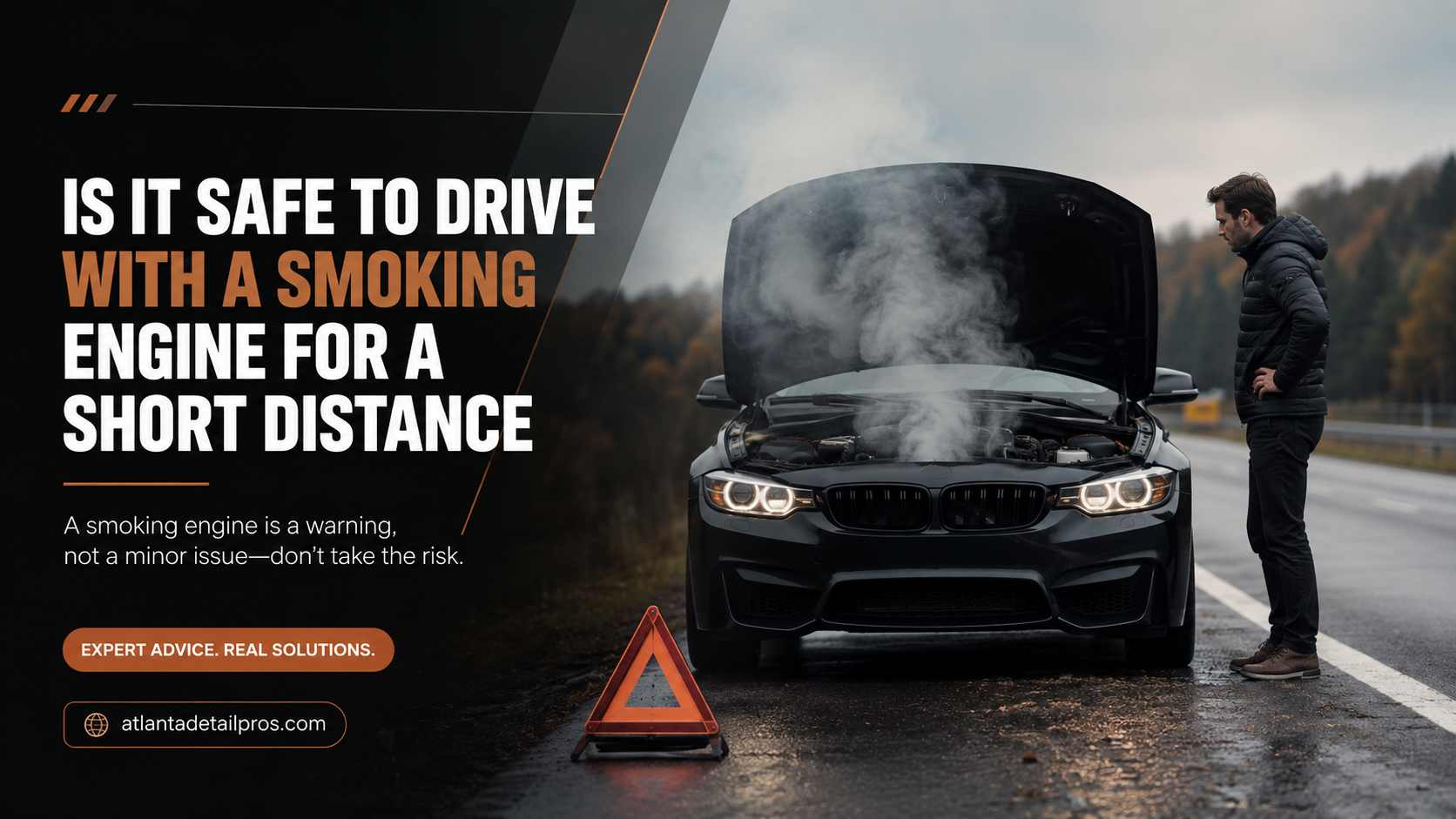
Driving a smoking engine for even a short distance is risky and depends almost entirely on the color and source of the smoke: white or blue smoke signals internal engine damage that will worsen with every mile, while thin black smoke is less immediately catastrophic but still needs same-day attention.
The mistake most drivers make is assuming “just around the corner” is a safe margin. For a blown head gasket or severe oil consumption, even a two-mile drive can turn a $1,500 repair into a $6,000 engine replacement.
Understanding why the smoke matters as much as the distance helps you make a faster, better decision at the roadside. Your engine is a precisely engineered system where combustion gases, coolant, and oil occupy separate chambers. When those boundaries fail, smoke appears as a distress signal. Acting on that signal correctly is the difference between a repair bill and a total loss.
This guide breaks down every smoke color, what it means mechanically, and exactly how far (if at all) you can safely push the vehicle without causing irreversible damage.
What Engine Smoke Color Actually Means at the Mechanical Level
White Smoke: The Most Urgent Warning
White or gray-white smoke coming from the exhaust almost always means coolant is entering the combustion chamber and being burned. The two most common culprits are a blown head gasket and a cracked cylinder head. Both are serious failures that allow coolant to migrate into cylinders, where it vaporizes into that distinctive sweet-smelling white cloud.
Running the engine in this condition causes a cascade of secondary failures. Coolant dilutes the engine oil, stripping its lubricating properties within minutes of mixing. Coolant contamination also causes bearing surfaces to score. A head gasket that is merely leaking at the start of a drive can be completely destroyed by the end of it. Coolant loss also compounds the damage: as the cooling system loses fluid, engine temperature rises unchecked.
The chemistry is unforgiving. Engine oil contaminated with coolant loses viscosity at operating temperature. Bearing surfaces that depend on a continuous pressurized oil film experience metal-to-metal contact within minutes of oil quality falling below the threshold. On interference engines like the Honda K-series, the Toyota 2AZ-FE, or the Ford EcoBoost 1.5L, this metal-to-metal contact can score cylinder walls beyond the point of hone-and-re-ring repair, forcing a full engine replacement.
Safe driving distance: essentially zero. Pull over, shut off the engine, and call a tow. A half-mile drive with a blown head gasket and dropping coolant level can seize a cylinder.
Blue or Blue-Gray Smoke: Serious but Slightly More Forgiving
Blue smoke means the engine is burning oil. This happens when piston rings are worn, valve seals are failing, or the PCV system is overwhelmed. The engine is losing lubrication with each combustion cycle. Unlike coolant intrusion, oil burning is often a progressive condition that has been developing for weeks before the smoke becomes visible.
The key variable is how much oil the engine is consuming. If the dipstick reads low and the smoke is heavy, you are minutes away from oil starvation and potential spun bearings. If the smoke is light and intermittent and the oil level is within the normal range, a short 2 to 3 mile drive to a shop is often survivable with close temperature monitoring.
Engines particularly prone to excessive oil consumption include the Subaru EJ series (valve stem seals and ring land failures), the BMW N47 and N63 (valve stem seals), the Audi/VW 2.0T TSI (PCV and ring failure), and the Toyota 5S-FE with high mileage (valve seals). Knowing your engine’s history of this issue matters when making the call.
Safe driving distance: 1 to 3 miles maximum if oil is not critically low, engine temperature stays normal, and smoke does not thicken.
Black Smoke: Rich Fuel Mixture, Lower Immediate Risk
Black smoke from the exhaust indicates excess unburned fuel, a condition called running rich. Common causes include a stuck fuel injector, a failed mass airflow sensor, a faulty oxygen sensor, or a clogged air filter. The engine is not in immediate mechanical danger from the smoke itself, but fuel washing the cylinder walls and diluting the oil is a longer-term concern.
A vehicle blowing black smoke can usually be driven a short distance to a shop without catastrophic consequences, provided the engine temperature is normal and no other warning lights are present. The fuel economy will be poor and the catalytic converter may be damaged by the excess fuel load, but you are not facing the same immediate seizure risk as with white or blue smoke.
Safe driving distance: 5 to 10 miles with monitoring, assuming temperature gauge and oil pressure light are normal.
White Smoke Only on Cold Start
Thin white vapor during the first 60 to 90 seconds of a cold start, which then disappears completely, is almost always condensation burning off the exhaust system. This is completely normal, especially in cold or humid climates. The diagnostic distinction: if the smoke clears before the engine reaches operating temperature and there is no coolant loss over time, this is not a warning sign.
The reliable test is to run the engine to full operating temperature. If white smoke persists more than 3 to 4 minutes after a cold start, or if you are losing coolant from the reservoir between fill-ups, the smoke is not condensation.
Smoke Source Location Changes Everything
Smoke From Under the Hood vs. From the Exhaust
Smoke visible rising from the engine bay, rather than from the tailpipe, indicates something entirely different from exhaust smoke. Oil dripping onto a hot exhaust manifold or catalytic converter, a coolant leak spraying onto a hot surface, or burning electrical insulation will all produce under-hood smoke. This type of smoke carries a fire risk that exhaust smoke does not.
If you see smoke rising from under the hood while driving, pull over immediately and shut off the engine. Do not open the hood until you can confirm the source, because introducing fresh air to a smoldering electrical fire or a coolant steam event can worsen the situation significantly. Call roadside assistance and wait.
Smoke From the Oil Cap or Dipstick Tube
White or gray smoke escaping from the valve cover area, oil filler cap, or dipstick tube points to blow-by: combustion gases are leaking past the piston rings and pressurizing the crankcase. This is a symptom of significant ring wear. The engine is still running on all cylinders but internal wear is advanced. You can typically drive 2 to 5 miles with steady blow-by smoke, but the condition requires prompt mechanical inspection.
On turbocharged engines, blow-by from the crankcase can also enter the intake system through the PCV and cause secondary blue smoke from the exhaust. Check whether the smoke is visible when you first get on boost, which points to a turbocharger seal failure rather than ring wear alone. Turbo seal failure produces blue smoke specifically during acceleration or immediately after a deceleration when oil pressure in the turbo cartridge exceeds the seal’s ability to contain it.
Decision Framework: Should You Drive It?
| Smoke Color | Most Likely Cause | Immediate Risk Level | Drive to Shop? | Max Suggested Distance |
|---|---|---|---|---|
| White (sweet smell, persistent) | Head gasket / cracked head | Red: Critical | No: tow it | 0 miles |
| Blue / blue-gray | Burning oil | Amber: High | Only if oil is full | 1 to 3 miles |
| Gray from exhaust or valve cover | Oil blow-by | Amber: High | Only if oil is full | 2 to 5 miles |
| Black | Rich fuel mixture | Yellow: Moderate | Yes, with monitoring | 5 to 10 miles |
| White (cold start only, clears fast) | Normal condensation | Green: None | Yes | Normal driving |
| Under-hood smoke (any color) | External leak / fire risk | Red: Critical | No: pull over now | 0 miles |
What Actually Happens When You Push Through the Smoke
For a blown head gasket scenario, here is the typical failure sequence when a driver ignores the white smoke and continues driving:
Miles 0 to 1: Coolant continues entering the combustion chamber. Coolant level drops. Oil begins to show a milky contamination if coolant is mixing through a crack in the head or block.
Miles 1 to 3: Coolant level drops below the minimum. The cooling system can no longer regulate temperature. The temperature gauge begins climbing toward the upper range.
Miles 3 to 5: Overheating causes thermal expansion in the aluminum cylinder head. A head that had a small crack now has a large one. A head gasket that was leaking in one spot now fails across multiple cylinders.
Miles 5 to 8: If the driver pushes through the temperature warning, the engine may hydro-lock if coolant fills a cylinder before the piston reaches top dead center, bending a connecting rod. Alternatively, the pistons score the cylinder walls as lubrication fails. At this point the engine is typically a total loss.
A tow costs $75 to $200. A head gasket repair on a four-cylinder engine costs $1,200 to $2,200. A replacement engine costs $3,500 to $8,000 installed. The financial math is not complicated.
“I thought it was just steam from the rain hitting a hot engine. I drove it four miles to the gas station and the temperature gauge went into the red on the last block. By the time the mechanic looked at it, both a head gasket and a cracked head: they had to rebuild the whole top end for $4,100. A tow would have saved me at least $2,500.”: Steve Patterson, 2017 Honda Accord 2.4L
How to Assess the Situation at the Roadside
Step 1: Identify the Smoke Source and Color
Pull over safely and let the engine idle for 30 seconds. Determine whether the smoke is coming from the exhaust pipe, from under the hood, or from the engine bay specifically. Use the color guide above to assign a risk level before making any other decisions.
Step 2: Check the Temperature Gauge
Look at your temperature gauge immediately. If it is reading in the upper quarter of the normal range or above, the cooling system is already compromised. Do not drive further under any circumstances.
Step 3: Check Oil Level and Condition
Shut off the engine and wait 2 minutes for oil to drain back to the sump. Pull the dipstick. If the oil shows a milky, foamy, or caramel-colored appearance, coolant has contaminated it: do not drive at all. If the oil is black but at minimum level with blue smoke, you may have a very short drive window. If the oil is below the add mark, top off before attempting any drive.
Step 4: Check Coolant Level
Look at the coolant overflow reservoir. If it is empty or below the minimum line and you are seeing white smoke, you are already in the danger zone. Do not add coolant and continue driving: the system has a breach that added fluid will not fix.
Step 5: Make the Call
Use the decision table. If the answer is “tow it,” that is the correct answer regardless of how close the shop is. Emergency roadside assistance through AAA or your auto insurance company is often free or heavily discounted. The call takes 10 minutes. An engine replacement takes 10 days and several thousand dollars.
Repair Cost Ranges by Smoke Cause
| Cause | Typical Repair | Independent Shop Cost Range |
|---|---|---|
| Blown head gasket (4-cyl) | Head gasket + resurfacing | $1,200 to $2,200 |
| Blown head gasket (V6 / V8) | Head gasket set + labor | $2,000 to $3,800 |
| Cracked cylinder head | Head replacement or rebuild | $1,800 to $4,500 |
| Worn valve seals (blue smoke) | Valve stem seal replacement | $600 to $1,400 |
| Worn piston rings | Engine rebuild or replacement | $2,500 to $6,000 |
| Stuck injector (black smoke) | Injector cleaning or replacement | $200 to $600 per injector |
| Failed MAF sensor (black smoke) | MAF sensor replacement | $150 to $350 |
| PCV valve failure (blue smoke) | PCV valve replacement | $40 to $120 |
| Turbocharger seal failure | Turbo rebuild or replacement | $500 to $2,200 |
Frequently Asked Questions
How long can I drive with white smoke coming from my exhaust?
You should not drive at all with sustained white smoke from the exhaust. Pull over, shut off the engine, and arrange a tow. White exhaust smoke almost always indicates coolant entering the combustion chamber through a failed head gasket or cracked head. Every additional mile risks coolant starvation, overheating, and catastrophic engine failure that can turn a $1,500 repair into a $6,000 engine replacement.
Is white smoke always a head gasket?
White smoke is the most common symptom of a blown head gasket, but it can also indicate a cracked cylinder head, a leaking intake manifold gasket on some engine designs, or a cracked engine block in severe cases. In cold weather, thin white vapor for the first 60 to 90 seconds is normal condensation and not a cause for concern. The reliable indicator of a problem is smoke that persists after the engine reaches operating temperature combined with measurable coolant loss between fill-ups.
Can I add water to the radiator and drive a smoking engine to the shop?
Adding coolant or distilled water to a low cooling system buys a small amount of time if the loss is from a minor external leak and not an internal head gasket failure. If the head gasket is the problem, the added coolant will be consumed into the combustion chamber during the drive. This strategy sometimes allows a 1 to 2 mile drive, but it should only be attempted with the temperature gauge actively monitored and a plan to pull over immediately if temperature rises above the midpoint.
My engine smells like something is burning but I see no smoke: should I stop?
Yes. Pull over and investigate before continuing. A burning smell without visible smoke often means oil or coolant is dripping onto a hot exhaust surface but has not yet reached a quantity that produces visible smoke. It can also indicate overheating brake components on a downhill descent, a slipping drive belt, or an electrical fault. Identifying the source before continuing prevents a minor issue from becoming a fire or breakdown.
Does blue smoke mean my engine is ruined?
Blue smoke does not automatically mean the engine is ruined, but it does indicate significant internal wear. If oil consumption is light (less than 1 quart per 1,000 miles) and engine performance is otherwise normal, many engines continue running reliably for tens of thousands of additional miles with regular oil level monitoring. If consumption is heavy or the smoke is thick and constant, the engine is approaching the end of its serviceable life and a rebuild or replacement decision is approaching.
Can I still sell a car with a smoking engine?
Yes. Junk car buyers and salvage buyers routinely purchase vehicles with blown head gaskets, burning oil engines, and other smoke-related failures. Disclosure of the condition is required, but the vehicle still has scrap metal and parts value. Depending on the vehicle make, year, and model, a running car with a smoking engine may bring $300 to $2,500 from a reputable junk car buyer. Getting multiple offers is always worthwhile before signing over the title.
What is the fastest way to tell if I have a head gasket failure versus a minor external leak?
A combustion leak test kit, available at any auto parts store for $20 to $30, draws air from the cooling system through a chemical that changes color (typically from blue to yellow-green) in the presence of combustion gases. A positive test result confirms combustion gases are entering the coolant system, which is the definitive sign of a head gasket or head failure. You can also look for a milky residue on the underside of the oil filler cap, which indicates coolant mixing into the engine oil.
The Bottom Line
Never drive a white-smoking engine: call a tow. The 15 minutes and $100 to $200 cost of a tow is the cheapest insurance against a $4,000 to $8,000 engine failure. Blue and gray smoke offer a narrow short-distance window only if oil level is confirmed adequate and the temperature gauge stays normal throughout the drive.
For black smoke, the immediate mechanical risk is lower, but the vehicle still needs same-day attention. Unburned fuel washing cylinder walls and over-fueling the catalytic converter create their own repair bills if ignored. The shop visit that seems inconvenient today is always cheaper than the tow and repair combination that follows a catastrophic failure.
If the vehicle already has significant mechanical issues on top of the smoking problem, get an honest assessment of total repair cost before spending money on a tow and diagnosis. When repair costs approach or exceed vehicle value, a cash-out sale to a junk car buyer is often the smarter financial move.