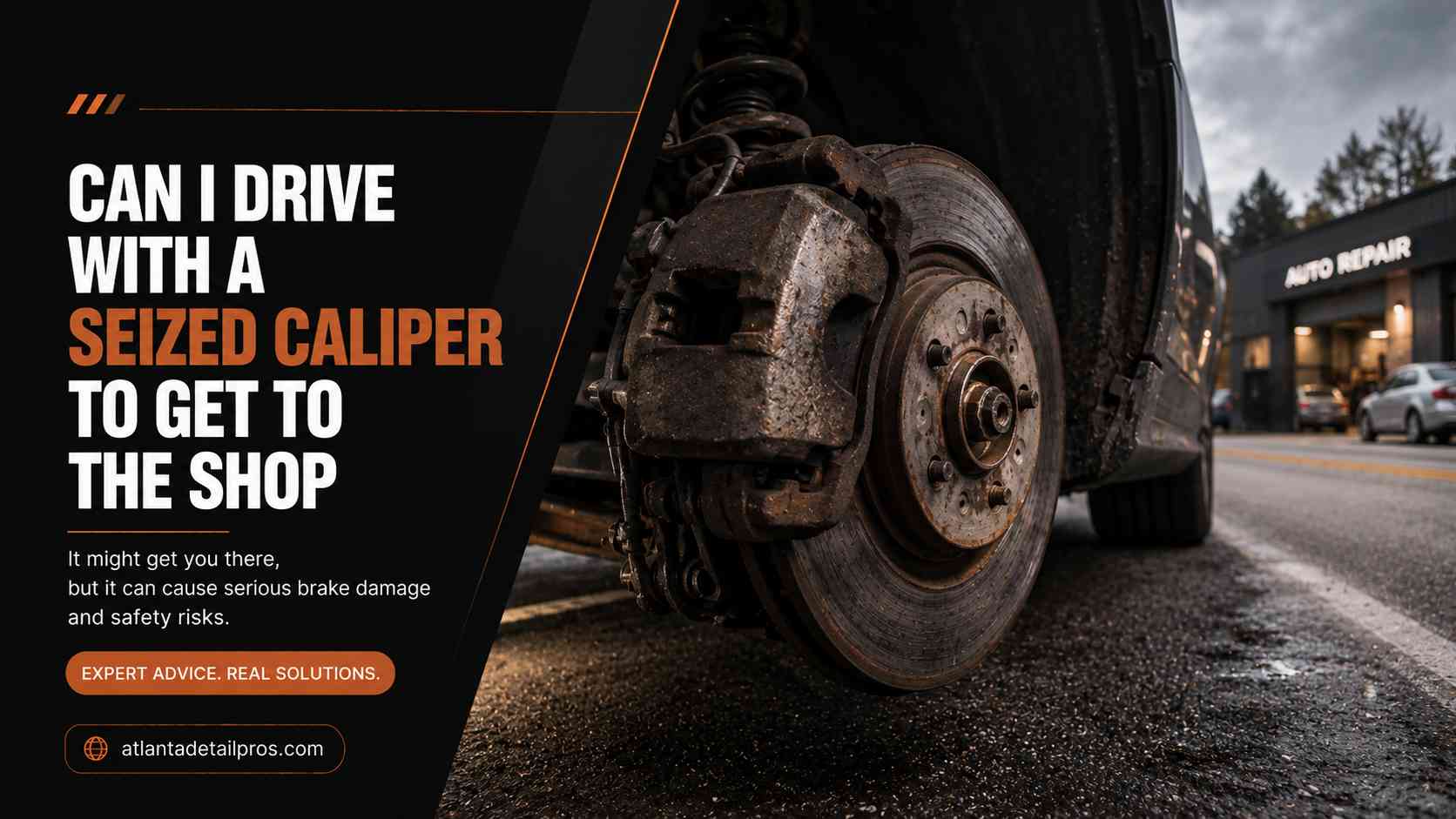
Driving with a seized brake caliper to reach a shop is possible for a very short distance at low speed, but a fully seized caliper that is dragging constantly generates enough heat to warp the rotor, boil the brake fluid, and in severe cases ignite the wheel and tire: if the vehicle pulls sharply to one side, if you smell burning, or if the affected wheel is too hot to hold your hand near, do not drive it.
The ability to move the vehicle does not mean it is safe to do so.
A caliper seizes when the piston or slide pins freeze in position. The result is either constant pad-to-rotor contact (dragging brake) or complete loss of braking on that wheel (if the caliper fails to apply). Both scenarios are driving hazards, but the dragging caliper is the more urgent and the more common failure.
What a Seized Caliper Does During Driving
The Dragging Caliper Failure Mode
A caliper with a frozen piston maintains constant contact between the brake pad and the rotor. The friction from this constant contact generates heat proportional to vehicle speed and distance driven. At low city speeds (under 25 mph) for very short distances (under 0.5 miles), heat buildup is manageable. At highway speeds or over longer distances, the heat chain reaction unfolds:
The rotor absorbs heat and reaches the warping threshold (typically above 500 degrees Fahrenheit for cast iron rotors). The brake fluid in the caliper and brake line absorbs heat. Brake fluid boils at 400 to 500 degrees Fahrenheit (DOT 3 dry boiling point). Boiled brake fluid creates vapor bubbles that compress rather than transmit pedal pressure, causing a soft or sponken pedal that does not slow the vehicle. This is brake fade from fluid boiling, and it removes braking on all wheels, not just the seized one.
In extreme cases, the grease in the wheel bearing reaches combustion temperature. The wheel seal melts. The tire sidewall heats from conduction through the wheel. Wheel fires from seized calipers are not rare: they are a known failure outcome of ignored dragging calipers driven for significant distances.
The Stuck-Open Caliper Failure Mode
Less commonly, a caliper can seize in the released (open) position, preventing the pads from fully engaging. This reduces braking force on that corner and can cause the vehicle to pull away from the affected side under braking. This failure is less immediately dangerous than a dragging caliper but still removes a meaningful fraction of braking capacity.
How Calipers Seize: Understanding the Mechanism Before You Drive
Piston Seizure
The most common caliper seizure is a frozen piston. The piston is a chrome-plated aluminum or steel cylinder that extends from the caliper bore under hydraulic pressure to push the brake pad against the rotor. The piston rides on a rubber boot seal that keeps contaminants out of the bore. When the boot tears (from age, abrasion, or impact), moisture and road debris enter the bore. The chrome plating on the piston corrodes and the piston seizes in the extended or partially extended position.
A piston seized in the extended position holds the pad permanently against the rotor (dragging). A piston seized in the retracted position prevents the pad from applying under braking (reduced braking force). The extended seizure is more immediately dangerous because of the heat it generates.
Slide Pin Seizure
Floating calipers (used on the vast majority of modern vehicles) move laterally on two steel slide pins coated in high-temperature grease. As the pad wears, the caliper slides on these pins to maintain even pad contact on both sides of the rotor. When the slide pins corrode or the rubber boots that protect them tear, the pins freeze in position. A frozen inboard slide pin causes the inboard pad to press while the outboard pad lifts away. This creates a one-sided drag that is less severe than a full piston seizure but still generates heat and causes uneven rotor wear.
Slide pin seizure is easier and cheaper to repair than piston seizure: freeing and lubricating the pins without replacing the caliper is often possible if the piston itself is still mobile.
Rear Caliper Parking Brake Integration
Many rear calipers incorporate the parking brake mechanism into the caliper piston using a screw-and-nut mechanism. When the parking brake cable seizes, it can hold the rear piston in the applied position without any hydraulic input. This produces a rear drag that is identical in symptom to a hydraulic seizure. On integrated parking brake calipers, you cannot release the piston by simply opening the bleeder valve: the piston must be wound back (rotated while being pushed in) using the correct tool.
Field Assessment Before You Drive a Single Mile
Step 1: Identify Which Corner Has Seized
If the vehicle pulls to one side during braking, the caliper on the opposite side from the pull is likely dragging (more braking force on one side pulls the vehicle toward it). If the vehicle pulls during normal driving without braking, the caliper is dragging enough to slow that wheel relative to the others.
Step 2: Check Wheel Temperature
Carefully hold your hand 2 to 3 inches from each wheel after a short test drive or after the vehicle has been parked. A normal wheel is warm. A dragging caliper wheel is often too hot to hold your hand near within a few inches after even a 1-mile drive. If any wheel is radiating heat you can feel from several inches away without touching it, do not drive further.
Step 3: Look for Visual Signs
A seized caliper may produce brake dust accumulation significantly heavier on one wheel than the others. You may see the pad material visibly contacting the rotor when looking through the wheel spokes. A brake pad worn to metal on one side while the opposite side is thick confirms uneven caliper function.
Decision Table: Drive or Tow?
| Condition | Temperature Check | Symptom | Drive to Shop? |
|---|---|---|---|
| Mild drag, slight pull | Wheel warm but touchable | Slight resistance, no smell | Yellow: Under 1 mile, low speed only |
| Moderate drag, clear pull | Wheel hot after short drive | Resistance notable, mild smell | Red: Tow strongly recommended |
| Heavy drag, severe pull | Wheel extremely hot | Vehicle fighting you, burning smell | Red: Tow immediately |
| Caliper stuck open | Normal wheel temp | Pull under braking only | Yellow: Under 3 miles, careful driving |
| Soft or spongy pedal | Any elevated temp | Pedal sinks under braking | Red: Tow, brake fluid is compromised |
| Smoke from wheel | Any | Visual smoke | Red: Pull over, do not drive |
“I drove about two miles to the gas station with what I thought was a mild pull. By the time I got there the front left wheel was glowing faintly and the rotor had a blue tint from the heat. The caliper had seized completely. The mechanic said if I had driven another mile at that temperature the fluid in the line would have boiled and I would have had no brakes at all. What should have been a $180 caliper job was $450 because the rotor was also warped past spec.”: Leon Bradshaw, 2014 Ford Escape 1.6T
What Driving Distance Does to Repair Cost
| Distance Driven on Seized Caliper | Likely Additional Damage | Cost Impact |
|---|---|---|
| Under 0.5 miles at low speed | None: caliper only | $0 additional |
| 0.5 to 2 miles | Rotor likely warped or scored | Add $80 to $200 per rotor |
| 2 to 5 miles | Rotor and possibly wheel bearing | Add $200 to $500 |
| 5 to 10 miles | Rotor, bearing, brake line heat damage | Add $400 to $900 |
| Over 10 miles sustained | Rotor, bearing, possibly tire and wheel | Add $500 to $2,000 |
Repair Cost Ranges for Seized Caliper Repairs
| Repair | Independent Shop Cost Range |
|---|---|
| Single caliper replacement (front) | $150 to $350 |
| Single caliper replacement (rear) | $130 to $300 |
| Caliper plus rotor replacement (one corner) | $250 to $550 |
| Caliper, rotor, and pads (full corner) | $300 to $650 |
| Wheel bearing replacement (if heat damaged) | $200 to $500 |
| Brake fluid flush (if overheated) | $80 to $150 |
Frequently Asked Questions
How do I know if my caliper is seized versus just worn brake pads?
Worn pads produce a squealing sound that appears when braking and disappears when you release the pedal. A seized dragging caliper produces a grinding or dragging sensation that is present during driving even without applying the brakes, and it creates heat at that specific wheel. A seized caliper often smells like burning after a drive of more than half a mile. The combination of pulling during normal driving (not just braking) and heat at one wheel is the seized caliper signature.
Can I release a seized caliper myself temporarily?
A seized slide pin can sometimes be freed temporarily by removing the caliper, cleaning and lubricating the slide pins, and reinstalling. This is a valid temporary fix if the piston itself is not seized and if you can do the work yourself before driving further. A seized piston requires either a caliper rebuild kit or full caliper replacement. If you are not certain which component has seized, do not attempt to release it on the roadside and drive on it.
Why does a seized caliper cause the vehicle to pull to one side?
The dragging caliper applies more braking force to that wheel than the opposite wheel. The vehicle steers toward the side with greater braking force because that wheel is slowing faster than the other. The pull during braking is toward the seized caliper. During normal driving with a constant drag, the pull is more subtle but still present as the engine works harder to overcome the resistance on the dragging wheel.
Will a seized caliper drain the battery?
No, but it will measurably reduce fuel economy and increase engine load because the engine is working against the constant brake drag. On a hybrid or electric vehicle, regenerative braking systems can partially mask a dragging caliper by blending the caliper drag into the overall deceleration feel, which sometimes delays the driver’s awareness of the problem.
Can both front calipers seize at once?
Both calipers seizing simultaneously is uncommon but not impossible if the brake master cylinder has failed and is not releasing hydraulic pressure, or if a collapsed brake hose is trapping pressure in the caliper. A collapsed brake hose allows pressure to build (applying the brakes) but does not allow pressure to return (releasing the brakes). If both front wheels are dragging simultaneously, suspect the master cylinder or a collapsed hose rather than two independent caliper failures.
The Bottom Line
A seized caliper gives you a very short driving window under specific conditions: mild drag, no burning smell, wheel temperature that is warm but not hot, and a direct route under one mile at low speed. Outside those conditions, the thermal damage sequence from a dragging caliper makes every additional mile exponentially more expensive and physically dangerous.
The brake system has no backup. When brake fluid boils from caliper heat, the pedal loses effectiveness on all four wheels, not just the seized corner. That converts a single-corner repair into a potential complete brake failure at whatever speed you are traveling. Arrange a tow whenever the wheel is hot to the touch, whenever you smell burning, or whenever the pull is severe enough that you are actively correcting the steering to drive straight.