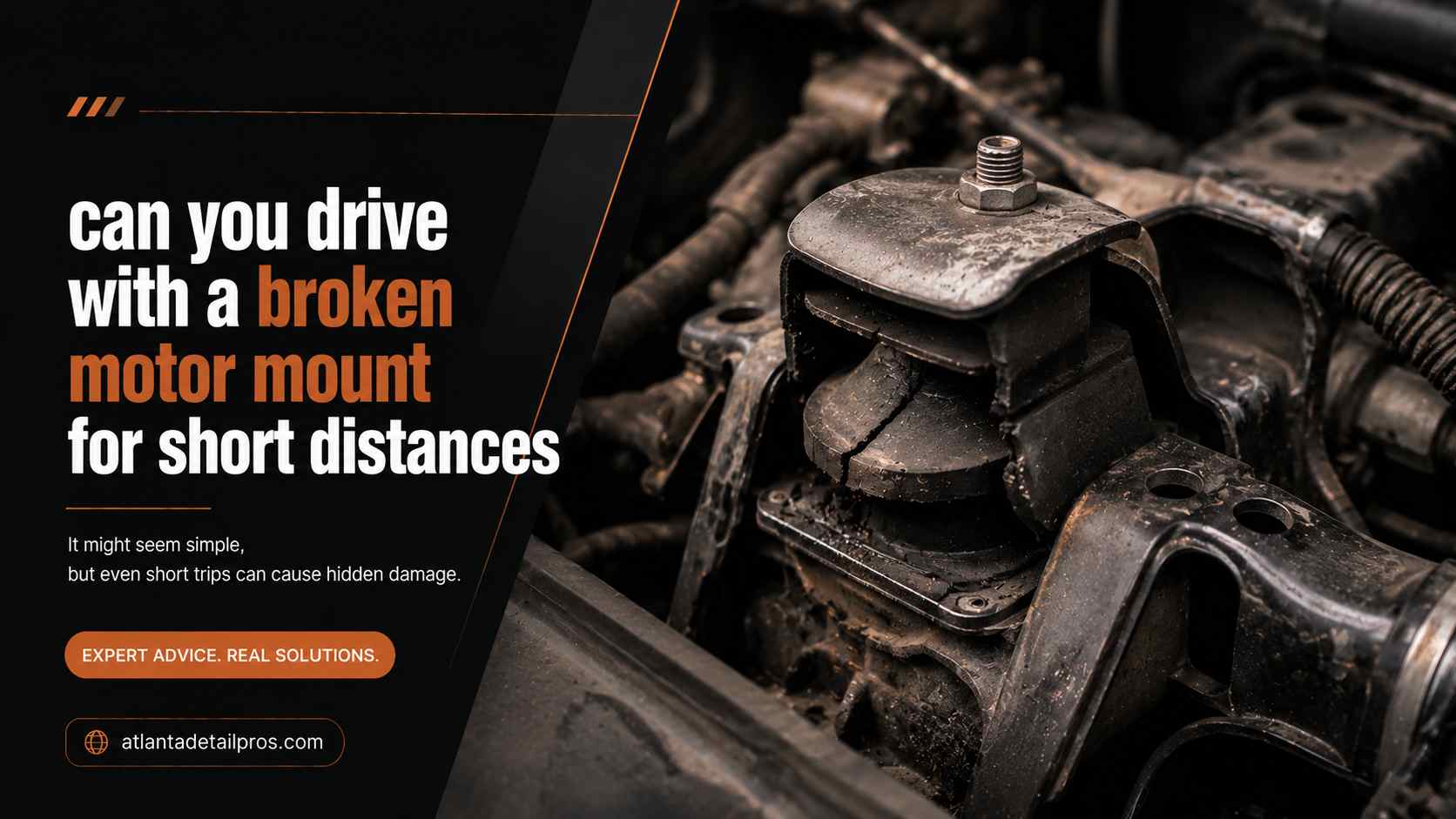
You can drive with a broken motor mount for short distances at low speeds, but every mile increases the risk of secondary damage to surrounding components and, in a worst-case scenario, allows the engine to shift far enough to contact the radiator, snap a CV axle, or tear a coolant hose.
The severity depends entirely on which mount failed, how completely it failed, and how aggressively you drive.
Motor mounts are hydraulic or solid rubber brackets that secure the engine and transmission to the subframe. They absorb engine torque and vibration while keeping the drivetrain in a fixed position relative to the steering, cooling, and exhaust systems. A failed mount removes that control: the engine can move several inches under acceleration rather than millimeters.
What a Broken Motor Mount Actually Does to the Drivetrain
How Mounts Fail and What Remains
Most modern vehicles use 2 to 4 engine mounts and 1 to 2 transmission mounts. The rubber core of each mount deteriorates from heat and age, eventually cracking or tearing. Hydraulic mounts filled with fluid can also rupture and collapse completely. When one mount fails, the remaining mounts absorb the added load and fail faster.
A failed mount causes the engine to lurch noticeably during acceleration and deceleration. You will feel a clunk or thud when leaving a stop, when coming to a stop, and during any abrupt throttle change. On FWD vehicles, the engine can shift laterally under hard acceleration, which loads the CV axle joints at a sharper angle than they are designed to handle.
Components Most at Risk From Engine Movement
The primary victims of a broken motor mount beyond the mount itself are: CV axles and axle boots on FWD vehicles, coolant hoses at the engine connection points, the radiator (if the engine shifts forward), the exhaust flex pipe or manifold gasket, and the throttle body or intake boot (which can tear if the engine rocks past its normal range of motion).
Severity Classification
| Mount Location | Severity if Failed | Drive to Shop? | Max Safe Distance |
|---|---|---|---|
| Top or side torque strut | Moderate: engine rocks but stays anchored | Yellow: Yes | 10 to 20 miles, gentle driving |
| Primary engine mount (one of two) | High: significant lurch and vibration | Yellow: Yes, no aggressive acceleration | 5 to 10 miles |
| Both primary mounts failed | Critical: engine position unstable | Red: Tow recommended | Under 2 miles, flat road only |
| Transmission mount failed | Moderate to High: driveline angle changes | Yellow: Yes, smooth acceleration | 5 to 15 miles |
| All mounts failed | Critical: engine/trans movement severe | Red: Tow | Do not drive |
How to Drive Safely to the Shop With a Failed Mount
If only one mount has failed and the others are intact, you can typically reach a shop safely by following these specific adjustments: avoid hard acceleration from a stop, accelerate and decelerate gradually, avoid tight turns at speed (reduces lateral CV axle loading on FWD), stay on flat roads when possible, and keep speeds below 45 mph. Every sudden throttle input rocks the engine on a failed mount and loads the remaining components harder.
“I drove about eight miles to the shop with a failed front mount on my FWD Civic. Took it easy the whole way. The mechanic confirmed the mount was completely separated but nothing else was damaged because I kept the throttle smooth. He said people who push through hard before getting it fixed usually show up with a torn CV boot or a cracked radiator on top of the mount.”: Ray Espinoza, 2016 Honda Civic 1.5T
What Actually Happens If You Keep Driving on a Failed Mount
The progression when a broken mount is ignored rather than repaired:
Week 1 to 2: The remaining mounts absorb additional load stress. The engine rocks noticeably under throttle. Vibration transmits through the floor and steering column. CV axle joints on FWD vehicles are loaded at sharper angles on each power application.
Weeks 2 to 6: Secondary mount deterioration accelerates. The exhaust flex pipe fatigues from repetitive movement and may crack. On turbocharged engines, intercooler couplings can loosen or tear from engine rock cycles.
Month 2 and beyond: With multiple mounts failed, the engine can shift far enough under full acceleration to contact surrounding components. Radiator contact, hose disconnection, or CV axle snap are the most common catastrophic outcomes.
How to Confirm a Failed Motor Mount Before Driving Anywhere
Visual Inspection With a Helper
The most reliable field test requires two people. Have a helper sit in the driver’s seat with the engine running. Stand at the front or side of the vehicle where you can see the engine. Have the helper shift from park to reverse, hold the brake, and apply light throttle. Watch the engine: it should move only 1 to 2 millimeters at most. On a vehicle with a failed mount, the engine will visibly rock or lurch several inches in the direction opposite to the applied torque.
Repeat the test by shifting to drive and applying light throttle. A healthy mount set shows almost no movement. A failed mount shows exaggerated, delayed, or uncontrolled engine rotation. This test takes less than two minutes and tells you definitively whether the mount is the problem before you decide whether to drive or call a tow.
Under-Hood Visual Check
With the engine off and cool, inspect each mount visually. The rubber core of a healthy mount is intact, slightly compressed, and shows no cracking. A failed mount will show one or more of: a visible gap between the rubber and the metal bracket, a collapsed or pancaked rubber section, hydraulic fluid leaking from a collapsed hydraulic mount, or the metal mounting bracket separated entirely from the rubber. A mount that looks intact but has a visible gap at any point between the rubber and the bracket is compromised and should be replaced even if it has not fully failed.
Listening During a Test Drive
Drive the vehicle slowly in a parking lot. Accelerate gently, then lift off the throttle abruptly. A failed motor mount produces a distinct thud or clunk precisely at the moment of throttle transition. This is the engine rocking against its remaining constraint points. The clunk from a motor mount is more pronounced in drive than reverse and tends to be a single heavy impact sound rather than the repetitive click of a worn CV joint or the rhythmic knock of a loose heat shield.
Platform-Specific Motor Mount Failure Patterns
Certain engine and platform combinations are known for accelerated motor mount wear that brings drivers to this decision earlier than expected:
Honda and Acura FWD vehicles (K-series and J-series engines): The front torque mount (also called the dynamic damper or upper engine mount) is the most common failure point, typically between 80,000 and 120,000 miles. It is accessible and inexpensive (the part costs $30 to $80) but causes significant engine rock if ignored.
Ford F-150 and Mustang (Coyote 5.0L and EcoBoost): The passenger-side engine mount is a frequent failure on high-mileage examples, with the rubber core separating from the bracket. Replacement mounts for the Coyote platform cost $60 to $150 each.
Subaru boxer engines (EJ and FB series): The rear transmission mount is particularly vulnerable on Subaru vehicles used for spirited driving. The mount position means a failure produces a clunk specifically during up-shifts under acceleration and is often mistaken for a drivetrain noise.
Toyota Camry and Avalon (2.5L and 3.5L, 2012 to 2022): The front strut mount (which doubles as a torque reaction mount) deteriorates in climates with extreme temperature cycling. Cost to replace is $80 to $200 for the part.
GM trucks and SUVs (5.3L and 6.2L): The transmission mount fails frequently on high-mileage 6L80 equipped vehicles, producing a clunk specifically during 1-2 upshifts that is often misdiagnosed as a transmission issue.
Repair Cost Comparison: Mount Only vs. Secondary Damage
| Repair Scenario | Independent Shop Cost Range |
|---|---|
| Single motor mount replacement | $150 to $400 |
| Two motor mounts (typical pair replacement) | $280 to $700 |
| Transmission mount | $120 to $350 |
| Mount replacement and torn CV boot | $400 to $800 |
| Mount replacement and cracked radiator | $550 to $1,100 |
| Mount replacement and snapped CV axle | $450 to $900 |
Frequently Asked Questions
How do I know if my motor mount is broken?
The clearest signs are a loud clunk or thud when accelerating from a stop or lifting off the throttle, visible engine movement when a helper revs the engine while you watch from outside, and excessive vibration at idle that disappears at driving RPM (because the mount is no longer dampening engine rocking). A mechanic can confirm visually by checking for collapsed or separated mount rubber.
Can a broken motor mount damage the engine itself?
A failed mount does not damage internal engine components directly. The damage it causes is to surrounding systems: CV axles, hoses, radiator, and exhaust. However, if a coolant hose tears as a result of engine movement, the resulting overheating can cause head gasket and engine damage, which makes a failed mount an indirect path to expensive internal damage.
Is it safe to drive on the highway with a broken motor mount?
No. Highway speeds and on-ramp acceleration involve full-throttle inputs that produce maximum engine torque and maximum rocking movement on a failed mount. Surface street driving at moderate throttle minimizes the movement range. Highway driving maximizes it. If you must drive to a shop, use surface streets under 45 mph.
Do all four mounts need to be replaced at once?
Not necessarily, but mounts age together. If one has failed, the others are likely within 20,000 to 40,000 miles of the same condition. Replacing mounts in pairs (both engine mounts, for example) is cost-effective because the labor to access them overlaps. A mechanic inspecting one failed mount should assess all remaining mounts and give you a condition report on each.
What does a broken motor mount sound like compared to other clunks?
A motor mount clunk is specifically associated with throttle transitions: it happens when you press the accelerator or release it, not during steady driving or over bumps. A clunk only over bumps points to suspension components (sway bar links, control arm bushings). A clunk during braking typically indicates worn brake hardware. The throttle-transition timing is the diagnostic key for motor mount noise.
The Bottom Line
A single failed motor mount is a drivable situation for a short distance if you keep the throttle smooth, stay on surface streets, and go directly to the shop. It is not a park-and-wait emergency in the way that an oil pressure light or overheating event is. But it is also not something to defer for weeks while driving normally, because the secondary damage it causes to CV axles, radiators, and exhaust components reliably turns a $200 repair into a $700 repair.
Drive gently, repair promptly. Any mount failure that causes significant visible engine movement or that has progressed to multiple mounts requires a tow rather than a careful slow drive.
If you are evaluating an older vehicle with multiple failed mounts alongside other deferred maintenance, factor the total repair cost against the vehicle’s value before committing to the repair. Motor mount replacements are straightforward and affordable in isolation, but they are frequently accompanied by other rubber component failures (control arm bushings, sway bar links, transmission mounts) that add to the total estimate.
A complete rubber component refresh on a high-mileage FWD vehicle can run $800 to $1,800 when all worn items are addressed at the same time, which is worth knowing before approving piecemeal repairs.