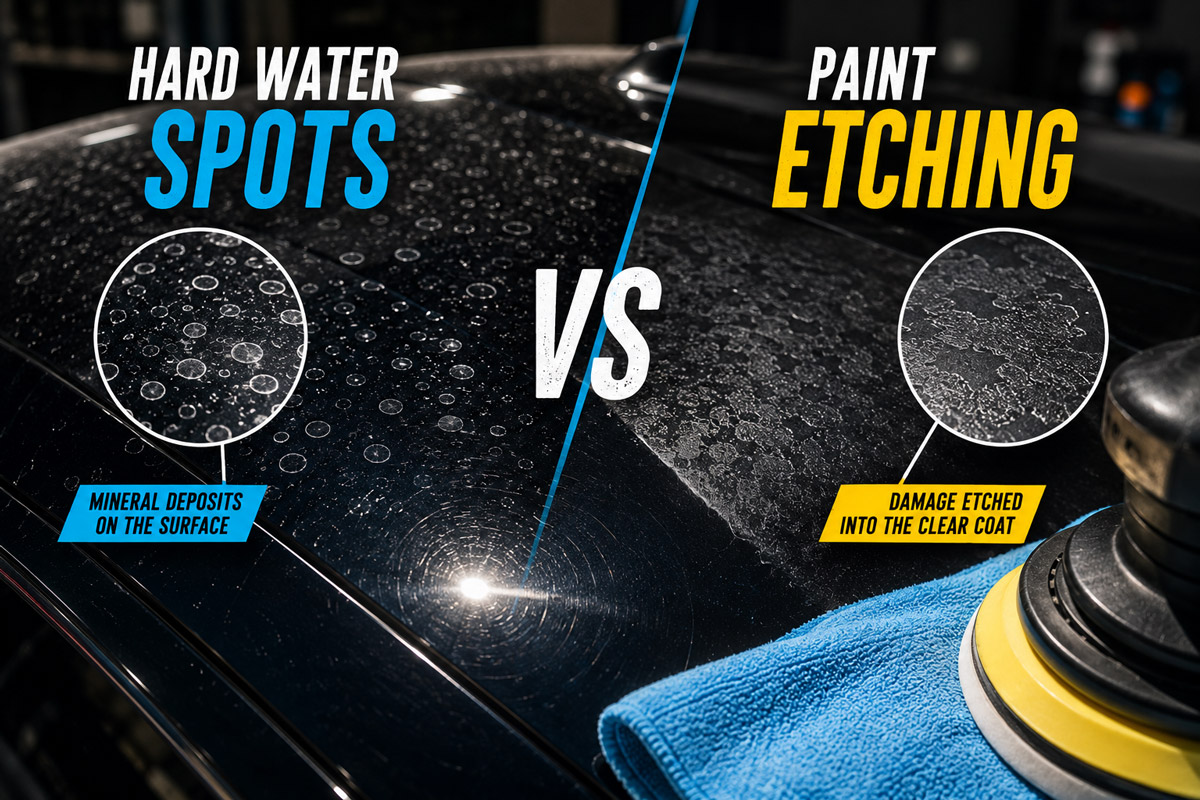
Every car owner loves the sight of a pristine, mirror like reflection on their vehicle’s bodywork. However, few things disrupt that beautiful finish faster than unsightly circular marks scattered across the hood, roof, and trunk. If you have ever washed your car only to find that the circular rings remain completely unchanged, you are dealing with one of two distinct paint imperfections: hard water spots or paint etching.
At first glance, these two issues look almost identical. Both present themselves as ugly, white or gray rings that ruin your paint’s gloss. Because they look so similar, many drivers mistakenly treat them the same way. But using the wrong treatment can waste hours of your time, or worse, cause permanent damage to your vehicle’s clear coat.
Understanding the deep structural differences between these two conditions is the secret to choosing the correct correction method and saving your car’s finish.
The Core Difference: Above vs Below the Clear Coat
The fundamental distinction between hard water spots and paint etching boils down to geometry and chemistry. One sits harmlessly on top of your paint, while the other has actively eaten its way inside.
What are Hard Water Spots?
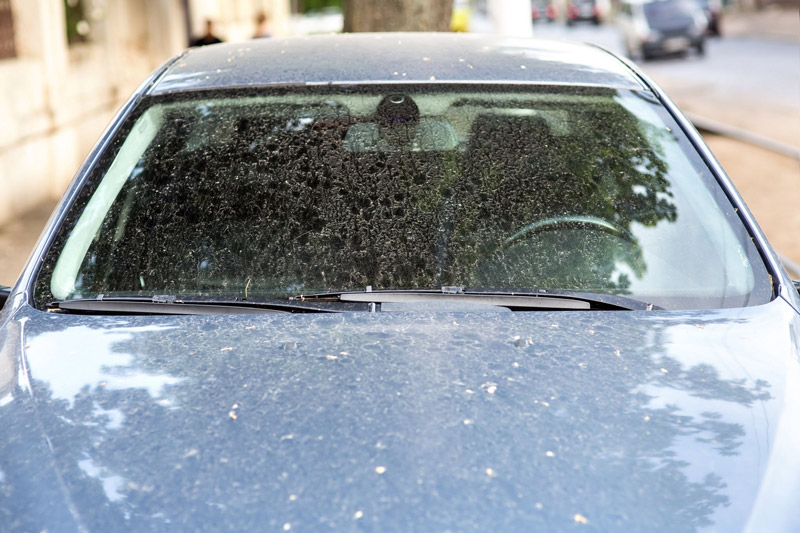
Hard water spots, often referred to by professional detailers as Type I water spots, are topical mineral deposits. When tap water, lawn sprinkler water, or groundwater evaporates off your vehicle’s surface, it leaves behind the dissolved elements it was carrying. These elements are primarily heavy minerals like calcium and magnesium carbonate. As the liquid H2O disappears into the air, these minerals solidify, forming a hard, chalky, shell like crust that sits entirely on top of the clear coat.
Because they sit above the surface, they act like a physical shield that blocks light from hitting the paint uniformly. The good news is that the clear coat underneath remains structurally sound and untouched.
What is Paint Etching?
Paint etching, categorized as Type II or Type III water spotting, represents physical, permanent structural damage to the clear coat itself. Etching is not a deposit; it is a microscopic crater where a portion of the protective clear coat has been chemically dissolved and hollowed out.
This happens due to a chemical reaction between the clear coat and highly acidic or highly alkaline substances. When corrosive elements dwell on the paint, they corrode the resin system. The sun accelerates this destruction by heating up the panel, baking the corrosive liquid and forcing it to eat downward into the paint layers. The result is a fractured, dull indentation where paint used to be.
Side-by-Side Comparison
To help visualize how these imperfections contrast with one another, review this detailed breakdown of their features:
| Feature | Hard Water Spots (Type I) | Paint Etching (Type II / III) |
| Physical Profile | Raised above the paint surface | Recessed or cratered into the paint |
| Visual Appearance | Chalky, crisp white or gray circular rings | Dull, ghost like rings or fractured wrinkles |
| The Primary Cause | Calcium and magnesium left by dried water | Acid rain, bird droppings, or baked-in minerals |
| Lighting Test | Blocks the paint gloss uniformly | Shows blurry or distorted reflections at a 45° angle |
| Quick Fix Method | Soluble with dedicated chemical removers | Requires mechanical polishing or compounding |
Two Simple Diagnostic Tests You Can Do At Home
You do not need an expensive digital paint depth gauge to figure out which issue is plaguing your car. You can diagnose the problem accurately using two straightforward methods.
Test 1: The Fingernail Test
The easiest and fastest way to tell the difference is to use your sense of touch.
1.Wash the target area:Prerequisite.
Thoroughly wash the affected panel using a dedicated car shampoo to remove all loose dirt, road grime, and dust particles.
2.Dry the surface completely:Critical step.
Use a clean, high quality microfiber drying towel to dry the area completely. Any leftover liquid water will distort your sense of touch.
3.Execute the touch check:Analysis.
Close your eyes and run your fingernail very lightly across the circular spot. Pay close attention to the resistance you feel.
- If it is a Hard Water Spot: Your fingernail will catch on a raised, textured ridge. You will distinctly feel the elevated edge of the crusty mineral deposit sitting on top of the surface.
- If it is Paint Etching: Your fingernail will glide smoothly over the area or feel a slight, recessed dip, similar to a microscopic pothole. The paint itself has been hollowed out, leaving nothing raised to catch your nail.
Test 2: The Chemical Dwell Test
If the fingernail test is inconclusive because the markings are incredibly faint, the Chemical Dwell Test will give you a definitive answer. This test utilizes a mild acid to see if the blemish can be dissolved.
1.Prepare the panel:Cool and shaded.
Ensure the vehicle is parked in a shaded garage or driveway. The body panels must be completely cool to the touch so the chemical solution does not dry out instantly.
2.Mix or select your solution:Chemical selection.
Acquire a dedicated automotive water spot remover, or create a budget friendly 50/50 mix of white vinegar and distilled water in a clean spray bottle.
3.Apply the dwell towel:30 to 60 seconds.
Soak a clean microfiber towel in the mixture. Place the soaked towel directly flat over the mystery spots and let it dwell undisturbed for 30 to 60 seconds.
4.Wipe and inspect:Final evaluation.
Gently agitate the area using light pressure with the damp towel, then wipe the product away entirely and dry the panel with a separate clean microfiber cloth.
Now, take a close look at the panel under bright lighting.
If the spot has disappeared completely, leaving behind a perfectly glossy finish, it was a standard hard water spot. The acidic solution successfully broke the chemical bonds of the alkaline calcium and magnesium, dissolving them away.
If the white, chalky residue is gone but you still see a faint ghost ring, a dull outline, or a fractured texture in the clear coat, the minerals have progressed into paint etching. The acid cleaned the mineral crust off the surface, but it cannot fill the physical crater left behind.
How to Fix Each Issue Safely
Once you have identified exactly what is wrong with your paint, you can implement the correct restoration strategy. Treating these issues requires entirely different toolsets.
Water Spot Diagnosis
Raised Mineral Crust
Hard Water Spot
Chemical Removal
- Acidic removers
- Zero mechanical abrasion
Recessed Crater
Paint Etching
Paint Correction
- Machine polishing
- Levels surrounding clear coat
Removing Hard Water Spots (Type I)
Because hard water spots sit on top of the clear coat, they can usually be dissolved without using harsh abrasive friction.
Your goal here is chemical dissolution. Use a specialized acidic water spot remover formulated for automotive clear coats. Spray the product onto the area, allow it to break down the minerals for the manufacturer specified time, and wipe away gently.
Critical Warning: Avoid scrubbing aggressively with dry towels or stiff sponges. Mineral deposits are incredibly hard structures. If you try to scrub them off mechanically with pure force, you will grind those sharp mineral crystals directly into your clear coat, creating deep, severe scratches that will require extensive compounding to remove.
Fixing Paint Etching (Type II / III)
Chemicals like vinegar, detailing sprays, or water spot removers will completely fail to fix etching. They cannot fix the issue because a chemical liquid cannot fill a physical hole in your plastic clear coat layer.
To eliminate paint etching, you must perform mechanical paint correction. This process involves using a dual action machine polisher paired with a foam or microfiber polishing pad and an abrasive polishing compound.
When you machine polish the area, you are not pulling the crater up; instead, you are safely shaving down and leveling the undamaged clear coat surrounding the crater. By removing a microscopic layer of the surrounding clear coat until it perfectly matches the depth of the recessed crater, the surface becomes completely flat again. This flat surface allows light to reflect perfectly, restoring a mirror like reflection.
Because clear coat is extremely thin, this requires a patient, measured approach to ensure you do not accidentally buff completely through the clear coat layer.
Protect Your Investment Before It Happens
The best way to handle both hard water spots and paint etching is to prevent them from occurring in the first place. You can safeguard your clear coat by adopting a few smart habits:
- Never wash your vehicle in direct sunlight, as the heat will flash dry the water before you can towel it off.
- Avoid parking near commercial lawn sprinklers, which often utilize untreated, mineral heavy well water.
- Apply a high quality ceramic coating or paint protection film. These sacrificial layers provide excellent chemical resistance, buying you valuable time to wash away acidic rain or bird droppings before they can touch your actual paint.
If you are dealing with stubborn spots on your vehicle and want to make sure you take the safest path to a flawless finish, the team at Atlanta Detail Pros is always here to help restore your car’s true shine.