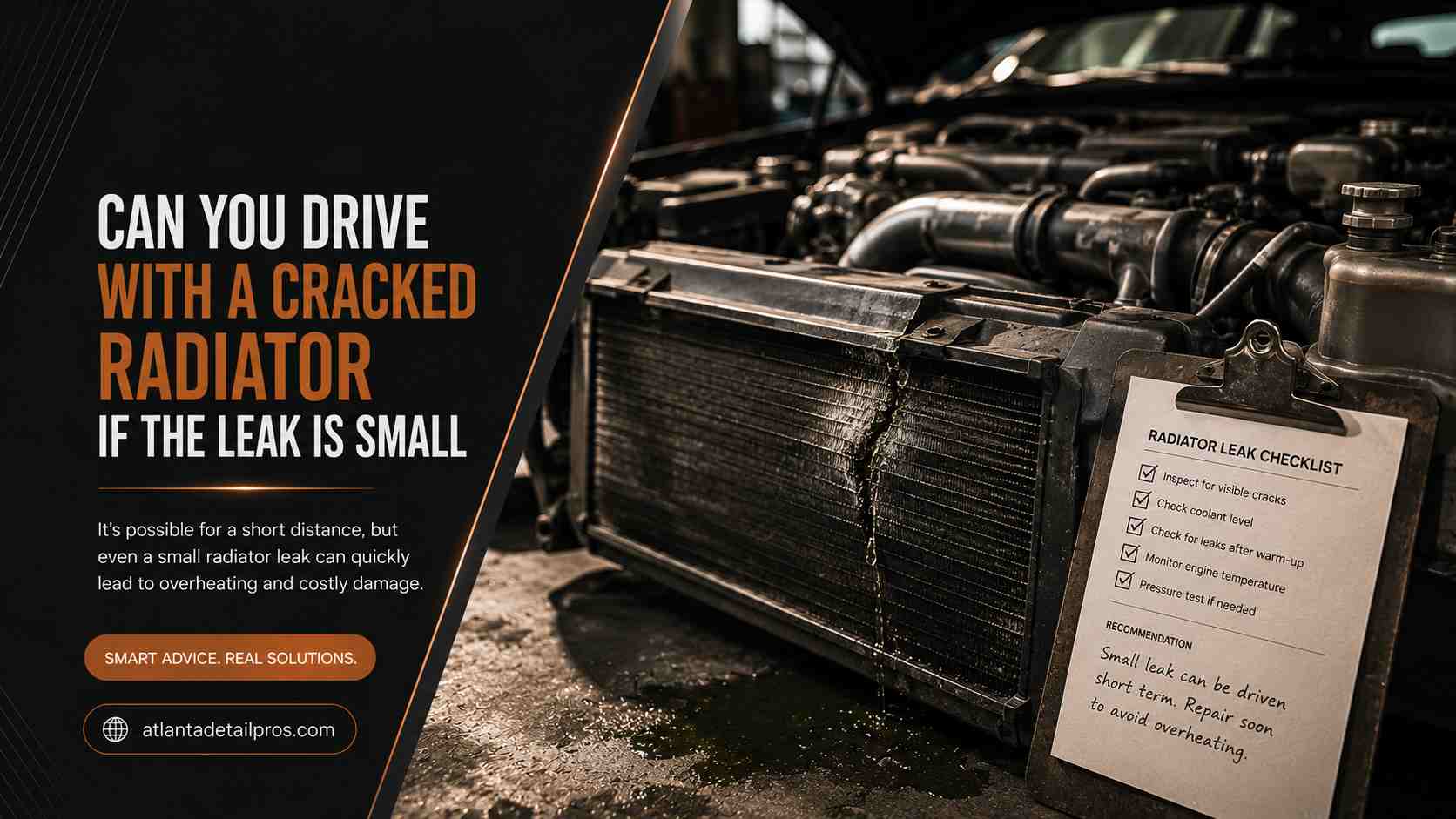
Yes, you can technically drive short distances with a small radiator crack that is leaking slowly, but the safe driving distance is not measured in miles: it is measured in how quickly the coolant level drops, and a crack that seems minor at idle can rapidly worsen under the pressure and thermal stress of highway driving, turning a slow drip into a full coolant dump in minutes.
The real answer is not whether you can drive with a cracked radiator, but whether the risk of the crack progressing during your drive is acceptable given what happens when coolant runs out at speed.
“I had a tiny hairline crack in the plastic end tank of my radiator. Was barely a drip at idle. Drove it 18 miles to work on a cold morning and it was fine. Tried the same drive in July: coolant was pouring out by mile 8. The heat expanded the crack and what was a hairline became a gap. Engine overheated, head gasket went. Repair bill was $2,800. The radiator would have cost $180.”: Chris Bateman, former radiator gambler
Why Crack Severity and Location Matter More Than Crack Size
The Two Types of Radiator Cracks
Plastic End Tank Cracks (Most Common)
Modern radiators use aluminum cores with plastic end tanks on each side. These plastic tanks are the most common site for cracks because plastic becomes brittle with age and thermal cycling. A small crack in the plastic end tank may weep coolant slowly at operating pressure (10 to 16 PSI in most cooling systems) but can open significantly when heat causes the plastic to expand.
The deceptive part: a crack in a cold radiator may be nearly invisible. The same crack under hot operating pressure with expanded plastic can be three times wider.
Aluminum Core Tube Cracks (More Serious)
Cracks in the aluminum cooling tubes within the radiator core are less common but harder to seal and more likely to progress rapidly. A tube crack under pressure can split further along the tube’s length with each heat cycle.
How Operating Pressure Affects a Small Crack
A vehicle cooling system runs at 10 to 16 PSI of internal pressure. At idle in a parking lot, the system may be at the lower end of this range. At highway speed with a fully warmed engine and a working thermostat, the system maintains maximum pressure. A crack that seeps at 10 PSI may spray or pour at 16 PSI.
This is why driving a cracked radiator on the highway is riskier than driving it at low speed: higher speed means higher cooling system pressure, more stress on the crack, and faster coolant loss.
What Actually Happens When the Crack Opens Further While Driving
The Progression From Slow Drip to Emergency
- Slow drip phase: coolant seeps from the crack at a rate of a few drops per minute; the overflow reservoir compensates
- Active leak phase: crack widens under pressure; coolant loss accelerates to a stream; temperature gauge begins rising
- Overheating phase: coolant level drops below minimum; the thermostat opens to allow maximum coolant flow but there is not enough coolant for the system to maintain temperature
- Critical phase: coolant may be 2 to 3 quarts low; temperature gauge enters the red zone; steam may appear from under the hood
- Damage phase: sustained overheating warps the cylinder head, blows the head gasket, or in severe cases cracks the engine block
Steps 1 through 3 can occur within 10 to 20 miles of highway driving when a crack that seemed small propagates under pressure.
Safe Distances and Conditions With a Known Small Crack
When Driving Is More Acceptable
Conditions that reduce (but do not eliminate) the risk:
- Cold weather: lower ambient temperature reduces thermal stress on the crack and provides more time before overheating occurs
- Short, slow-speed trips: less system pressure at low speed; shorter time for crack to progress
- Coolant level is topped off immediately before driving
- Temperature gauge is monitored continuously
- You have a plan to pull over immediately at the first sign of temperature rising
Typical safe window (not a guarantee): 5 to 15 miles at low speed on a cool day with a fresh coolant top-off and constant gauge monitoring. This window shrinks dramatically in hot weather or at highway speed.
What to Do Before Driving With a Cracked Radiator
If you must drive with a known crack before getting it repaired:
- Top off the coolant to the maximum mark in the overflow reservoir and the radiator (if the cap is accessible)
- Carry a gallon of pre-mixed coolant and a rag in the vehicle
- Set your phone’s timer to alert you every 5 minutes so you check the temperature gauge
- Know the route and have a pull-off location identified every few miles
- If the gauge moves above the normal range, pull over immediately, turn off the engine, and wait: do not open the radiator cap
Temporary Sealants: Do They Work on Radiator Cracks?
Radiator stop-leak products (Bar’s Leaks, K-Seal, etc.) can slow or stop small crack seepage by depositing solid particles in the leak path. They work best on:
- Very small hairline cracks (under 1mm width)
- Pinhole leaks in the core
They are less effective on wider cracks, splits in plastic end tanks, or cracks that flex under pressure. Stop-leak is a temporary measure that buys time to reach a shop: it is not a permanent repair and can clog heater cores and internal passages if used excessively.
Radiator Replacement Cost: Why the Math Favors Repair
| Vehicle Type | Replacement Radiator Cost | Labor | Total | Cost of Overheating (head gasket) |
|---|---|---|---|---|
| Economy sedan (Civic, Corolla) | $80 to $200 | $80 to $150 | $160 to $350 | $900 to $2,500 |
| Midsize sedan (Accord, Camry) | $100 to $250 | $100 to $200 | $200 to $450 | $1,200 to $3,000 |
| Pickup truck (F-150, Silverado) | $150 to $400 | $150 to $250 | $300 to $650 | $1,500 to $4,000 |
| SUV (Explorer, Tahoe) | $200 to $500 | $150 to $300 | $350 to $800 | $1,500 to $4,500 |
Frequently Asked Questions
Can a Small Radiator Crack Get Worse While Driving?
Yes, and often rapidly. Thermal expansion under operating temperature and cooling system pressure (10 to 16 PSI) can cause a hairline crack to widen significantly during a single drive. Conditions that accelerate crack progression include hot weather, highway speed (higher system pressure), and driving until the coolant runs low.
How Far Can I Drive With a Leaking Radiator?
There is no reliable mileage answer because crack progression depends on the crack’s size, location, material, ambient temperature, and driving conditions. A slow drip might survive 15 miles of city driving in cold weather or fail after 5 miles of highway driving on a hot day. Monitor the temperature gauge continuously and be prepared to stop immediately if it rises above normal.
Will Radiator Stop-Leak Fix a Cracked Radiator?
Stop-leak products can temporarily slow very small cracks and pinhole leaks. They are not reliable for wider cracks, splits in plastic end tanks, or any crack that flexes under pressure. Use them only as a short-term measure to reach a repair shop, not as a permanent solution.
What Does It Cost to Replace a Cracked Radiator?
Radiator replacement costs $160 to $800 at an independent shop depending on the vehicle. This is a fraction of the cost of head gasket replacement ($900 to $4,500) that often results from driving on a cracked radiator until the engine overheats.
The Bottom Line
A small radiator crack is not an invitation to drive normally until you can get to the shop at your convenience: it is an invitation to get to the shop as soon as possible, by the most direct and least demanding route available. Chris Bateman’s experience illustrates the exact consequence of misjudging a “small” crack: what seemed safe on a cold morning was catastrophic on a hot summer day because thermal expansion turned a hairline into a gap. The radiator is the least expensive part of this story. Make the repair the same week you find the crack.