A hissing noise from the engine bay that occurs only on cold start and disappears as the engine warms up is most commonly caused by a vacuum hose or intake rubber component that has contracted in the cold and developed a small gap at a connection point, or a coolant system hose that seeps steam slightly when cold and seals as it expands with heat.
The cold-only nature of this sound is the diagnostic key: thermal contraction during the overnight cool-down period creates small gaps in rubber and plastic components that close again as the engine reaches operating temperature.
Understanding this thermal mechanism is the starting point for finding the source efficiently. This guide covers every realistic cause of a cold-start-only hissing noise from the engine bay, how each one behaves, how to locate the source without shop equipment, and the urgency of each cause.
Why Cold Start Specifically Triggers This Hissing: The Thermal Mechanism
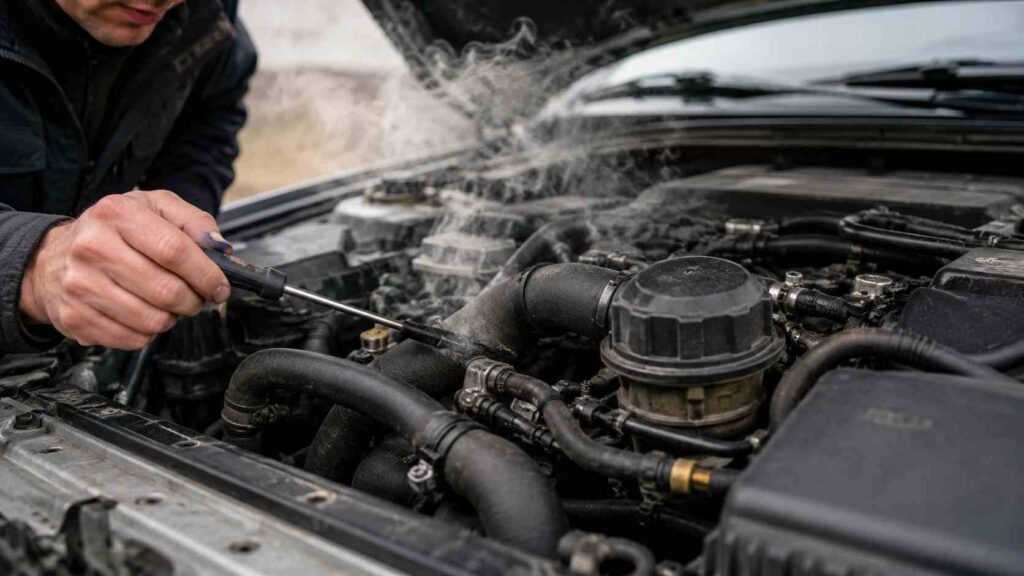
Every rubber, plastic, and metal component in the engine bay contracts when cold and expands when heated. This thermal cycling over thousands of heat-up and cool-down cycles fatigues rubber hoses, loosens metal clamps, and causes small cracks in plastic manifolds and housings to open and close with temperature.
A component whose gap or crack is small enough to seal under the pressure and expansion of operating temperature will hiss at cold start: when the gap is at its widest: and go silent as the engine warms and the material expands enough to seal the gap or reduce it below the threshold where air flow through it produces an audible sound.
This is the cold-only mechanism. It applies to vacuum leaks, coolant system seeps, and intake system leaks equally.
Cause 1: Vacuum Hose Leak at a Connection Point
Vacuum hoses are small-diameter rubber tubes that carry engine vacuum to various sensors, actuators, and brake boosters throughout the engine bay. They are connected at both ends either by friction-fit over barbed nipples or with clamps. As these rubber hoses age and harden from heat cycles, they contract in the cold and may gap slightly at the connection point they are fitted on.
A vacuum hose leak produces a distinctive high-pitched hiss at cold start that may sound similar to a small air leak from a pressurized line. It typically occurs right from startup and decreases as the engine warms.
How to find it: with the engine cold and running, listen carefully near the vacuum lines on and around the intake manifold, brake booster line (the large-diameter hose going to the brake booster), and PCV system hoses. A vacuum leak can sometimes be located by spraying small amounts of brake cleaner or carburetor cleaner near suspected hose ends: if the engine RPM changes briefly, the spray entered the intake through the leak. Use this method carefully and keep the spray away from hot components.
Common locations for vacuum leaks:
- Brake booster vacuum hose at the intake manifold nipple
- PCV valve hose connections at the valve cover or intake
- Small vacuum lines at the throttle body or intake manifold
- EVAP canister purge valve hose connections
Urgency: a vacuum leak does not typically damage the engine but does affect fuel trim and can cause rough idle, poor fuel economy, and may trigger a check engine light. Address within a few weeks.
Repair cost: a vacuum hose replacement is $10 to $50 for the part and 30 to 90 minutes of labor. A mechanic using a smoke machine to locate the leak charges $80 to $150 for the diagnostic step.
Cause 2: Intake Manifold Gasket or Throttle Body Gasket Leak
The intake manifold gasket seals the joint between the intake manifold and the cylinder head. A failing intake manifold gasket allows air to enter the intake stream outside of the metered airflow, producing a hissing sound. This leak may be more pronounced at cold start because the metal components have not yet expanded enough to seat the gasket tightly.
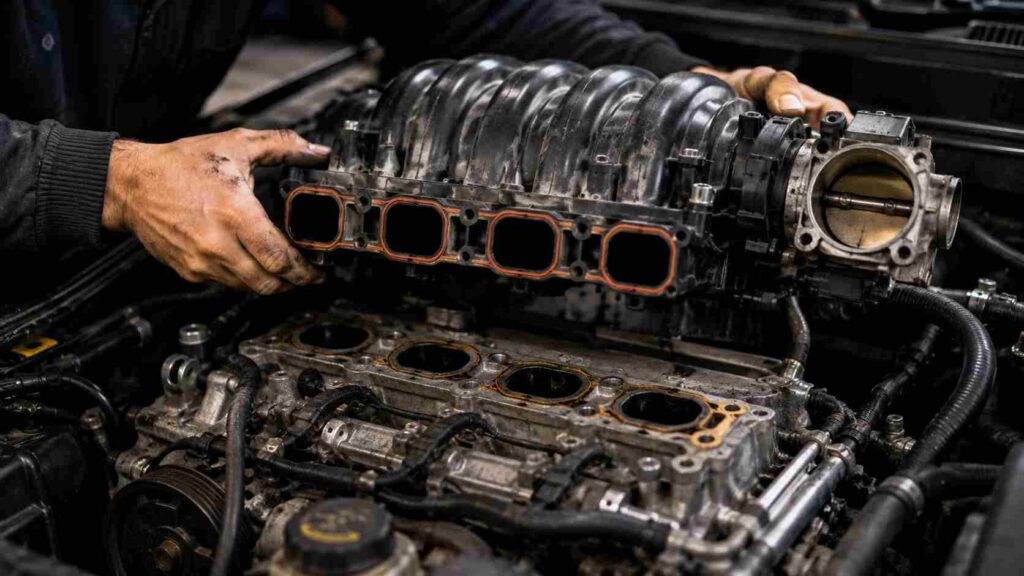
Similarly, the throttle body gasket seals the throttle body to the intake manifold. A deteriorated or improperly seated throttle body gasket produces a hiss that is most audible near the front or top of the engine near the throttle body housing.
How to distinguish from a vacuum hose: intake manifold and throttle body gasket leaks produce a broader, less localized hiss than a single vacuum hose leak. The sound is often most audible near the intake manifold surface or throttle body, and it may correlate with a high or rough idle that improves as the engine warms and the gasket seals better.
Repair cost: throttle body gasket replacement: $80 to $200. Intake manifold gasket replacement: $200 to $600 depending on engine configuration and access.
Cause 3: Coolant System Hose Seeping Steam at Cold Start
A coolant hose that has small cracks in its surface, or that has loosened slightly at its hose clamp, may allow a very small amount of coolant to contact a hot surface or to simply seep at startup before the cooling system reaches full operating pressure and temperature. This seepage produces a hissing or steaming sound at cold start that stops as the system pressurizes and the hose expands.
How to identify coolant hose involvement: the hiss may be accompanied by a faint coolant smell (sweet, slightly syrupy odor) or very faint wisps of steam near the hose in question. Check all coolant hose connections: at the radiator, at the thermostat housing, at the heater core connections on the firewall, and at the engine block. Look for dried coolant residue (a crusty, whitish or green deposit) around hose clamps, which indicates past seeping.
Urgency: a small seeping coolant hose that seals at operating temperature is not immediately dangerous but indicates a hose that is deteriorating and may fail more completely in the future. Have it inspected and replaced before it progresses.
Repair cost: individual coolant hose replacement: $80 to $250 including parts and labor depending on the specific hose and vehicle.
Cause 4: PCV System Hose Crack or Separation
The positive crankcase ventilation (PCV) system uses a network of hoses to route crankcase gases back into the intake manifold for combustion. These hoses are exposed to oil vapors, heat, and cold cycles that cause them to crack and harden over time. A cracked PCV hose produces a hissing sound at cold start that may improve as the hose softens slightly with heat.
How to identify PCV involvement: locate the PCV valve on the valve cover (a small cylindrical valve with a hose connection) and trace the hose from it to the intake manifold or air intake system. Inspect the hose visually for cracks, particularly near the ends where it connects to the valve and to the intake. A cracked hose may also produce increased oil consumption and oil mist in the intake if the crack is significant.
Repair cost: PCV hose replacement: $30 to $120 depending on hose complexity. PCV valve replacement (often done at the same time): $20 to $60 for the part.
Cause 5: Exhaust Manifold Leak at Cold Start
An exhaust manifold crack or gasket leak produces a ticking or hissing sound that is loudest when the exhaust manifold is cold and contracted. The metal contracts overnight, widening a crack or gap in the gasket. As the manifold heats, it expands and the gap closes: and the sound stops or greatly diminishes.
How to distinguish an exhaust leak from a vacuum leak: an exhaust leak hiss has a slightly different character: it may smell faintly of exhaust, it correlates with engine firing pulses (you may hear it as a rhythmic puffing rather than a smooth hiss), and it is loudest on the side of the engine where the exhaust manifold is located rather than at the top near the intake manifold.
Urgency: an exhaust manifold leak should be repaired within a few thousand miles. It can allow combustion gases to enter the engine bay, damage nearby components with heat, and worsen over time as the leak cycles open and closed with each heat cycle.
Repair cost: exhaust manifold gasket replacement: $200 to $600 depending on vehicle access. Cracked manifold replacement: $400 to $900.
How to Find the Source Without Shop Equipment
| Test | How to Perform It | What the Result Tells You |
|---|---|---|
| Listen at cold idle | With engine running cold, move slowly around the engine bay and listen at different heights and locations | Localize the noise to intake side vs. exhaust side vs. top vs. firewall area |
| Smell test | Sniff near the suspected location; coolant smells sweet; exhaust smells like burned gas | Coolant smell indicates coolant hose; exhaust smell indicates manifold leak |
| Visual inspection for deposits | Look for white or greenish crusty deposits around hose connections | Coolant seeping past a hose clamp leaves mineral deposits at the connection point |
| Warm-up monitor | Time how long after startup the noise disappears | A noise that stops within 2 minutes typically involves thermal expansion sealing a gap |
| RPM response | Note whether the hissing changes pitch or intensity when RPM is raised slightly | A vacuum leak hiss typically gets louder and may change pitch at higher RPM; an exhaust puff becomes more rhythmic |
Frequently Asked Questions
What causes a hissing noise from the engine bay only on cold start?
The most common causes are a vacuum hose that has contracted overnight and gapped at its connection point, an intake or throttle body gasket that seals more completely at operating temperature than when cold, a coolant hose seeping slightly before the system reaches full operating pressure, or an exhaust manifold leak that seals as the manifold expands with heat. All of these share the same thermal mechanism: a gap that is present when cold closes as components expand.
Is a hissing noise at cold start serious?
The urgency depends on the source. A vacuum hose leak is not immediately dangerous but causes rough running and may trigger a check engine light. A coolant hose seep can progress to a larger coolant leak. An exhaust manifold leak should be addressed within a few thousand miles to prevent damage to surrounding components. None of these causes require avoiding driving the vehicle, but all should be diagnosed and repaired within a few weeks.
How do I find a vacuum leak in my engine bay?
Listen carefully near vacuum hose connections at the intake manifold, brake booster, throttle body, and PCV system at cold idle. A smoke machine test performed by a mechanic is the most reliable method: smoke is pumped into the intake system and exits visibly at the location of any leak. At home, carefully spraying carburetor cleaner near suspected vacuum hose ends at idle and listening for a brief engine RPM change can identify the location.
Can I drive with a hissing noise at cold start?
In most cases, yes, for a limited time. A vacuum hose leak or intake gasket leak allows unmetered air into the intake and causes rough idling and fuel trim issues but does not cause immediate engine damage. A coolant hose seep should be monitored closely and the coolant level checked regularly. An exhaust manifold leak should be repaired soon rather than driven on for months.
Why does the hissing stop when the engine warms up?
Because the underlying cause is thermal: a gap or crack that is open when components are contracted in the cold closes as those components expand to their operating-temperature dimensions. Rubber hoses swell slightly with heat, metal manifolds expand and seat their gaskets more firmly, and clamps that were slightly loose become effective seals as the components around them expand. The noise stopping at warmup is confirmation that thermal expansion is sealing the leak: and that the leak will return every cold start until the component is repaired.
The Bottom Line
A cold-start hissing noise from the engine bay is one of the more useful diagnostic symptoms in everyday vehicle ownership because the cold-only pattern narrows the cause to components that change their sealing behavior with temperature. Vacuum hoses, coolant hoses, intake gaskets, PCV hoses, and exhaust manifolds all fit this pattern.
The location of the sound: intake manifold side versus exhaust side, top of the engine versus lower: is the most useful clue available without shop equipment. Find the side, then trace the specific component. Most cold-start hisses are resolved with a hose replacement or gasket replacement costing $30 to $300. None of them are reasons to avoid driving the vehicle today, but all of them will eventually progress if left without attention.