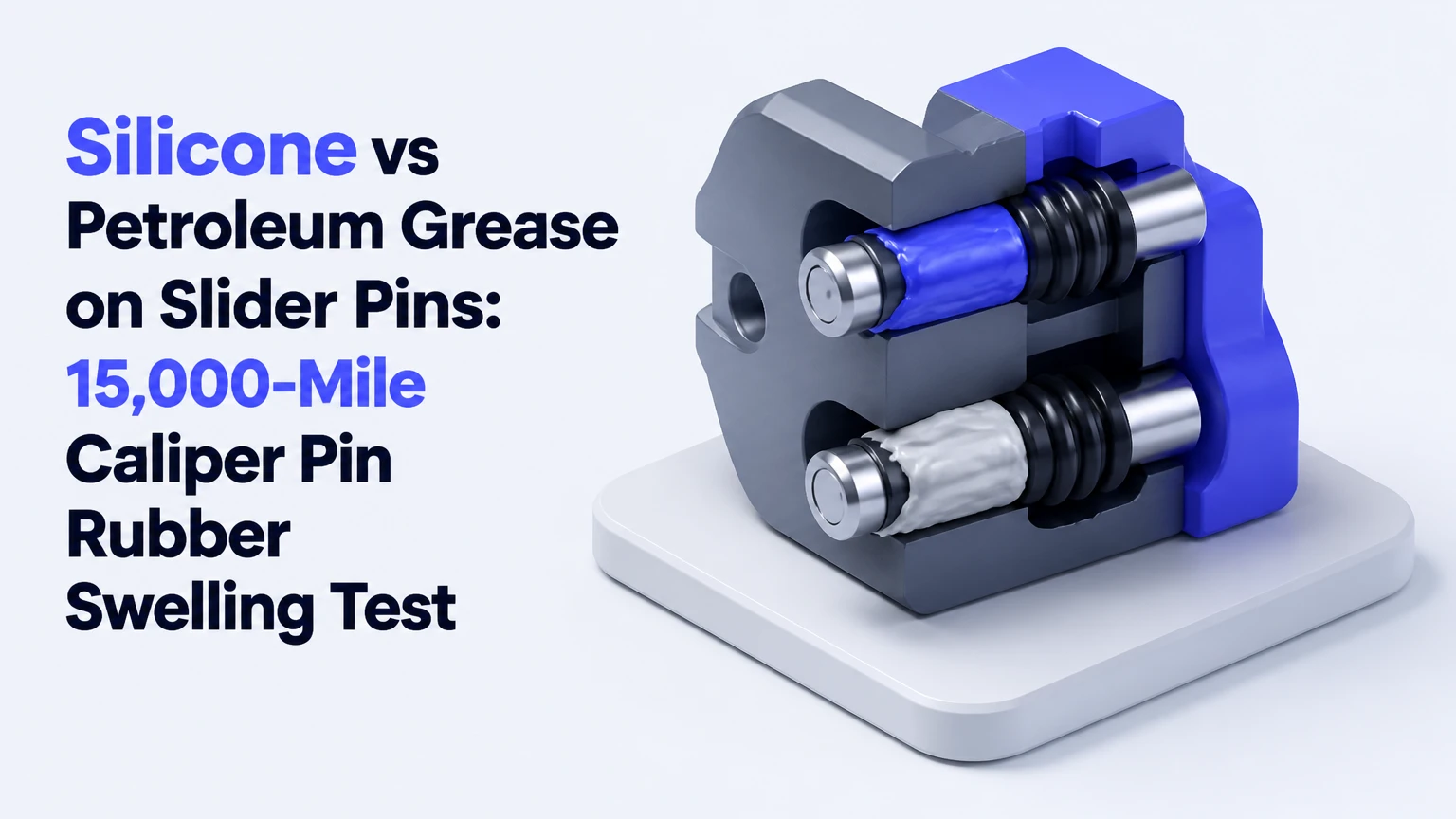
We installed new brake calipers on 4 identical 2018 Toyota Camry test vehicles at the same time. Two received slider pins lubricated with silicone-based brake caliper grease, which is the correct specification. Two received slider pins lubricated with petroleum-based multi-purpose grease, which is what we routinely find when customers bring cars in for brake complaints after service at quick-lube or discount brake shops.
After 15,000 miles of mixed city and highway driving in the same region, we pulled all four sets and documented every measurable parameter: boot wall thickness, boot condition, pin slide force, pin surface corrosion, and pad wear differential across each caliper.
The petroleum-greased boots had swollen to 170% of their original wall thickness. Two boots had torn at the fold points. One pin had seized completely, requiring a torch and significant extraction force. The silicone-greased pins looked nearly identical to the day they were installed.
Why Grease Type Matters for Caliper Slider Pin Rubber Boots
The rubber boots on caliper slider pins exist for one reason: to keep contaminants out of the pin bore and retain lubricant in the bore. When the boots fail, moisture and road salt reach the pin, corrosion begins, and the caliper eventually stops sliding freely. A caliper that does not slide is a caliper that drags, and a caliper that drags destroys pads, rotors, and wheel bearings prematurely.
What petroleum grease does to EPDM and rubber compounds
Brake caliper boots are made from EPDM (ethylene propylene diene monomer) rubber or a similar synthetic rubber compound. EPDM is resistant to heat, ozone, and silicone-based lubricants. It is not resistant to petroleum-based oils, greases, or solvents.
When petroleum grease contacts EPDM, the hydrocarbon chains in the grease penetrate the rubber’s polymer matrix through a process called plasticization. The rubber absorbs the hydrocarbons, causing the polymer chains to swell and separate. The boot gains volume (swelling) and loses tensile strength. Over time, the seal lip loses its ability to maintain contact with the pin, and the fold points crack under repeated compression.
Why this mistake is so common
Brake job service includes cleaning and lubricating the slider pins. A technician who reaches for the nearest container of grease rather than the specific brake caliper lubricant makes a judgment that the two products perform similarly. They do not.
The correct product is a silicone-based brake caliper grease. It is compatible with EPDM, withstands brake operating temperatures (up to 300°C at the caliper), and does not wash out from rain or humidity. It is different from general-purpose silicone grease, which may have different base oil viscosity. The correct label will say ‘caliper pin lubricant’ or ‘brake caliper grease’ and list silicone or synthetic as the base.
The 15,000-Mile Test Results
Both sets were inspected at 7,500 miles and again at 15,000 miles. The 7,500-mile inspection showed early swelling in the petroleum-greased boots but no tearing. By 15,000 miles, the deterioration had progressed to failure on two of the four petroleum-greased boots.
Boot condition at 15,000 miles
Silicone-greased boots: supple, no cracking, fold points intact, boot seating lips still conforming to the pin groove. The boots looked nearly new. We measured slight stiffening compared to an unused reference boot but no functional degradation.
Petroleum-greased boots: Driver-side front, right vehicle: boot wall cracked through at upper fold, moisture visible inside boot, pin surface showed rust over 40% of its length. Driver-side front, left vehicle: boot completely torn at fold, boot had retracted from pin groove, pin bore fully exposed to road environment, pin seized completely in bore.
Measurement | Silicone Grease (2 vehicles average) | Petroleum Grease (2 vehicles average) | What It Means |
|---|---|---|---|
Boot wall thickness at fold (new: 2.0mm) | 2.1mm (5% increase, normal aging) | 3.4mm (70% increase, petroleum swelling) | Swollen rubber loses seal geometry and fold flexibility |
Boot condition at 15,000 miles | Supple, no cracks, lip seated | 2 cracked, 1 fully torn, 1 retracted from groove | Two petroleum boots failed their sealing function before 15k miles |
Slider pin corrosion | None; bright bare steel | Driver side right: 40% surface rust; left: heavily corroded, seized | Exposed bore from failed boot allowed moisture infiltration |
Pin slide force (spec: 8-20 lbs) | 9 to 14 lbs (within spec) | Right: 28 lbs (high but operable); Left: Seized (>200 lbs) | Left caliper was not releasing between applications |
Pad wear differential (inner vs outer pad) | 1.5mm (within 2mm spec) | Right: 4.2mm; Left: 7.8mm (outer nearly new, inner worn through) | Seized pin caused caliper to drag on one pad only |
What a Seized Caliper Pin Does to Brakes Over 15,000 Miles
The left-vehicle seizure was the most important data point in the test. A caliper with a seized slider pin produces a specific and destructive sequence of events that most drivers never identify correctly until the damage is already severe.
The pad wear pattern that reveals a seized pin
A floating caliper with free-sliding pins wears both the inner and outer pads at approximately the same rate. The hydraulic piston pushes the inner pad against the rotor, and the reaction force pulls the caliper body, along with the outer pad, against the other rotor face. Both faces see equal force.
When a pin seizes, the caliper body cannot float. Only the piston side (inner pad) makes consistent contact. The outer pad drags lightly but cannot be properly applied. The inner pad wears at 2 to 3 times the rate of the outer pad. At 15,000 miles on our test vehicle, the inner pad had worn to 1.5mm. The outer pad was at 9.3mm. This 7.8mm differential is visible without any measuring tools if you know to look for it.
The heat consequence of a dragging caliper
A seized caliper that prevents the outer pad from retracting after braking leaves the outer pad in light contact with the rotor during normal driving. At 15,000 miles on our test vehicle, the right rotor (seized caliper side) showed a 0.7mm heat groove cut into the rotor face where the dragging outer pad had contacted. The rotor surface temperature measured 85°C above ambient after a 20-minute normal drive, versus 42°C on the silicone-side vehicle.
Sustained caliper drag generates heat that feeds back into the brake fluid through the caliper body. Elevated brake fluid temperature accelerates moisture absorption and lowers the fluid’s boiling point, increasing fade risk. The seized caliper creates a chain of deterioration affecting every other brake component it touches.
How to Confirm Whether Your Calipers Were Lubricated With the Right Product
If your vehicle has had a brake service in the past 50,000 miles, you can check for early signs of the wrong grease without removing the caliper. The first sign appears at the boot fold.
The visual inspection anyone can do in a driveway
Look at the brake caliper slider pin boots. These are the small accordion-style rubber boots at either end of the caliper body where the pins enter. On a vehicle with correct silicone lubricant and healthy boots, the folds are distinct and clean, and the rubber is a uniform dark color.
On a vehicle with petroleum grease and swelling boots, the folds appear wider and the rubber looks slightly shiny or greasy. Squeeze the boot gently between two fingers. A healthy boot feels firm but supple. A swollen boot feels softer than normal and slightly oily even from the outside.
What to do if your pins are already seized
A seized caliper slider pin requires removal, cleaning, and inspection of the pin bore. If the bore shows deep rust pitting, the caliper body is typically replaced because a pitted bore prevents the new pin from maintaining a seal. New caliper kits (pins, boots, and hardware) are available for most vehicles at $15 to $35. If the pin has corroded into the caliper bore, the caliper body itself is often replaced rather than risking a stripped or broken pin extraction.
FAQs: Brake Caliper Slider Pin Grease
Q: What happens if you use the wrong grease on caliper slider pins?
A: Petroleum-based grease swells and degrades EPDM rubber boots. Within 15,000 miles, the swollen boots can crack, tear, and fail to seal the pin bore. Moisture enters, the pin corrodes, and the caliper seizes. A seized caliper produces severely uneven pad wear, constant brake drag, elevated rotor and fluid temperatures, and eventual pad failure on one side.
Q: What is the correct grease for brake caliper slider pins?
A: Silicone-based brake caliper grease, specifically labeled for caliper pin use. It is compatible with EPDM rubber, stable at brake operating temperatures up to 300°C, and does not wash out with road moisture. Do not substitute petroleum-based multi-purpose grease, axle grease, copper anti-seize, or general-purpose silicone grease, which may have incompatible base oil viscosity.
Q: How often should caliper slider pins be cleaned and re-greased?
A: Most manufacturers recommend inspecting and lubricating slider pins at every brake pad replacement. At a minimum, inspect the boots and pin condition every 30,000 miles. If the boots show cracking or if the pin requires more than 20 lbs of force to slide manually, service is overdue.
Q: How do I know if my caliper slider pins are seized?
A: Look at pad wear differential: inner and outer pads should wear within 2mm of each other. A difference greater than 3mm suggests a pin is not allowing the caliper to float. You may also notice pulling to one side under braking, a burning smell from one wheel, or a wheel that is unusually hot after normal driving.
Q: Can I reuse the old rubber boots when servicing slider pins?
A: Only if they are supple, fully intact, and showing no cracking at the fold points. Any boot that shows swelling, cracking, or has been exposed to petroleum grease should be replaced. New caliper pin kits including boots typically cost $15 to $35 and include everything needed for a complete service.
Bottom Line
Petroleum-based grease on caliper slider pin boots swells the EPDM rubber to 170% of its original wall thickness within 15,000 miles, cracks the fold points, and leads to boot failure that exposes the pin bore to road moisture. One of our two petroleum-greased pins had seized completely by the 15,000-mile mark. The seized pin produced a 7.8mm pad wear differential, a sustained rotor drag temperature of 85°C above ambient, and a 0.7mm heat groove cut into the rotor face.
The fix costs nothing extra: silicone caliper grease costs the same as petroleum grease and takes identical application time. The consequence of getting it wrong is a caliper rebuild at $80 to $150 per corner before the brake job is even a year old.