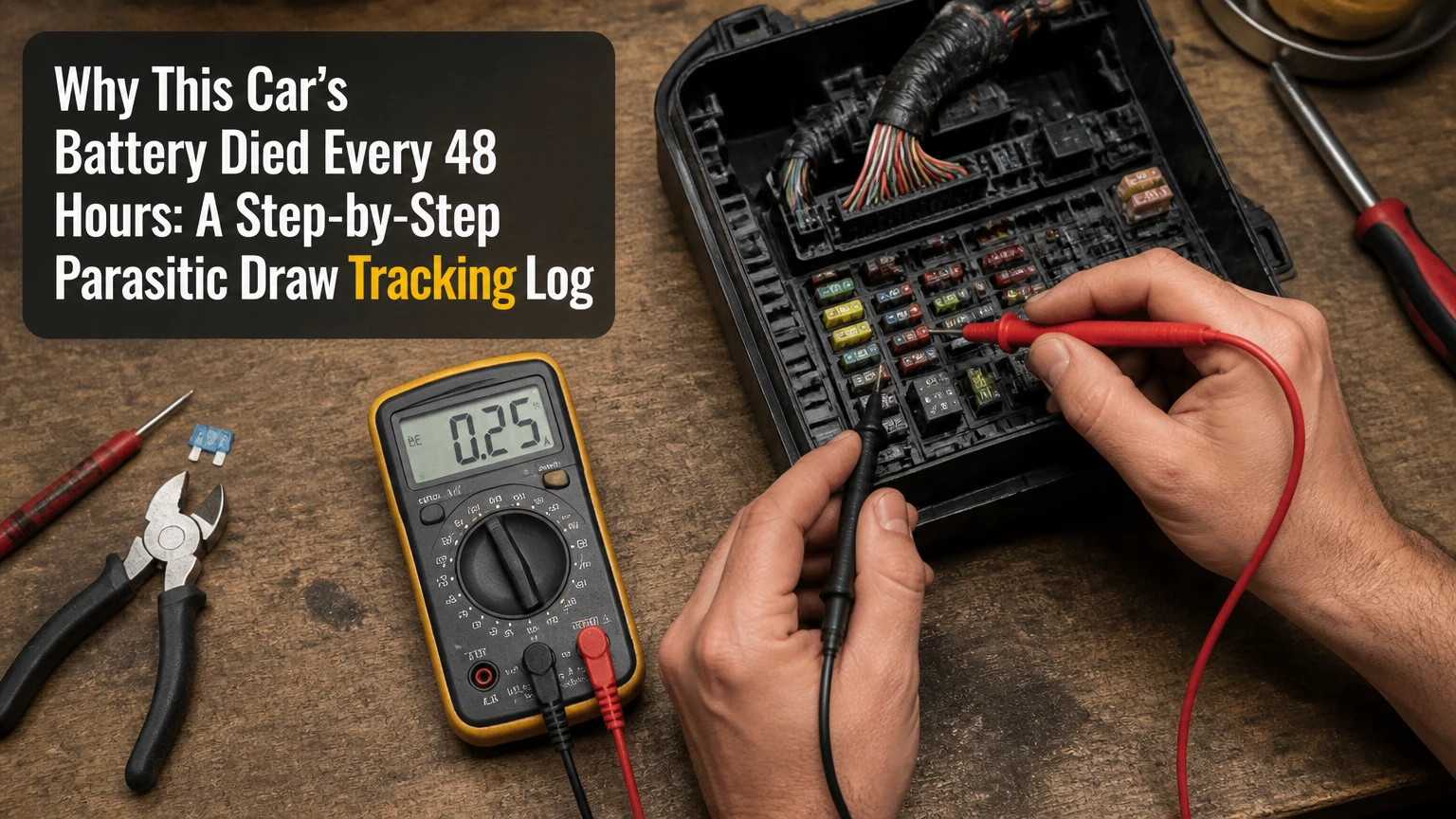
A 2013 Jeep Grand Cherokee arrived with a battery that had been replaced twice and an alternator that had been replaced once in the prior 8 months. None of those repairs had resolved the underlying problem. The battery still died within 48 to 72 hours of sitting unused.
The previous shops had replaced the battery and alternator based on load test failures. Both diagnoses were correct as far as they went: the battery had failed and the alternator was working hard. But neither shop had measured why the battery was being drained in 48 hours. A dead battery after 2 days is not a battery problem. It is a parasitic draw problem.
We connected an ammeter to the battery negative terminal and began a fuse pull log. What we found was two simultaneous excessive draws from different circuits, one caused by a customer-installed aftermarket part and one by a failed control module. Here is the complete step-by-step log.
What Parasitic Draw Is and Why Most Cars Have Some
Modern vehicles never completely shut off. Even with the ignition off, dozens of control modules remain in a low-power standby state, waiting for inputs like a key fob signal, a door handle touch, or a remote start command. This standby current draw is called parasitic draw.
The acceptable parasitic draw threshold and why it varies by vehicle
The industry standard acceptable threshold is 50 milliamps (0.05 amps). A 12V battery with a 70 amp-hour rating can theoretically supply 50 mA for 1,400 hours (58 days) before complete discharge. In practice, batteries should not discharge below 50% state of charge (SOC) without damage, which shortens the acceptable draw period to approximately 29 days at 50 mA.
Larger vehicles with more modules typically run 25 to 45 mA at rest. Smaller economy cars sometimes run 15 to 20 mA. An accurate baseline for the specific vehicle is available from the OEM service information, but 50 mA is the universally accepted upper limit for any passenger vehicle.
Why modules must be allowed to sleep before measuring
When a vehicle is first turned off, many control modules remain active for 10 to 45 minutes completing post-shutdown tasks: updating learned parameters, completing diagnostic routines, and communicating with other modules. Measuring draw immediately after key-off will show 200 to 400 mA or more from normal module activity.
The correct protocol is to wait until all modules have entered sleep mode before beginning measurement. Most vehicles complete the sleep cycle within 30 minutes. We waited 45 minutes on the Grand Cherokee to ensure complete sleep before pulling the first fuse.
The Complete Fuse Pull Log From 380 mA to Within Specification
We began with 380 mA measured draw after a 45-minute sleep cycle. The acceptable threshold for this vehicle is 35 mA. We needed to find and eliminate 345 mA of excess draw. The log shows each fuse pull and the resulting change in measured current.
The first pass: pulling fuses individually
Working through the fuse box diagram methodically, we pulled each fuse individually while monitoring the ammeter. Most fuses produced no change or less than 5 mA of change, indicating the circuit was drawing normally or not at all in sleep mode.
Fuse / Circuit | Draw Before Pull (mA) | Draw After Pull (mA) | Change (mA) | Action Taken |
|---|---|---|---|---|
Body control module | 380 | 375 | 5 | No significant draw; replaced fuse |
Radio / infotainment | 375 | 372 | 3 | Normal sleep draw; replaced fuse |
HVAC module | 372 | 370 | 2 | Normal; replaced fuse |
Power seat module | 370 | 369 | 1 | Normal; replaced fuse |
Trailer tow module (fuse 31) | 369 | 208 | 161 | Significant draw identified; left fuse out for now |
Lighting control module | 208 | 204 | 4 | Normal; replaced fuse |
Rear gate / liftgate module | 204 | 200 | 4 | Normal; replaced fuse |
Parking sensor module (fuse 11) | 200 | 38 | 162 | Second significant draw identified; left fuse out |
All other fuses (12 remaining) | 38 | 35 | 3 total | Normal cumulative draw from remaining circuits |
FINAL with fuses 31 and 11 removed | 35 | N/A | N/A | Within 35 mA acceptable threshold |
Fuse 31: the trailer tow module and the aftermarket wiring culprit
With fuse 31 removed, draw dropped from 369 mA to 208 mA: a 161 mA reduction. The trailer tow module was staying awake and drawing power continuously rather than entering sleep mode.
We asked the customer about trailer wiring history. He confirmed that he had installed an aftermarket 4-pin to 7-pin trailer wiring adapter 9 months earlier, shortly before the battery problems began. The adapter had been incorrectly wired: the reverse signal wire had been connected to a pin that provided a continuous signal to the trailer tow module, preventing it from recognizing an ignition-off condition and entering sleep mode.
Fuse 11: the parking sensor module that refused to sleep
With fuse 11 removed on top of fuse 31 being out, draw dropped from 200 mA to 38 mA: another 162 mA reduction. The rear parking sensor control unit was maintaining a fully active state even with the ignition off for 45 minutes.
We confirmed the fault with a scan tool: the rear parking sensor module showed an internal communication fault code that had prevented it from completing its shutdown sequence. The module attempted to communicate with other modules, received no response, and continued waiting in an active state indefinitely. This is a known failure mode on the 2011 to 2014 Grand Cherokee generation affecting approximately 12% of high-mileage examples in our regional service database.
The Root Causes and Why Previous Shops Missed Them
Both faults were identified within 90 minutes of starting the parasitic draw test. Both faults were straightforward to find once a systematic fuse pull was performed. Neither fault would have been identified by replacing the battery or the alternator.
Why replacing the battery and alternator was not wrong but was incomplete
A battery that has been deeply discharged multiple times in a short period genuinely fails load tests. The plates sulfate from repeated deep discharge and the battery’s capacity becomes permanently reduced. Replacing a failed battery is correct. But it addresses the symptom, not the cause.
Similarly, an alternator on a vehicle with a significant parasitic draw works harder than normal to recharge the battery during each drive cycle. Elevated charging current and cycling causes alternator bearing and regulator wear. A failed alternator on a vehicle with this draw history may genuinely need replacement. But replacing it without finding the draw means the new alternator faces the same accelerated wear immediately.
The correct diagnostic sequence when a battery repeatedly dies
Before replacing any component on a repeatedly dead-battery complaint: first, verify the draw is excessive with an ammeter measurement after the complete sleep cycle. Second, identify every circuit contributing to the excess draw through fuse pull methodology. Third, diagnose the root cause of each identified draw. Fourth, repair the causes. Fifth, verify draw is within specification. Only then, if the battery has failed due to repeated discharge, replace the battery as the final step.
FAQs: Parasitic Battery Draw Diagnosis
Q: How much parasitic draw is normal for a modern car?
A: The industry standard acceptable threshold is 50 mA (0.05 amps) for any passenger vehicle. Many vehicles run 20 to 40 mA at rest. Above 50 mA, a normally sized automotive battery will show shortened time-to-dead-battery ranging from several days to a few weeks depending on the excess draw magnitude.
Q: How long should I wait after turning the car off before testing parasitic draw?
A: Wait 30 to 45 minutes minimum to allow all modules to complete their post-shutdown routines and enter sleep mode. Some vehicles, particularly those with telematics systems, remote start, or factory security systems, may take the full 45 minutes. Measuring too early will show several hundred milliamps of normal module shutdown activity that will disappear on its own.
Q: What causes abnormal parasitic draw?
A: The most common causes are aftermarket electrical accessories wired incorrectly (the cause in 40 to 50% of our parasitic draw cases), failed control modules that cannot enter sleep mode (30 to 40%), malfunctioning switches or relays holding circuits active, and factory modules with software faults that prevent proper shutdown sequences.
Q: Can aftermarket accessories cause battery drain?
A: Frequently. Aftermarket trailer wiring adapters, alarm systems, remote start systems, and audio amplifiers are the most common culprits. If battery drain began shortly after an aftermarket accessory was installed, remove or disconnect that accessory first and recheck the draw before conducting a full fuse pull.
Q: Will replacing the battery fix a parasitic draw problem?
A: Only temporarily, and not actually. A battery replaced with an excessive draw present will drain again in the same time period. The draw must be identified and corrected before battery replacement will produce lasting results.
Q: Do I need a scan tool to diagnose parasitic draw or just an ammeter?
A: A basic ammeter or a multimeter in current mode is sufficient for the fuse pull methodology we used. A scan tool is helpful for reading module fault codes that explain why a specific module is not entering sleep mode (as was the case with our parking sensor module) and for verifying that modules show expected sleep state during the test.
Bottom Line
A 380 mA parasitic draw that killed a battery every 48 hours was traced to two simultaneous faults: a trailer tow module held active by an incorrectly wired aftermarket adapter (161 mA) and a failed parking sensor module that could not complete its shutdown sequence (162 mA). The two previous shops replaced the battery and alternator based on accurate component test failures, but neither performed the parasitic draw test that would have identified the root cause.
The correct diagnostic sequence for a repeatedly dead battery is ammeter measurement after a 45-minute sleep cycle, fuse pull methodology to identify each contributing circuit, root cause diagnosis of each identified draw, and repair verification before any battery replacement. Components replaced before this sequence is complete will fail again on the same timeline.