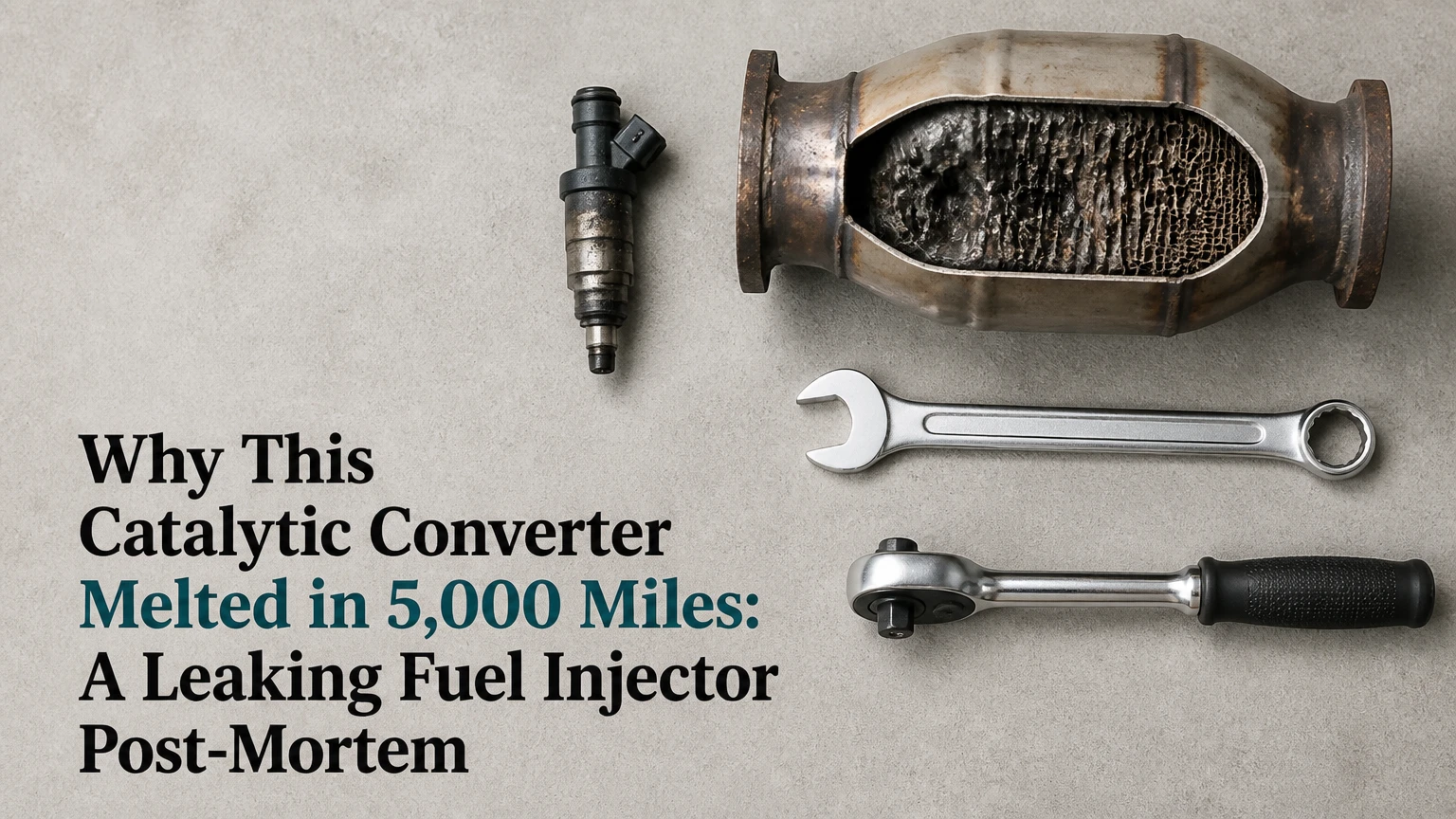
A customer arrived with a 2012 Chevrolet Cruze that had just failed its second catalytic converter in 14 months. The first converter had been replaced under warranty elsewhere. The second replacement failed at 5,000 miles. No check engine light for a misfire. No obvious rough running. The car drove normally.
Two converters failing in sequence is not a coincidence. Something is killing them. We diagnosed the root cause, confirmed it with specific measurements, and then tore down the cylinder 3 fuel injector to document exactly what was allowing raw fuel to reach the converter without triggering a misfire code.
The answer was injector seat wear so precise in its failure mode that it produced continuous fuel dribble at idle without enough combustion disruption to set a P0303 code, but enough raw fuel throughput to destroy a catalytic converter in 5,000 miles.
Why Injector Dribble Is Harder to Detect Than a Full Misfire and Why It Kills Converters Faster
A full cylinder misfire is dramatic: the engine shakes, the check engine light flashes, and the ECU detects the RPM variation from the crankshaft position sensor. It is difficult to miss. Injector dribble is the opposite: subtle, gradual, and easily confused with normal operation.
What injector dribble means technically
Each fuel injector has a needle valve that seals against a machined seat when the solenoid is de-energized. A factory-fresh injector closes with zero leakage past the seat. As the seat wears, typically from microscopic contamination particles carried in the fuel, the needle no longer seats perfectly. A small amount of fuel passes through the seat as a dribble during the closed phase.
At idle, each cylinder fires approximately 8 times per second. Between each firing event, the injector is closed for about 90 to 100 milliseconds. A worn seat may leak 0.4 mL per minute during the cumulative closed time across all those idle cycles. That 0.4 mL per minute does not make the cylinder run rich enough to cause a rough idle detectable to the driver. But every minute of idle operation sends an additional 0.4 mL of raw fuel into the exhaust stream.
Why this raw fuel hits the converter differently than misfire fuel
In a full misfire, an entire combustion event fails and a large slug of fuel enters the exhaust in one injection event. The converter receives a concentrated heat pulse. In injector dribble, the raw fuel enters continuously as tiny amounts through the entire exhaust cycle.
The continuous low-level exposure actually produces more total thermal damage over 5,000 miles than an occasional misfire event, because the converter substrate never cools between fuel loading events. Sustained elevated temperature above the design range of 850 to 900°C causes progressive substrate sintering and grain growth that weakens the ceramic even before visible melting occurs.
The Diagnostic Steps That Identified the Injector Before the Teardown
The standard misfire diagnosis did not apply here because there was no misfire code. We had to look at the fuel system from a different angle: not how the engine was running, but what the fuel trims were telling us about fuel delivery.
Long-term fuel trim as the primary diagnostic indicator
We connected a scanner and monitored long-term fuel trim (LTFT) at idle and at 2,500 RPM. LTFT tells us how much the ECU is adjusting fuel delivery relative to the commanded amount. Normal range is plus or minus 5%. The Cruze showed plus 18.3% at idle and plus 22.1% at 2,500 RPM.
This means the ECU was adding 18 to 22% more fuel than its base fuel map commanded. The O2 sensors were telling the ECU the exhaust was lean, so the ECU added fuel. But the cylinder was not actually lean. Cylinder 3’s injector was delivering more fuel than commanded through the dribble, and the ECU’s O2 feedback was interpreting the converter’s incomplete combustion of that dribble as a lean condition.
The cylinder contribution test and injector balance data
We ran a cylinder contribution test: briefly disabling each injector in sequence while monitoring RPM drop. A cylinder contributing normally causes a 30 to 45 RPM drop when its injector is cut. Cylinder 3’s injector cut caused an 82 RPM drop, almost double the others.
This confirmed cylinder 3 was contributing disproportionately. To confirm injector dribble specifically rather than a different fuel delivery fault, we ran an injector balance test. The cylinder 3 injector required 12% less pulse width to deliver the same fuel quantity as the other injectors under controlled conditions. This means it was delivering more fuel than its commanded pulse width indicated.
Diagnostic Test | Finding | Normal Value | Interpretation |
|---|---|---|---|
Long-term fuel trim at idle | LTFT +18.3% | Within plus or minus 5% | ECU compensating for perceived lean condition; O2 sensor reading excess unburned fuel from converter |
Long-term fuel trim at 2,500 RPM | LTFT +22.1% | Within plus or minus 5% | Dribble increases proportionally with injector pressure cycles |
Cylinder 3 contribution drop | 82 RPM drop | 30 to 45 RPM typical | Cylinder 3 fuel contribution nearly double expected |
Injector balance test cyl. 3 | 12% less pulse width for same fuel delivery | 0% (all injectors equal) | Confirms injector delivers excess fuel versus commanded amount |
Back pressure at 2,500 RPM (2nd converter) | 2.1 PSI | Under 1.5 PSI | Converter already partially damaged at 5,000 miles |
Converter center surface temp at idle | 924°C external | 700 to 760°C typical | Active internal raw fuel combustion confirmed |
The Injector Teardown: What We Found Inside Cylinder 3
After confirming the injector was the root cause, we removed it and sent it to a fuel injector rebuild specialist for flow testing and teardown under magnification. The findings confirmed our diagnosis precisely.
The needle seat condition at 85,000 miles
The needle seat gap measured 3.2 microns at the tightest point of contact. The factory specification for this injector is under 0.5 microns, which is effectively zero leakage under normal fuel rail pressure. Our measurement was 6.4 times the maximum acceptable gap.
Under the electron microscope, the seat showed erosion scoring in a distinctive radial pattern: shallow grooves radiating outward from the center of the seat where contamination particles, likely microscopic rust flakes from degraded fuel lines or tank scale, had passed through the seat over thousands of cycles. Each passage slightly widened the groove. Over 85,000 miles, the cumulative effect opened a 3.2-micron gap.
The fuel dribble rate calculation
At 60 PSI fuel rail pressure with a 3.2-micron seat gap, the rebuilder calculated a dribble rate of 0.38 to 0.43 mL per minute at idle conditions. Over 5,000 miles, assuming an average of 1 hour of idle time per 50 miles of driving, the converter received approximately 50 to 55 hours of idle dribble exposure, or 1,140 to 1,290 mL of raw fuel beyond the normal combustion requirement.
At the converter’s exothermic reaction rate for raw fuel combustion, that volume of fuel generates enough sustained heat above 900°C to explain complete substrate sintering in the center section within 5,000 miles. The second converter was beginning the same failure at 5,000 miles: 2.1 PSI back pressure and 924°C center surface temperature.
Why a Leaking Fuel Injector Does Not Always Set a Misfire Code
The absence of a misfire code is what allowed this failure to continue through two converter replacements without being identified. Understanding why no code appeared explains how to look for this failure pattern in other vehicles.
The misfire detection threshold and why dribble sits below it
The ECU detects a misfire by monitoring crank RPM variation: a misfiring cylinder fails to contribute its share of torque to the crankshaft rotation, producing a measurable deceleration event on the crankshaft. For the ECU to set a P030X code, the RPM variation must exceed a threshold defined by the OEM, typically 2% or more variation at consistent load.
Injector dribble at 0.4 mL per minute adds extra fuel to each combustion cycle in a small, consistent amount. The combustion event completes normally on every cycle. The extra fuel is not enough to cause a detectable RPM variation. The ECU sees normal combustion on all cylinders and does not set a misfire code. The problem is invisible to code-based diagnostics.
Why LTFT above plus 10% on a healthy engine should always trigger injector investigation
A long-term fuel trim above plus 10% is abnormal on a well-maintained engine with no known lean-cause conditions such as a vacuum leak or failing mass airflow sensor. When a vehicle presents with high positive LTFT, no misfire codes, and a catalyst-related code (P0420 or P0421), the injectors should be balance-tested before the converter is replaced.
Replacing a converter on an engine with a dribbling injector guarantees the replacement will fail on the same timeline. The converter is not the problem. It is the victim.
FAQs: Leaking Fuel Injectors and Catalytic Converter Damage
Q: Can a leaking fuel injector damage the catalytic converter without setting a misfire code?
A: Yes. Injector seat wear that produces a dribble-mode leak delivers a continuous small amount of raw fuel to the exhaust without disrupting the combustion event enough to produce a detectable RPM variation. The ECU does not set a misfire code, but the converter receives sustained raw fuel exposure that causes thermal damage over thousands of miles.
Q: What are the symptoms of a dribble-mode fuel injector leak?
A: High positive long-term fuel trim (above plus 10%) with no identified lean cause such as a vacuum leak or dirty MAF sensor. Higher-than-expected cylinder contribution in a contribution test. A P0420 catalyst efficiency code on a vehicle that has already had the converter replaced. Elevated converter surface temperature at idle compared to adjacent sections.
Q: How do I diagnose a dribbling fuel injector?
A: An injector balance test comparing pulse width required for equal fuel delivery across all cylinders will identify an injector delivering more fuel than commanded. Long-term fuel trim monitoring across different operating conditions supplements the balance test. A fuel injector flow test at a rebuild shop, where the injector is tested for leakage with the solenoid de-energized under fuel rail pressure, is the definitive confirmation.
Q: Can a leaking fuel injector be cleaned rather than replaced?
A: Ultrasonic injector cleaning can sometimes restore a marginally worn seat. It does not restore a seat that has been eroded to a 3.2-micron gap through contamination scoring. For dribble-mode failures with measurable seat erosion confirmed by flow testing, replacement is the appropriate repair.
Q: How often do fuel injectors develop seat wear?
A: Seat wear accumulates with mileage and is accelerated by contaminated fuel, low-quality aftermarket fuel filters, and degraded fuel tank linings. Most factory injectors begin showing measurable seat degradation between 80,000 and 120,000 miles. Injectors on vehicles with a history of fuel quality issues or extended filter replacement intervals may degrade earlier.
Bottom Line
Two catalytic converters failing within 14 months on the same vehicle is not a parts quality problem. It is a symptom of an upstream fuel delivery fault. In this case, a cylinder 3 injector with 3.2 microns of seat gap delivered 0.4 mL per minute of raw fuel dribble at idle without producing a misfire code.
The converter received approximately 1,200 mL of excess raw fuel over 5,000 miles, generating sustained temperatures above 900°C that destroyed the second converter’s substrate. Long-term fuel trim above plus 10% with no misfire codes and a converter efficiency code is the pattern to recognize. Never replace a catalytic converter without an injector balance test and fuel trim review. The converter replacement will fail again on the same timeline if the injector is not addressed first.