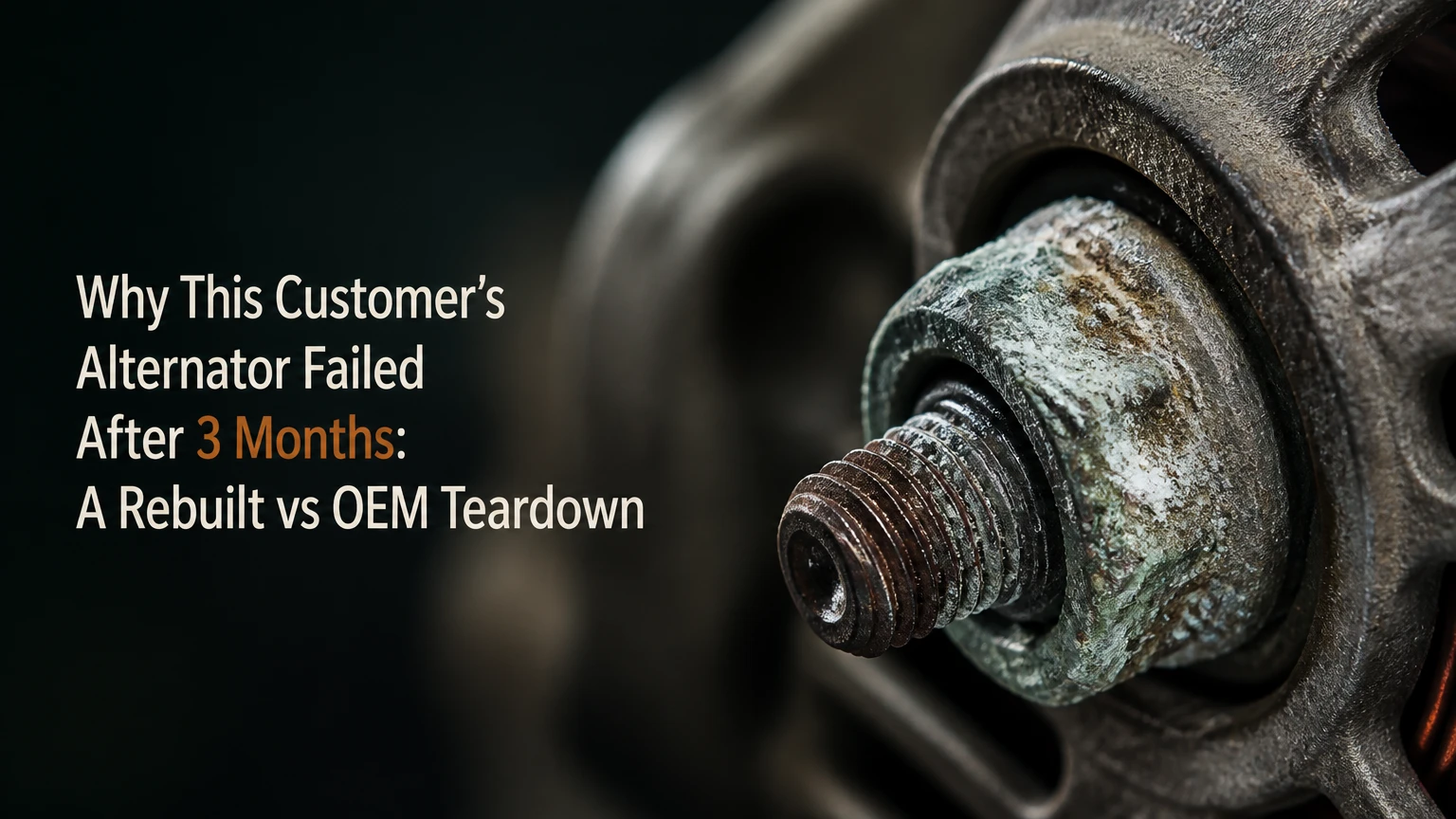
A 2011 Toyota Camry came back to our shop 91 days after we installed a remanufactured alternator. The battery light was back on. The charging voltage had dropped to 12.4V at idle, effectively meaning the alternator was producing almost nothing.
The customer had paid $89 for the rebuilt unit at a national parts retailer. He wanted to know why it had failed. So did we.
We tore down the failed rebuilt unit on the bench and compared every measurable component to a new OEM Denso alternator of the same specification. What we found was not a manufacturing defect in the traditional sense. It was a predictable failure caused by a surface quality problem that no parts retailer discloses and that most customers never hear about.
What This 3-Month Alternator Failure Looked Like From the Outside
From the outside, the failed alternator looked like any other electrical failure: battery light on, low voltage, dead car if left too long. But the symptom pattern told us something specific before we even opened it.
The voltage signature that pointed at brush failure rather than a diode or regulator
We tested the charging system at idle before removing anything. Voltage was 12.4V. At 2,000 RPM, it climbed to 12.9V but never reached the normal 13.8 to 14.4V range. This partial output pattern is characteristic of brush wear.
A failed diode produces a different signature: a distinctive AC ripple on the DC charging output. A failed regulator typically produces either no output or fixed maximum output. Partial-but-diminishing voltage that rises slightly with RPM points at brushes that are still making intermittent contact but not maintaining it consistently.
What the wiring and connector showed before the teardown
The B+ output terminal on the alternator showed 0.3V of voltage drop under load, indicating moderate resistance at the connection. The wiring from that terminal to the battery showed no significant drop. This ruled out a wiring problem and confirmed the issue was inside the unit.
The Teardown: Every Component Measured Side by Side Against an OEM Unit
We disassembled both alternators on the bench simultaneously. For each component, we measured what the rebuilt unit showed and compared it to the OEM unit’s condition. The differences told the story clearly.
The commutator surface: the root cause that everything else flows from
The commutator is the copper slip ring that the carbon brushes contact as the rotor spins. In a working alternator, the brushes ride on a smooth commutator surface. Over years of use, the commutator develops wear grooves where the brushes have tracked.
On the failed rebuilt unit, we measured the commutator surface roughness with a profilometer. The reading was Ra 3.4 micrometers, meaning the surface had visible grooves and irregularities. A new OEM commutator measures Ra 0.8 micrometers or better. The rebuild shop had not machined the commutator surface before reinstalling new brushes.
Why an unmachined commutator destroys new brushes in weeks
Carbon brushes are designed to seat against a smooth surface. When you install new brushes against a grooved commutator, the brushes ride on the groove ridges rather than making full-face contact. The contact area drops from 100% to roughly 30 to 40%.
Less contact area means higher current density at the remaining contact points. Higher current density means more heat. More heat means faster carbon sublimation. A brush that should last 80,000 miles wears out in 15,000 to 25,000 miles on a grooved commutator. On the worst commutator surfaces, like the 3.4 Ra we measured, the wear rate is even faster.
The bearing: why re-grease is not the same as replacement
The rebuild unit’s front bearing measured 0.38mm of radial play. The specification calls for no more than 0.05mm. A new OEM bearing measures effectively zero play.
Rebuild shops commonly clean and re-grease used bearings rather than replacing them. A bearing with 150,000 miles of thermal cycling has micro-spalled races. No amount of fresh grease restores the race geometry or the ball-to-race fit. High bearing play produces vibration that accelerates brush wear further.
The diode pack: different standards between OEM and rebuilder supply chains
We tested each diode in both units using a multimeter in diode mode. OEM diodes showed forward voltage drops of 0.51 to 0.54V. The rebuilt unit’s diodes showed forward drops of 0.48 to 0.77V. Two of the six diodes in the rebuilt pack were outside the 0.5 to 0.65V acceptable range.
The wide variation suggests the rebuilt pack used diodes sourced from lower-tier suppliers with looser tolerance screening. Diodes outside spec produce higher heat during operation, which accelerates thermal fatigue in the surrounding solder joints.
Component | OEM Alternator (New) | Rebuilt Unit (Failed at 91 Days) | The Consequence |
|---|---|---|---|
Commutator surface roughness | Ra 0.8 µm (smooth) | Ra 3.4 µm (grooved from prior use) | Brushes ride on grooves, contact area drops 60-70%, rapid wear begins immediately |
Brush length at failure | N/A (new: 15.0mm) | 8.2mm (original was ~15mm) | 43% wear in 91 days; projected total failure within another 45 days |
Front bearing radial play | < 0.05mm (effectively zero) | 0.38mm (7.6x over limit) | Vibration accelerates brush bounce and wear; early failure of rotor windings possible |
Diode forward voltage drop | 0.51 to 0.54V (tight spread) | 0.48 to 0.77V (wide spread, 2 out of spec) | Out-of-spec diodes run hot; solder joint fatigue over months, not years |
Rotor windings resistance | 2.8 Ohm (as-spec) | 2.9 Ohm (within range, reused) | Original windings; no degradation yet, but at 150k miles with no inspection |
Regulator brush contact springs | OEM spring rate, new | Reused springs, softened with age | Reduced spring force reduces brush contact pressure, compounding groove-contact problem |
Why the Commutator Surface Is the Component That Determines Everything
Everything else in this failure, the rapid brush wear, the reduced contact pressure, the intermittent voltage output, flows from the one decision the rebuilder made: not machining the commutator before installing new brushes.
What commutator machining costs and why rebuilders skip it
A commutator surface grind on a lathe takes approximately 12 minutes and costs about $4 to $8 in shop time at a remanufacturing facility. It requires a lathe with a diamond tool bit, which is standard equipment in any proper alternator rebuild shop.
Economy rebuild operations skip this step to reduce labor cost and processing time. At high volume, machining every commutator adds $6 per unit to the production cost. On an $89 retail alternator with a 40% margin to the rebuilder, that $6 represents a significant percentage of profit per unit.
How to identify whether an alternator was properly rebuilt before you buy it
Ask the counter person whether the unit has been remanufactured or just rebuilt. These terms mean different things. A remanufactured alternator has been completely disassembled, all wear surfaces machined or replaced, and components tested individually before reassembly. A rebuilt unit may have had only failed components replaced with the rest reused.
Visually: a properly remanufactured alternator will have a clean, shiny commutator when you look through the brush inspection port (if accessible). A commutator that still shows dark wear bands from the original service life has not been machined.
The Economics: When a Rebuilt Alternator Actually Makes Sense and When It Does Not
Rebuilt and remanufactured alternators are not universally bad. Some rebuilders do complete teardowns with proper machining and full component replacement. The price often reflects the quality of the rebuild. Understanding where to draw the line protects the customer from paying twice.
The cost comparison when you factor in failure rates
If a rebuilt alternator at $89 has a 25% chance of failing within 6 months (based on our shop’s return rate on economy rebuilt units), the expected cost per alternator including installation labor is: $89 plus 0.25 times ($89 plus $120 labor) equals $142 effective cost. A quality remanufactured unit at $175 with a 5% 6-month failure rate: $175 plus 0.05 times ($175 plus $120 labor) equals $190 effective cost.
The rebuilt unit is still cheaper in this analysis. But the analysis changes when the car is driven long distances or when a charging failure leaves the driver stranded. Factor in the towing cost of a failure ($85 to $150 average) and the balance shifts.
The vehicles where OEM or quality remanufactured is the right call regardless of cost
High-mileage vehicles where the replacement will be the last alternator the car needs: the OEM unit will outlast the car’s remaining life. Any vehicle where alternator failure creates a serious stranding risk: highway commuters, rural drivers with long distances between service areas. And any vehicle that has already had one rebuilt unit fail: the second failure is not a coincidence, and investing in a quality unit at that point is the correct call.
FAQs: Rebuilt vs OEM Alternators
Q: Why do rebuilt alternators fail faster than OEM units?
A: The most common reason is an unmachined commutator surface. When new brushes are installed on a grooved commutator from 100,000-plus miles of use, the brushes cannot seat properly. They wear 3 to 5 times faster than designed because contact area is reduced and current density increases at the remaining contact points.
Q: What is the difference between a rebuilt and a remanufactured alternator?
A: Rebuilt typically means failed components were replaced while reusable components remained. Remanufactured means the unit was fully disassembled, all wear surfaces were machined or replaced, and components were tested individually. Remanufactured units command a higher price and typically carry longer warranties.
Q: Can I check whether a rebuilt alternator was properly machined before I buy it?
A: Look through the brush inspection port if the alternator has one. A properly machined commutator will be bright copper-colored and smooth. One that was not machined will show dark wear bands where the original brushes tracked. That dark banding tells you the commutator surface was not prepared for new brushes.
Q: How long should an alternator last?
A: A factory OEM alternator on a well-maintained vehicle typically lasts 100,000 to 180,000 miles. A properly remanufactured unit with new bearings, machined commutator, and tested diodes should achieve 80,000 to 120,000 miles. An economy rebuilt unit with no machining may last 20,000 to 50,000 miles under normal conditions.
Q: Is the bearing failure also common in rebuilt alternators?
A: Yes. Rebuilt units commonly reuse the original bearings with fresh grease rather than replacing them. A bearing that has seen 150,000 miles of thermal cycling has micro-spalling on the races that grease alone cannot remedy. High bearing play produces vibration that accelerates brush wear and can damage the rotor windings over time.
Bottom Line
The 91-day rebuilt alternator failure came down to one unmachined commutator surface with Ra 3.4 micrometers of roughness instead of the 0.8 micrometers a new OEM unit delivers. New brushes on that surface had their contact area reduced by 60 to 70%, causing them to wear at 4 times the normal rate. By the time the customer came back, the brushes had worn from 15mm down to 8.2mm: 43% of their life gone in 91 days.
The bearing played a supporting role at 0.38mm of radial play, and the diodes showed the wide tolerance variation of lower-tier supply chain parts. An $89 alternator with these characteristics is not a savings. It is a delayed purchase of the same part plus installation labor a second time.