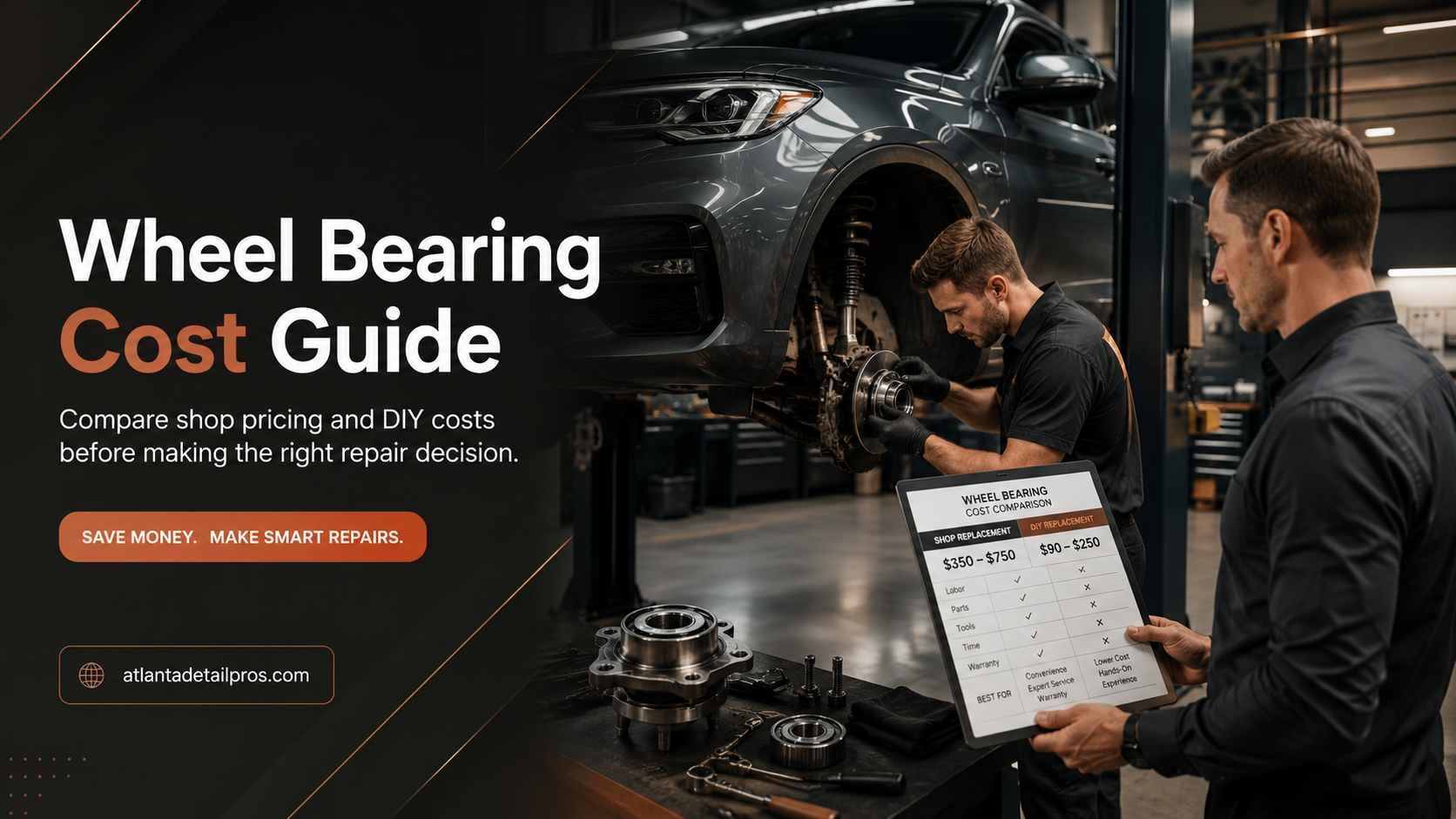
Wheel bearing replacement is one of those jobs where the cost range is so wide that a single number is almost useless without context. You will find quotes ranging from $150 to $800 per wheel at shops, and the difference has almost nothing to do with how good the shop is. It comes down to the bearing design your specific vehicle uses, whether that design requires a hydraulic press or just basic hand tools, and how accessible the bearing is on your particular corner of your particular model.
This guide gives you the actual numbers broken down by bearing type, vehicle category, and repair path (shop versus DIY), so you can evaluate any quote you receive and decide whether this is a job to hand off or one you can handle yourself.
The Biggest Factor in Cost: Bearing Type, Not Labor Rate
Before comparing shop versus DIY costs, you need to understand that the single most important variable in wheel bearing replacement cost is not which shop you go to, it is which type of bearing your vehicle uses. Two vehicles side by side can have wildly different wheel bearing costs purely because of bearing design. There are two main types.
Hub Assembly (Bolt-On): Faster, More Common on Modern Vehicles
Most vehicles manufactured after 2000, and virtually all front-wheel drive passenger cars, use an integrated hub bearing assembly. The bearing is permanently sealed inside a hub unit that bolts directly to the steering knuckle with three or four bolts. To replace the bearing, you remove the hub assembly as a unit and bolt on a new one. No press required. The job takes 1 to 2 hours. This is the more DIY-friendly type and the one that keeps shop labor costs on the lower end of the range.
Pressed-In Bearing: Requires a Hydraulic Press, More Labor
Older vehicles, rear-wheel drive trucks, and many rear suspension designs use a bearing that presses into the hub or knuckle rather than bolting in as an assembly. Replacing this type requires pressing the old bearing out with a hydraulic bearing press and pressing the new one in with precise alignment. Without a press, this job cannot be done correctly. The press work adds 1 to 3 hours to the labor time and is the main reason some wheel bearing jobs cost significantly more than others. This is the type that is generally not worth attempting as a DIY without press access.
Shop Cost: What You Actually Pay per Wheel
The ranges below reflect independent shop pricing using quality aftermarket parts in 2026. Dealer rates are typically 25 to 50 percent higher. The ranges assume normal access conditions: a vehicle that is not severely rusted and does not require special removal procedures beyond the standard job.
Front Wheel Bearing Replacement at a Shop
For the typical front-wheel drive car or crossover with a bolt-on hub assembly, expect $250 to $450 per wheel at an independent shop. This includes a quality aftermarket hub assembly ($80 to $180 for the part) and 1.5 to 2.5 hours of labor at the shop’s rate. Midsize SUVs like the Toyota RAV4, Honda CR-V, and Nissan Rogue fall in the $300 to $500 range. Performance vehicles and European models with tighter access or higher OEM part costs can reach $500 to $700.
Rear Wheel Bearing Replacement at a Shop
Rear wheel bearings are often cited as cheaper than fronts, but this is not universally true. On simple rear axle designs where the bearing presses into a flange, rear jobs run $200 to $400 per wheel. On vehicles with complex independent rear suspension where the hub assembly integrates the bearing and the ABS reluctor ring, rear jobs can run $300 to $550. On 4WD trucks with a solid rear axle and a pressed-in axle bearing, the job is simple and inexpensive at $150 to $300 per side. The critical point: confirm what type your specific vehicle has before assuming rear means cheaper.
Trucks and Large SUVs: The High End of the Range
Full-size trucks like the Ford F-150, Chevy Silverado, and Ram 1500 use front hub assemblies that are larger, heavier, and more labor-intensive to access. Front wheel bearing replacement on these platforms runs $350 to $700 per wheel at independent shops. The F-150 in particular is known for expensive wheel bearing jobs due to the size and access difficulty of the front hub. On some configurations, the axle shaft must be removed to access the bearing fully, adding another hour of labor.
DIY Cost: What You Pay in Parts and Tools
DIY wheel bearing replacement saves the labor cost, which typically runs $150 to $350 per wheel. Whether that savings is realistic depends entirely on what type of bearing your vehicle uses and what tools you already have.
Parts Cost for Hub Assembly Replacement
A replacement hub bearing assembly for most common passenger vehicles costs $60 to $180 from a quality aftermarket supplier such as Timken, SKF, Moog, or Detroit Axle. OEM assemblies from the dealer cost more, typically $150 to $350, but are not usually necessary on high-mileage vehicles where the bearing has already lasted well past its initial service period. The part cost for a hub assembly job is straightforward: one part, one price, no press.
Tools Required and Their Cost
For a hub assembly job (bolt-on type), the tools are basic: floor jack, jack stands, socket set (including a large axle nut socket typically 30mm to 36mm), breaker bar, and a torque wrench capable of reaching 150 to 220 ft-lbs for the axle nut. Most experienced DIYers already own these tools. The rental or purchase cost if you do not is $50 to $150 for the axle nut socket and a quality torque wrench.
For a pressed-in bearing job, add a hydraulic bearing press to the list. A quality press costs $100 to $300. Alternatively, many AutoZone locations loan presses for free with a deposit, and some tool rental shops carry them. Without a press or press access, do not attempt a pressed-in bearing replacement: the bearing will not seat correctly and will fail prematurely or be unsafe.
When DIY Saves Money and When It Does Not
For hub assembly vehicles in rust-free states, DIY is genuinely straightforward and saves $150 to $350 per wheel in labor. For the same vehicle in a rust-belt state where the hub bolts and axle nut are corroded, a job that took an hour in Arizona takes three hours in Ohio and may require heat, penetrating lubricant, and specialized extraction tools. Budget your time honestly. A frozen axle nut alone can defeat the DIY plan.
The ABS Sensor Factor: A Cost That Often Gets Added
Modern wheel bearings include an ABS wheel speed sensor reluctor ring integrated into the hub assembly. When the bearing fails, the reluctor ring often fails with it, which can trigger ABS warning lights alongside the bearing noise. The new hub assembly includes a new reluctor ring as part of the unit, so replacing the bearing also restores ABS function if that was affected.
When the ABS Sensor Itself Also Needs Replacement
The wheel speed sensor is a separate component mounted on the knuckle or backing plate. It reads the reluctor ring on the rotating hub. When the bearing fails with significant play, the reluctor ring sometimes damages the sensor tip or the sensor wiring gets pinched during the hub removal process. If an ABS warning light appears after the bearing replacement, inspect the sensor and its wiring. A replacement wheel speed sensor costs $20 to $80 and takes 20 minutes to swap. Ask your shop to check the sensor before closing up the job, as it is trivial to access while everything is already apart.
Shop vs DIY: Side-by-Side Cost Comparison
The table below summarizes typical costs for the most common replacement scenarios. These are independent shop rates using aftermarket parts. Dealer rates should be assumed 25 to 50 percent higher.
Vehicle Type and Bearing Style | Shop Total (Parts + Labor) | DIY Parts Only | DIY Savings |
|---|---|---|---|
Compact/midsize car, front hub assembly | $250-$450 per wheel | $60-$150 | $150-$300 per wheel |
Midsize SUV, front hub assembly | $300-$550 per wheel | $80-$180 | $200-$370 per wheel |
Full-size truck, front hub assembly | $350-$700 per wheel | $100-$220 | $250-$500 per wheel |
Rear bearing, simple axle design | $150-$350 per wheel | $40-$120 | $110-$230 per wheel |
Pressed-in bearing (any position) | $300-$600 per wheel | $30-$80 bearing + press | Limited unless press available |
Frequently Asked Questions
How much does wheel bearing replacement cost?
At an independent shop, $250 to $550 per wheel covers the majority of passenger cars and crossovers. Full-size trucks and SUVs run $350 to $700. Rear bearings on simpler designs cost $150 to $400. DIY parts cost $60 to $180 for hub assemblies plus any tools you need to acquire. The largest cost variable is whether the bearing is a bolt-on hub assembly or a pressed-in unit requiring press equipment.
Can I replace a wheel bearing myself?
Yes, if your vehicle uses a bolt-on hub assembly. This is the most common modern design and requires only standard hand tools and a torque wrench. The job takes 1 to 2 hours for an experienced DIYer and saves $150 to $350 in labor. If your vehicle uses a pressed-in bearing, DIY is only realistic if you have access to a hydraulic bearing press. Without one, the bearing cannot be correctly seated and the job is unsafe.
Is it worth paying extra to have both bearings done at the same time?
On the same axle, typically not: front left and front right bearings are independent and both sides failing at the same time is not common. On the opposite side of the same axle, if one bearing is clearly humming and the other is at the same mileage with similar history, having the shop check the second while the first is off saves a second mobilization and labor cost for disassembly if it is indeed close to failing. Ask the shop to inspect the opposite side and give you its remaining life assessment.
How do I know if my wheel bearing needs replacement?
The most reliable sign is a humming, droning, or growling noise that changes pitch when you gently steer left or right at highway speed. This is the cornering load test: the noise gets louder when weight transfers to the failing bearing and quieter when weight shifts away. Confirm by grabbing the wheel at 12 and 6 o clock on safely supported jack stands and rocking it front to back: any perceptible play or wobble confirms bearing wear. An illuminated ABS warning light can also indicate a bearing whose integrated reluctor ring has failed.
The Bottom Line
Wheel bearing replacement costs $250 to $550 per wheel for most passenger vehicles at an independent shop. The cost variation comes almost entirely from bearing type and vehicle size, not from shop quality differences. DIY saves $150 to $350 in labor on hub assembly vehicles with standard tools and is genuinely manageable for anyone with basic automotive experience. For pressed-in bearings without press access, the shop is the right call. Get the ABS sensor inspected at the same time as the bearing, and have the shop check the opposite side while everything is already apart.