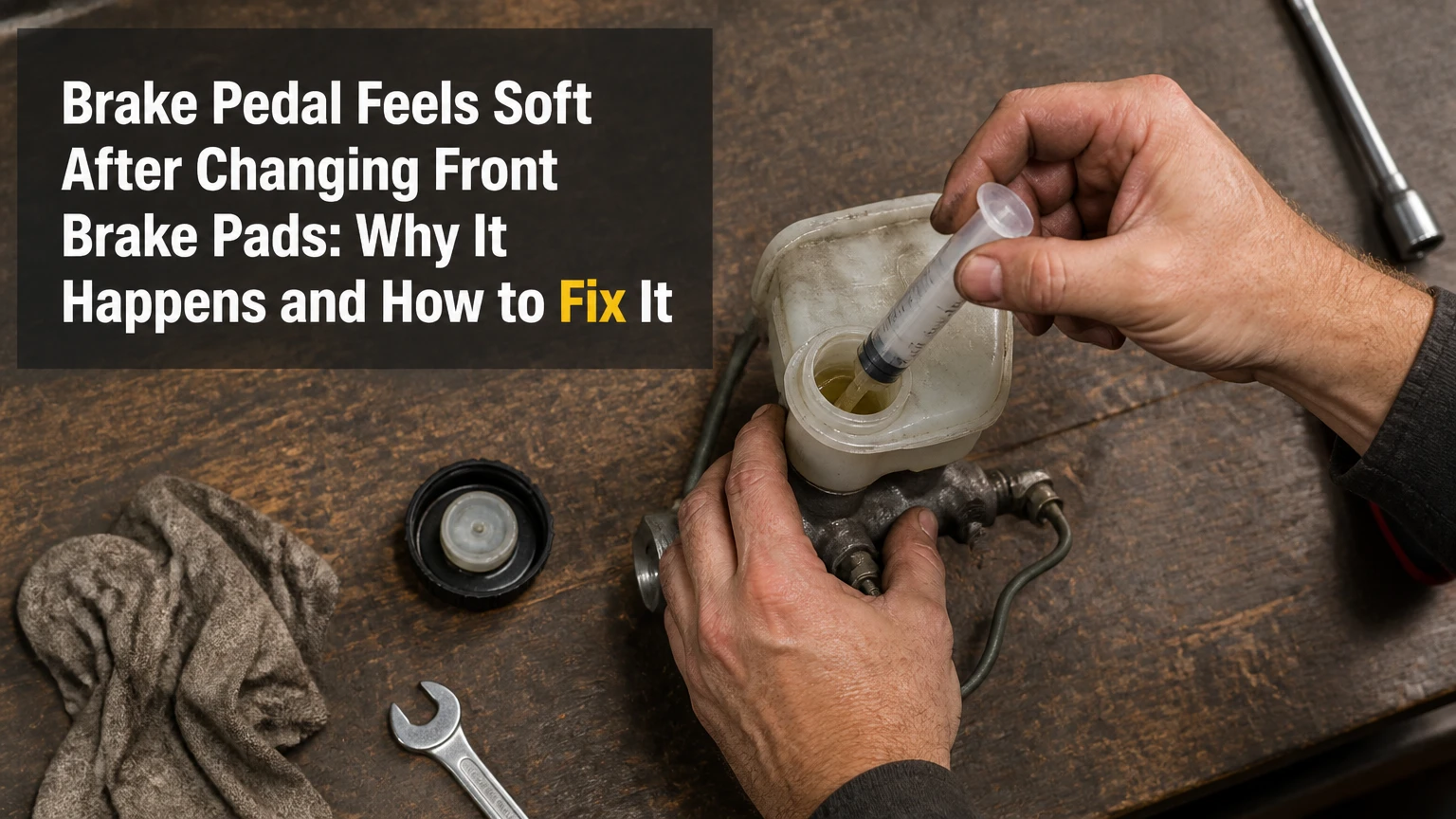
A soft or spongy brake pedal after a front brake pad replacement almost always means air was introduced into the brake hydraulic system during the job, typically because the caliper pistons were pushed back into the caliper bore without opening the brake bleeder screws, which forces old fluid and trapped air backward through the system.
This is the most common and correctable DIY brake mistake, and it is fixed by properly bleeding all four brakes in the correct sequence.
Exactly Why the Pedal Goes Soft After a Pad Change
New brake pads are thicker than worn pads. To install new pads, the caliper pistons must be retracted (pushed back into the caliper body) to create space for the thicker pad. There are two ways to push pistons back: with the bleeder screw closed (wrong way) or with the bleeder screw open (correct way).
When the bleeder screw is closed and the piston is pushed back with a C-clamp or piston tool, the displaced hydraulic fluid has nowhere to go forward (toward the brake line and master cylinder) because the line is a closed hydraulic circuit. The fluid is forced backward, toward the ABS unit and master cylinder, often pushing air from the caliper bore and line junction into the hydraulic circuit. This air compresses under pedal pressure rather than transmitting force, producing the soft or spongy sensation.
Pushing fluid backward also forces old, potentially contaminated fluid from the caliper (the lowest point of the system, where moisture-saturated fluid accumulates) back into the ABS modulator valves and master cylinder, which degrades the fluid quality in the most critical components.
The correct method: open the bleeder screw, push the piston back slowly while fluid exits through the bleeder into a catch container, then close the bleeder. This keeps the hydraulic circuit uncontaminated and prevents air introduction.
Other Causes of Post-Pad-Change Soft Pedal
Incomplete Bleeding After the Job
Even if the pistons were retracted correctly, air can enter through a bleeder screw that was not fully tightened, a bleeder screw that stripped slightly, or a brake line fitting that was inadvertently disturbed during the job. Any breach in the hydraulic circuit that allowed air in produces a soft pedal.
New Pads Require Initial Bedding
New pads are flat and the rotor surface has micro-topography from previous pad material transfer. Until the new pad surface conforms to the rotor, full contact is not achieved. This is not a hydraulic problem but a mechanical one: the pads physically require several hard stops from highway speed to fully seat. This produces a longer pedal travel sensation rather than a truly spongy compressible pedal. Distinguish between a pedal that compresses (feels like squeezing a sponge) and one that simply travels further before engaging (which is seating, not an air problem).
Air in the ABS Module
On vehicles where the piston was pushed back forcefully with the bleeder closed, air and old fluid can be driven into the ABS hydraulic modulator. Standard four-corner bleeding may not fully purge air from the ABS module passages. In this case, the soft pedal persists after normal bleeding and requires ABS module bleed cycles using a scan tool that activates the ABS solenoids sequentially to release trapped air.
Damaged Brake Line or Hose
If a rubber brake hose was crimped, bent sharply, or if a fitting was cross-threaded during the job, it can develop an internal restriction or air leak. Check the flexible rubber hoses at each caliper for any kinking or damage from the repair.
Master Cylinder Issue
Less commonly, forcing fluid backward with a closed bleeder can damage the master cylinder internal seals if the seals are old and the backflow pressure is significant. A master cylinder with damaged seals produces a pedal that slowly sinks to the floor under steady pressure. This is distinguishable from air (which produces a spongy sensation on initial application) by applying steady pressure: if the pedal sinks slowly rather than holding, suspect the master cylinder.
The Fix: How to Bleed the Brake System Correctly
Standard Four-Corner Bleed Sequence
Bleed brakes starting from the wheel farthest from the master cylinder and working toward the closest. For most vehicles with the master cylinder on the driver side near the firewall, the sequence is: right rear, left rear, right front, left front. Some manufacturers specify different sequences: check the factory service manual for your specific vehicle.
For each wheel: attach a clear tube to the bleeder screw, submerge the other end in a container of clean brake fluid (to prevent air from being drawn back), have a helper pump the pedal 3 to 4 times and hold it, then open the bleeder screw 3/4 turn while the pedal is held. Fluid and any air bubbles will flow out. Close the bleeder before the helper releases the pedal. Repeat until no bubbles appear in the outflow. Keep the master cylinder reservoir filled throughout the process.
One-Person Pressure Bleeder
A brake bleeder kit that pressurizes the master cylinder reservoir from the top (Motive Products or similar, $30 to $70) allows one person to bleed brakes without a helper. These kits are particularly effective for post-DIY soft pedal situations.
When ABS Module Bleeding Is Required
If the pedal remains soft after thorough four-corner bleeding, ABS module bleeding is the next step. This requires a professional-grade scan tool (Snap-on, Autel, or Dealer-level tool) that can activate individual ABS solenoids on command. Most independent shops have this capability. The technician activates each valve while the brakes are bled, releasing any air trapped in the ABS passages.
Cause and Fix Summary
Cause | Pedal Feel | Fix | DIY or Shop? |
|---|---|---|---|
Air from piston retraction with closed bleeder | Spongy compression on initial press | Bleed all four corners in sequence | DIY possible with helper or pressure bleeder |
Air trapped in ABS module | Soft after four-corner bleed fails to fix | ABS module bleed with scan tool | Shop: requires scan tool |
Incomplete bleeding during job | Spongy, often one corner worse | Complete four-corner bleed | DIY |
New pads not yet bedded | Long travel but not spongy under pressure | 10 to 15 firm stops from highway speed | DIY: bedding procedure |
Damaged flexible brake hose | Soft on one wheel, spongy throughout | Replace affected hose | DIY or shop |
Master cylinder seal damage | Pedal sinks slowly under steady pressure | Master cylinder replacement | Shop recommended |
How to Tell If the Soft Pedal Is Dangerous Right Now
Press the brake pedal firmly and hold it for 30 seconds. If the pedal holds position without moving, the hydraulic system is sealed and you likely have air in the line that will be corrected with bleeding. If the pedal slowly sinks to the floor under steady pressure, there is a leak in the system or a failed master cylinder seal: do not drive the vehicle until this is resolved. A sinking pedal under static pressure is a brake system failure requiring immediate attention.
Frequently Asked Questions
Can I drive with a soft brake pedal after changing pads?
A mildly soft pedal that still provides strong braking before the midpoint of pedal travel is drivable for short distances to a shop. A pedal that must be pressed to within an inch of the floor before brakes engage significantly is dangerous and the car should not be driven. Test the braking effectiveness in a safe area before committing to road traffic.
How long does bedding new brake pads take?
Standard bedding procedure: from 35 mph, apply firm (not emergency) brake pressure until speed drops to about 5 mph without coming to a complete stop. Repeat 6 to 8 times with a 30-second cool-down between applications. From 55 mph, repeat the same procedure 4 to 6 times. Allow the brakes to cool completely before parking. After this procedure, the pad material is transferred to the rotor surface and the pedal feel improves noticeably.
I used a C-clamp to push the piston back. Is that why the pedal is soft?
If you closed the bleeder before pushing the piston back with the C-clamp, yes: that is almost certainly why the pedal is soft. The fix is to bleed all four corners thoroughly. The clamp technique is fine as long as the bleeder screw was open and a tube was draining fluid into a catch container while the piston was being pushed back.
Do I need to bleed all four brakes or just the front two I worked on?
Bleed all four. Forcing fluid backward when the piston was retracted affects the entire hydraulic circuit. Bleeding only the front two will not purge air that was driven into the rear portion of the system or the ABS module. A complete four-corner bleed is required.
The Bottom Line
A soft pedal after a pad change is almost always caused by the piston retraction method: pushing pistons back with the bleeder closed forces air into the hydraulic circuit. The fix is a thorough four-corner bleed in the manufacturer-specified sequence. If four-corner bleeding does not restore a firm pedal, ABS module bleeding with a scan tool is the next step. Test the pedal for static hold (no sinking under steady pressure) before driving: a pedal that sinks slowly is a potential brake failure and is not safe to drive on.