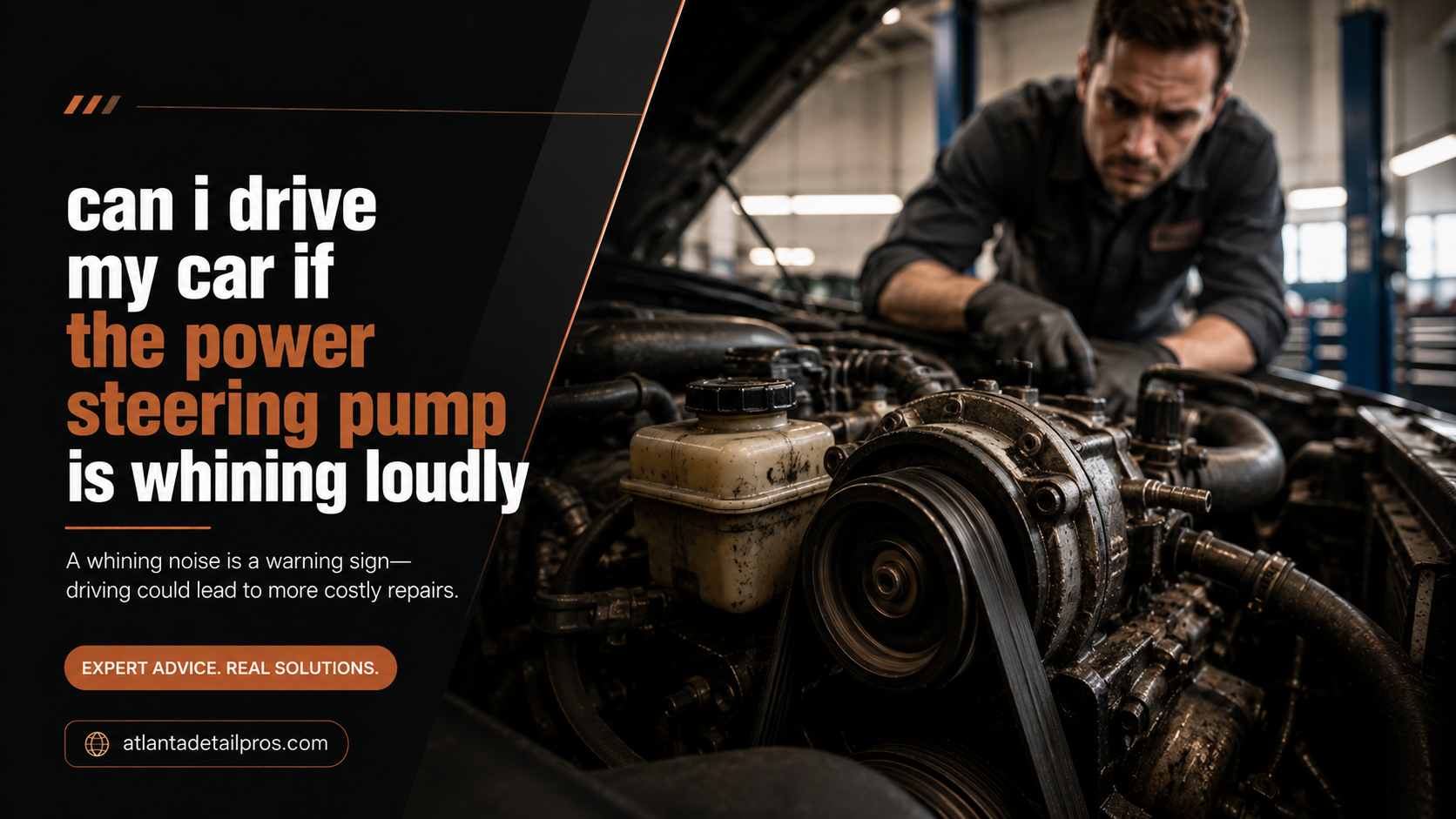
A loudly whining power steering pump means the system is either low on fluid, has air in the lines, or the pump’s internal vanes and bearings are actively failing: continuing to drive accelerates the damage and risks a pump seizure that can snap the serpentine belt and leave you without power assist at exactly the wrong moment.
The whine you are hearing is the sound of metal cavitating inside the pump at high speed, a process that generates metal contamination in the fluid and erodes the pump internals with every steering input you make.
You are already at the wheel and the whine starts every time you turn. The question is how much mechanical damage is accumulating and how quickly this situation will progress. The answers depend on the whine pattern, the fluid condition, and the underlying cause, all of which you can assess in five minutes before deciding whether to drive on or call a shop.
This guide explains the mechanism behind power steering pump noise, what different whine patterns diagnose, and when you can safely drive to a shop versus when continued driving is converting a $280 pump repair into a $1,400 pump-plus-rack replacement.
The Mechanism Behind Power Steering Pump Noise
How a Hydraulic Power Steering Pump Works
A hydraulic power steering pump is a vane-type or gear-type pump driven by a belt from the crankshaft. It generates hydraulic pressure, typically 1,000 to 1,500 PSI, that acts on a piston in the steering rack to reduce the effort required to turn the wheel. The pump’s internal vanes or rotors sweep fluid from a low-pressure inlet to a high-pressure outlet on every revolution.
The critical detail: the pump’s vanes and rotor operate on a film of hydraulic fluid. That fluid is simultaneously the medium being pumped and the lubricant keeping the metal surfaces from contacting each other. When fluid level drops below the minimum, or when a failing shaft seal allows air into the inlet, air is drawn into the pump. Air compresses differently from fluid and does not provide the same lubricating film. Metal surfaces begin contacting each other at operating speed. This metal-on-metal contact under pressure is cavitation, and the high-pitched whine or moan you hear is the acoustic signature of that process. It also generates heat and metal particles that circulate through the entire steering system.
What Each Whine Pattern Actually Tells You
Whine only during full-lock turns: The pump is working at maximum pressure output and the fluid level or system restriction is marginal. This is the earliest, least severe stage of the problem.
Whine starting as soon as the wheel moves from center: More significant fluid loss, internal pump wear, or a failing pump bearing. The pump is cavitating under normal steering loads rather than only at maximum pressure demand.
Constant whine or groan even with the wheel held straight: The most serious pattern. The pump bearings are failing and the pump is struggling to maintain pressure at idle without any steering load. This stage often precedes complete pump seizure.
Whine that increases with engine RPM regardless of steering input: Points specifically to a bearing failure rather than a fluid issue, because the noise intensity tracks rotational speed, not hydraulic pressure demand.
Urgency Rating by Whine Pattern
| Whine Pattern | Likely Cause | Urgency | Safe to Drive? |
|---|---|---|---|
| Whine only at full lock | Low fluid or air in system | Yellow: Moderate | Yes: top off fluid, shop within 2 days |
| Whine when steering from center position | Fluid low or early pump wear | Amber: High | Short distance only: avoid abrupt maneuvers |
| Whine at any steering input, normal and full lock | Advanced cavitation or wear | Amber: High | Drive to shop same day, no more than 5 miles |
| Constant whine at idle without steering input | Bearing failure | Red: Critical | Tow or drive under 2 miles maximum |
| Whine with noticeably heavier steering feel | Pump pressure failing | Red: Critical | Tow: power assist is about to fail |
What Happens When You Continue Driving With a Whining Pump
Stage 1: Fluid Aeration and System Contamination
As cavitation continues, the pump generates microscopic metal particles from the eroding vane tips and rotor surfaces. These particles circulate through the high-pressure hose into the steering rack, through the return line, and back into the reservoir. Once the reservoir contains metal particle contamination, those particles re-enter the pump on the next cycle. This is a self-accelerating wear loop: cavitation generates metal particles that cause more cavitation and more particle generation.
Stage 2: Steering Rack Contamination and Seal Damage
The steering rack uses precision-machined internal bores and rubber seals to convert hydraulic pressure into linear movement of the steering shaft. Metal particles circulating through the system abrade these seals and bore surfaces. A rack that was sealing perfectly before the pump started whining can sustain internal seal damage that causes fluid bypass and progressive rack failure, adding $500 to $1,200 to the repair bill beyond the pump replacement itself.
Stage 3: Serpentine Belt Failure From Pump Seizure
A pump whose bearings have seized stops rotating while the belt continues to drive it. The belt experiences extreme side-load friction at the pump pulley and either strips its ribs or snaps completely. On most modern vehicles, the power steering pump shares the serpentine belt with the alternator, water pump, and air conditioning compressor. A belt failure from a seized pump means simultaneous loss of charging, cooling, and cabin comfort, converting a power steering problem into a multi-system breakdown on the road.
“The pump had been whining for about three weeks. I topped it off twice and the sound kept coming back. On a Tuesday morning pulling into a parking lot the belt snapped from the seized pump and I lost the alternator and nearly the water pump all at once. By the time everything was repaired: new pump, belt, contaminated fluid flushed from the rack: it was $1,400. The pump alone would have been about $280 if I had gone in when the whining started.”: Stephanie Wren, 2013 Honda Odyssey 3.5L
DIY Diagnosis Steps Before You Make the Drive Decision
Step 1: Check Fluid Level and Condition
Open the power steering reservoir (typically a small reservoir with a steering wheel icon near the front of the engine bay). Check the level against the MIN and MAX marks. If the fluid is below minimum, low fluid is the primary cause.
Inspect the fluid condition. Normal power steering fluid is clear to light amber. Dark brown or black fluid indicates oxidation and advanced degradation. Fluid with a milky or foamy appearance contains significant air contamination. Fluid that feels gritty between your fingers contains metal particles from internal pump wear. Gritty fluid means the contamination has already spread beyond the pump itself, and a fluid flush of the entire system will be required alongside the pump replacement.
Use the correct fluid type for your vehicle: most domestic vehicles use a universal power steering fluid. Many Honda vehicles require Honda PSF. Many BMW and European vehicles require Pentosin CHF 11S. Many newer GM vehicles use Dexron ATF. Using an incorrect fluid accelerates seal degradation.
Step 2: Inspect for External Leaks
Look under the vehicle for a pink, red, or clear oily puddle. Inspect the power steering hoses, particularly the high-pressure hose from the pump outlet to the rack and the low-pressure return line from the rack back to the reservoir. Wet spots on the hose surface near fittings indicate seeping connections. A wet area at the rack body near the tie rod mounting points indicates a rack seal leak, which is a secondary problem requiring a separate repair from the pump.
Step 3: Map the Whine Pattern
With the engine idling, listen carefully: does the whine start immediately with the first steering input, only at full lock, or even before you touch the wheel? Slowly turn from full left to full right while a helper watches the reservoir for bubbles appearing in the fluid. Bubbling indicates air is entering the system through a low fluid level or a leaking pump shaft seal, confirming the fluid path of the problem.
Step 4: Check Steering Feel
Note whether steering resistance has increased compared to normal. Hydraulic power steering at low speeds should require minimal force from the driver. Any noticeable increase in effort, particularly on one side of the steering arc or at specific lock positions, indicates the pump is no longer generating adequate pressure in those conditions.
Repair Cost Ranges by Component and Vehicle Type
| Repair | Vehicle Type | Independent Shop Cost Range |
|---|---|---|
| Fluid top-off and air bleed | All | $20 to $60 (fluid cost and bleed labor) |
| Full power steering fluid flush | All | $80 to $150 |
| Power steering pump replacement (4-cyl domestic or Asian) | Honda, Toyota, Nissan, domestic | $200 to $500 |
| Power steering pump replacement (V6 or V8) | Domestic and Asian V-engines | $300 to $650 |
| Power steering pump replacement (European) | BMW, Audi, Mercedes-Benz | $500 to $1,200 |
| High-pressure hose replacement | All | $150 to $400 |
| Steering rack replacement (from contamination damage) | All | $500 to $1,500 |
| Electric power steering motor or module | Vehicles with EPS (post-2012 common) | $400 to $1,200 |
Note: many vehicles built after 2010 use electric power steering (EPS) rather than hydraulic. EPS systems do not produce cavitation whine. An EPS vehicle that produces a moan or groan points to the electric motor, column bearings, or a torque sensor fault. The diagnosis and repair path is entirely different from a hydraulic pump failure.
Frequently Asked Questions
Is it dangerous to drive without power steering if the pump completely fails?
Driving without power steering is manageable at highway speeds because hydraulic assist provides minimal force contribution at speed anyway. The danger emerges at low speeds where the force required to turn the wheel increases dramatically. In a parking lot, at a tight intersection, or on an exit ramp, the steering will feel extremely heavy. In an emergency maneuver, the additional effort required could cause understeer or a slower response than the driver expects. Most drivers can manage a short, slow surface-street drive to a shop, but it is not a condition to normalize or continue.
How long does a hydraulic power steering pump typically last?
Most hydraulic power steering pumps are designed to last 80,000 to 150,000 miles under normal service conditions. Pump life is significantly shortened by low-fluid operation (the most common cause of early failure), by contaminated fluid that was never replaced, by high-pressure hose leaks that went unaddressed and allowed air into the system, and by frequent full-lock turning such as tight parking maneuvers at maximum lock repeatedly over years.
Can I overfill the power steering reservoir and cause problems?
Yes. Overfilling causes the fluid to foam under pressure as air gets mixed in during pump operation. Foamed fluid does not transmit hydraulic pressure effectively and can produce the same symptoms as low fluid: whining, hard steering, and aerated fluid. Fill only to the MAX cold line on the reservoir when the engine is cold, or to the HOT MAX line when the engine is at operating temperature. These are distinct markings on most reservoirs.
My power steering only whines on cold mornings: is that a problem?
A brief whine during cold startup that disappears completely within 1 to 2 minutes as the fluid warms to operating temperature is common and generally not a concern. Power steering fluid thickens at low temperatures, and the pump may cavitate slightly until the fluid reaches normal viscosity. A whine that persists beyond 2 minutes in cold weather, or that has developed progressively over time from no cold-start whine to a consistent one, indicates low fluid or early pump wear that warrants inspection.
Will a power steering stop-leak additive fix a whining pump?
Stop-leak additives are formulated to swell rubber seals slightly, which can temporarily reduce a seeping seal leak (the most benign cause of fluid loss). They cannot repair a mechanical bearing failure or worn vane set. Adding a stop-leak product to a pump that is whining from mechanical wear introduces additional foreign material to an already-stressed system and does not address the actual problem. Address the source of the fluid loss rather than adding a product to the symptoms.
How do I know if my vehicle has electric or hydraulic power steering?
Open the hood and look for a power steering fluid reservoir: a small, translucent tank with a hose leading toward the steering rack. If no reservoir exists, the vehicle has electric power steering. You can also look at the drive belt routing: a hydraulic pump pulley will be visible at one of the belt-driven components on the engine front. Electric power steering has a motor attached directly to the steering column or rack with no belt-driven component.
The Bottom Line
A whining power steering pump is not a noise to monitor from a safe distance for a few weeks. The cavitation process that produces the sound is simultaneously generating metal contamination that spreads through the rack and destroys seals throughout the hydraulic circuit. What begins as a $280 pump replacement becomes a $1,400 pump-plus-rack-plus-flush repair within weeks of the first whine being ignored.
Top off the fluid and check for visible leaks as the first immediate step. If topping off eliminates the whine and no leak source is visible, the pump drew in air from low fluid and you may have bought days of additional time. If the whine persists after a correct fluid top-off, the pump has mechanical wear that requires replacement. Drive to a shop within the same day at the furthest.
Never drive a vehicle to the point where a seized power steering pump snaps the serpentine belt. The cascading failure that follows is dramatically more expensive than the pump alone and leaves you stranded in traffic rather than inconvenienced by a shop appointment.