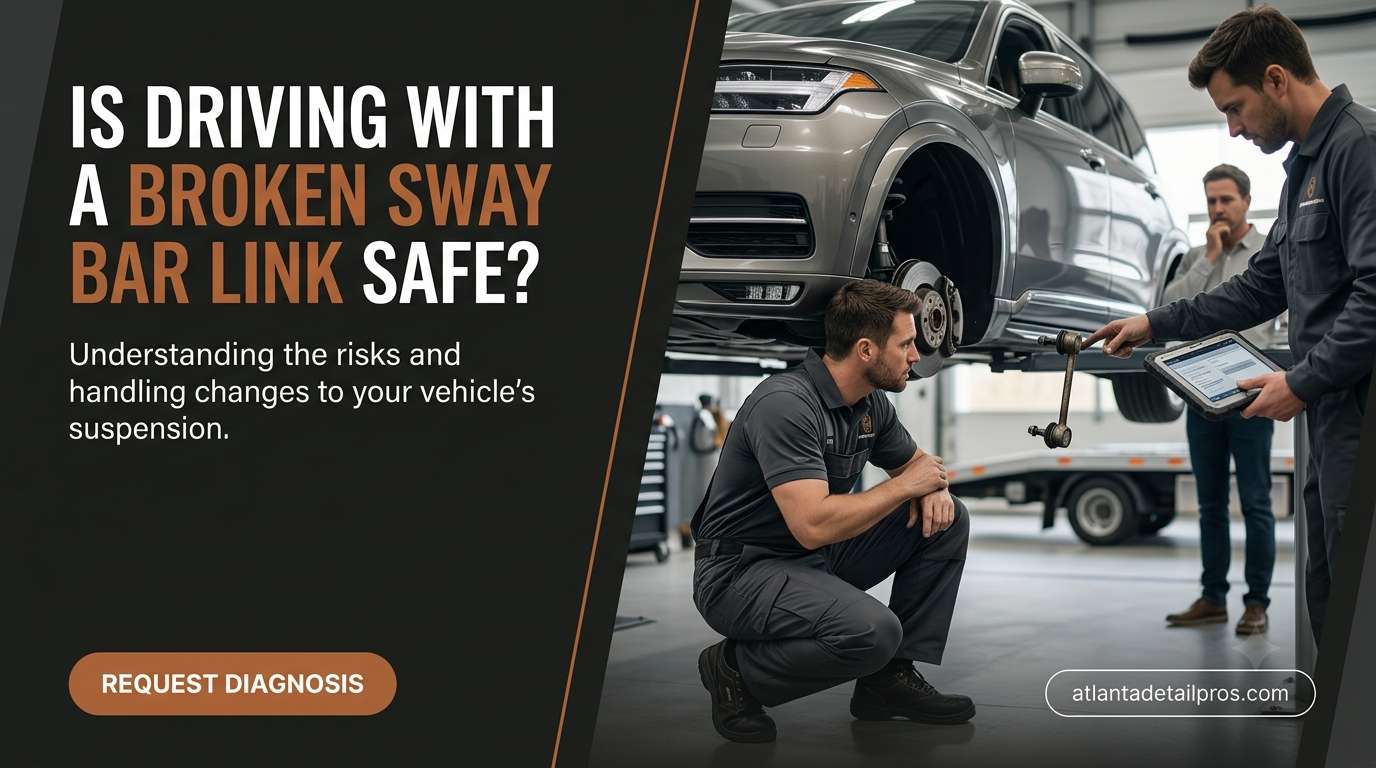
A broken sway bar link is one of those repairs where the true answer is more nuanced than most guides provide. The short version: yes, you can drive on a broken sway bar link, but the conditions matter significantly. A broken rear link on a sedan at city speeds is a fundamentally different situation from a broken front link on an SUV at highway speed. Most articles say the same thing about both situations. This one does not.
This guide covers what a sway bar link actually does, what changes when one breaks, the difference between a front failure and a rear failure, the specific conditions that make driving genuinely risky, the secondary damage that accumulates, and why this is one of the most DIY-friendly suspension repairs on most vehicles.
What a Sway Bar Link Is and What Actually Breaks
Before getting into risk levels, it is important to be precise about terminology because sway bar, sway bar link, and sway bar bushing are three different components that fail in different ways with different consequences. Most of the people asking this question have a broken end link, not a failed sway bar or bushing, and those are very different repairs.
The Sway Bar Itself
Also called the stabilizer bar or anti-roll bar, the sway bar is a thick metal torsion bar that runs laterally across the vehicle, connecting the left and right suspension through flexible mounts. When one side of the suspension compresses and the other does not, the bar twists and transfers some of that force to the opposite side, reducing body roll. A broken sway bar itself is extremely rare and requires significant impact to occur. If you have a broken sway bar body, the vehicle should not be driven and needs a tow.
The Sway Bar End Links
End links are the short rods that connect the end of the sway bar to the strut, control arm, or steering knuckle depending on the suspension design. They are the most common failure point because they contain small ball joints or rubber bushings that wear over time, and they are subjected to repeated movement and salt exposure. A broken end link means the sway bar is no longer connected to one side of the suspension. This is the most common scenario when people ask about driving with a broken sway bar link.
Sway Bar Bushings
The sway bar mounts to the vehicle frame or subframe through rubber-lined brackets called bushings. When these degrade, the bar moves within its mount and produces a creaking or knocking sound. A failed sway bar bushing reduces anti-roll effectiveness but the bar is still connected to both wheels. The handling effect is less severe than a broken end link. Both wear simultaneously on high-mileage vehicles, so inspecting both when one is found failed is recommended.
What Changes When a Sway Bar End Link Breaks: The Physics
When an end link breaks, one end of the sway bar becomes disconnected from the suspension. The bar is now only connected on one side and through its center bushings. Instead of functioning as a torsion spring that resists differential suspension movement, it becomes a loose, single-sided appendage that contributes no meaningful anti-roll resistance.
The practical result is increased body roll during cornering. The body leans more than designed when turning because the sway bar no longer counteracts the weight transfer to the outside wheels. The amount of additional roll depends on the original sway bar stiffness and the vehicle type. A stiff sports sedan with a thick front sway bar will notice the difference significantly. A large truck with a relatively thin rear sway bar may barely notice at normal driving speeds. The handling change is real but it is a degradation of handling capability, not a sudden loss of control.
Front Broken End Link vs. Rear Broken End Link: Different Risk Levels
This is the distinction that almost every guide glosses over by treating all broken sway bar links as equally risky. They are not. The front and rear sway bars serve the same function but their failure affects the vehicle differently because the front suspension is connected to steering and the rear is not.
Broken Front Sway Bar End Link: More Noticeable, More Risky at Speed
On most front-wheel drive and all-wheel drive vehicles, the front sway bar connects to the strut assembly. When the front end link breaks, the strut is no longer tied to the sway bar and front body roll increases. In cornering, more weight transfers to the outside front wheel. The car understeers more readily: the front end pushes outward rather than following the intended cornering line. Emergency lane changes or highway on-ramp sweeps at speed become noticeably less stable because the front of the car leans further than designed before weight transfers fully.
Limit speed to below 50 mph with a broken front end link. Avoid highway driving, particularly sweeping on-ramps and abrupt lane changes. Surface streets at moderate speed are acceptable for a few days while the repair is arranged.
Broken Rear Sway Bar End Link: Less Immediately Risky
A broken rear end link increases rear body roll. In most front-wheel drive vehicles, this manifests as the rear swinging outward more readily during cornering, which feels like the tail of the car is looser than normal. For most drivers at normal road speeds this is manageable. The car does not handle as precisely but it remains controllable. Highway speed with a broken rear link is less dangerous than with a broken front link, though it is still not the recommended condition.
Rear broken link: comfortable driving at city speeds for several days. Highway lane changes feel looser. Avoid abrupt lane changes and maintain more following distance to allow for slower-feeling emergency maneuvers.
EXCEPTION: High-center-of-gravity vehicles including SUVs, trucks, and vans are more sensitive to sway bar link failure than low sedans. On a tall vehicle, the increased body roll from a broken sway bar link is more pronounced and the rollover threshold is meaningfully reduced. Treat a broken front end link on an SUV or truck as requiring more urgent attention than the same failure on a sedan.
When the Broken End Link Becomes a More Serious Problem
A broken end link that is merely disconnected is manageable for a short period. A broken end link where a piece of the link is still attached but loose introduces a secondary risk: the loose piece can contact the tire sidewall, the brake rotor, or other suspension components as the suspension cycles over bumps and during cornering.
If the broken end link has left a dangling rod or stub that you can see or hear making intermittent contact with other components, that changes the risk profile entirely. A loose metal stub contacting a tire sidewall during cornering can cause a sudden tire failure. If you can see or hear the broken link piece making contact with anything on the vehicle while driving, tow the car rather than driving it to the shop.
Secondary Damage From Driving on a Broken End Link
A broken end link subjects the adjacent sway bar bushing to additional stress because the bar is now pulling unevenly on the remaining bushing rather than being balanced across both end connections. Driving on a broken end link for weeks accelerates sway bar bushing wear and may cause the remaining end link on the same axle to fail sooner. In most cases, both end links on an axle are replaced simultaneously when one is found failed, both because they are inexpensive parts and because they have both been subjected to the same mileage and environmental exposure.
The Repair: Why a Broken Sway Bar End Link Is One of the Best DIY Jobs in Suspension
Sway bar end links are among the most DIY-accessible suspension repairs. On most vehicles, replacing a front or rear end link requires no more than a jack, jack stands, and a socket set. Some designs require a Torx bit or an Allen wrench to hold the ball stud while loosening the nut. The parts cost $15 to $50 per link, and most vehicles require 20 to 45 minutes per side for an experienced DIYer.
| Scenario | Safe to Drive? | Speed Limit | Timeframe to Fix | DIY Difficulty |
| Rear link broken, sedan, city driving | Yes for limited time | Under 60 mph | Within the week | Easy |
| Front link broken, sedan, city only | Cautiously, short trips | Under 50 mph | Within 2-3 days | Easy |
| Front or rear link broken, SUV or truck | Low speed city only | Under 40 mph | Repair today | Easy to moderate |
| Broken link piece making contact with tire or other part | No. Tow. | None | Immediate | N/A |
Frequently Asked Questions
Can I drive with a broken sway bar end link?
Yes, for a limited time at reduced speed. A broken rear end link is less risky than a broken front end link. At city speeds below 50 mph the car remains controllable. Avoid highway speeds, abrupt lane changes, and hard cornering. The longer you delay, the more the broken link can damage the sway bar bushing and the adjacent end link. Most end link replacements take under an hour and cost $15 to $50 in parts, making this one of the best reasons to repair promptly rather than monitor.
What happens if you drive with a broken stabilizer bar link?
Increased body roll during cornering because the sway bar is no longer connected to that side of the suspension and cannot resist weight transfer. The car feels looser in turns and lane changes. At highway speed on a broken front link, understeer increases: the front of the car pushes outward in corners more than normal. The handling is degraded but not immediately uncontrollable at low speeds. At highway speed with a broken front link on a tall vehicle, the risk increases meaningfully.
How do I know if my sway bar link is broken?
A broken end link most commonly produces a clunking or knocking sound over bumps, speed bumps, and during cornering. The clunk appears when the disconnected sway bar end moves freely rather than being constrained by the link. Visual confirmation: with the vehicle safely on jack stands, look at each end link. A broken end link will have visible damage: a snapped ball stud, a cracked bushing housing, or a link that hangs loose rather than being tightly connected between the sway bar and the strut or control arm.
How much does a sway bar end link replacement cost?
Parts cost $15 to $50 per link, with most standard vehicles using links in the $20 to $40 range. Labor at an independent shop runs $60 to $150 per pair, for a total job cost of $80 to $200. Both links on the same axle are typically replaced simultaneously. Many DIYers complete this repair in under an hour with basic tools. It is one of the least expensive and most accessible suspension repairs available.
Do I need an alignment after replacing sway bar end links?
No. Sway bar end links do not affect wheel alignment geometry. Replacing them does not change toe, camber, or caster settings and an alignment is not required after this repair. This is in contrast to ball joint, tie rod, or control arm replacement, all of which do require an alignment.
The Bottom Line
A broken sway bar end link is not a pull-over-immediately emergency, but it is also not a drive-on-it-indefinitely situation. The risk level depends on which axle is broken, what type of vehicle you drive, and whether any piece of the broken link can contact the tire or other components. A broken rear link on a sedan at city speeds is a this-week repair. A broken front link on an SUV is a today repair. And the repair itself, a $20 part and 45 minutes of work, is one of the most accessible jobs in suspension maintenance. There is rarely a good reason to drive on a broken sway bar link for more than a few days.