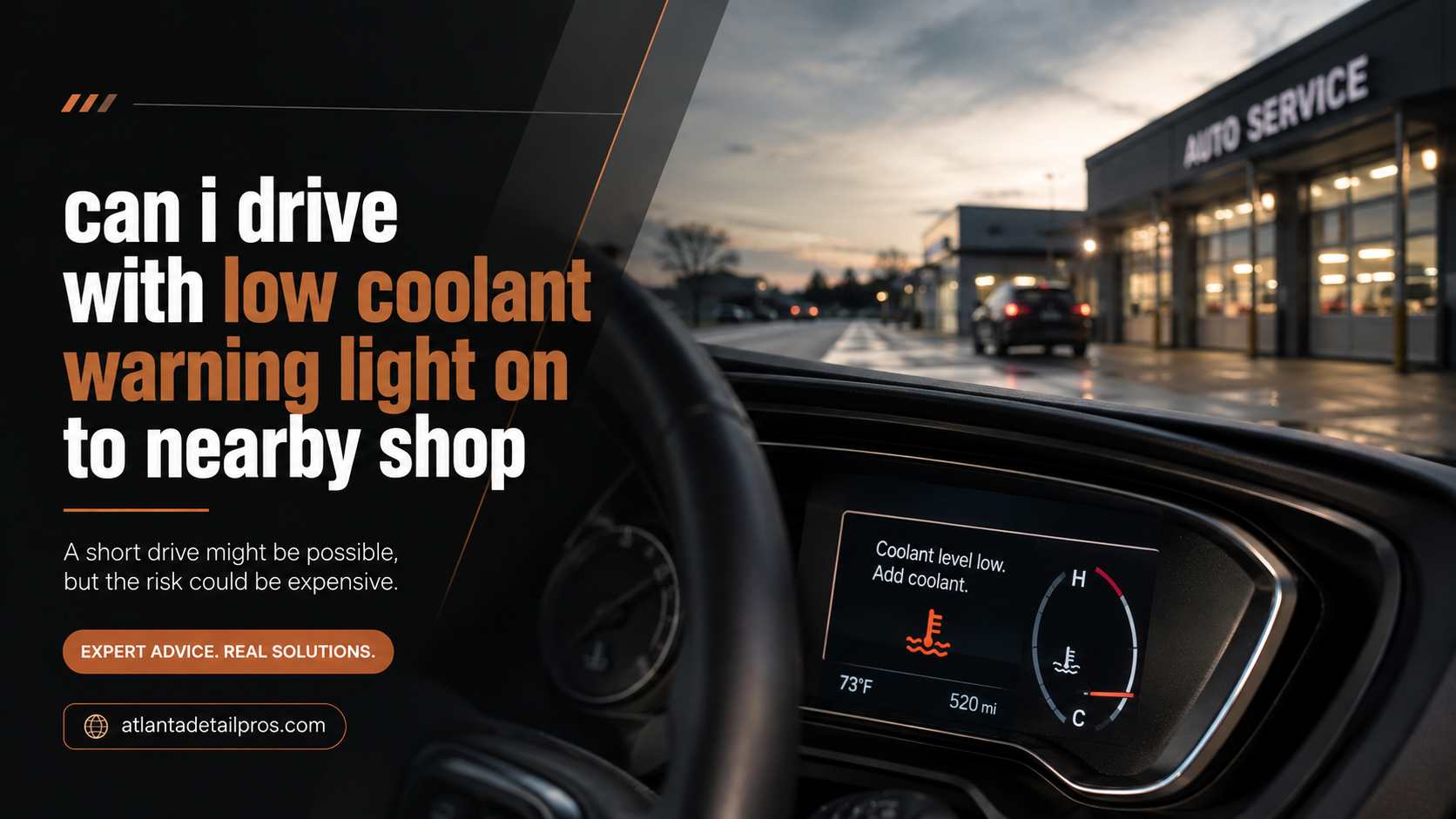
You can drive with the low coolant warning light on to a nearby shop, but only if the engine temperature gauge stays in the normal range, the shop is within 1 to 2 miles, and you are prepared to pull over immediately if the temperature begins to rise.
Coolant warnings that appear without any temperature elevation give you a small safety window: warnings that appear alongside a rising temperature gauge or a hot engine smell give you almost none.
The low coolant light is one of the warning indicators most drivers dismiss until it becomes a crisis. Unlike a check engine light, which can reflect dozens of non-urgent issues, the low coolant warning means a physical fluid level has dropped below the threshold needed to fully protect your engine. That distinction is important because the cooling system has almost no tolerance for significant fluid loss before temperatures climb into the damage range.
This guide tells you exactly what to check before you turn the key, what to monitor during the drive, and when to stop and call a tow instead of gambling on the short distance.
Why Coolant Level Matters More Than Most Drivers Realize
How the Cooling System Actually Works
Your engine produces enough heat from combustion to destroy itself within minutes without active cooling. The coolant system works by circulating a water and antifreeze mixture through passages in the cylinder block and head, where it absorbs heat, then routes it to the radiator where the heat dissipates into the ambient air. The system is sealed and pressurized to raise the boiling point of the coolant mixture above 230 degrees Fahrenheit, or approximately 110 degrees Celsius.
When the coolant level drops, two things happen simultaneously: the system loses its ability to regulate heat output, and air pockets can form in the system. Air pockets are worse than simply low fluid because they create localized hot spots. A pocket of air sitting near a combustion chamber means that section of the engine block or head has no active cooling. Cast iron and aluminum can both crack from localized thermal stress within seconds of an air-lock hot spot developing at full operating temperature.
The physics is simple but the consequences are expensive: a system that is 20 percent low on coolant may manage adequately at idle but fail catastrophically under the heat load of highway speeds or stop-and-go traffic, where the engine is producing sustained power output and generating heat faster than a degraded cooling system can dissipate it.
What Causes the Warning Light to Appear
The low coolant sensor sits in the coolant reservoir or in the radiator itself, depending on the vehicle design. Ford, GM, and Chrysler vehicles frequently place the sensor in the overflow reservoir. Many European and Japanese vehicles use a float-type sensor in the coolant reservoir cap. It triggers when fluid drops below a calibrated minimum.
A slow external coolant leak from a hose, clamp, radiator, or water pump is the most benign scenario. Coolant has been seeping out over time and the level has finally crossed the warning threshold. A fast external leak is more urgent: the system is losing fluid actively and the window before overheating is shorter. Internal coolant consumption through a failing head gasket or cracked cylinder head is the most serious cause, because the coolant is entering the engine combustion chamber itself and no amount of top-up will fix the underlying problem.
Knowing which type of loss you are dealing with before you drive is the single most important diagnostic step.
The 5-Minute Roadside Check Before You Drive
Check the Temperature Gauge First
Before moving the vehicle, look at the temperature gauge. If it is already reading above the midpoint, or if it climbed noticeably during the drive that triggered the warning, you are already in a compromised state. Do not drive further: call a tow.
If the gauge is in the normal zone and the engine started from cold within the last few miles, your window is better. Proceed to the next checks.
Inspect for Visible Coolant Leaks
Look under the vehicle. A puddle of green, orange, pink, or yellow fluid directly under the engine or at the front of the vehicle indicates an active external leak. A small puddle on the ground after an overnight park suggests a slow drip that may give you the 1 to 2 mile window. A large puddle or fluid actively dripping from the undercarriage while the engine idles means the leak rate is too fast to risk driving, regardless of how close the shop is.
A coolant leak is typically identifiable by its sweet smell and slightly slick feel when rubbed between the fingers. It differs from an air conditioning condensate drip, which is clear water with no smell, and from an oil drip, which is darker and oily in texture.
Check the Coolant Reservoir Level
Open the hood and locate the translucent coolant overflow reservoir, typically positioned near the radiator with a pressurized cap. Check the level against the MIN and MAX markings on the side of the reservoir. Do not open the radiator cap on a warm or hot engine: the system is pressurized and boiling coolant can spray and cause severe burns. If the reservoir is just below the MIN line, you may have enough residual fluid in the system for a short monitored drive. If the reservoir is completely empty, the system has lost a significant amount of fluid and the risk of air pockets is high.
Top Off if Coolant or Distilled Water Is Available
If you carry coolant or can obtain it at a nearby gas station before attempting the drive, topping off the reservoir buys additional safety margin. Add the correct coolant type for your vehicle: the reservoir cap or owner’s manual specifies the correct formulation. If coolant is not available, distilled water is an acceptable emergency alternative for a short one-time use. Do not use tap water repeatedly, as mineral deposits cause scaling in the cooling passages over time.
After topping off, run the engine for 2 minutes and recheck the level. If it has already dropped noticeably in those 2 minutes, you have an active internal or large external leak that will not tolerate even a short drive.
Decision Table: Drive or Tow?
| Condition | Temperature Gauge | Visible Leak | Drive to Shop? |
|---|---|---|---|
| Coolant warning only, gauge normal | Normal | None visible | Green: Yes, stay under 2 miles |
| Coolant warning, slow drip | Normal | Small puddle under car | Yellow: Top off first, stay under 1 mile |
| Coolant warning, active external leak | Normal | Fluid dripping while idling | Red: No, tow |
| Coolant warning, gauge elevated | Climbing | Any | Red: No, tow |
| Coolant warning and white exhaust smoke | Any | Any | Red: No, tow |
| Coolant warning and steam from hood | Any | Spray visible | Red: No, pull over and engine off |
| Coolant warning and milky oil on dipstick | Any | Any | Red: No, tow |
How to Drive Safely to the Shop When the Window Allows It
Turn the Cabin Heater to Maximum
This sounds counterintuitive, but turning the heater to maximum heat and high fan speed actually helps protect the engine in a borderline situation. The heater core is a second small radiator: it pulls heat from the coolant and dumps it into the cabin. Running it at maximum output reduces the heat load on the main radiator and can delay the onset of overheating by several minutes. Open the windows if the cabin temperature becomes uncomfortable for you.
Watch the Temperature Gauge Continuously
Keep your eyes moving between the road ahead and the temperature gauge for the entire drive. Do not look at your phone, adjust audio, or engage with anything that takes your attention from the gauge. If the needle moves above the midpoint, pull over immediately, put the vehicle in park, and shut off the engine. Wait 20 to 30 minutes for the system to cool and pressure to drop before opening the hood. Call a tow from this point rather than trying to restart and continue.
Drive at Steady Moderate Speed, Avoid Stop-and-Go
Airflow through the radiator is what makes it effective. At a steady 35 to 45 mph on a surface street, natural airflow provides meaningful cooling supplementation. In stop-and-go traffic, the radiator relies entirely on the electric cooling fan, which provides far less airflow than natural motion. A 1.5-mile drive on a lightly trafficked road is safer than a 0.3-mile drive through congested parking lot traffic on a hot day. Choose the routing that minimizes idling and stop-and-go conditions.
Do Not Restart a Hot Engine After Shutdown
If you stop to check on the vehicle mid-route, do not restart the engine immediately if you notice it is warmer than normal. The most dangerous moment in a borderline overheating situation is the restart: coolant circulation stops when the engine shuts off, and heat soak from the hot engine surfaces can cause localized boiling in the cylinder head passages. Wait at least 10 minutes before any restart when the temperature gauge has been above the midpoint during the drive.
“The low coolant light came on about two miles from the mechanic. I figured I could make it. I watched the temperature gauge the entire drive and it started creeping upward at the last intersection. I pulled into a parking lot, shut it off, and called for a tow to cover the last half mile. The shop found a cracked coolant hose fitting: about $180 to fix. If I had pushed through that last bit, I might have been looking at head gasket territory.”: Nina Vasquez, 2019 Hyundai Sonata 2.4L
What Happens When You Ignore the Warning and Overheat
The overheating damage sequence is fast and predictable:
Stage 1 (Temperature gauge at upper normal): Coolant is at minimum effective level. Heat dissipation is marginally adequate. No permanent damage yet but the margin is gone. Any additional heat input, such as climbing a grade or sitting in traffic, pushes the system past the threshold.
Stage 2 (Temperature gauge in upper third): Coolant is boiling in localized areas. Steam bubbles form and break the liquid contact between coolant and metal surfaces. Oil begins to thin from heat. Most vehicles activate a warning buzzer or illuminate an overheat warning light at this stage.
Stage 3 (Temperature gauge in red zone): Head gasket begins to fail from thermal stress. Aluminum cylinder heads warp from uneven thermal expansion across the combustion deck surface. This warping can happen within 1 to 3 minutes at maximum temperature. Machining a warped head costs $200 to $400 in addition to the gasket replacement labor.
Stage 4 (Continued overheating): Coolant boils out of the reservoir completely. Coolant circulation stops. Piston scoring and connecting rod bearing failure follow within minutes of complete oil film breakdown.
Total repair cost reaching Stage 4: $3,500 to $9,000 depending on engine type, extent of damage, and whether the engine can be rebuilt or requires replacement.
Coolant Types by Vehicle: Using the Wrong Type Adds Problems
| Coolant Color | Type | Common Vehicles |
|---|---|---|
| Green (IAT) | Inorganic Additive Technology | Older domestic vehicles, pre-2000 |
| Orange / Red (DEXCOOL OAT) | Organic Acid Technology | GM vehicles 1996 to present |
| Blue / Yellow (HOAT) | Hybrid OAT | Many European and Asian imports |
| Pink / Purple (POAT) | Phosphated OAT | Toyota, Lexus, Honda |
| Purple (Si-OAT) | Silicated OAT | Volkswagen, Audi, BMW, Mercedes |
Mixing incompatible coolant types causes the additives to react and gel, reducing heat transfer efficiency and potentially clogging the narrow passages in the heater core and radiator. For a one-time emergency top-off to reach a shop, distilled water will not damage the system and is always the safest emergency choice when the correct coolant type is not available. The shop can drain and refill with the correct formulation on arrival.
Common Causes of Coolant Loss and Their Repair Costs
| Cause | Repair | Independent Shop Cost Range |
|---|---|---|
| Leaking upper or lower radiator hose | Hose replacement | $80 to $250 |
| Leaking coolant reservoir tank | Reservoir replacement | $50 to $200 |
| Failing water pump with external weep | Water pump replacement | $350 to $900 |
| Cracked radiator (external leak) | Radiator replacement | $300 to $900 |
| Leaking thermostat housing | Housing replacement | $150 to $400 |
| Leaking heater core (internal) | Heater core replacement | $600 to $1,800 |
| Blown head gasket | Head gasket repair | $1,200 to $3,800 |
| Cracked cylinder head | Head replacement or rebuild | $1,800 to $4,500 |
Frequently Asked Questions
How low does coolant have to be before it causes engine damage?
Coolant does not need to be completely empty to cause damage. Once the level drops below the minimum line and air pockets form in the system, localized overheating can begin within minutes of sustained driving under load. The exact threshold varies by engine design, but most manufacturers calibrate the warning sensor to trigger with enough buffer remaining for a short drive to safety, provided the driver responds immediately rather than delaying.
Can I keep adding coolant and continue driving indefinitely?
Topping off the coolant and continuing to drive works only if the loss is from a very slow external drip. If the vehicle is consuming coolant internally through a head gasket failure, the added coolant will be burned in the combustion chamber and the level will drop again within miles. An engine that requires coolant additions every few days has an active failure that requires diagnosis. Continuing to drive while adding fluid repeatedly allows secondary damage to accumulate in the oil and cylinder surfaces.
Is it safe to open the radiator cap when the engine is warm?
No. The cooling system operates at 13 to 16 PSI when at normal temperature, and opening the cap releases that pressure instantly, causing boiling coolant to spray outward. Always wait at least 20 to 30 minutes after shutting off the engine before touching the radiator cap. If you must check coolant on a warm engine, only look at the external translucent overflow reservoir, which is not pressurized and can be opened safely.
Why does my coolant level keep dropping with no visible leak on the ground?
Coolant disappearing without visible puddles under the car typically means one of three things: an internal head gasket leak where coolant enters the combustion chamber and burns (look for white exhaust smoke and a sweet smell from the tailpipe), a leak into the engine oil (check the dipstick for a milky or foamy appearance), or a very small external leak that evaporates before reaching the ground, such as a weeping hose clamp area. All three require diagnostic attention before the loss rate accelerates.
How much does a cooling system pressure test cost?
Most independent shops charge $50 to $120 for a cooling system pressure test, which pressurizes the system with air to identify external leaks. A full inspection including thermostat check, radiator cap test, and hose inspection runs $80 to $150. Many shops waive or discount the diagnostic fee when you authorize the repair based on their findings. Dealership service departments typically charge $120 to $200 for the same service.
Can a low coolant level damage the water pump?
Running a cooling system critically low on coolant can expose the water pump impeller to air rather than liquid, reducing lubrication to the pump seal and shaft bearing. Extended running in this condition accelerates seal wear. More commonly, the overheating caused by low coolant is what causes the water pump shaft seal to fail prematurely, since rubber seals degrade faster at elevated temperatures. A pump that was functioning normally before a low-coolant overheating event may develop a weep leak shortly afterward.
The Bottom Line
The low coolant warning light gives you a small window, not a blank check. If the temperature gauge is normal and the shop is within 1 to 2 miles with a clear route, a slow and continuously monitored drive is often viable. If the temperature gauge is climbing, white exhaust smoke is present, or fluid is actively dripping from the undercarriage, the answer is a tow rather than a gamble on the distance.
The single most important habit you can build is watching the temperature gauge without interruption during any drive where the coolant warning is active. The gauge tells you in real time whether the cooling system is managing the heat load. When it rises above the midpoint, that is the signal to stop before the damage becomes irreversible and expensive.
Keeping a jug of the correct coolant in your trunk costs $15 and can turn a tow situation into a self-rescue. If the repair cost for the underlying cause of the coolant loss exceeds what the vehicle is worth to you, a cash-out sale to a junk car buyer is often the more practical financial decision rather than investing in an aging vehicle with compounding cooling system issues.