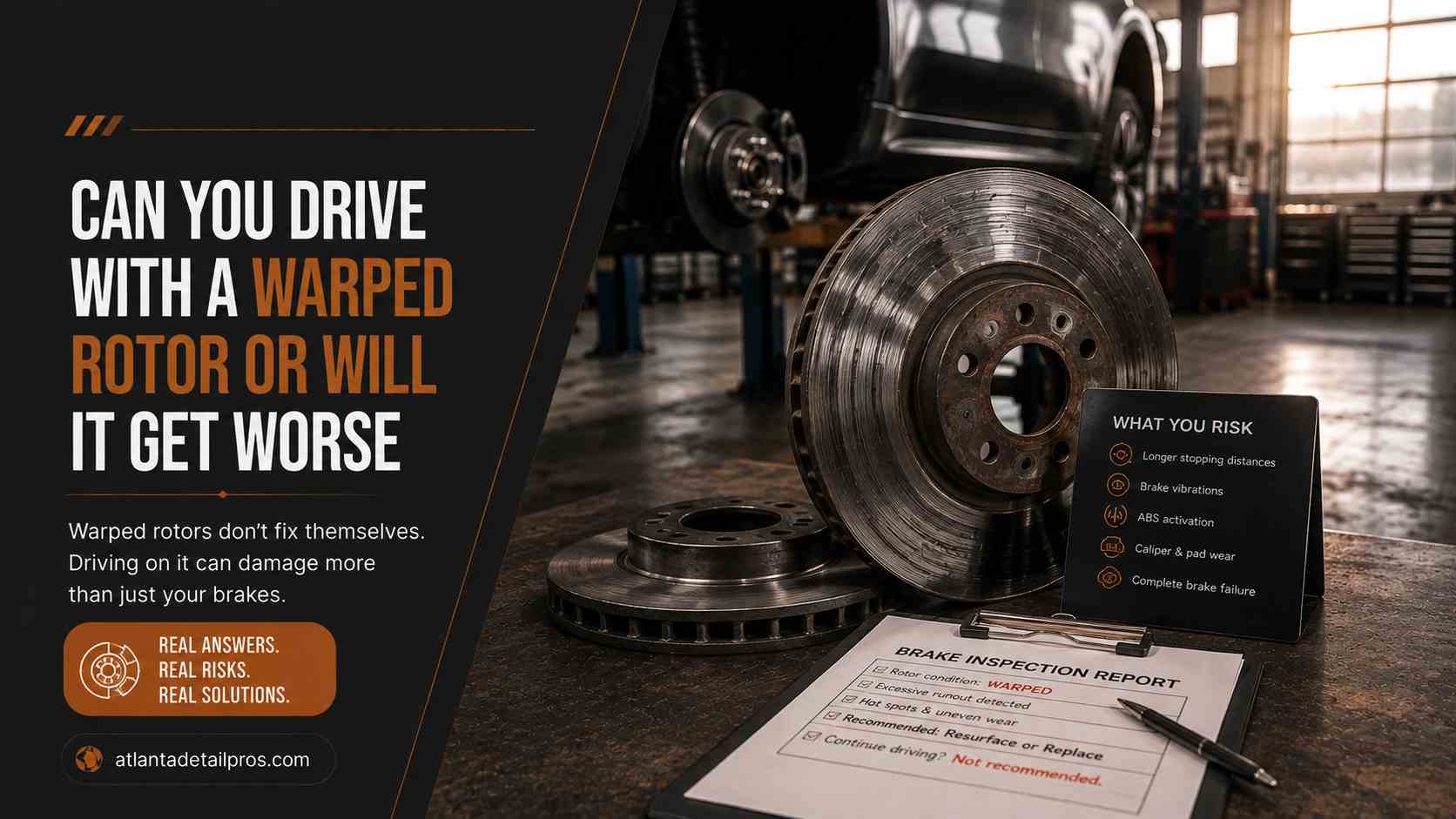
You can drive short distances on a warped rotor, but the damage compounds quickly and the situation almost always gets worse the longer you wait.
A warped rotor causes the brake pad to bounce across an uneven surface every time you slow down, generating heat and friction in patterns your braking system was never designed to handle. What starts as an annoying vibration through the steering wheel or brake pedal becomes a genuine safety issue within a few hundred miles of highway driving.
Most drivers notice the shimmy when slowing from highway speed and assume it is a minor inconvenience. The reality is more complicated. Warped rotors do not heal on their own, and the physics of repeated thermal cycling mean the warp tends to deepen rather than stabilize. Whether you are weighing the cost of immediate repair against waiting until your next scheduled service, the answer almost always favors acting sooner.
This article covers exactly what happens mechanically as you continue driving on a warped rotor, how to read the urgency of your specific situation, and what the repair costs look like so you can make a genuinely informed decision.
How a Rotor Gets Warped: Mechanism and Physics
The term “warped rotor” is technically a misnomer but it has stuck because it describes the symptom accurately: the rotor surface is not uniformly flat, causing the pad to make inconsistent contact during braking. The actual cause in most cases is uneven brake pad material transfer, not the rotor physically bending.
Thermal Deposit Transfer
When you apply the brakes hard or ride them repeatedly at temperature, pad material transfers to the rotor surface unevenly. These deposits build up in localized spots and create high points that the pad contacts first on each revolution. This differential contact is what you feel as a pulsation in the pedal or a shimmy through the steering wheel. True metallurgical warping from heat can also occur on thin or low-quality rotors, but the pad-deposit mechanism is responsible for the majority of cases in passenger vehicles.
Why the Problem Compounds
Every time you brake on a rotor with uneven deposits, those high spots receive more friction, more heat, and more additional deposit transfer. The problem is self-reinforcing. A mild pulsation you first noticed three weeks ago is statistically likely to be measurably worse now. The only variables that slow the progression are driving style and total mileage accumulated since the warp first appeared.
Urgency Rating: How to Read Your Specific Situation
Not all warped rotor situations carry the same urgency. The table below uses a color-coded decision framework to help you assess where you stand.
Symptom Pattern | Likely Severity | Action |
|---|---|---|
Light vibration only above 60 mph during braking | Low (green: safe to monitor) | Schedule repair within 2 to 3 weeks |
Pulsation felt below 40 mph, consistent on every brake application | Moderate (amber: caution) | Repair within 1 week |
Grinding or scraping sound combined with vibration | High (red: stop driving) | Do not drive: pad material may be gone |
Steering wheel pulls hard to one side under braking | High (red: stop driving) | Stop driving: caliper or pad issue alongside warp |
Brake pedal travels further before engaging | Critical (red: stop driving) | Stop driving: brake system integrity compromised |
If your symptoms match the amber or red categories, the conversation is no longer about whether the rotor gets worse. It is about whether you can stop the car predictably enough to avoid an accident.
What Actually Happens: A Failure Timeline
First 500 Miles After Warp Appears
The vibration is present but manageable. Braking distances are not yet significantly affected. The rotor surface, if measured with a dial indicator, typically shows runout between 0.002 and 0.005 inches. Most drivers in this window are safe to drive cautiously to a shop appointment.
500 to 2,000 Additional Miles
The uneven deposit pattern has deepened. The pulsation is now noticeable at lower speeds and the vibration may be felt in the seat as well as the steering wheel. Rotor thickness variation has likely increased past the manufacturer’s service limit. Brake pad wear becomes uneven, meaning you may now need to replace pads earlier than their expected service life.
Beyond 2,000 Miles on a Warped Rotor
At this point most drivers have also worn the brake pads unevenly enough that the caliper piston is not retracting cleanly. Heat soak into the caliper during extended braking events can cause brake fade. In some cases the rotor thickness drops below the minimum specification and the rotor can crack under hard braking. This is the phase where what started as a $180 rotor replacement becomes a $500 to $700 job that includes pads, rotors, and potentially a caliper rebuild or replacement.
Can You Drive It to the Shop? A Practical Answer
For most drivers with light-to-moderate symptoms in the green or amber range, yes, you can drive cautiously to a repair appointment scheduled within a few days. The operative words are cautiously and few days.
Avoid highway speeds if possible. Keep additional following distance so you are not applying emergency braking. Avoid steep grades where you would be riding the brakes for extended periods. If you hear metal-on-metal grinding, stop immediately and arrange a tow: grinding means the pad material is gone and you are contacting metal to metal, which can destroy a rotor in a single stop at speed.
“I kept putting off the shimmy for two months thinking it was just annoying. By the time I got it in, the tech showed me the rotor had cracked at the hat section. Ended up replacing the rotor, caliper bracket, and both front pads. Lesson learned the hard way.” : Brian Kowalczyk, 2018 Ford F-150 owner
DIY Diagnosis Steps Before You Call the Shop
Step 1: Isolate Front vs. Rear
Warped front rotors produce vibration in the steering wheel during braking. Warped rear rotors create pulsation felt through the seat and brake pedal but not typically in the steering column. This tells you which axle to address first and helps you quote the job accurately before calling a shop.
Step 2: Speed Threshold Test
Note the speed at which the vibration begins and ends. Vibration that starts at 55 mph and stops at 25 mph during a single braking event suggests the high spot on the rotor passes the pad contact zone at a specific rotational frequency. Pure speed-related vibration that appears at highway speeds without braking is more likely a wheel balance or tire issue, not a rotor issue.
Step 3: Jounce Test
With the vehicle parked, push down firmly on each corner of the front bumper and release. Listen for clunking. If you hear clunking alongside the brake vibration, you may have a worn control arm bushing or ball joint contributing to the sensation: the brake issue alone would not explain the clunk under compression.
Repair Cost Ranges (Independent Shop Pricing)
Repair Scope | Typical Cost Range |
|---|---|
Single rotor replacement (front), no pads | $90 to $160 parts + $60 to $90 labor |
Front axle rotors and pads (both sides) | $220 to $420 complete |
Rear axle rotors and pads | $180 to $350 complete |
Rotor resurfacing (if within spec) | $20 to $40 per rotor labor |
Caliper replacement (if seized from heat damage) | $120 to $280 per caliper additional |
Resurfacing is worth considering only if the rotor is thick enough. Most rotors on vehicles with more than 70,000 miles are already close to or below the minimum thickness for safe machining. A good independent shop will measure before recommending resurface vs. replace.
FAQs
Can a warped rotor cause vibration when I am not braking?
A warped rotor produces vibration primarily under braking because that is when the pad contacts the uneven surface. If you are feeling vibration at speed without applying the brakes, the more likely causes are a wheel balance issue, a tire with a flat spot, or a worn wheel bearing. Have the bearing checked if the vibration is present at a constant speed and does not change when you lightly apply or release the brakes.
Will driving on warped rotors damage anything else on my car?
Yes, over time. The repeated lateral loading on the caliper piston from pad bounce can wear the caliper seals prematurely, leading to fluid leaks. Uneven pad wear from a warped rotor can also allow one pad to wear down to the backing plate while the other still has material remaining, resulting in metal-on-metal contact. The suspension components see additional stress from the vibration, though in most cases this does not cause immediate failure in components that are otherwise in good condition.
How long can I drive with a mildly warped rotor before it becomes dangerous?
There is no universal mileage number because it depends on driving conditions, brake application frequency, vehicle weight, and the severity of the initial warp. As a conservative guideline: if your symptoms are in the low-severity green category, you have roughly one to three weeks of normal driving before the situation likely escalates. If you are doing long highway commutes with frequent hard braking, compress that estimate significantly.
Can I fix a warped rotor myself?
If you have basic tools and jack stands, replacing a rotor is a manageable DIY job. The parts cost is the same whether you do it yourself or pay a shop. Where DIYers get into trouble is torquing the lug nuts correctly (use a torque wrench, not an impact gun at maximum setting) and bedding the new pads properly after installation. Skipping the bedding process on new rotors and pads can cause the exact pad material transfer that creates another warp within the first 10,000 miles.
Is it possible for a rotor to unwarp on its own?
No. Pad material deposits do not redistribute themselves through normal driving. Thermal cycling during normal use can sometimes reduce minor surface irregularities marginally, but not enough to eliminate a pulsation that is already detectable. If you are noticing a pulsation, the variance is beyond the threshold your brake system can compensate for.
Bottom Line
Driving on a warped rotor is a temporary situation, not a stable one. The physics of repeated thermal loading and pad deposit transfer make progression the default outcome, not the exception. If your symptoms are mild and you have a shop appointment within a few days, driving cautiously is reasonable. If your symptoms are moderate to severe, or if you hear any metal-on-metal contact, stop and arrange a tow.
The cost of addressing warped rotors at the early stage, typically $220 to $420 for a front axle job with pads, is substantially lower than the bill you will face after a cracked rotor, seized caliper, or destroyed pad has been added to the invoice. Brake system repairs compound in cost the same way the damage compounds in severity. Act on the early warning signs and the repair stays simple.