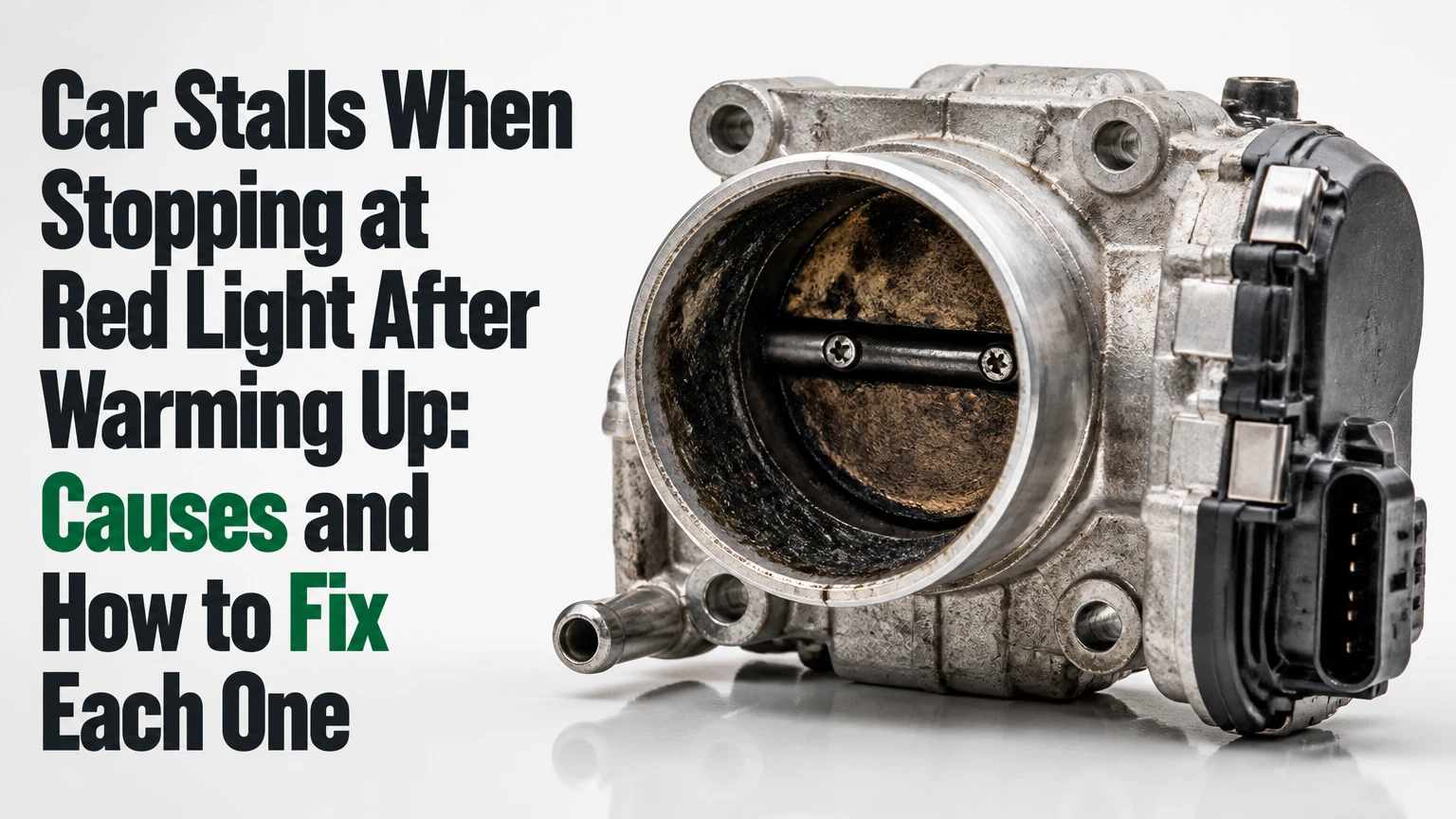
A car that stalls when coming to a stop at a red light specifically after the engine has warmed up, but runs normally when cold, almost always has a failed or dirty idle air control valve that cannot maintain adequate idle speed at warm operating temperature, or a carbon-fouled throttle body that restricts airflow to the point where the warm engine cannot sustain idle against the load of stopping. T
he warm-only qualifier is the most important diagnostic detail: it tells you the problem is not a cold-start enrichment issue but a component that behaves differently or fails specifically at operating temperature.
Why Warming Up Changes the Idle Requirements
A cold engine requires additional fuel and air to idle smoothly while components expand to operating temperature. The ECM commands an elevated cold idle speed (typically 1,200 to 1,500 RPM) through the idle air control system and enriches the fuel mixture. Many components that are marginal at warm idle function adequately at cold idle because the ECM compensates more aggressively.
Once the engine reaches operating temperature, the ECM reduces idle RPM to the base warm idle target (typically 650 to 800 RPM). The idle air control valve must now maintain this lower target precisely, with less margin for error. A component that was borderline at cold idle often fails entirely at warm idle because the ECM is no longer providing the aggressive compensations of cold start.
The load of coming to a stop adds to this: the power brakes and power steering both load the engine at the exact moment you are slowing to an idle, pulling RPM down just as the idle management system is trying to maintain its minimum target.
Cause 1: Dirty or Failed Idle Air Control Valve
The idle air control (IAC) valve bypasses a controlled amount of air around the closed throttle plate to maintain the target idle RPM. When the valve becomes coated with carbon deposits (from crankcase blow-by vapors that pass through the PCV system), the bypass passage is restricted and the valve cannot supply adequate air for warm idle.
The warm-specific failure pattern of IAC valves is explained by thermal expansion: at operating temperature, the valve body and pintle expand. A slightly sticky or restricted IAC may still operate adequately when cold because the passage is slightly larger when cold. At operating temperature, the slight thermal expansion of the pintle and housing reduces the effective bypass area and the valve fails to maintain idle.
Cleaning: remove the IAC valve (typically two bolts on the intake manifold or throttle body), spray the pintle and valve seat with throttle body cleaner, and work the pintle by hand to free any carbon deposits. Reinstall and test. Many IAC-related stalling problems are resolved by cleaning alone. If cleaning does not help, test the IAC valve resistance (typically 6 to 13 ohms between the control terminals) and compare to specification. A failed IAC valve replacement costs $40 to $150 for the part.
Cause 2: Carbon-Fouled Throttle Body
Carbon deposits on the throttle plate edge and bore create a restriction that partially closes the effective opening at idle. The ECM compensates by opening the IAC valve further, but if the throttle body fouling is severe, the combined restriction exceeds what the IAC can compensate for. This stalling pattern is typically progressive: warm idle becomes gradually rougher over months, then occasional stalling begins.
Throttle body cleaning: disconnect the intake duct, hold the throttle plate open by hand or with a screwdriver (never damage the plate or bore), and spray throttle body cleaner generously while wiping with a clean cloth. Repeat until the bore and plate edges are clean metal rather than black with carbon. The entire cleaning takes 20 to 30 minutes and costs nothing beyond the cleaner can. Do not use carburetor cleaner on electronic throttle bodies: it can damage rubber seals and plastic sensor components.
Cause 3: EGR Valve Stuck Open
The exhaust gas recirculation (EGR) valve introduces a controlled amount of exhaust gas into the intake manifold to reduce combustion temperature and NOx emissions. It is designed to be closed at idle and open only under part-throttle driving conditions. An EGR valve that sticks open at idle introduces exhaust gas that dilutes the intake charge beyond what the engine can sustain, and the mixture becomes too dilute to maintain idle.
The warm-specific nature of EGR stalling is explained by the valve itself: EGR valves can stick open when hot from accumulated carbon or a failed diaphragm. The valve seat and pintle expand at operating temperature, changing the closing force relationship. Symptoms: rough warm idle that improves at slightly higher RPM, stalling specifically at light loads.
Check: disconnect the EGR valve vacuum line or electrical connector (on electronic EGR) and test whether the idle improves. If the warm stalling disappears with the EGR disconnected, the valve or its control system is the cause.
Cause 4: Torque Converter Clutch Engaging at Low Speed
The torque converter lock-up clutch (TCC) is normally programmed to engage at highway cruise speed and disengage before the vehicle decelerates to near-idle speed. On some vehicles with a faulty TCC solenoid or incorrect TCM programming, the TCC engages at inappropriately low speeds and can stall the engine at low speeds when the vehicle slows to a stop, because the locked converter effectively makes the transmission and engine a rigid connection that cannot slip.
The pattern: the engine does not stumble or rough-idle; it simply stalls cleanly when slowing to a stop, as if someone turned off the key. It does not restart difficulty and resumes normal operation when moving again. This is distinct from IAC or throttle body stalling, which typically produces a rough idle before stalling.
Cause 5: Mass Airflow Sensor Contamination
A contaminated MAF sensor element underreports the actual airflow entering the engine. The ECM delivers too little fuel based on the low airflow reading, causing a lean condition. At warm idle where the ECM is already managing the fuel mixture precisely, a lean condition from a bad MAF reading can push the idle mixture outside the range the engine can sustain, causing stalling.
Clean with CRC MAF Sensor Cleaner specifically (other solvents damage the delicate sensor wire). Allow to fully dry before reinstalling. A new MAF sensor costs $60 to $200 depending on vehicle.
Cause 6: Coolant Temperature Sensor Failure
The coolant temperature sensor (CTS) tells the ECM what temperature the engine is at so the ECM can adjust fuel delivery appropriately. A CTS that fails in the cold-reading direction (sends a signal indicating the engine is cold when it is actually warm) causes the ECM to enrich the mixture as if for cold start even after the engine reaches operating temperature. This creates a rich condition that can foul plugs and cause rough warm idle and stalling. A CTS that is intermittent may cause the problem to appear and disappear unpredictably.
Cause Hierarchy Summary
Cause | Idle Before Stall? | Check Engine Light? | Key Test | Repair Cost |
|---|---|---|---|---|
Dirty/failed IAC valve | Rough, hunting idle | Sometimes P0505 | Clean IAC; check resistance | $0 (cleaning) to $150 |
Carbon throttle body | Rough, low RPM | Rarely | Visual inspection and cleaning | $0 to $30 |
EGR valve stuck open | Rough at idle, smoother at 1,000 RPM | Sometimes P0401/P0402 | Disconnect EGR; does idle improve? | $100 to $400 |
TCC engaging at low speed | Clean stall, no rough idle | P0741/P0740 | TCC engagement speed observation | $150 to $600 |
Dirty MAF sensor | Rough idle, poor acceleration | P0171/P0174 | Clean MAF sensor | $0 to $200 |
Coolant temp sensor failure | Rich symptoms: dark smoke, rough | P0115/P0116 | Compare CTS reading to actual temp | $20 to $100 |
“I replaced the IAC valve twice in two years on my Silverado before someone finally told me to clean the throttle body first. The throttle body had a quarter inch of carbon caked on the edge of the plate. After cleaning it, the idle smoothed out and the stalling never came back. The IAC was probably fine both times.” — Priya Nair, 2009 Chevrolet Silverado 1500 5.3L
Diagnosis Sequence
Step 1: Clean the throttle body first. This is free and resolves or significantly improves stalling in a large percentage of cases. Do not skip this step.
Step 2: Clean the IAC valve (if your vehicle has one; drive-by-wire systems do not have a separate IAC valve). Inspect and clean with throttle body cleaner.
Step 3: Pull OBD-II codes. Any stored codes narrow the diagnosis significantly. P0505 is IAC circuit malfunction. P0171/P0174 is lean condition suggesting MAF or vacuum leak. P0401 is insufficient EGR flow. P0740/P0741 is TCC solenoid circuit.
Step 4: Check fuel pressure at warm idle. Pressure should be stable within the manufacturer specification at idle. A pressure drop when the engine is warm points toward the fuel pressure regulator.
Step 5: If the above steps do not resolve the issue, a smoke test for vacuum leaks and a MAF sensor cleaning are the next steps before considering sensor replacement.
Frequently Asked Questions
Why does my car restart immediately after stalling but then stall again?
Immediate restart after warm stalling is characteristic of IAC, EGR, or TCC causes rather than fuel delivery or ignition causes. If the engine had a fuel delivery failure, it would be harder to restart. An engine that stalls, restarts easily, and stalls again quickly is running correctly everywhere except at warm idle: this isolates the problem to the idle management system rather than the core engine systems.
Can a bad fuel injector cause warm stalling at lights?
A leaking injector that drips fuel into a cylinder after the engine is shut off can cause a flooded, hard-to-start condition after a warm soak. A failed injector that does not flow adequately causes a misfire rather than stalling. Neither pattern matches warm stalling specifically at lights. Injectors are unlikely to be the primary cause of this specific symptom pattern.
Should I use a fuel injector cleaner for warm idle stalling?
Fuel injector cleaners address injector carbon deposits and have no meaningful effect on IAC valve, EGR, or throttle body carbon deposits. For warm idle stalling, throttle body cleaning and IAC cleaning are far more directly relevant than injector cleaner. Use an OBD-II reader to pull codes and direct the cleaning efforts at the appropriate component.
The Bottom Line
Warm stalling at red lights is an idle management problem, not a core engine problem. Clean the throttle body and IAC valve before replacing any parts. These two free or near-free cleaning procedures resolve the majority of warm stalling cases. Follow with a code scan and targeted cleaning or replacement of the specific component the codes indicate. If no codes are present and cleaning does not help, vacuum leak testing and MAF sensor cleaning are the next steps.