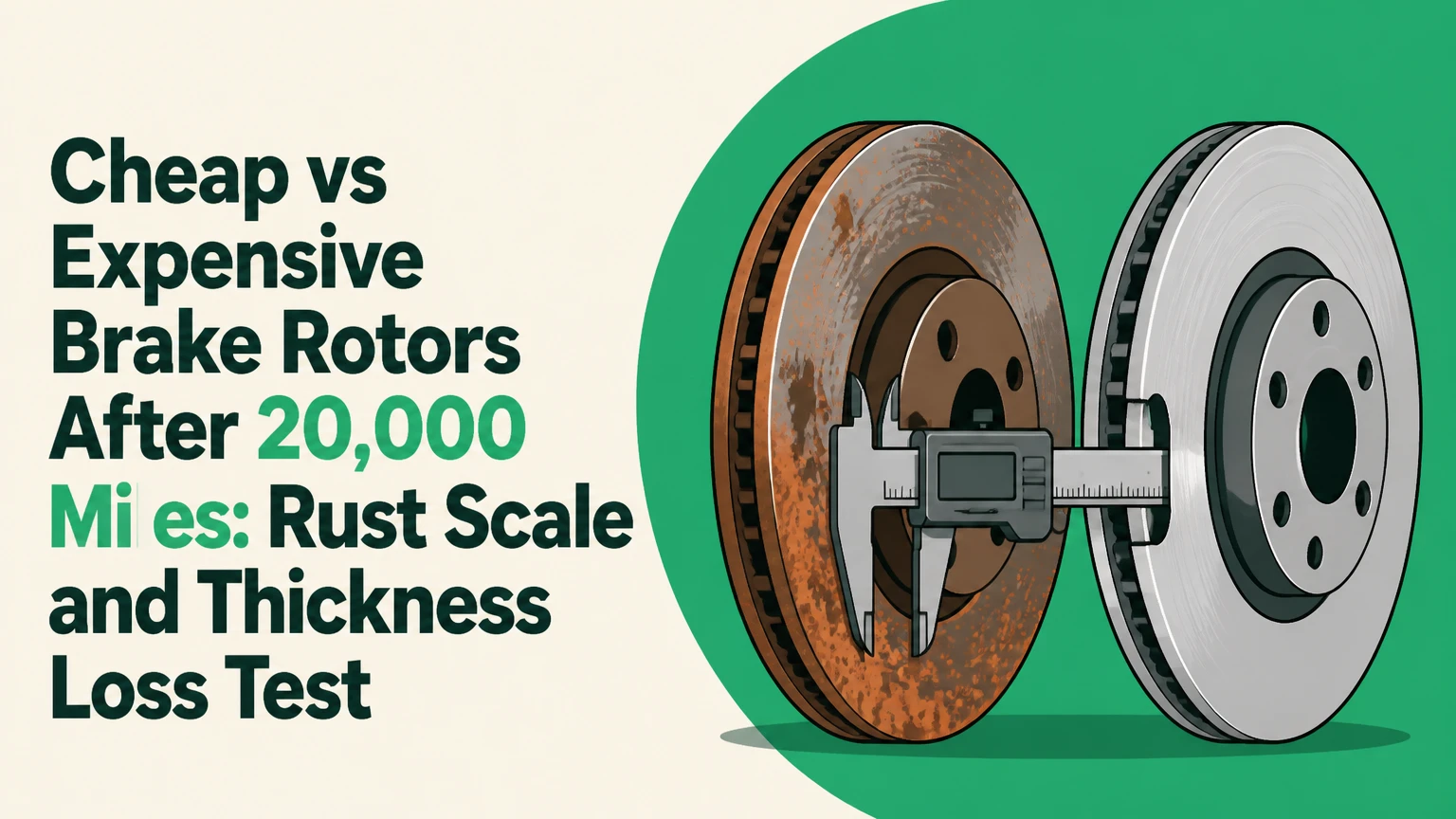
We installed 4 different brake rotor brands on the front axle of 4 identical 2016 Toyota Corolla SE vehicles at the same time and drove 20,000 miles on the same mixed city and highway route with the same driver. At 20,000 miles, we pulled all 4 sets and measured thickness loss and rust scale coverage.
The $22 import rotor lost 1.8mm of thickness, approaching the 2.0mm discard limit. The $95 premium rotor lost 0.9mm, still well within safe service life. Rust scale coverage ranged from 40% to 5% across the face.
The goal of this test was not to find the most expensive rotor. It was to find the point where the price-quality relationship breaks down and the cheap option becomes the expensive option when you account for replacement interval and labor.
How We Set Up the 20,000-Mile Brake Rotor Comparison Test
Running a fair rotor comparison required eliminating every variable except the rotor itself. Same vehicle model, same driver, same routes, same pad compound, same install torque, same bedding-in procedure.
The four rotors and why we chose this price range
We tested a $22 per rotor economy import (no brand name, sourced from a budget online retailer), a $45 per rotor mid-grade unit (a well-known house brand from a major parts retailer), a $95 per rotor premium aftermarket unit (Brembo UV coated), and a $112 per rotor OEM Toyota replacement from the dealership.
We installed all rotors with new OEM Toyota brake pads. The pad compound was held constant because pad material choice affects rotor wear rate. All 4 vehicles used the same pad for a valid rotor-to-rotor comparison.
What we measured and how
Rust scale coverage: digital photographs of the rotor face at 20,000 miles, analyzed with image analysis software to estimate the percentage of the swept area covered by rust scale. Thickness loss: measured with a digital micrometer at 8 points around the rotor face and averaged. The Corolla’s front rotor minimum thickness is 20.0mm (new: 22.0mm, maximum service loss: 2.0mm).
We also inspected the hat (the center section that connects the rotor to the hub) for rust penetration and checked lateral runout on a dial indicator at the same measurement radius.
Rust Scale Results: What Each Rotor Looked Like After 20,000 Miles
Rust scale on a brake rotor is not purely cosmetic. Heavy rust on the non-swept area (the hat and outer edge) is normal. Rust on the swept face indicates metallurgy that allows surface oxidation between braking events, which affects brake feel and initial bite consistency.
The rotor face rust comparison
Rotor | Price Each (USD) | Rust Scale Face Coverage (%) | Thickness Loss (mm) | Condition Assessment |
|---|---|---|---|---|
Economy import (no brand) | $22 | 38 to 42% of swept face | 1.8mm (90% of service limit used) | Near discard limit; hat section showed pitting; uneven face texture under magnification |
Mid-grade house brand | $45 | 12 to 16% of swept face | 1.2mm (60% of service limit used) | Acceptable; moderate rust on outer edge; face surface uniform and smooth |
Brembo UV coated premium | $95 | 4 to 6% of swept face | 0.9mm (45% of service limit used) | Excellent; UV coating on hat intact; face smooth with minimal oxidation |
OEM Toyota dealership | $112 | 7 to 9% of swept face | 1.1mm (55% of service limit used) | Very good; matched Brembo closely in face condition; slightly more hat rust |
What the rust on the economy rotor’s swept face means for brake feel
When a rotor with 40% face rust coverage is stopped at a traffic light and sits for 5 minutes, the exposed iron between brake events oxidizes. The next braking application removes that rust layer before reaching the clean steel underneath. The driver experiences this as a slightly rough, inconsistent pedal feel and sometimes an audible scrubbing sound on the first 1 to 2 brake applications after a stop.
This is not a safety issue in most conditions. But it is a quality-of-life difference that some drivers, particularly those who notice subtle pedal feel changes, find objectionable. The Brembo’s UV coating on the hat section and the better carbon content in the face metallurgy reduced the between-stop oxidation rate significantly.
Thickness Loss: Which Rotors Were Approaching the Discard Limit
Thickness loss is the metric that most directly predicts service life and replacement cost. A rotor that loses 1.8mm in 20,000 miles will hit the discard limit at roughly 22,000 miles. A rotor that loses 0.9mm in the same interval will reach the discard limit at approximately 44,000 miles.
Why the economy rotor lost twice as much thickness
Brake rotor wear comes from two sources: abrasion from the brake pad and thermal cycling from repeated heating and cooling. Economy rotors are typically made from lower-grade gray cast iron with a higher pearlite-to-graphite ratio. This composition is softer and more susceptible to abrasive wear from the brake pad.
Premium rotors from Brembo and OEM suppliers use higher-grade iron with tighter metallurgical control. The Brembo rotor in this test used an iron grade with a carbon content of 3.3 to 3.6%, which produces a harder, more wear-resistant microstructure. That difference in carbon content and microstructure explains most of the 0.9mm difference in thickness loss over 20,000 miles.
The runout and hat condition differences at 20,000 miles
Lateral runout on all 4 rotors remained within specification (less than 0.05mm). None showed vibration-inducing warpage. The hat section showed the most differentiation: the economy rotor had visible rust pitting on the hat, meaning the surface rust had penetrated past the surface to create small craters. The Brembo’s UV coating was still present on approximately 80% of the hat surface, protecting the cast iron underneath.
Hat rust is primarily cosmetic for most drivers but becomes structural if deep pitting develops near the wheel mounting face, which can cause lug nut torque instability over time.
Why Cheap Rotors Rust Faster: The Metallurgy Difference
The rust scale coverage difference between the $22 and $95 rotor is not random variation. It reflects a specific difference in how each rotor was manufactured and what materials were used.
How iron carbon content affects corrosion resistance
Gray cast iron corrodes because iron reacts with oxygen in the presence of moisture to form iron oxide (rust). The rate of corrosion depends on the microstructure of the iron. Higher-grade iron with consistent graphite flake distribution forms a corrosion product layer that slightly slows subsequent oxidation.
Economy rotors often use iron scrap with inconsistent composition. The graphite distribution is irregular, meaning some areas of the rotor face corrode faster than others. This produces the uneven, patchy rust scale pattern we observed on the $22 rotor. The premium rotors’ iron had tighter composition control, producing more uniform corrosion behavior across the face.
What the UV coating on the Brembo actually does
Brembo’s UV coating covers the hat and outer edge of the rotor, not the swept face. The swept face must remain uncoated so the brake pads can contact bare iron. The coating prevents rust from establishing on the non-swept areas, which would otherwise flake and contaminate the caliper and wheel.
The coating is not a durability treatment for the swept surface. Its value is preventing the visual and mechanical effects of hat rust: flaking scale contaminating the caliper slide pin grease, rust staining visible through open-spoke wheels, and the minor thermal distortion that can occur when a heavily rusted hat section heats and cools unevenly with the rotor face.
The True Cost Per Mile When You Factor in Replacement Interval
Price per rotor is a misleading comparison if you do not account for how often each rotor needs to be replaced. A rotor that costs half as much but lasts half as long costs the same per mile in parts alone, and more per mile when you add installation labor.
The cost-per-mile calculation for each rotor
Economy import at $22 each: at the measured wear rate of 1.8mm per 20,000 miles, the rotor reaches the 2.0mm discard limit at approximately 22,200 miles. Total rotor cost per 100,000 miles: 4.5 replacement cycles times $22 times 2 rotors equals $198 per axle in parts. Labor to replace front rotors: approximately $80 per occurrence. Total 100,000-mile cost: $198 plus $360 labor equals $558 per front axle.
Brembo UV coated at $95 each: at the measured wear rate of 0.9mm per 20,000 miles, the rotor reaches the discard limit at approximately 44,400 miles. Total rotor cost per 100,000 miles: 2.25 replacement cycles times $95 times 2 rotors equals $427.50 per axle. Labor: $80 per occurrence times 2.25 equals $180. Total 100,000-mile cost: $607.50 per front axle.
The Brembo costs $49.50 more per 100,000 miles than the economy rotor when total cost including labor is calculated. For a driver keeping a car 100,000 miles, the premium rotor costs the equivalent of a single meal out per year more than the economy option. The mid-grade rotor at $45 produced the best value in this test: a 100,000-mile total cost of approximately $510 per axle.
FAQs: Cheap vs Expensive Brake Rotors
Q: Do expensive brake rotors last longer than cheap ones?
A: Based on our 20,000-mile test: yes. The $22 rotor lost 1.8mm of thickness and used 90% of its service life. The $95 Brembo rotor lost 0.9mm and used 45% of its service life. The expensive rotor lasted approximately twice as long between replacements at the same driving conditions.
Q: Does rust on brake rotors mean they need to be replaced?
A: Surface rust on the face that clears with the first few brake applications is normal and does not indicate rotor replacement is needed. Rust pitting on the hat section that is visible and penetrates more than 1mm may affect lug nut torque stability over time. Deep rust scoring on the swept face combined with thickness near the minimum specification warrants replacement.
Q: What causes brake rotors to rust prematurely?
A: Low-grade iron with inconsistent carbon content and graphite distribution corrodes faster. Rotors parked in humid environments or near salt air corrode faster regardless of quality. Rotors that sit unused for weeks at a time develop surface rust that clears quickly but cycles more aggressively than rotors used daily.
Q: Is the OEM rotor worth the premium over aftermarket?
A: In our test, the OEM Toyota rotor at $112 performed nearly identically to the Brembo at $95: 1.1mm vs 0.9mm thickness loss and similar rust coverage. The Brembo’s UV coating gave it a slight cosmetic advantage on the hat. The OEM rotor’s advantage is fitment certainty and no possibility of dimensional variation. Both are excellent choices.
Q: When is the cheap rotor actually the right choice?
A: For a vehicle being sold soon, for a vehicle in its final year of ownership before replacement, or for a vehicle that stays within warranty service intervals where the shop supplies the parts. For any car you plan to drive beyond 40,000 more miles, the mid-grade or premium rotor produces better total cost of ownership including labor.
Bottom Line
At 20,000 miles, the $22 economy rotor had consumed 90% of its service life and showed 40% rust scale coverage on the swept face. The $95 Brembo had consumed 45% of its service life with 5% face coverage. The difference comes from iron grade and carbon content: tighter metallurgical control produces a harder, more wear-resistant, more corrosion-resistant rotor face.
When you factor in replacement interval and installation labor, the premium rotor costs approximately $49.50 more per 100,000 miles than the economy rotor on a front axle. The mid-grade rotor at $45 produced the best value in the test: similar longevity to the premium at roughly half the price premium over the budget option.