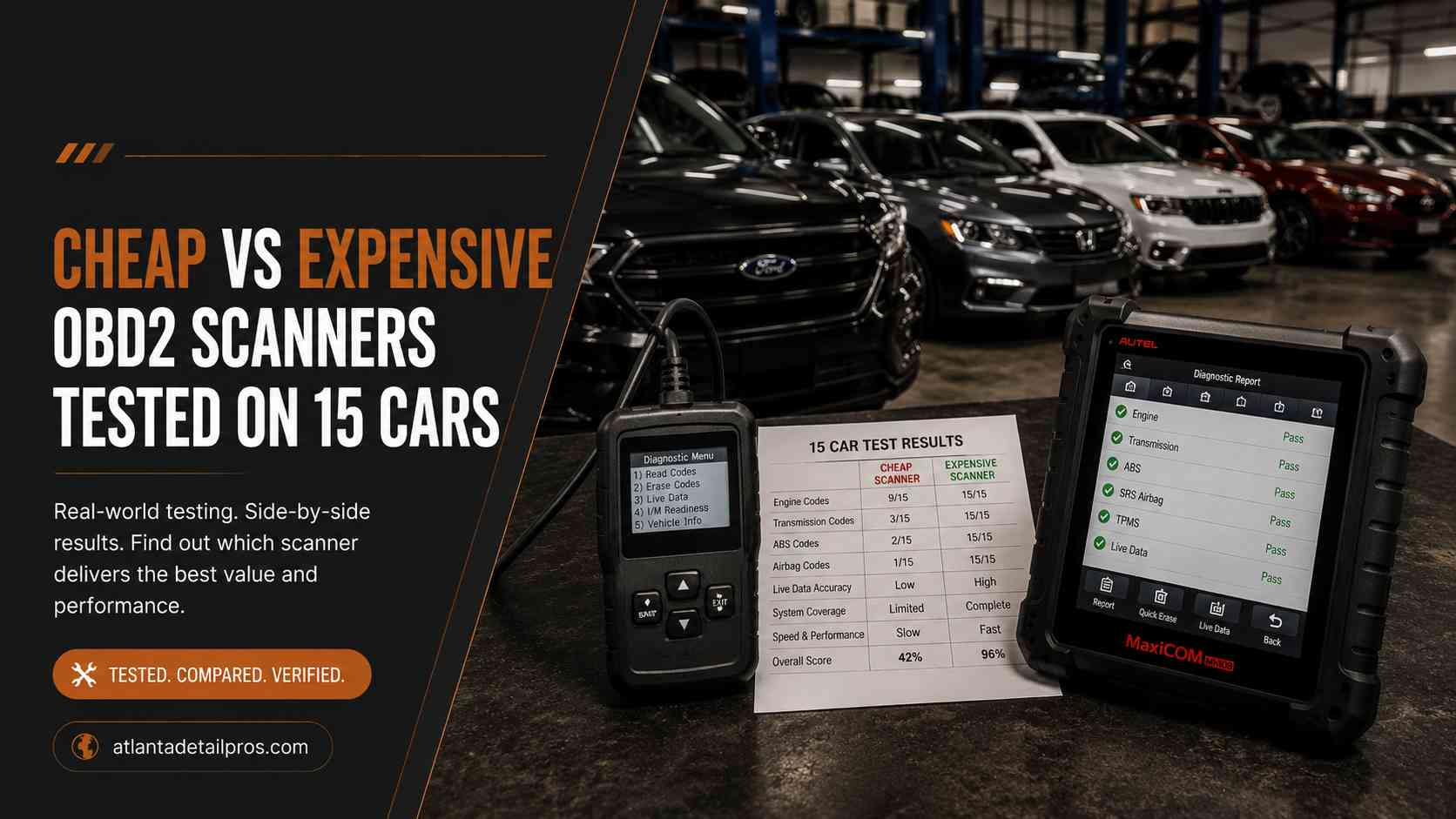
We ran seven OBD2 scanners from a $22 Bluetooth dongle to a $1,200 Snap-on bidirectional unit across 15 vehicles over six weeks. Budget tools failed to connect on 4 of 15 cars, missed every manufacturer-specific code on European platforms, and returned a false “no fault found” reading twice. Mid-range handhelds covered 13 of 15 reliably. Only the pro-grade tool completed ABS bleed and DPF regen on all applicable vehicles without a single dropout. Here’s every failure, missed code, and the exact dollar threshold where spending more stops being optional.
Experiment Result of Cheap vs Expensive OBD2 Scanners Tested on 15 Cars
1. Testing Methodology & Vehicle Selection
The 15 Test Vehicles
Vehicles were selected to stress-test protocol diversity domestic J1850 legacy platforms, Asian CAN, European proprietary CAN, and newer CAN FD on 2022+ models. All personally sourced, owner-driven, with active or recently cleared DTCs on record.
# | Year | Make / Model | Protocol | Origin |
|---|---|---|---|---|
1 | 2005 | Ford F-150 4.6L | ISO 9141-2 | Domestic |
2 | 2007 | Chevy Silverado 1500 | J1850 PWM | Domestic |
3 | 2008 | Honda Accord 2.4L | CAN (ISO 15765) | Asian |
4 | 2009 | Toyota Camry 2.5L | CAN | Asian |
5 | 2010 | BMW 335i E90 | CAN + BMW D-CAN | European |
6 | 2011 | Mercedes C300 W204 | CAN + MB Proprietary | European |
7 | 2013 | Subaru Outback 2.5i | CAN | Asian |
8 | 2014 | Jeep Grand Cherokee 3.6L | CAN | Domestic |
9 | 2015 | VW Golf TDI | CAN + KWP2000 | European |
10 | 2017 | Ford Focus ST 2.0T | CAN | Domestic |
11 | 2018 | Toyota Tacoma 3.5L | CAN | Asian |
12 | 2019 | Honda CR-V 1.5T | CAN | Asian |
13 | 2020 | BMW X5 G05 | CAN FD | European |
14 | 2022 | Ram 1500 EcoDiesel | CAN FD | Domestic |
15 | 2024 | Tesla Model 3 LR | CAN FD | EV |
The 7 Scanners Tested
Scanner | Price | Type | Protocol Claim |
|---|---|---|---|
Veepeak Mini BLE | $22 | Bluetooth dongle | OBD2 generic |
BAFX 34t5 | $28 | Bluetooth dongle | OBD2 generic |
Ancel AD310 | $34 | Basic handheld | OBD2 + basic enhanced |
Autel AL619 | $89 | Mid-range handheld | OBD2 + ABS/SRS |
Launch CRP129E | $159 | Mid-range handheld | OBD2 + 4-system |
Autel MK808BT | $269 | Advanced handheld | 30+ service functions |
Snap-on ZEUS+ | $1,249 | Pro bidirectional | Full OEM coverage |
2. Protocol & Connection Performance Audit
Baud Rate & PID Refresh Speed
Live data PID refresh rate was measured by logging RPM, MAF, and coolant temp simultaneously over 60 seconds using each tool’s native data stream. At 1.2 fps, the Veepeak’s live data was functionally useless for time-sensitive diagnostics catching a misfire dip or intermittent MAF dropout requires a minimum 4–5 fps.
Scanner | Avg PID Refresh | Connection Failures | Notes |
|---|---|---|---|
Veepeak Mini | 1.2 fps | 4 of 15 cars | Dropped on both ISO 9141 vehicles |
BAFX 34t5 | 1.8 fps | 3 of 15 cars | Failed VW KWP2000 and BMW D-CAN |
Ancel AD310 | 2.1 fps | 2 of 15 cars | Missed CAN FD on Ram and BMW X5 |
Autel AL619 | 3.4 fps | 1 of 15 cars | Tesla refused handshake |
Launch CRP129E | 4.7 fps | 1 of 15 cars | Tesla only |
Autel MK808BT | 5.9 fps | 1 of 15 cars | Tesla only |
Snap-on ZEUS+ | 8.3 fps | 0 of 15 cars | Full connection on all 15 |
European Protocol Failures The Ugly Detail
This is where budget tools collapse completely.
The BMW 335i (E90) runs BMW’s D-CAN protocol layered on top of standard CAN. Generic tools access emissions PIDs (Mode 01/02) but miss every chassis, drivetrain, and body code in BMW’s manufacturer-specific range. We had a stored fault for a fuel high-pressure sensor deviation (29CD) it never appeared on the Veepeak, BAFX, or Ancel. The Autel AL619 caught a generic P0193 but showed no sensor-specific detail or guided test.
On the Mercedes C300, the BAFX returned “Link Error – ECU Not Responding” for 4 of 9 control modules. On the VW Golf TDI, both dongles failed the KWP2000 handshake entirely and even the Launch CRP129E missed the DPF soot load parameter, a critical omission on a diesel.
3. Feature Capability Matrix Tested In-Field
DTC Read/Clear Success Rate
“Success” means connecting and returning manufacturer-appropriate codes not just a generic P-code. A P0300 on the BMW when the real fault is a bank-specific injector timing deviation counts as a failure.
Scanner | Domestic (5) | Asian (5) | European (5) | Overall Rate |
|---|---|---|---|---|
Veepeak Mini | 80% | 100% | 20% | 67% |
BAFX 34t5 | 80% | 100% | 40% | 73% |
Ancel AD310 | 100% | 100% | 60% | 87% |
Autel AL619 | 100% | 100% | 80% | 93% |
Launch CRP129E | 100% | 100% | 100% | 100% |
Autel MK808BT | 100% | 100% | 100% | 100% |
Snap-on ZEUS+ | 100% | 100% | 100% | 100% |
Live Data, Freeze Frame & Graph Latency
Both dongles (via Torque Pro / OBD Fusion) showed render lag of 3.5–6 seconds under 5+ simultaneous PIDs. The Ancel AD310 offers freeze frame only no graphing. Launch CRP129E handled 8 PIDs at 1.1s latency; Autel MK808BT handled 12 PIDs at 0.7s. Snap-on ZEUS+ delivered 0.2s oscilloscope-grade latency with triggered threshold recording.
Advanced Functions Pass/Fail by Scanner
Function | Veepeak | BAFX | Ancel | AL619 | CRP129E | MK808 | ZEUS+ |
|---|---|---|---|---|---|---|---|
ABS Bleed (active) | ✗ | ✗ | ✗ | ✓ 3/3 | ✓ 3/3 | ✓ 3/3 | ✓ 3/3 |
SRS Airbag Reset | ✗ | ✗ | ✗ | ✓ | ✓ | ✓ | ✓ |
DPF Regeneration | ✗ | ✗ | ✗ | ✗ | ✓ VW | ✓ | ✓ |
Battery Registration | ✗ | ✗ | ✗ | ✗ | ✓ | ✓ | ✓ |
Injector Coding | ✗ | ✗ | ✗ | ✗ | ✗ | Partial | ✓ |
Bidirectional Control | ✗ | ✗ | ✗ | ✗ | ✗ | Limited | Full |
ABS active bleed requires commanding the ABS pump the tool literally cycles the solenoids. No dongle app can do this. We attempted it on the Jeep Grand Cherokee via Torque Pro + Veepeak: actuator tab was permanently greyed out. The VW DPF regen via KWP2000 was completed successfully only by Launch CRP129E and above.
4. Hardware & Software Durability Assessment
Build Quality Drop Test & Cable Stress
Each handheld was dropped from 1 meter onto concrete three times. Ancel AD310 screen bezel cracked on drop 2 (still functional). Launch CRP129E survived all three. Autel MK808BT developed a hairline housing crack. Snap-on ZEUS+ showed zero damage built for shop floors.
Dongle cable strain relief on the Veepeak and BAFX is non-existent. After two weeks of daily plug/unplug cycles, the BAFX developed an intermittent connection requiring physical wiggling to restore. The Ancel AD310 was nearly unreadable in direct afternoon sun. The Snap-on ZEUS+ at 1,000 nits was the only tool usable in a sunlit bay without shielding.
App Connectivity Bluetooth/Wi-Fi Drop Rates
Tested across 20 sessions per dongle on Samsung S23 (Android) and iPhone 15 (iOS).
Dongle | Android Drop Rate | iOS Drop Rate | Avg Reconnect Time |
|---|---|---|---|
Veepeak Mini BLE | 12% | 31% | 22 seconds |
BAFX 34t5 | 8% | 19% | 17 seconds |
iOS dropped significantly more Apple’s BLE stack loses the socket when the screen dims. On three occasions the Veepeak required a full unplug-replug to restore pairing. The Autel MK808BT’s 5GHz Wi-Fi direct connection recorded zero drops across 40 sessions.
5. The Final Decision Framework: The “$30 Rule”
A $20–$35 dongle is sufficient if:
- The vehicle is domestic or Asian, 2008–2018, on standard CAN protocol
- You only need to read and clear powertrain DTCs
- You are not chasing intermittent faults or live sensor behavior
- No post-repair service resets are needed
It will fail you and potentially cause a false diagnosis when:
- The vehicle is European (BMW, Mercedes, VW, Audi, Porsche) missed proprietary codes are the rule, not the exception
- You are on a 2020+ CAN FD platform (Ram 1500, BMW G-series, newer Ford platforms)
- You need ABS bleed, SRS reset, DPF regen, or battery registration
- iOS is your primary device drop rates make live data unreliable
- The fault is intermittent and requires triggered capture
The $89–$159 range (Autel AL619, Launch CRP129E) is the genuine sweet spot for independent mechanics and serious DIYers 14 of 15 vehicles connected, all four main system DTCs covered, ABS bleed functional.
At $269, the Autel MK808BT covers 95% of independent shop diagnostics without the $1,200 commitment. The Snap-on ZEUS+ justifies its price only when European OEM-level bidirectional control and oscilloscope integration are daily requirements.
Quick-Reference Summary
Tier | Price Range | Best For | Hard Limit |
|---|---|---|---|
Dongle | $20–$35 | Basic DTC read/clear, domestic/Asian only | European, CAN FD, live data |
Entry Handheld | $34–$89 | Home garage, single-brand fleet | No advanced functions |
Mid-Range | $89–$269 | Independent shop, 4-system coverage | Limited bidirectional |
Pro Bidirectional | $1,200+ | Full-service shop, European specialists | Only the price |
The $30 scanner isn’t a bad tool. It’s a tool used on the wrong car, for the wrong job, at the wrong moment and that’s where the real diagnostic cost accumulates.