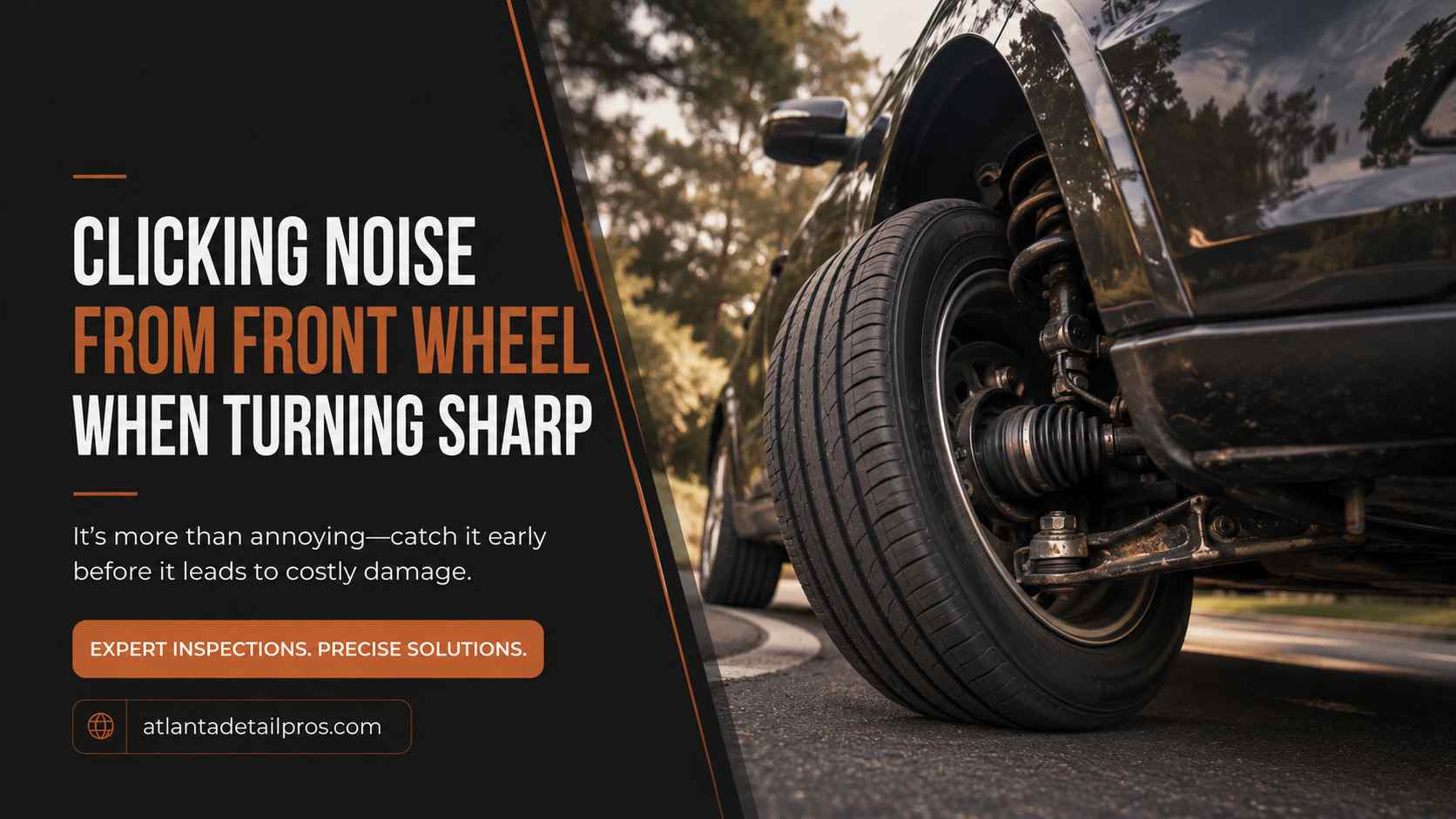
That rhythmic clicking sound from the front of your car when you make a sharp turn is one of the most recognizable symptoms in automotive diagnosis, and the cause is almost always the same thing. If your car clicks from one front corner specifically when the wheel is turned sharply, especially at low speed like when pulling out of a parking space or swinging into a driveway, you are almost certainly listening to a worn outer CV joint.
This is not a you-can-diagnose-it-next-month situation. A CV joint that is clicking is a CV joint that is past its warning stage. The clicking is the sound of the worn internal balls slapping the degraded race surfaces. Once the clicking starts, the joint deteriorates faster with each sharp turn. But the good news is that CV joint repairs are well-established, usually affordable, and something many DIYers handle themselves. Let us walk through everything.
Why Sharp Turns Make the CV Joint Click
The outer CV joint is what allows the axle to transmit power to the wheel while also accommodating the full angular range of steering lock. At straight-ahead driving, the joint runs at a small angle and operates smoothly. When you turn the wheel sharply to full lock, the operating angle of the joint increases dramatically. This high angle places maximum stress on the internal balls and their grooves. If the joint is worn and the groove surfaces are damaged, the balls skip and snap through the worn areas at this high angle, producing the characteristic clicking.
This is why the click is specific to sharp turns and usually absent at straight-ahead driving. The joint works at a manageable angle most of the time. It is only at high steering lock where the wear becomes audible. The earlier you catch it, the more options you have. An early-stage clicking joint can sometimes be addressed with just a CV boot replacement and fresh grease. A joint that has been clicking for months needs the full axle assembly replaced.
Confirming It Is the CV Joint and Not Something Else
Before you buy any parts, confirm you are dealing with a CV joint and not a brake hardware rattle, loose wheel bearing, or something else that occasionally masquerades as a CV joint click. The CV joint click has specific characteristics that set it apart.
The Characteristics of a CV Joint Click
A true CV joint click is rhythmic and tied to wheel rotation speed, meaning the click rate increases as wheel speed increases. It is most pronounced at slow speed during sharp turns, parking lot maneuvers, or tight corners. It often disappears completely at highway speed or during straight-line driving. It comes from one specific corner of the car, not a general underhood noise. If you turn left and the clicking happens, the right front CV joint is more likely (loading the outer joint). If you turn right and it clicks, suspect the left front. This is because turning transfers load to the opposite side joint.
The Torn Boot Test
Locate the rubber accordion boot at the outer end of each front axle shaft, near the wheel hub. This boot keeps grease in and contamination out. Look for tears, splits, or areas where the boot has collapsed. If the boot is torn and you can see black grease slung around the wheel well or on the inside of the wheel, the joint has been running dry or contaminated for some time. A torn boot on the outer end is the fastest visual confirmation that the outer CV joint is compromised.
Your Repair Options: Boot vs Full Axle, and Which Is Right for You
Once you confirm a CV joint issue, you have two repair paths: replace just the boot and regrease the joint if it was caught early, or replace the entire axle shaft assembly. Most mechanics in 2026 recommend the full axle replacement in most cases, not because it sounds better, but because it is often nearly the same price and eliminates the risk of having to do the job again.
CV Boot Replacement Only
This is the appropriate repair only if: the boot is just beginning to tear or has recently torn, the joint has not been running contaminated for an extended period, there is no clicking when turning at any angle, and the joint shows no internal play or roughness when checked on jack stands. A split boot kit costs $15 to $40 and the labor for replacement (which requires axle removal on most vehicles) runs $120 to $200. If the joint is already clicking, this repair is a waste of money because the internal surfaces are already damaged.
Full CV Axle Replacement
A remanufactured or new aftermarket CV axle shaft costs $60 to $120 for most front-wheel drive passenger vehicles. Dealer-spec or OEM shafts run $150 to $300. Labor to swap the axle is 1 to 2 hours at most shops, putting the total repair at $200 to $400 at an independent shop. This is the recommended repair for any joint that is already clicking. The new axle includes both the inner and outer joints freshly greased and booted, and it resets the entire axle assembly to new condition. For the small price difference, getting the full axle makes more sense than gambling on a boot-only repair on a damaged joint.
IMPORTANT: Always replace CV axles in pairs on front-wheel drive vehicles if both sides show wear, but do not replace a good side just because one side failed. Have the mechanic check both sides during the repair. Also, never reuse the axle nut without a new one: the axle nut is a torque-to-yield fastener on most vehicles and must be replaced when removed.
What Happens If You Ignore the Clicking
The clicking starts as a nuisance and becomes a safety concern. A CV joint that continues to operate in a worn condition deteriorates faster with each sharp turn and each mile driven. The internal ball grooves deepen, the balls lose their spherical shape, and eventually the joint loses its ability to transmit power smoothly. In the final stage of failure, the joint can separate entirely. On a front-wheel drive vehicle, a separated outer CV joint means the wheel can no longer receive power and steering becomes severely compromised. This is a roadside-stranded event at minimum and a loss-of-control event at worst if it happens under load on a curve.
Frequently Asked Questions
What causes a clicking noise when turning my front wheel?
Almost always a worn outer CV (constant velocity) joint. The joint allows the front axle to transmit power while the wheel turns. When the internal ball bearings wear, they produce a rhythmic clicking sound specifically during sharp, slow-speed turns when the joint operates at its maximum angle. The sound is louder during tight cornering and usually absent during straight-line driving.
Which CV joint is clicking: left or right?
Turning left tends to load the right front outer joint, so clicking when turning left often indicates the right side. Turning right loads the left front outer joint, so clicking when turning right often points to the left side. This is a general guide: confirm by inspecting both boot conditions and checking for grease sling on each wheel well.
Can I drive with a clicking CV joint?
For short necessary distances at low speed, yes. For extended highway driving, no. Highway driving loads the joint continuously and can accelerate the failure. Avoid sharp turns and hard acceleration until the repair is completed. If the clicking is accompanied by a vibration or the noise has become a grinding sound, do not drive the vehicle.
How much does it cost to fix a clicking CV joint?
A full CV axle shaft replacement, which is the recommended repair for a clicking joint, typically costs $200 to $400 at an independent shop including the shaft and labor. A DIY replacement runs $60 to $120 in parts. A boot-only repair on a joint that is not yet clicking costs $150 to $250 at a shop.
The Bottom Line
A clicking front wheel during sharp turns is a worn outer CV joint until proven otherwise. Inspect the boot first: if it is torn and grease has escaped, the joint is compromised. Schedule the axle replacement rather than hoping the boot-only option buys enough time. A full CV axle for most front-wheel drive cars costs less than many people expect, and the repair protects you from the joint separating at the worst possible moment.