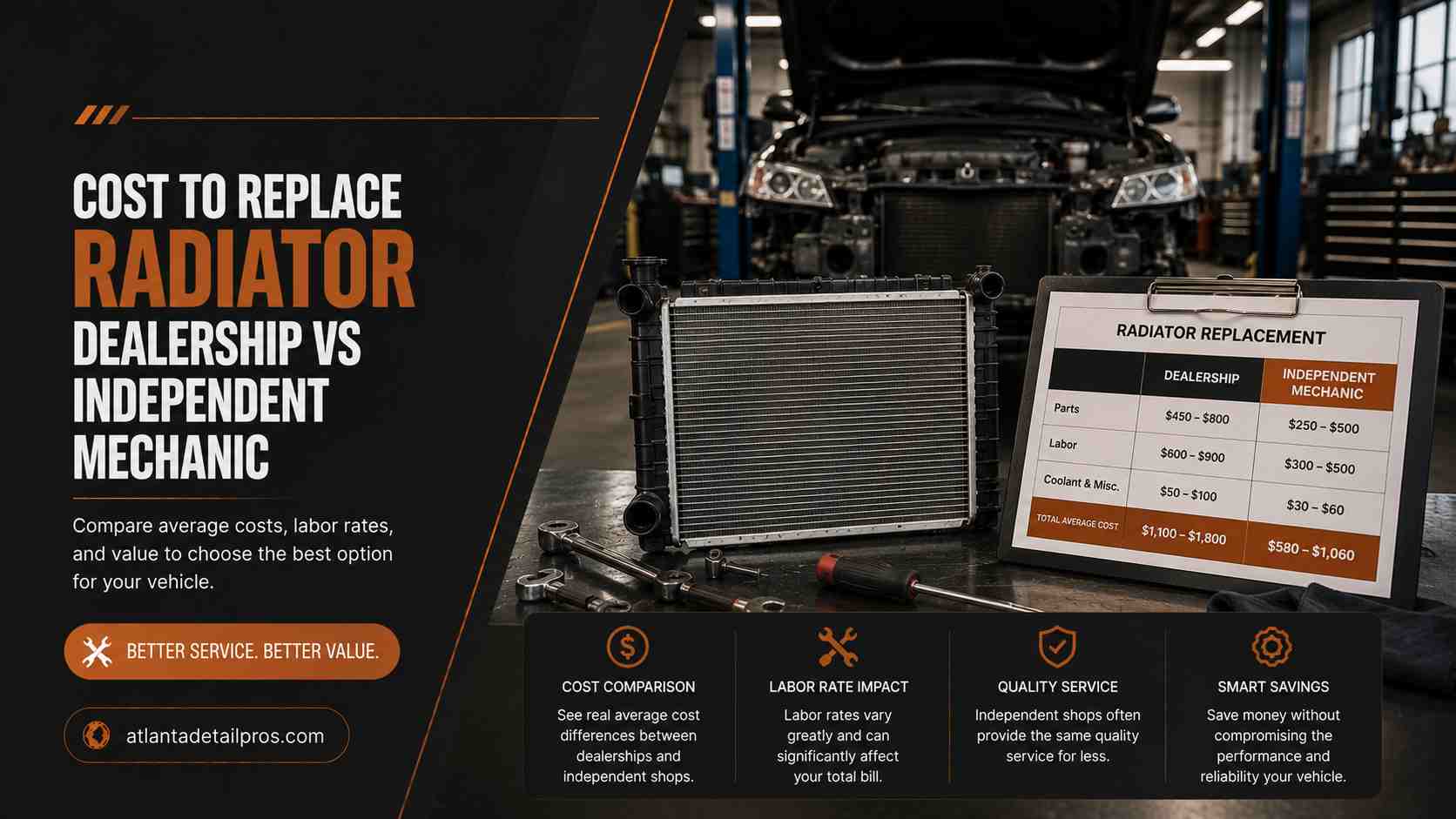
Radiator replacement costs $300 to $900 total at an independent mechanic and $450 to $1,400 at a dealership, with the radiator itself costing $80 to $400 in parts and labor ranging from $100 to $350 depending on how many components must be removed to access the radiator on the specific vehicle.
The wide range in labor cost reflects the significant design differences across vehicles: a front-wheel-drive compact where the radiator lifts straight out from the top after removing a few brackets takes 1 to 1.5 hours, while a pickup truck where the bumper, grille, AC condenser, and cooling fan shroud must be removed first takes 3 to 4 hours.
The radiator itself is a commodity part on most vehicles. An aluminum-core, plastic-tank aftermarket radiator from a reputable supplier performs identically to the OEM unit on most applications. The OEM unit from a dealer is typically 50 to 100 percent more expensive than a quality aftermarket equivalent without any meaningful performance advantage on a standard passenger vehicle. Understanding this distinction is one of the fastest ways to reduce a radiator replacement bill without sacrificing quality.
What the Job Includes
A radiator replacement is a cooling system job, which means the coolant must be drained before the radiator is removed and the system must be refilled and bled of air after the new radiator is installed. The complete job includes draining the coolant, removing the upper and lower hose connections, disconnecting the transmission cooler lines on vehicles with an automatic transmission (the transmission fluid cooler is typically integrated into the radiator end tank), removing the radiator mounting hardware and any obstructing components, installing the new radiator, and refilling with the correct coolant specification.
The cooling system bleed procedure is a step that is sometimes skipped at shops focused on speed. An air pocket in the cooling system after a radiator replacement causes localized overheating in the engine, which can damage the very head gasket the new radiator is protecting. A proper bleed procedure takes 15 to 30 minutes and should be included in any radiator replacement.
The upper and lower radiator hoses and the radiator cap are typically inspected and often replaced at the same time. If the vehicle is older and the hoses have not been replaced recently, replacing them at this visit adds only parts cost (typically $30 to $80 per hose) and minimal labor since the system is already drained.
Radiator Cost by Vehicle Platform
The cost of the radiator itself varies considerably by vehicle type. Plastic-tank aluminum-core radiators are the standard on most passenger vehicles and are the least expensive. All-aluminum radiators on trucks and performance vehicles are more expensive. Radiators with integrated transmission coolers are slightly more expensive than radiator-only units.
Vehicle Platform | Aftermarket Radiator Cost | OEM Radiator Cost |
|---|---|---|
Compact car (Civic, Corolla, Sentra) | $80 to $150 | $150 to $300 |
Midsize car (Camry, Accord, Malibu) | $100 to $200 | $200 to $400 |
Full-size sedan or crossover | $120 to $250 | $250 to $500 |
Full-size truck (F-150, Silverado, Ram) | $150 to $350 | $300 to $600 |
Heavy-duty truck (F-250, Silverado 2500) | $200 to $400 | $400 to $800 |
European luxury vehicle (BMW, Mercedes, Audi) | $200 to $500 | $500 to $1,200 |
Labor Cost by Vehicle Type
Labor time for a radiator replacement is driven by access complexity. The flat-rate labor time for this job varies from under 1.5 hours on easy-access vehicles to over 4 hours on trucks and vehicles with substantial front-end disassembly requirements.
Vehicle Configuration | Labor Hours | At $100/hr Independent | At $155/hr Dealer |
|---|---|---|---|
FWD compact, top-out radiator access | 1 to 1.5 hours | $100 to $150 | $155 to $230 |
FWD midsize, fan shroud removal required | 1.5 to 2.5 hours | $150 to $250 | $230 to $390 |
RWD car, limited front access | 1.5 to 2.5 hours | $150 to $250 | $230 to $390 |
Pickup truck, bumper or grille removal | 2.5 to 4 hours | $250 to $400 | $390 to $620 |
SUV with integrated AC condenser removal | 2.5 to 3.5 hours | $250 to $350 | $390 to $540 |
European luxury vehicle, modular front clip | 3 to 5 hours | $300 to $500 | $465 to $775 |
Dealer vs Independent Mechanic: What the Gap Pays For
The price difference between a dealer and an independent mechanic on a radiator job follows the same pattern as most maintenance repairs: the gap is primarily labor rate, not skill or outcome quality.
A dealer charges $130 to $185 per hour for labor. A reputable independent shop charges $90 to $130 per hour. On a 2-hour radiator job, the labor rate difference is $80 to $110. On a 3.5-hour truck job, it is $140 to $195. Add the parts markup difference (OEM at the dealer vs quality aftermarket at the independent shop) and the total gap widens to $150 to $400 on most jobs.
When the Dealer Makes Sense for a Radiator Job
The case for the dealer is stronger on European vehicles where the radiator is part of a modular front assembly that requires specific factory disassembly procedures, on vehicles covered under a manufacturer warranty or extended service plan that covers the repair, and on vehicles where the radiator failure has been caused by a known manufacturing defect covered under a technical service bulletin (TSB).
When the Independent Shop Is the Better Choice
For any domestic or Japanese vehicle outside of a manufacturer warranty, a reputable independent shop with cooling system experience delivers the same repair outcome at a meaningfully lower total cost. A quality aftermarket radiator from Denso, CSF, Mishimoto, or Spectra Premium is the appropriate specification for most passenger vehicles and is what the majority of experienced independent shops use.
“The dealer quoted me $980 to replace the radiator on my Tacoma. An independent shop in the same city quoted $510 with a Denso radiator and new hoses. Same labor time, different rate, different parts source. I went with the independent shop. The repair was done in 3 hours, the Denso radiator has been on the truck for 40,000 miles without a single issue.” : Victor Calderon, 2016 Toyota Tacoma owner
What Else Gets Replaced at the Same Visit
A radiator job opens the cooling system and provides access to several related components. Replacing them at the same visit, when the system is already drained and partially disassembled, costs far less than doing each as a standalone job later.
The thermostat is accessible on many engines when the upper radiator hose is removed. A new thermostat and gasket costs $15 to $50 in parts and adds 20 to 30 minutes of labor at most. The radiator cap should always be replaced when the radiator is replaced, since the old cap may not hold the new radiator’s rated pressure correctly. A cap costs $12 to $25.
On vehicles with an automatic transmission, the transmission cooler lines connect to the original radiator’s integrated cooler. New radiators include the cooler, but the lines and fittings should be inspected for corrosion before reuse, particularly on vehicles in northern states where road salt degrades line connections. Replacing corroded cooler line fittings at this visit adds $40 to $120 in parts and minimal labor.
Additional Parts Often Replaced at Same Visit
Component | Parts Cost | Incremental Labor |
|---|---|---|
Radiator cap | $12 to $25 | Included |
Thermostat and gasket | $15 to $50 | $20 to $40 |
Upper radiator hose | $20 to $50 | Included (already off) |
Lower radiator hose | $20 to $50 | $15 to $30 |
Transmission cooler line fittings (if corroded) | $40 to $120 | $20 to $40 |
Coolant flush and new coolant | $20 to $60 (coolant) | Included |
Total Cost Summary: Independent Shop vs Dealer
Vehicle Category | Independent Shop Total | Dealer Total |
|---|---|---|
Compact FWD | $300 to $550 | $450 to $800 |
Midsize car or crossover | $400 to $700 | $600 to $1,100 |
Full-size truck or SUV | $550 to $900 | $800 to $1,400 |
European luxury vehicle | $700 to $1,200 | $1,200 to $2,200 |
FAQs
How long does a radiator replacement take?
On easy-access vehicles (FWD compacts with top-out access), the job takes 1 to 2 hours. On trucks and vehicles requiring front-end disassembly, it takes 2.5 to 4 hours. Budget a full shop day if the vehicle is a heavy-duty truck or a European vehicle with a modular front clip.
Should I replace the radiator hoses at the same time as the radiator?
If the hoses have not been replaced in the past 50,000 to 60,000 miles, yes. The cooling system is already drained and the hoses are already removed to access the radiator. Replacing them at this point costs only the parts ($20 to $50 per hose) with no meaningful additional labor. A hose that fails six months after a radiator replacement is a return trip that costs far more than the proactive hose replacement.
Can I use any coolant in my car after a radiator replacement?
No. Modern vehicles use coolant formulations (OAT, HOAT, NOAT) that are not universally interchangeable. Using the wrong coolant type degrades the corrosion inhibitor chemistry and can accelerate corrosion of aluminum components, including the new radiator. Use the coolant type specified in the owner’s manual or match the color and specification of the coolant already in the system.
Is an aftermarket radiator as good as OEM?
For most passenger vehicles, yes. The OEM radiator on most domestic and Japanese vehicles is manufactured by the same suppliers (Denso, Calsonic, Modine) that supply quality aftermarket units. The OEM label adds a dealer markup but does not necessarily reflect a different product. On European vehicles where the radiator is integrated with more complex components, the OEM vs aftermarket calculus is more nuanced and worth discussing with your shop.
What causes a radiator to need replacement?
The most common causes are a cracked plastic end tank (the plastic end tanks on aluminum-core radiators become brittle after 8 to 15 years), pinhole corrosion in the aluminum core from degraded coolant that has lost its inhibitor package, physical impact damage from road debris or a minor collision, and internal contamination from transmission fluid that has leaked through a failed cooler into the coolant circuit.
Bottom Line
Radiator replacement costs $300 to $900 at a reputable independent mechanic and $450 to $1,400 at a dealership, with quality aftermarket parts delivering the same functional outcome as OEM at 30 to 50 percent lower parts cost. The labor rate difference between an independent shop and a dealer typically adds $80 to $250 to the dealer bill on top of the parts premium.
Get quotes from both a dealer and a reputable independent shop, ask what radiator brand each is using, and confirm that the quote includes a complete cooling system bleed, a new radiator cap, and new coolant. A shop that quotes the radiator without mentioning the coolant refill is not quoting the complete job.