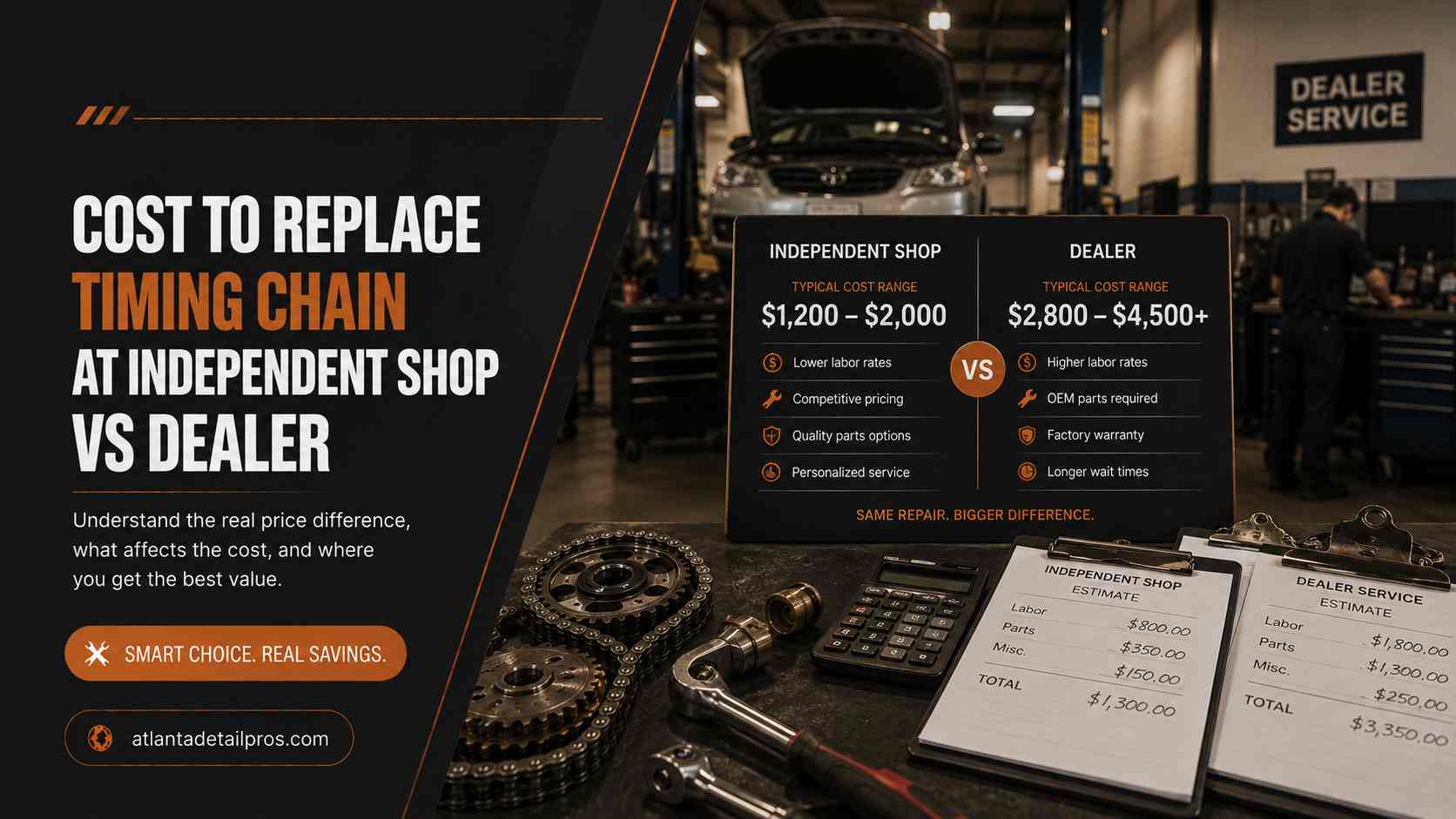
Timing chain replacement costs $600 to $1,800 at an independent shop and $900 to $2,800 at a dealership for most 4-cylinder and V6 engines, with the price difference driven almost entirely by labor rate differences rather than by any meaningful difference in parts quality or repair outcome.
The timing chain itself is rarely the only part replaced: a complete timing chain job includes the tensioner, one or both guide rails, and on variable valve timing engines, the phaser sprockets and VVT solenoids. The scope of the job is what separates a $700 repair from a $2,500 one, and understanding what should be included in each quote protects you from the most common billing dispute in this repair category.
A timing chain job is one of the most labor-intensive repairs on a modern engine. Access requires removing the valve cover, front engine cover, damper, and in many cases coolant components and accessories that obstruct the front of the block. The labor time alone, not the parts, determines the majority of the bill, which is why the shop you choose matters significantly more on this job than on most repairs.
What the Repair Should Always Include
Every timing chain replacement, regardless of who performs it, should include certain components as a minimum scope. Replacing only the chain without addressing the related wear components almost always leads to a repeat failure within 20,000 to 40,000 miles.
A complete timing chain job includes the timing chain itself, the primary chain tensioner, all guide rails and tensioner arms (which are often plastic and wear at the same rate as the chain), and a new front cover gasket or RTV sealant. On engines with variable valve timing, the cam phaser sprockets and VVT oil control solenoids are typically replaced as part of the same service because they are the components that develop the correlation codes that triggered the diagnosis. Before accepting any quote, ask specifically whether the tensioner, guide rails, and all gaskets are included. A quote covering only the chain and tensioner but not the worn guide rails is incomplete and will result in a return visit.
Cost by Engine Type and Vehicle Platform
The total repair cost varies significantly by engine design. Inline 4-cylinder engines with a single chain and limited VVT hardware are the least expensive. V6 and V8 engines with dual chains, multiple phasers, and complex front cover designs are the most expensive.
Engine Type | Independent Shop Range | Dealership Range |
|---|---|---|
4-cylinder single chain (Civic, Corolla, Focus) | $600 to $1,100 | $900 to $1,600 |
V6 single primary chain (Accord, Camry, Altima) | $900 to $1,500 | $1,200 to $2,000 |
V8 single primary chain (F-150 5.0L, Mustang) | $1,000 to $1,600 | $1,400 to $2,200 |
V8 dual chain with phasers (GM 5.3L, Ford 3.5L EcoBoost) | $1,200 to $2,200 | $1,800 to $3,200 |
BMW N20 and N26 (secondary chain failure) | $1,400 to $2,400 | $2,000 to $3,500 |
Ford 3.5L EcoBoost secondary phaser chain | $900 to $1,600 | $1,400 to $2,400 |
Independent Shop vs Dealer: What the Difference Actually Pays For
The price gap between an independent shop and a dealership on a timing chain job is real and consistent, typically 25 to 50 percent higher at the dealer. Understanding what that premium does and does not buy helps you make an informed choice.
Dealer labor rates are typically $130 to $185 per hour in most markets, compared to $90 to $130 per hour at a well-equipped independent shop. On a timing chain job that requires 6 to 10 hours of labor, a $50 per hour labor rate difference translates directly to $300 to $500 in additional cost before parts. The dealer also typically uses OEM parts, which may carry a 20 to 40 percent parts premium over quality aftermarket alternatives.
What You Get at a Dealer
A dealer repair comes with manufacturer warranty backing (typically 12 months or 12,000 miles on parts and labor), factory-trained technicians who specialize in your platform, and OEM-specified VVT relearn procedures performed with the factory scan tool. On vehicles where the VVT system requires a relearn after a chain replacement (common on GM 5.3L, Ford EcoBoost, and BMW N-series engines), the dealer completes this step automatically.
What You Get at a Quality Independent Shop
A reputable independent shop with documented experience on your specific engine platform can complete a timing chain job to the same mechanical standard as a dealer at a lower total cost. Ask directly: how many timing chain jobs has your shop completed on this engine? Quality aftermarket chains, tensioners, and guide sets from manufacturers such as Cloyes, Iwis, and Melling meet or exceed OEM specifications for most platforms and are priced 20 to 40 percent below dealer parts pricing.
Factors That Increase the Final Bill
Several conditions discovered during the repair can increase the quote significantly. A reputable shop informs you before proceeding with any work that expands the original scope.
Guide rail condition is the most common cost driver beyond the basic kit. On engines like the GM 5.3L with AFM, the guide rails can be worn through to the metal backing by the time the chain is audibly rattling. If partially broken guide rail pieces have entered the oil pan, oil pan removal and cleaning is an additional step that adds $100 to $250 in labor.
Water pump and thermostat replacement is often recommended at the same service visit on engines where these components are located near the timing chain or driven by it. Adding the water pump when the front cover is already off costs $50 to $100 in incremental labor versus $250 to $400 as a standalone job later.
Cam phaser replacement on variable valve timing engines should be discussed before the repair begins. If phasers are not included in the initial scope and return codes appear after reassembly, partial disassembly is required again. On high-mileage examples, include phaser inspection and replacement in the initial authorization.
Additional Finding | Typical Cost Addition |
|---|---|
Guide rail debris in oil pan (cleaning required) | $100 to $250 |
Timing-chain-driven water pump replacement | $80 to $200 additional |
Cam phaser replacement (per phaser) | $150 to $400 additional |
VVT oil control solenoid replacement (per solenoid) | $80 to $180 additional |
Valve cover gasket replacement (if leaking) | $80 to $200 additional |
Head gasket damage from overheating during chain failure | $800 to $2,500 additional |
“Got quotes from the dealer and three independent shops for my Silverado 5.3L timing chain. Dealer was $2,400. Best independent shop that specialized in GM trucks was $1,350, same parts kit, same guide rail replacement, and they found and showed me a cracked guide before I authorized anything. Saved over $1,000 and have not had a single issue in 35,000 miles since.” : Owen Driscoll, 2009 Chevrolet Silverado 5.3L owner
Questions to Ask Before Authorizing the Repair
A few specific questions asked before you sign the work order protect you from scope disagreements after the fact. Ask whether the tensioner, guide rails, and all related gaskets are included in the quoted price. Ask whether the cam phasers will be inspected and whether replacement is included or available at an additional quoted price. Ask whether the oil will be drained and the pan inspected for debris. Ask what the warranty is on parts and labor. Ask whether a VVT relearn procedure will be performed after the repair.
A shop that cannot answer these questions specifically lacks the platform-specific experience this repair requires.
Is It Worth Repairing vs Replacing the Vehicle?
A timing chain job is worth completing on any vehicle that is otherwise in good condition. The engine itself is not compromised by timing chain stretch: the chain is a wear item, and replacing it restores correct operation. The repair cost represents the labor of access, not any fundamental engine damage.
The calculation changes if the chain has jumped teeth and bent valves. On an interference engine, a jumped chain at operating speed can bend multiple valves. A compression test after a jumped chain confirms whether valve damage has occurred. A bent valve repair adds $500 to $1,500 to the bill and may not be economical on a high-mileage vehicle where other systems are also near end-of-life.
FAQs
Why is the timing chain replacement so expensive compared to a timing belt?
A timing chain is accessed through the front of the engine, which requires removing the front engine cover, damper, and often coolant and accessory components. On many engines this represents 6 to 10 hours of labor. A timing belt on many engines is accessible with the front plastic cover removed in 2 to 4 hours. The complete chain kit (tensioner, guides, phasers) also costs more than a belt kit.
How long does a timing chain replacement take at a shop?
Most timing chain replacements take 6 to 12 hours of labor depending on engine complexity. A straightforward 4-cylinder job takes 5 to 7 hours. A V8 dual-chain replacement with phaser work takes 10 to 14 hours. A shop may have the vehicle for two days on a complex job even though actual wrench time is less.
Can I drive with a stretched timing chain until I save up for the repair?
If the only symptom is a brief cold-start rattle that clears within 60 seconds and no correlation codes are stored, cautious short-distance driving is possible. If correlation codes are stored or the rattle is present when the engine is warm, avoid highway driving. A chain that jumps at operating speed on an interference engine causes immediate and expensive valve damage.
Will the check engine light go off after the timing chain is replaced?
On vehicles with VVT and camshaft correlation codes (P0016, P0017, P0018, P0019), the codes should clear and not return after a correctly executed replacement that includes the phasers and a VVT relearn procedure. If codes return after the repair, the phasers, solenoids, or the software relearn were not addressed during the job.
Should I get an OEM chain or is aftermarket acceptable?
Quality aftermarket timing chain kits from reputable manufacturers such as Cloyes, Iwis, and Melling are engineered to OEM specifications and are used by professional independent shops without issue. The key is avoiding the cheapest no-name kits that may use substandard pin and link materials. Ask your independent shop which brand they are using: a shop that uses a recognized aftermarket brand is not cutting corners.
Bottom Line
Timing chain replacement costs $600 to $1,800 at a reputable independent shop and $900 to $2,800 at a dealership, with the difference representing labor rate and parts pricing rather than any difference in repair quality. The most important factor is not which category of shop you use but whether the shop has documented experience with your specific engine platform and whether the quote includes the complete scope: chain, tensioner, guide rails, gaskets, phasers, and a VVT relearn.
Get quotes from two to three shops, ask the same scope questions at each, and compare the complete job price rather than the chain price alone. An independent shop quoting the full scope at $1,350 is a better value than a dealer quoting $2,200 for the same components and labor hours.