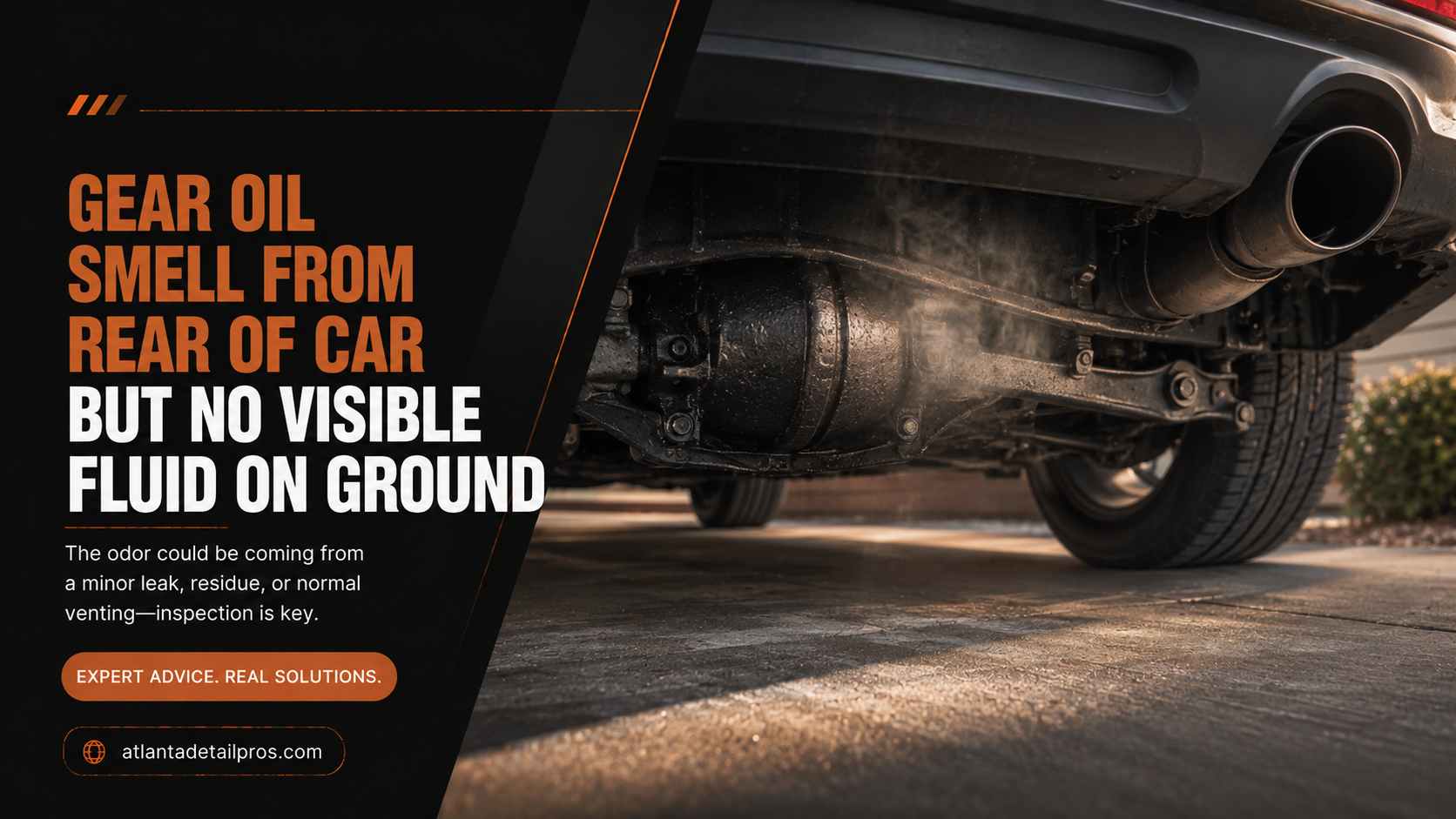
A gear oil smell from the rear of your car with no visible fluid on the ground almost always means a very early axle seal or differential seal is seeping at a rate too slow to produce a puddle, but fast enough to deposit oil on hot drivetrain components where it burns off as a sharp sulfur-like odor.
This stage of the problem is the best time to find it: the seal is failing but the fluid loss is not yet measurable at the fill plug, the brakes are not yet contaminated, and the repair cost is at its lowest. Once the seep progresses to a drip and then a puddle, the same seal job may also require brake shoe replacement, bearing replacement, and differential fluid service.
The sulfur-based additive package in gear oil has a very low odor threshold: your nose detects it at concentrations far below what would leave a visible trail. This is why a smell-but-no-puddle situation is the normal presentation of a brand-new axle or differential seal failure. The oil is reaching exhaust components, brake backing plates, or the underside of the floor pan, vaporizing on contact with heat, and rising into the wheel well or through the undercarriage.
Do not wait for a puddle to confirm the diagnosis. The smell itself is the diagnostic data.
What Gear Oil Smells Like and Why It Is Distinctive
Gear oil uses extreme pressure (EP) additives based on sulfur-phosphorus chemistry. These additives are what allow gear oil to protect metal surfaces under the enormous contact pressure of a ring and pinion mesh. The same sulfur chemistry that makes gear oil effective makes it immediately identifiable by smell: sharp, chemical, and unmistakably different from engine oil (which smells of hot petroleum or combustion byproducts) or transmission fluid (mildly sweet and synthetic).
If you are smelling something sulfurous, sharp, and chemical from the rear of the vehicle, particularly after a drive when the differential is hot, the source is gear oil from the rear axle assembly.
Why There Is Smell But No Puddle
Stage 1 Seal Seep: Vaporization Before Accumulation
A seal in the earliest stage of failure allows a micro-thin film of gear oil to pass the seal lip on each shaft revolution. The volume is too low to accumulate into a drip. Instead, the oil migrates along the axle shaft, reaches the backing plate or caliper bracket, and contacts a surface hot enough to vaporize it. The smell reaches you but the driveway stays clean.
Oil Burning Off Exhaust Components
On rear-wheel-drive vehicles, the exhaust pipes and muffler run along the undercarriage near the differential and rear axle. Even a small amount of gear oil mist settling onto a hot exhaust pipe produces a strong smell. This is often the first sign of a pinion seal beginning to fail: the seal at the front of the differential releases oil toward the driveshaft, which distributes it along the exhaust as a fine mist.
Vent Overpressure Without Active Seal Failure
A partially clogged differential vent can cause the housing to push oil vapor through the vent itself rather than through a seal. This produces a strong gear oil smell without visible fluid since the vapor condenses on underbody surfaces as a thin film rather than collecting as a drip. Locating and cleaning the vent tube resolves this without requiring seal work.
Root Cause Diagnosis Table
Smell Pattern | Most Likely Source | Action Required |
|---|---|---|
Strongest immediately after highway drive | Pinion seal early seep, oil on exhaust | Inspect pinion seal and driveshaft |
Strongest after slow city driving and stops | Axle shaft seal seep on hot backing plate | Inspect both rear axle tube ends |
Present even cold, faint petroleum note | Cover gasket weep, oil on exhaust pipe | Inspect rear differential cover perimeter |
Smell after water crossing or rain | Vent clog overpressure | Locate and clear differential vent |
Smell only inside cabin with windows up | Oil reaching exhaust near HVAC intake | Inspect full undercarriage for source |
Where to Look: A Step-by-Step Inspection
Step 1: Check the Differential Fluid Level
Remove the fill plug from the differential housing and check the level with a finger or small probe. If the level is noticeably below the fill plug opening, the seal is beyond stage 1 and measurable fluid is being lost. Even if the level appears correct, the smell is still valid evidence of a seep.
Step 2: Clean the Undercarriage and Re-Check
Spray the entire rear axle assembly, differential housing, driveshaft, and nearby exhaust components with brake cleaner and wipe down what you can reach. Park on clean cardboard after a 20-minute drive. Inspect for any wet film or discoloration. Even a stage 1 seep that produces no drip will leave an oily sheen on surfaces near the source: the axle tube near the seal, the backing plate, or the differential housing perimeter.
Step 3: Check the Differential Vent
Locate the vent tube or vent plug, typically a rubber hose or threaded fitting at the top of the differential housing. Remove it and verify it is open and clear. A blocked vent will feel pressurized when removed while the differential is warm. Clear the vent with a thin wire or replace it if blocked.
Step 4: UV Dye Test
Add gear oil UV dye to the differential through the fill plug. Drive for 20 to 30 minutes. Use a UV lamp to scan the entire rear axle assembly. UV dye reveals a stage 1 seep that produces no visible trail under normal light: the dye fluoresces brightly along the exact path of the oil film and identifies the source precisely.
Smell Without Puddle Urgency Scale
Smell Intensity | Fluid Level at Fill Plug | Recommended Action |
|---|---|---|
Faint, only after long drives | Normal | Inspect within 1 week using UV dye |
Moderate, present after most drives | Normal | Inspect immediately with UV dye or clean and recheck |
Strong, present after short drives | Slightly low | Repair within 3 to 5 days |
Very strong, detectable inside cabin | Low | Do not drive: active leak with brake risk |
“I kept smelling something burning and sulfury from the back of my truck but found nothing on the garage floor. Took it to a shop and they UV tested the whole rear end. Turned out the pinion seal was seeping onto the exhaust. Tiny amount of oil, massive smell. Caught it before any real fluid loss.” : Kevin Hartley, 2011 Chevrolet Silverado 1500 owner
Vehicle-Specific Patterns
Jeep Wrangler TJ and JK with Dana 35 and Dana 44 rear axles develop axle shaft seal seeps as early as 60,000 miles when the axle has seen water crossings. The rubber seal lip degrades faster with repeated immersion and temperature shock. The smell is often first noticed on the trail before any driveway evidence appears.
Toyota Tacoma and 4Runner with the 8.4-inch rear differential develop pinion seal seeps around 100,000 to 130,000 miles. The exhaust routing on these platforms passes close enough to the pinion area that a stage 1 seep produces noticeable cabin odor before any driveway drip develops.
Ford F-150 with the 8.8-inch rear axle is known for axle shaft seal weeping between 90,000 and 120,000 miles. The first sign is typically a burning smell from the rear wheel area after sustained highway driving with no visible evidence underneath.
GM trucks with the 10-bolt rear axle frequently develop cover gasket seeps that produce odor before puddles. The factory RTV sealant hardens with age and develops hairline gaps that allow vapor transfer before a weeping leak forms.
FAQs
Is a gear oil smell from the rear of the car dangerous to ignore?
In the short term, a faint smell with normal fluid level and normal brake feel is not immediately dangerous. In the medium term, ignoring it allows the seep to progress to a drip and eventually to brake contamination, which is a safety issue. The smell-but-no-puddle stage is the lowest-cost and lowest-risk point to address the problem.
Could the smell be coming from somewhere other than the rear differential?
Yes. A transfer case on four-wheel-drive vehicles uses a similar gear oil or ATF formulation and can produce an identical smell if it is seeping. The rear output shaft seal on a transfer case sits close to the driveshaft and can mist oil onto exhaust components. Confirm the source is the rear axle and not the transfer case by inspecting both locations with UV dye.
How can I tell if gear oil has already reached my rear brakes?
With the vehicle on jack stands, remove a rear wheel and inspect the inside of the drum or inner face of the rotor hat. Gear oil contamination appears as a darkened, wet, or greasy film on the drum interior or brake hardware. Feel for a soft or grabby sensation in the rear brakes: either symptom combined with the smell suggests brake contamination.
Does gear oil smell go away on its own?
No. The smell will only intensify as the seal continues to degrade. Gear oil deposited on exhaust components burns off over time but is continuously replenished by the ongoing seep. The smell fading briefly does not mean the seal has recovered.
What is the repair cost if caught at the smell-only stage?
At the smell-only stage with no brake contamination, repair cost is typically $80 to $200 per affected seal at an independent shop. This is the lowest cost version of the repair. Once brake shoes or drums are involved, add $150 to $270. Once the differential has lost measurable fluid, a fluid service is added to the seal work.
Bottom Line
A gear oil smell from the rear of the car with no visible puddle is an early seal failure asking to be addressed before it becomes a more expensive problem.
The smell-but-no-puddle stage is temporary: all stage 1 seeps progress given enough mileage and heat cycles. The window where this costs $80 to $200 to fix is open right now. The window where it also requires brake shoe replacement and a differential fluid service requires you to have driven past the point where driveway evidence first appeared.
Use UV dye to confirm the source. Check the vent tube while you are under there. Book the repair before the next long drive. Acting at the smell stage is the correct and lowest-cost response to this problem.