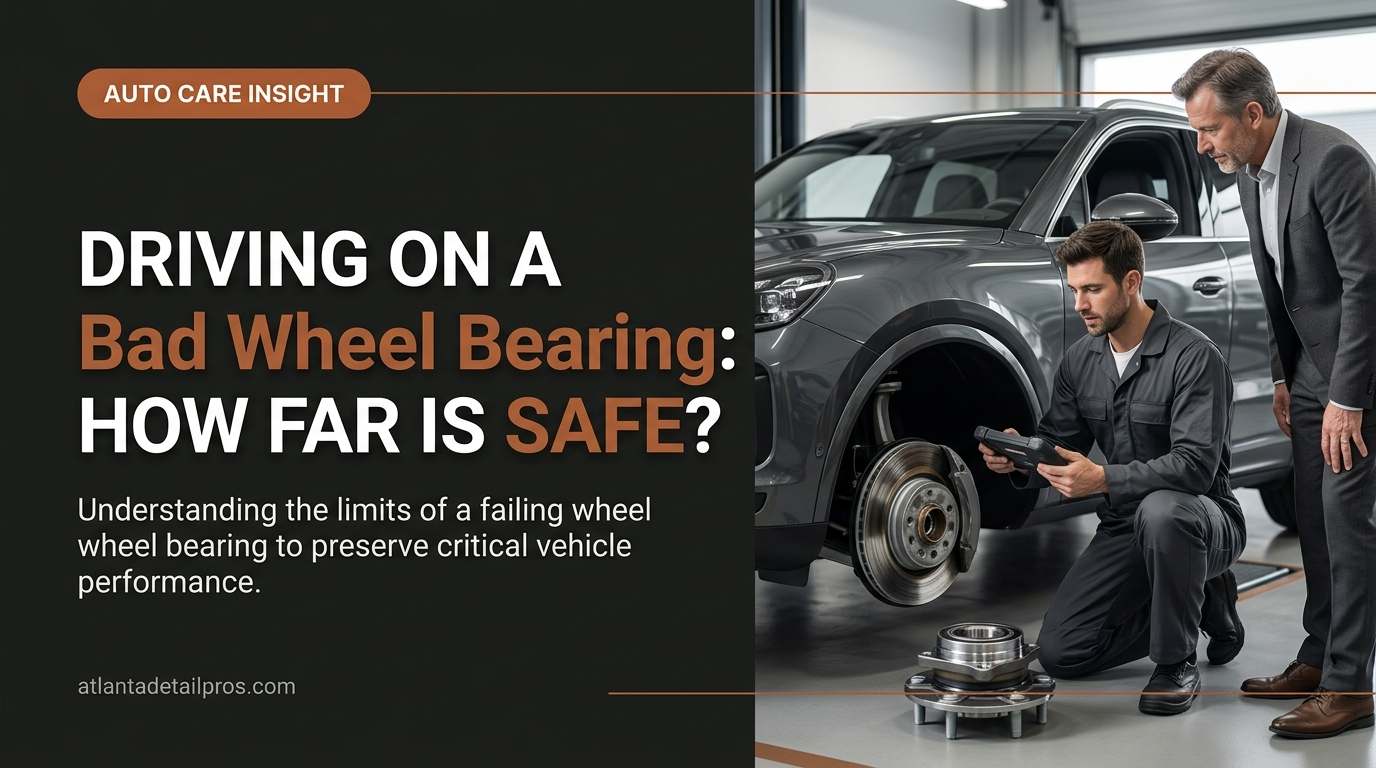
The honest answer is: it depends on what stage of failure the bearing is in, and the range is enormous. A bearing producing only a faint hum at highway speed may tolerate several hundred miles of cautious driving before reaching dangerous territory. A bearing that is grinding at 20 mph could fail catastrophically within the next 50 miles or on the very next drive. The noise is the diagnostic signal, and the character of the noise tells you more than any mileage figure.
This guide gives you the stage-by-stage breakdown, the specific tests that help you gauge how advanced the failure is, what collateral damage accumulates while you delay, and the one failure mode that causes wheel separation, because that is the information every other article either buries or skips.
How Wheel Bearings Fail: The Progression That Determines Your Driving Window
A wheel bearing is a precision assembly of hardened steel balls or tapered rollers housed in a race and packed with grease. It allows the wheel to spin freely with minimal friction while supporting the full load of the vehicle. Bearing failures are almost always a lubricant story: the grease breaks down from heat and age, the seal that keeps the grease in and contamination out fails, and the dry metal-on-metal contact begins wearing the rolling elements and the race surface. This process is irreversible and self-accelerating because heat generated by the dry contact drives out any remaining grease faster, which produces more heat.
The rate of failure progression is not linear and cannot be predicted precisely. A bearing can produce the same faint hum for months, and then deteriorate from hum to grinding in a single drive when the grease reservoir finally exhausts. This unpredictability is the core reason that generous mileage estimates for bad wheel bearings should be treated as statistical averages rather than safe individual limits.
The Three Failure Stages and What Each Means for Your Driving Range
Matching your symptoms to the correct stage is the most important step in this diagnosis. Each stage carries a fundamentally different level of urgency and a different estimated driving window.
Stage 1: Faint Hum or Drone at Highway Speed
The bearing is beginning to lose its lubrication and smooth surface contact. The noise is a low drone or hum that appears above 40 to 50 mph and may be confused with tire noise or road surface variation. The key distinction from tire noise: tire noise is consistent regardless of steering input, while a failing wheel bearing hum typically changes pitch when you gently steer left or right at highway speed. Steering toward the bad bearing side loads it more heavily and the hum increases. Steering away from it reduces the load and the hum quiets. This is called the cornering load test and it is the fastest free diagnostic available.
At Stage 1, the bearing may tolerate 200 to 500 miles of cautious low-speed driving in many cases, though this range is not guaranteed. Do not use this range as a planning tool for extended trips. Schedule the repair within the week and avoid highway speed where possible.
Stage 2: Distinct Grinding, Rumbling, or Growling Noise
The bearing has lost significant lubrication and the rolling elements are contacting damaged race surfaces. The grinding or rumbling sound is audible at lower speeds, often below 30 mph, and becomes louder and more intense at highway speed. At this stage the bearing is generating significant heat and the deterioration rate has accelerated. The cornering load test is more pronounced: load on the bad bearing side produces an unmistakable growl that quiet side reduces significantly.
Stage 2 bearings should not be driven more than a few dozen miles to essential destinations at reduced speed. Highway driving at Stage 2 is genuinely dangerous because the increased speed dramatically increases the heat generation rate, which can compress the remaining bearing life from days into minutes. If Stage 2 symptoms are present, the safest decision is to arrange a tow.
Stage 3: Wheel Play, Vibration Through Steering or Floor, or ABS Warning Light
The bearing has developed physical play, meaning the hub can be physically moved relative to the spindle. Vibration is felt through the steering wheel, floorboard, or seat. The ABS system warning light may activate because the wheel speed sensor mounted on the hub assembly is reading inconsistently as the hub wobbles. At Stage 3, the bearing is on the verge of seizure or catastrophic failure. Do not drive. Arrange a tow immediately.
The Wheel Separation Risk: What Actually Happens When a Bearing Fails Completely
Wheel separation is the failure mode that makes a failing wheel bearing a genuine safety emergency rather than just an expensive repair. Most drivers who have heard the term assume it is extremely rare. It is rare, but it is also real, and it typically occurs without the clear warning signs most drivers expect.
The Seizure Scenario
When a bearing seizes, the rolling elements lock in place. The hub, which was rotating freely with the wheel, is suddenly prevented from rotating. On driven wheels (front-wheel drive front wheels, rear-wheel drive rear wheels), this can cause the affected wheel to lock up suddenly mid-drive. At highway speed, a sudden single-wheel lockup produces severe vehicle instability because the braking force is now entirely on one wheel while the others continue at speed.
The Wheel-Off Scenario
In the most severe cases, a bearing that has failed completely allows the wheel hub to separate from the spindle. The wheel comes off the vehicle. This is rare on modern hub-bearing assemblies but has occurred, including at highway speed. Real-world accounts from drivers who have experienced bearing failure confirm that it can happen suddenly and without final warning: the noise sounds stable for weeks and then fails on a single drive. One documented account involves a driver traveling at 75 mph whose wheel came off after approximately 350 miles of driving after the noise began. The outcome was a loss of control event.
A wheel bearing that is growling or grinding at low speeds, showing wheel play when you grab the tire at 12 and 6 o clock and rock it, or triggering an ABS warning light is at high risk of seizure or separation. Do not drive this vehicle on the highway under any circumstances. Arrange a tow.
The Cornering Load Test: How to Confirm a Bad Wheel Bearing in 60 Seconds
This is the fastest, most reliable free diagnostic for a suspected wheel bearing. It requires only an empty road and takes one minute. The principle is that loading the bearing increases the noise from a failing bearing, while unloading it reduces the noise. Steering direction determines which front bearing is loaded.
Find an empty road or large parking lot. Accelerate to 40 to 50 mph. Gently steer left, holding the wheel steady in a slight left curve. Then gently steer right, holding in a slight right curve. Listen for which steering direction makes the noise louder.
- Noise louder when steering left (loading right bearing): right bearing is failing.
- Noise louder when steering right (loading left bearing): left bearing is failing.
- Noise identical in both directions: tire noise, road noise, or a different source. Rotate tires front-to-rear and retest.
Perform the same test at lower speed (15 to 20 mph) to check rear bearings where the cornering load effect is less pronounced but still detectable.
What Happens to Other Components While You Delay
A bad wheel bearing that is allowed to deteriorate does not fail in isolation. The components around it absorb consequences that increase the total repair cost with each additional week of delayed service.
ABS Reluctor Ring Damage
Modern hub bearing assemblies contain a magnetic reluctor ring that the ABS wheel speed sensor reads as the hub rotates. When the bearing loses its precise geometry from wear, the reluctor ring can become damaged, corroded at the ring-to-hub interface, or physically broken. A damaged reluctor ring requires a new hub bearing assembly regardless, but a severely damaged ring can also damage the ABS sensor itself, adding $50 to $150 to the repair.
Spindle and Knuckle Damage
As the bearing race wears, the steel particles it generates are abrasive. Those particles distribute through the grease and score the spindle surface that the bearing race presses against. A scored spindle may require replacement along with the bearing, turning a $300 to $400 bearing job into a $600 to $900 job. On integrated hub-bearing assemblies common on modern vehicles, the spindle and hub are sometimes a single assembly, making the cost escalation significant.
Symptom Stage | Estimated Driving Range | Speed Limit | Urgency | Risk |
|---|---|---|---|---|
Faint hum at highway speed only | Up to 200-500 miles cautiously | Under 50 mph | Repair within the week | Low but rising |
Distinct grinding or rumbling at city speed | A few dozen miles max | Under 30 mph | Repair today or tow | Moderate to high |
Wheel play, vibration, ABS light on | Do not drive | None | Tow immediately | High: seizure or separation risk |
Frequently Asked Questions
How far can you drive on a bad wheel bearing?
It depends entirely on the failure stage. A faint hum at highway speed only may allow 200 to 500 miles of cautious driving at reduced speed as a statistical average, but no specific mileage is guaranteed because bearing progression is nonlinear. Grinding at low speed means the bearing may have tens of miles remaining before a dangerous failure. Any wheel play, ABS warning light, or severe vibration means zero additional safe miles. Use the cornering load test to assess which stage applies, not a mileage estimate.
Can I drive on the highway with a bad wheel bearing?
At Stage 1 with only a faint hum, short highway distances are lower risk but not recommended. At Stage 2 with grinding or low-speed noise, do not drive on the highway. Highway speed dramatically increases the heat generation rate inside a deteriorating bearing, compressing the remaining life from what might be days into minutes. Seizure and wheel separation are far more likely at 70 mph than at 25 mph.
How do I know which wheel bearing is bad?
Use the cornering load test. On an empty road at 40 to 50 mph, gently steer left then right and listen for which direction increases the humming or grinding. Noise louder when steering left means the right bearing is failing (more load on the outside of the turn). Noise louder when steering right means the left bearing is failing. Confirm by grabbing the tire at 12 and 6 o clock with the vehicle on jack stands and rocking it: any perceptible play or wobble confirms bearing failure at that corner.
How much does wheel bearing replacement cost?
On most front-wheel drive passenger cars with integrated hub-bearing assemblies, replacement costs $250 to $500 per corner at an independent shop including parts and labor. Trucks and SUVs with tapered roller bearings that require pressing run $300 to $600. The cost increases to $600 to $900 if the spindle or ABS reluctor ring has been damaged by an extended period of driving on a severely worn bearing.
The Bottom Line
A bad wheel bearing is not a set-number-of-miles problem. It is a failure-stage problem. Identify the stage using the cornering load test and the wheel play test. Stage 1 with a faint hum gives you a short window to arrange repair. Stage 2 with grinding gives you enough for a slow drive to a nearby shop if a tow is unavailable. Stage 3 with wheel play or an ABS light gives you nothing: tow the vehicle. The cost of a tow is $100 to $200. The cost of a seized bearing that damages the spindle and ABS sensor is $600 to $900. The cost of a wheel separation at highway speed has no price.