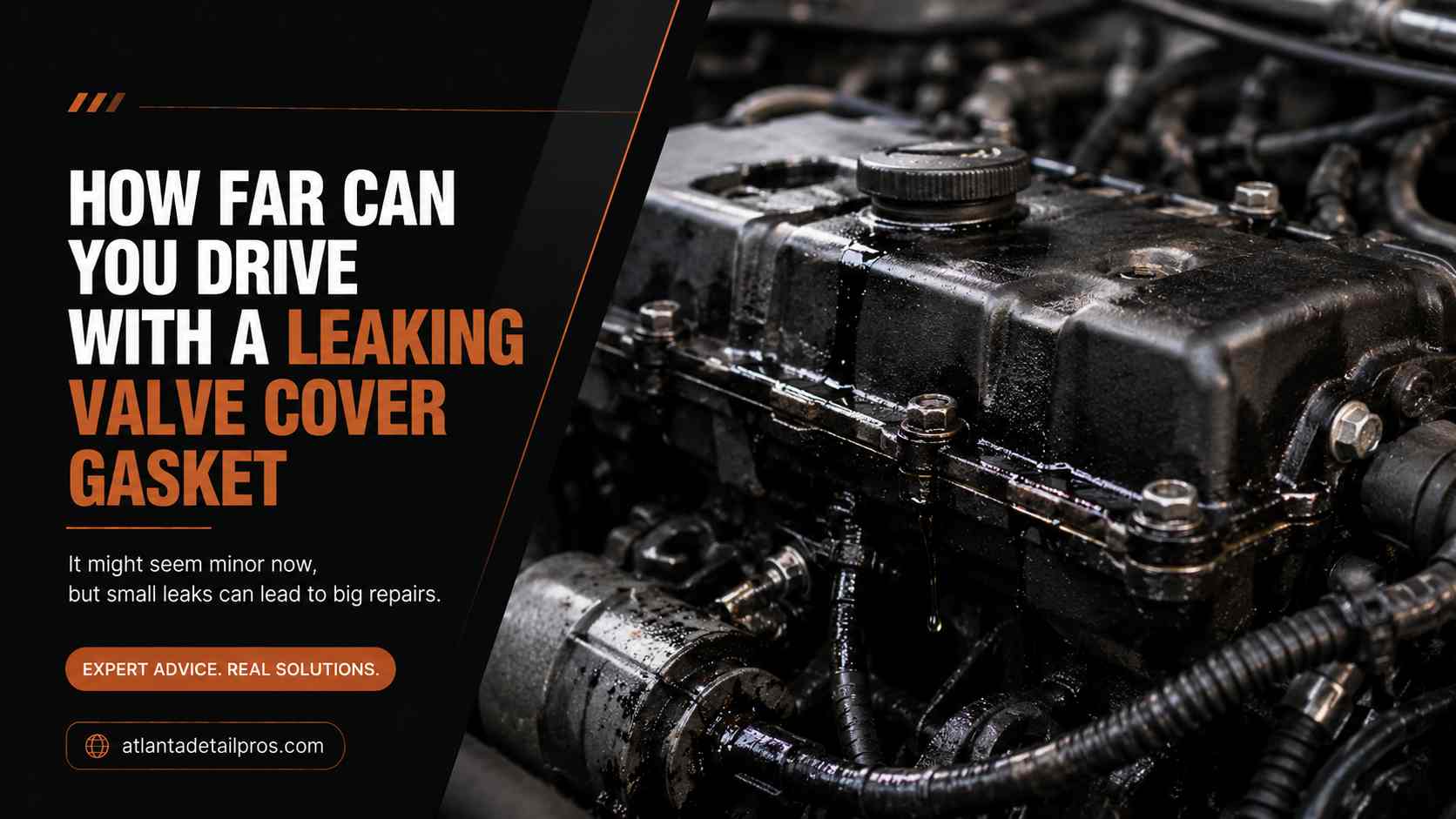
A leaking valve cover gasket can typically be driven hundreds of miles if the leak is a minor seep with no oil reaching hot exhaust surfaces: however, a leak that allows oil to drip or run onto the exhaust manifold or catalytic converter creates a genuine fire risk and should be treated as an immediate repair regardless of how small the leak appears.
The gasket condition matters far less than where the escaping oil ends up once it leaves the valve cover perimeter.
Most drivers discover a valve cover gasket leak through a burning oil smell at operating temperature, a dark puddle under the engine after parking, an oil residue visible on the engine’s exterior, or a misfire from oil fouling a spark plug. The valve cover gasket is a rubber or cork seal that runs around the perimeter of the valve cover, keeping oil inside the engine as it lubricates the overhead camshafts and valve train components. When it fails, oil seeps out along the joint between the cover and the cylinder head.
The repair is one of the most accessible and affordable gasket jobs on most engines. The risk of not doing it ranges from negligible to severe depending entirely on where the leaking oil travels after leaving the cover.
Why Valve Cover Gasket Leaks Vary So Widely in Severity
Low-Risk Drip: Oil Stays on the Block and Drips to the Ground
A valve cover gasket that seeps oil onto the top of the engine block or down the exterior of the cylinder head to the ground is a maintenance cost and an inconvenience, but it is not an immediate mechanical emergency. The engine is designed to tolerate external oil seepage: the critical issue is maintaining adequate oil volume inside the engine for lubrication, not preventing every external trace of oil.
On a vehicle where the valve cover sits atop the engine well away from any exhaust routing, a slow seep that drips to the ground can be driven for hundreds of miles with regular oil level monitoring. The repair can be scheduled at a convenient time within a few weeks without significant risk of secondary damage.
High-Risk Drip: Oil Reaches the Exhaust Manifold or Catalytic Converter
The exhaust manifold on a gasoline engine operates at 800 to 1,200 degrees Fahrenheit during normal driving. The catalytic converter operates at 800 to 1,600 degrees Fahrenheit at full operating temperature. Motor oil has an autoignition temperature of approximately 400 to 500 degrees Fahrenheit.
When valve cover oil seeps down the back or side of the cylinder head and contacts any exhaust component operating above 400 degrees Fahrenheit, it ignites. The ignition point is not always visible from the driver’s perspective because it typically occurs on the underside of exhaust manifold heat shields or at the junction between the cylinder head and the manifold, areas hidden from direct view.
Engine compartment fires that originate from oil-on-exhaust events typically start as a burning smell, then smoke, then a fire that can spread to plastic intake components, wiring harnesses, and the firewall before the driver is aware of the severity. This is the scenario that converts a routine valve cover gasket repair into a tow and potential vehicle total loss.
Secondary Risk: Spark Plug Tube Seal Failure and Misfires
Many modern engines route the spark plug boots and tubes through recesses in the center of the valve cover. The valve cover gasket often incorporates rubber O-ring seals around the base of each tube to prevent oil from entering the tube cavity and fouling the spark plug. When the perimeter valve cover gasket fails from age and compression set, the tube O-rings typically fail around the same time or shortly after.
Oil that enters the spark plug tube coats the plug electrode and insulator, causing an incomplete spark and a cylinder misfire. The driver experiences rough idle, acceleration hesitation, and the check engine light with misfire codes (P0300 through P0308 range, depending on cylinder count). On engines where the spark plug tubes are recessed deeply into the valve cover, oil in the tubes is actually the more common presenting symptom of a valve cover gasket failure than visible external leakage.
Platforms particularly prone to this failure mode include the BMW N52B30, N54B30, and S54B32, the Toyota 2GR-FE and 1GR-FE, the Honda J35Y (3rd generation Odyssey and Pilot), and the Ford Modular 4.6L 2-valve.
Engine Layout and Exhaust Proximity: Mapping the Risk Level
| Engine Layout | Valve Cover Location | Exhaust Manifold Proximity | Typical Risk Level |
|---|---|---|---|
| Inline-4, transverse FWD | Top center of engine | Front or rear of engine, variable | Yellow: inspect the oil path before driving |
| Inline-4, longitudinal RWD | Top center | Lateral, often close to cover edge | Yellow to Amber: trace carefully |
| V6 or V8, front bank | Front bank cover, accessible | Front manifold, typically below and forward | Yellow: more separation, easier to trace |
| V6 or V8, rear bank | Rear bank cover near firewall | Rear manifold, tight packaging | Amber: oil pools in inaccessible areas |
| Inline-6, longitudinal | Long top-of-engine cover | Side manifold along the block | Yellow to Amber: depends on failure location |
| Boxer (Subaru EJ, FA) | Left and right horizontal covers | Side manifolds at lower position | Amber: manifolds are close to cover edge |
| Turbocharged engine (any layout) | Varies | Turbocharger housing added heat source | Amber to Red: turbo surfaces exceed 1,000F |
How to Assess Your Specific Leak at Home in 15 Minutes
Step 1: Locate the Leak Point Precisely
With the engine fully warm (oil is thinner and the leak rate is highest), inspect the junction between the valve cover and the cylinder head all around the perimeter. Oil will appear as a wet, dark streak originating at the gasket line. Note the specific location: the corners of the cover, the areas near the front and rear sealing surfaces, and any locations near spark plug tubes are the most common failure points because gasket material compresses and hardens with age most severely at corners and stress points.
Step 2: Trace the Oil Path Downward
Follow every visible oil streak downward from the gasket failure point. This tells you where the oil goes after leaving the cover. Wipe the area clean with a rag, run the engine for 5 minutes, then look for new oil trails and trace each one. If oil runs from the valve cover perimeter across the top of the block and drips to the ground below the engine, the risk is low. If any trail leads toward the exhaust manifold, the heat shield above it, or the turbocharger housing, the risk is elevated and repair becomes urgent.
Step 3: Check for Burning Smell and Under-Hood Smoke
A burning oil smell while the engine is running at normal temperature confirms oil is already reaching a hot surface somewhere in the engine bay. This smell is often detectable from inside the vehicle with the heat turned on. Look for thin wisps of white-gray smoke rising from the engine bay, specifically from the exhaust manifold area. Smoke from an oil-on-exhaust contact point is typically thin and white-gray rather than blue or black.
If you see this smoke, the repair is urgent. It is no longer a scheduling convenience.
Step 4: Quantify the Oil Loss Rate
Check the dipstick. If the level has dropped half a quart or more since you last checked within the past week, the leak rate is significant. A valve cover gasket can leak at many different rates depending on how severely the gasket material has deteriorated and whether the valve cover itself has warped. Warped covers (common on aluminum-cover engines with over-torqued or repeatedly removed covers) cannot seal adequately even with a new gasket until the cover is straightened or replaced.
“I had a burning smell for about two weeks but the car ran fine and I didn’t see any obvious smoke. I finally put it on jack stands and looked from underneath. Oil had been dripping down onto the exhaust manifold and there was a carbon crust buildup about four inches long where it had been burning off. The mechanic said there was oil soaking into the manifold heat shield insulation that was close to catching properly. Two more weeks and it might have been an engine fire. The gasket replacement was $240 total.”: Jesse Ackerman, 2009 Subaru Outback 2.5L
How Far You Can Drive: A Practical Decision Table
| Leak Severity | Oil Destination | Drive Decision | Monitoring Required |
|---|---|---|---|
| Minor seep (a few drops per day) | Stays on block top, drips to ground | Green: Drive normally, repair within 4 to 6 weeks | Check oil level every 3 to 5 days |
| Moderate drip (steady trickle at operating temp) | Runs down block exterior to ground | Yellow: Drive to shop within 1 week | Check oil level every 1 to 2 days |
| Any amount of oil reaching exhaust surfaces | Contact with manifold or heat shield | Red: Repair within 48 hours, no highway driving | Do not drive if burning smell is present |
| Oil confirmed in spark plug tubes | Misfires, rough idle, check engine light | Amber: Drive to shop within 2 to 3 days | Avoid extended idling |
| Fast leak: oil level drops noticeably daily | Any path | Amber: Shop within 1 to 2 days | Check oil before every drive |
| Turbocharged engine with any exhaust-path leak | Turbo surfaces | Amber to Red: Same-day repair | Avoid boosted driving |
Valve Cover Gasket Repair Costs by Engine Type
| Engine and Difficulty | Access Required | Independent Shop Labor | Total Repair Cost |
|---|---|---|---|
| Inline-4, easy access (Honda K-series, Toyota 2AZ-FE) | Cover removal only | 0.75 to 1.5 hours | $100 to $260 |
| Inline-4, moderate access (VW EA888, Ford EcoBoost 2.0T) | Intake duct, coil packs | 1.5 to 2.5 hours | $200 to $420 |
| V6, front bank only (Toyota 3.5L 2GR, GM 3.6L LFX) | Intake manifold partial | 1.5 to 2.5 hours | $200 to $450 |
| V6 or V8, rear bank (any V-engine with firewall packaging) | Significant ancillary removal | 2.5 to 5 hours | $350 to $800 |
| BMW inline-6 (N52, N54, B58) | Integrated manifold and coil cover | 2 to 4 hours | $350 to $750 |
| Subaru boxer (EJ25, FA20), per side | Cover access, timing references | 1.5 to 2.5 hours per side | $220 to $500 per side |
| High-labor V8 (Land Rover, Mercedes AMG, some Fords) | Major front or top-end removal | 4 to 7 hours | $600 to $1,400 |
The gasket itself costs $12 to $80 for most vehicles. The cost of the repair is determined almost entirely by labor and by what must be removed to access the valve cover on the specific engine design. Replacing the gasket on a high-access inline-4 is genuinely a DIY job for someone with basic mechanical skills and 2 to 3 hours of time. Replacing the rear bank valve cover gasket on a transverse V6 in a minivan is a professional job.
Frequently Asked Questions
How do I know if the valve cover gasket is leaking versus the head gasket?
A valve cover gasket leak produces oil on the exterior of the engine: on the top or sides of the cylinder head and block, dripping to the ground. It does not cause coolant loss, white exhaust smoke, or oil-coolant mixing. A head gasket leak typically involves coolant entering the combustion chamber (white exhaust smoke with sweet smell, coolant reservoir losing level), oil-coolant mixing (milky dipstick or oil cap residue), or combustion gases entering the cooling system (bubbles in the reservoir under a running engine). An external oil seep at the valve cover perimeter with no cooling system symptoms is a valve cover gasket, not a head gasket.
Can I use RTV silicone sealant to fix a valve cover gasket leak externally?
Applying RTV to the outside of a leaking valve cover gasket joint is not an effective repair. Oil pressure inside the valve cover area pushes outward at the leak point, and externally applied sealant cannot withstand that pressure from the wrong side. RTV is used correctly during a proper gasket replacement as a supplemental sealant at the corners and at specific junction points where the gasket meets a different surface, applied to the inside of the joint during reassembly. External application is a waste of time and money.
Does a valve cover gasket leak affect engine performance?
A valve cover gasket leak does not directly affect performance unless oil has entered the spark plug tubes and fouled the plugs. Oil-fouled plugs cause misfires, rough idle, and hesitation under acceleration. If you have a rough idle or misfire along with a burning oil smell, inspect the plug tubes when removing the valve cover for the gasket replacement. You may need to replace fouled plugs at the same time, which adds $40 to $120 to the repair depending on plug type and cylinder count.
How long does a valve cover gasket last?
Factory valve cover gaskets on modern engines typically last 60,000 to 100,000 miles before the rubber compound shrinks, hardens, and loses its sealing compression. Engines that run consistently at high temperatures from towing, performance driving, or hot climates experience accelerated gasket degradation. Engines with a history of over-torqued valve cover bolts (a common DIY mistake) warp the aluminum valve cover and create uneven sealing pressure that shortens gasket life regardless of the rubber’s condition. If replacing one bank’s gasket on a V-engine, replacing both banks simultaneously is cost-effective since both gaskets are the same age.
Is it safe to keep adding oil to compensate for a slow valve cover gasket leak?
Topping off oil to compensate for a slow leak is an acceptable short-term bridge if the leak rate is very slow (less than half a quart per 1,000 miles) and you have confirmed the oil is not reaching any exhaust surface. It is not an indefinite strategy. The leak rate will increase as the gasket material continues to deteriorate. The ongoing risk of oil reaching exhaust components is always present with a leaking cover, regardless of how small the leak currently appears. Schedule the repair within the time frame appropriate to the leak severity.
Can a valve cover gasket leak cause an oil pressure drop?
A valve cover gasket leak large enough to drop the oil level significantly can indirectly cause low oil pressure because the oil pump needs adequate fluid volume to build and maintain pressure. A minor seep that loses a quart over several thousand miles will not affect oil pressure. A fast leak that drops the dipstick reading quickly creates the same oil pressure risk as any other significant oil loss. Check the dipstick regularly any time a valve cover gasket leak is known and unrepaired.
The Bottom Line
The valve cover gasket leak is one of the most manageable engine oil leaks from a safety standpoint, with one critical exception that changes the entire calculus: oil reaching the exhaust manifold or catalytic converter converts a routine maintenance item into a fire hazard that demands immediate attention, not a convenient scheduling window.
For leaks that stay on the engine block exterior and drip to the ground, a few weeks of deferred repair with active oil level monitoring is reasonable and low-risk. The monitoring interval should match the leak rate: a fast drip means checking the dipstick before every drive, not once a week.
The repair cost for most valve cover gaskets is among the most affordable gasket jobs in automotive maintenance, typically $100 to $450 on accessible engines. Deferring it until the burning smell turns to smoke, or until the oil level drops unexpectedly on a highway drive, adds the cost of a tow and potential secondary repairs to what should have been a simple, inexpensive shop visit.