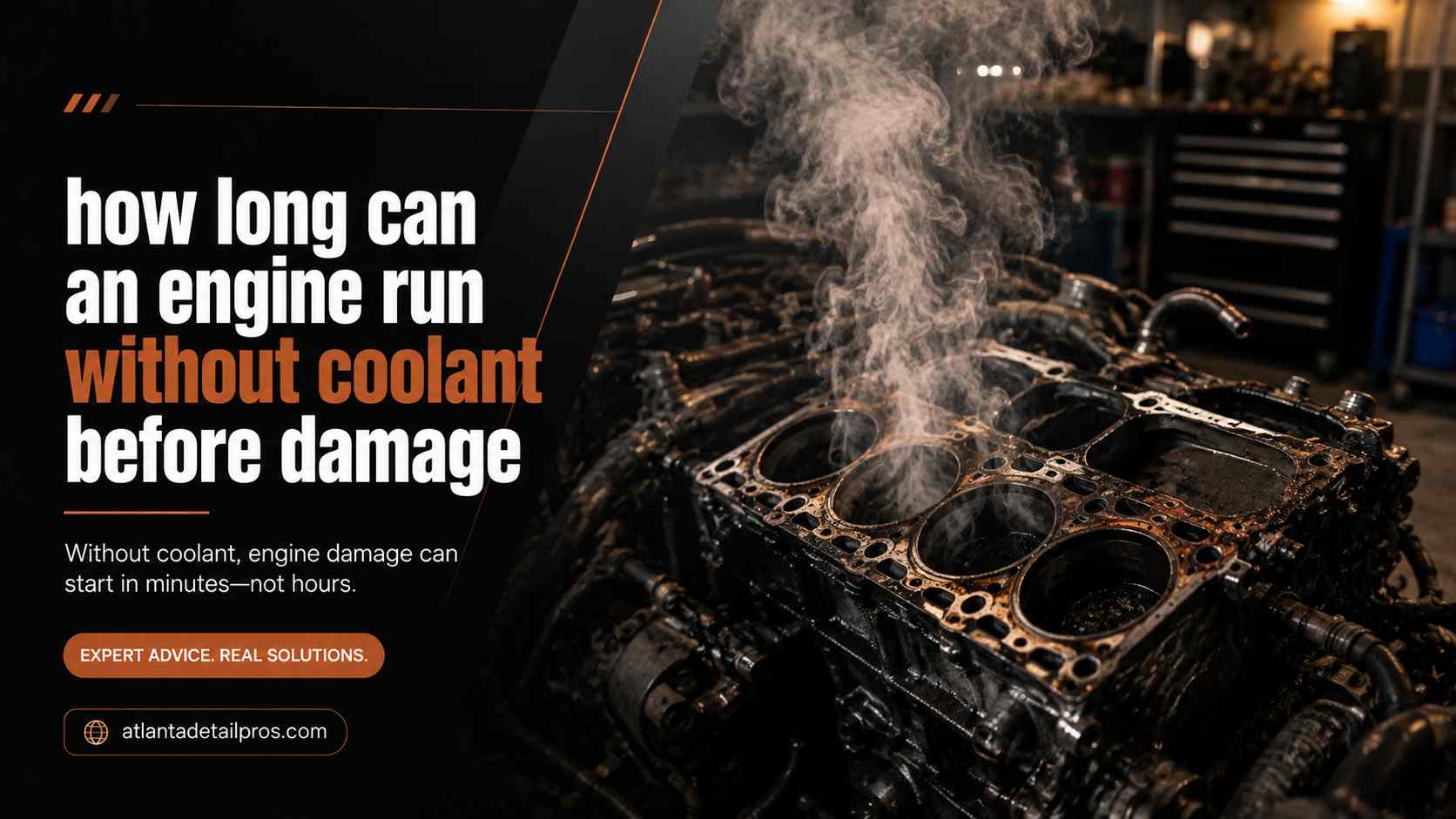
An engine running at operating temperature with no coolant will begin sustaining irreversible damage within 15 seconds to 2 minutes under load, and within 3 to 5 minutes at idle with no airflow through the radiator.
The exact window depends on engine material, operating load, ambient temperature, and whether any residual coolant remains in the block passages, but no modern engine tolerates zero-coolant operation for any meaningful length of time without consequence.
Most drivers encounter the zero-coolant scenario when a hose ruptures, a water pump fails catastrophically, or a head gasket breach rapidly evacuates the cooling system. The common instinct is to push through to the next exit or the nearest gas station. Understanding what is happening inside the engine during those minutes makes the cost of that decision concrete and unavoidable.
This guide covers the physical failure sequence at zero coolant, the differences between engine types, how far you can drive with critically low coolant before damage becomes inevitable, and what the repair bill looks like at each stage of the timeline.
The Physics of an Engine Running Without Coolant
What Coolant Actually Does at the Molecular Level
Modern gasoline engines produce combustion chamber temperatures reaching 4,500 to 5,000 degrees Fahrenheit at the flame front. The metal surfaces of the combustion chamber, cylinder head, and piston crown never reach that peak temperature because the combustion event is brief, but they do sustain temperatures of 400 to 700 degrees Fahrenheit in normal operation. The coolant system continuously absorbs that heat and carries it to the radiator, where it dissipates into the ambient air.
When coolant is absent, heat transfers only through the metal itself (conduction) and out to the surrounding air via the engine’s external surfaces (convection). The conductive and convective capacity of those external surfaces is a fraction of what a functioning coolant circuit provides. Heat builds faster than it can escape.
Aluminum, which makes up the cylinder heads and increasingly the engine blocks of modern vehicles, heats rapidly and uniformly because of its excellent thermal conductivity. This sounds like an advantage, but it also means the entire head reaches critical temperature within a much shorter window than a cast iron equivalent would. Aluminum begins losing structural strength above 400 degrees Fahrenheit and softens significantly above 650 degrees Fahrenheit, well within the range an uncooled aluminum head reaches within minutes of coolant loss under driving conditions.
Why the Head Gasket Is the First Component to Fail
The cylinder head is the most thermally stressed component in the engine. It sits directly above the combustion chamber and absorbs heat from both the combustion event above and the hot cylinder walls below. The head gasket is a composite sandwich of steel, elastomers, and sometimes copper that maintains a seal between the head and block at three critical boundaries: coolant passages, oil passages, and the combustion chamber edge.
As the head overheats without coolant, it expands unevenly. Modern engines use aluminum heads bolted to aluminum or cast iron blocks, two materials with different thermal expansion rates. This differential expansion causes the head to lift slightly from the block surface at the highest temperature zones, which are typically around the cylinders at the center of the block where heat concentrates. Once the head lifts even fractionally, the gasket loses clamping force at that point and combustion gases blow through, destroying the gasket permanently.
The Damage Timeline at Zero Coolant
Cold Engine Starting With No Coolant
An engine at ambient temperature and started with zero coolant has a slightly longer window before catastrophic failure than one already at operating temperature. The cold metal mass absorbs a significant amount of heat before reaching critical surface temperatures.
Typical timeline for a cold engine at idle with no coolant:
0 to 3 minutes: Engine heats rapidly. No cooling occurs. Temperature gauge climbs faster than normal. No damage yet, but the margin is already gone.
3 to 5 minutes: Cylinder head temperatures approach the threshold for head gasket stress. White steam may appear if any residual water remains in the block passages.
5 to 10 minutes: Aluminum head surfaces reach temperatures where the metal begins to soften at the highest stress points. Head gasket failure is occurring within this window whether or not the engine runs roughly.
10 to 20 minutes: Depending on the engine, catastrophic failure arrives: seized pistons, cracked head, warped combustion deck, or a bent connecting rod from hydraulic lock if residual coolant enters a cylinder during a combustion stroke.
Engine Already at Operating Temperature With No Coolant
This is the more common real-world scenario: a hose ruptures mid-drive or a water pump fails at highway speed. The engine is already at 195 to 220 degrees Fahrenheit, and the residual coolant is evacuating in seconds.
0 to 15 seconds: With no coolant flow and the engine under highway load, cylinder head temperatures begin climbing immediately. The water pump is no longer circulating any protective fluid.
15 to 60 seconds: Head temperature in the highest-load cylinders exceeds the normal operating range. Maximum heat output meets zero dissipation capacity.
1 to 2 minutes: Head gasket failure begins. White smoke may appear from the exhaust as the last residual coolant in the combustion chamber vicinity burns off.
2 to 5 minutes: Piston ring clearances close from thermal expansion, causing bore scoring. Connecting rod bearings lose their oil film as the oil thins severely under the heat load. On the Toyota 2GR-FE, the VVT actuators fail from oil degradation at this stage. On the GM LS family, aluminum heads warp and crack. On the Ford Coyote 5.0L, cylinder head bolt bosses can fracture from differential thermal expansion.
5 minutes and beyond: Engine seizure or catastrophic mechanical failure. The engine is typically a total loss at this point.
“The lower hose blew on the on-ramp at about 60 mph. I pulled over within maybe 45 seconds but by then the temperature gauge was already in the red. The engine still started the next morning but by the time it got to the shop the head gasket was gone on cylinders three and four. The mechanic said another 30 seconds of running under that load and I probably would have cracked the head too. Forty-five seconds cost me $1,800.”: Brian Koller, 2014 Toyota Camry 2.5L
Aluminum vs. Cast Iron: How Engine Material Changes the Window
| Engine Construction | Heat Absorption Rate | Time to Critical Temperature (under load) | Common Failure Mode |
|---|---|---|---|
| All-aluminum (head and block) | Fast: heats uniformly and quickly | 30 to 90 seconds | Head warp, gasket failure, piston scuffing |
| Aluminum head, cast iron block | Moderate: differential expansion stresses gasket | 60 to 120 seconds | Head gasket failure at the interface |
| All cast iron (older engines) | Slower: higher mass, slower to peak | 2 to 5 minutes | Warped head, cracked head, ring seizure |
Modern vehicles are almost universally in the aluminum head category. Only pre-1990 domestic trucks and some diesel engines still use all-iron construction. Any engine built after 2000 is in the fastest-to-overheat category.
How Far You Can Drive With Critically Low Coolant
A common scenario is not zero coolant but critically low coolant, where 10 to 20 percent of normal capacity remains. This buys time, but not much:
Under light load (city driving, flat road): 3 to 10 minutes before the temperature gauge enters the danger zone, depending on ambient temperature and engine displacement.
Under heavy load (highway speed, uphill, air conditioning on): 1 to 3 minutes before dangerous overheating begins.
At idle with hood up and airflow: 5 to 15 minutes, because both natural airflow and idle heat generation are low.
The temperature gauge is your only real-time indicator. When it moves above the midpoint, the safety window is already closing. When it reaches the upper quarter, potential damage is underway. When it enters the red zone, pull over and shut off the engine immediately.
The Failure Progression If You Continue Driving Through the Warning
Stage 1: Vapor Lock Accelerates Overheating
A rapid coolant loss event such as a burst hose causes the remaining coolant to boil in localized areas, forming steam pockets that block liquid coolant circulation even where some fluid remains. This vapor lock effect accelerates the overheating rate well beyond what the simple volume loss would suggest.
Stage 2: Head Gasket Failure
The head gasket fails between coolant passages and the combustion chamber. Combustion gases enter the coolant system (pressurizing the reservoir and causing overflow) and coolant enters the combustion chamber (producing white steam from the exhaust). This failure requires machine shop work to repair properly: the head must be removed, inspected for warpage, resurfaced if within tolerance, and reassembled with a new gasket set.
Stage 3: Cylinder Head Damage
Continued operation with a compromised head gasket allows the head to overheat to the point of warping. A warped head on a modern engine almost always requires replacement rather than machining because the warp typically exceeds the manufacturer’s maximum allowable surface tolerance. Replacement heads range from $400 to $1,200 for the part alone, before labor.
Stage 4: Lower Engine Failure
If the driver pushes past Stage 3, piston scoring, connecting rod bearing failure, and crankshaft damage follow in sequence. At this stage the engine is a complete loss.
Repair Cost by Damage Stage
| Damage Stage | Repair Required | Independent Shop Cost Range |
|---|---|---|
| Hose failure caught within 30 to 60 seconds, no engine damage | Hose replacement, coolant refill | $80 to $300 |
| Head gasket failure only, head intact and flat | Head gasket, resurfacing, coolant flush | $1,200 to $2,500 |
| Head gasket and warped or cracked head | Gasket set and head replacement or rebuild | $2,000 to $4,500 |
| Piston and ring damage added | Engine rebuild | $3,000 to $6,500 |
| Bearing failure or seizure | Engine replacement, installed | $4,000 to $9,000 |
Frequently Asked Questions
Will my car give me a warning before the engine is damaged from coolant loss?
The temperature gauge is the primary real-time warning. Most vehicles also have a high-temperature warning light calibrated to illuminate before catastrophic damage. However, by the time either indicator activates and the driver reacts and stops, some degree of damage may already be occurring if the overheating was rapid (burst hose scenario). Checking the temperature gauge every few minutes while driving gives the earliest possible warning before an indicator light activates.
Can I add cold water to an overheated engine to cool it down quickly?
No. Adding cold water to a severely overheated engine introduces thermal shock: the sudden temperature differential can crack a hot aluminum head or warp a head that was only mildly distorted from the overheating event. Always wait for the engine to cool fully before adding any coolant or water. If the engine has overheated significantly, a professional pressure test and inspection should precede any driving, even after coolant is added and the temperature normalizes.
Does turning off the AC and running the heater really help when the temperature gauge is rising?
Yes. Running the cabin heater at maximum output adds the heater core as a secondary heat exchanger, pulling heat from the coolant and dumping it into the cabin air. On an engine trending toward overheating due to low coolant, this can buy several additional minutes before the gauge reaches the critical zone. Turn the blower to maximum and open windows to manage cabin temperature. This is not a fix for a lost-coolant situation but it extends the safe pull-over window.
If my engine overheated but is running fine now, is it damaged?
Possibly. Many head gasket failures do not produce obvious performance symptoms in the short term. Compression may remain adequate across all cylinders and the vehicle may start and drive normally for days or weeks. Reliable diagnostic tests include a combustion leak detection test on the cooling system, a full compression test across all cylinders, and an oil inspection for coolant contamination (milky or foamy appearance on the dipstick). Some overheated engines only show progressive coolant consumption over the following weeks as the damaged gasket area continues to deteriorate.
Is it ever safe to drive even one mile with a coolant loss emergency?
In a genuine safety emergency, moving the vehicle a very short distance off a dangerous road may be justified. In any normal circumstance, no. Even 30 to 45 seconds of high-load driving with zero coolant at operating temperature can cost $1,800 or more in head gasket damage. A tow is always the correct call. If cell service is unavailable, shut off the engine and wait rather than driving to safety on an overheating engine.
What is the lowest RPM at which I can idle with low coolant without causing immediate damage?
Idle RPM generates less heat than driving under load, but it also generates less airflow through the radiator. Idling with critically low coolant is safer than driving with it, but it is not safe indefinitely. At warm idle with the hood open and no fan running, an engine with 20 percent of normal coolant capacity may last 5 to 15 minutes before the temperature gauge enters the red zone. Running the cabin heater at maximum during this wait extends the window further. Shut off the engine if the gauge approaches the upper quarter of its range.
The Bottom Line
The zero-coolant survival window is measured in seconds to minutes under driving conditions, not in miles. At highway speed under load, irreversible head gasket damage can occur in under 90 seconds. The temperature gauge is your only real-time instrument, and by the time it reads in the red zone, damage is already underway.
The pull-over-and-call-a-tow decision is always correct when coolant is suddenly lost. The financial gap between a tow combined with a hose replacement and the cost of a head gasket repair or engine replacement is measured in thousands of dollars. No driving scenario justifies the risk of continuing when coolant has been lost.
If your vehicle suffers repeated coolant loss events without a clear identified source, invest in a comprehensive cooling system pressure test before the next hose-on-the-highway moment. Finding the source of a slow coolant loss costs $80 to $150 at an independent shop and is among the highest-value diagnostic steps in preventive automotive ownership.