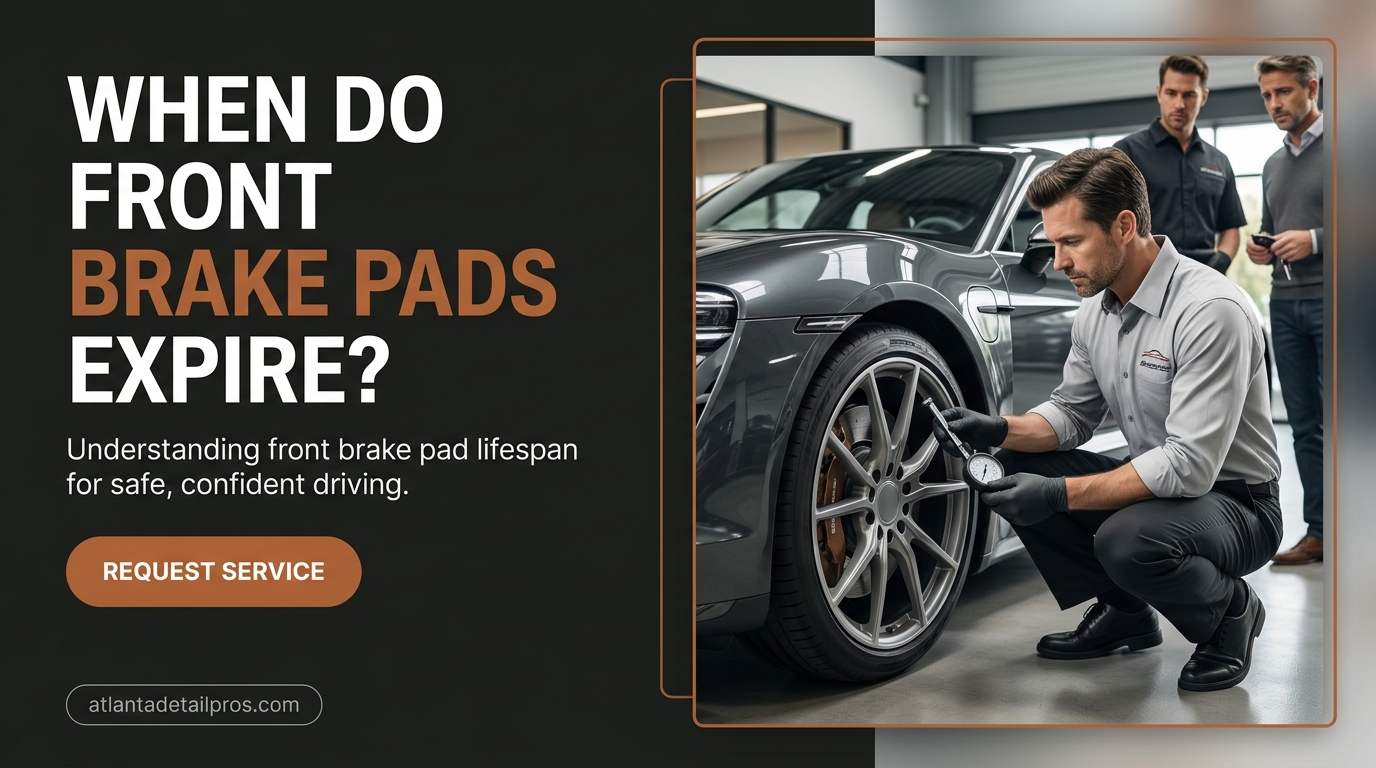
The textbook answer is 25,000 to 65,000 miles. The honest answer is: it depends entirely on how and where you drive, and the front pads always go before the rear pads. City commuters who brake hard at every light can eat through front pads in 20,000 miles. Steady highway drivers who coast to exits can get 70,000 miles from the same pads on the same car.
This guide gives you the realistic range for your specific driving situation, explains why front pads wear faster than rear pads, tells you the warning signs that mean replacement is now rather than soon, and covers what the job should cost so you know a fair quote when you see one.
Why Front Brake Pads Wear Out Faster Than Rear Pads
This is the first thing to understand, because it determines your replacement schedule. Front brake pads carry approximately 60 to 70 percent of the vehicle’s braking load. When you press the brake pedal, your car’s weight transfers forward. That weight shift puts more force on the front wheels, which means the front brakes do more work on every stop. Rear pads typically last one and a half to two times longer than front pads as a result. On many vehicles, you will replace front pads twice for every once you replace the rears.
This also means that if your rear pads are still at half-thickness, you should not use them as a reference for how long your fronts will last. They are working under different loads and wearing at different rates. Always evaluate front and rear brake pads separately during an inspection.
The Realistic Lifespan by Driving Style
The 25,000 to 65,000 mile range is accurate but not very useful without context. The driving style that fills most of those miles is what actually determines where in that range your pads land.
City Driving: 25,000 to 40,000 Miles
Urban commuters who spend most of their driving time in stop-and-go traffic are at the lower end of the range. Every red light, every merging situation, and every pedestrian crossing event means another brake application. City driving can mean 50 or more brake applications per mile of commuting in dense traffic. Front pads in this environment typically last 25,000 to 40,000 miles and sometimes less if the driver brakes hard rather than coasting to slow.
Mixed City and Highway Driving: 35,000 to 55,000 Miles
The most common driving profile for most American drivers includes some city commuting combined with regular highway use. Highway miles are very light on brakes since you are rarely stopping, only modulating speed with light applications. This mixed profile produces the most common result: front brake pads lasting 40,000 to 55,000 miles, which is why most manufacturer service guides suggest a front brake inspection around 40,000 to 50,000 miles.
Primarily Highway Driving: 50,000 to 70,000 Miles
Drivers who cover most of their mileage on highways with long stretches between stops see significantly longer pad life. The brakes are used infrequently and under light load when they are used. In this driving pattern, front brake pads regularly last 60,000 to 70,000 miles, and occasional 80,000-mile sets are not unheard of on vehicles with quality ceramic pads.
Other Factors That Determine Where in the Range You Fall
Driving style is the biggest factor, but three other variables pull the lifespan up or down significantly even for drivers with identical commutes.
Brake Pad Material
Organic brake pads (also called non-asbestos organic or NAO) are the softest and quietest but wear the fastest, typically lasting at the lower end of the range. They are common on economy vehicles and are quiet, gentle on rotors, and inexpensive to replace. Semi-metallic pads contain 30 to 70 percent metal and last significantly longer, typically 50,000 to 70,000 miles, with better performance under heavy braking but more rotor wear and slightly more noise. Ceramic pads are the longest-lasting and quietest of the three, excellent for mixed and highway driving, with lifespans of 50,000 to 70,000 miles and less brake dust than metallic pads.
Vehicle Weight and Type
Larger, heavier vehicles require more braking force per stop, which translates directly to faster pad wear. A three-ton pickup truck or a full-size SUV exerts significantly more stress on front brake pads per stop than a compact sedan. Performance vehicles with larger, grippier tires that generate more braking force also wear through pads faster. If you drive a heavy vehicle and primarily city miles, expect the lower end of the lifespan range consistently.
Driving Habits Beyond Style
Following distance is a brake pad’s best friend. Drivers who maintain larger following distances can begin slowing much earlier, using light brake pressure over a longer distance rather than hard stops from higher speed. This dramatically reduces the heat generated per stop, which is the primary mechanism of pad wear. Brake fade from repeated hard stops, particularly on downhill grades, generates significantly more heat and accelerates wear. Carrying heavy loads routinely, towing trailers, or frequently driving in hilly terrain all push brake pad life toward the shorter end of the range.
Warning Signs That Your Front Brake Pads Need Replacing Now
Do not wait until a warning sign appears to start thinking about brake pads. By the time the first sign appears, you are past the comfortable replacement window and into urgency territory. But knowing what each sign means helps you decide how immediately you need to act.
Sign 1: The Squealing Wear Indicator Tab
The most consistent early warning is a high-pitched squeal or squeak that appears specifically when the brakes are applied and disappears when you release the pedal. This is the sound of a small metal wear indicator tab that is machined into the brake pad specifically to contact the rotor when the pad reaches its minimum safe thickness. It is designed to be heard, not ignored. When you hear this squeal, you have some pad friction material remaining but the clock is ticking. Schedule brake service within the next few weeks, not months.
Sign 2: The Grinding Sound When Braking
A grinding noise under braking is a more serious warning than squealing. It means the brake pad friction material has worn through completely and the metal backing plate is contacting the rotor directly. Metal-on-metal contact damages the brake rotor surface rapidly, turning what would have been a pad-only replacement into a pad and rotor replacement. Rotor replacement adds $150 to $400 per axle to the repair cost. If you hear grinding, stop driving normally and get to a shop within a day or two at most. Braking distance is also compromised at this stage.
Sign 3: The Visual Inspection Through the Wheel Spokes
You do not need to remove the wheel to check approximate brake pad thickness on most vehicles. Look through the wheel spokes at the brake caliper clamping the rotor. The brake pad is visible between the caliper body and the rotor surface. A healthy pad shows at least 6mm to 8mm of friction material. A pad with 3mm or less is at the replacement threshold. A pad where the friction material appears flush with the metal clip or backing plate is in the grinding-risk zone immediately. This takes 30 seconds per wheel and can save you significant money by catching wear before the metal-on-metal stage.
What Front Brake Pad Replacement Costs
Knowing fair pricing prevents paying too much and helps you recognize when a quote is unreasonable. Front brake pad replacement costs vary by vehicle, shop type, and what else is being replaced.
Typical Front Brake Pad Replacement Cost at a Shop
At an independent shop, front brake pad replacement runs $150 to $300 for most passenger vehicles including parts and labor. This assumes the rotors are in serviceable condition and only the pads need replacement. Dealer service departments charge $200 to $450 for the same job. The labor time for front pad replacement is typically 1 to 2 hours. If rotors are warped, scored, or below minimum thickness and need resurfacing or replacement, add $100 to $200 per rotor for resurfacing or $150 to $300 per rotor for replacement.
DIY Brake Pad Replacement
Front brake pads are one of the most commonly performed DIY repairs. The parts cost for quality brake pads runs $30 to $80 for most vehicles, making the DIY versus shop cost difference substantial. The job requires a floor jack, jack stands, basic hand tools, a C-clamp or brake piston tool to compress the caliper piston, and brake cleaner spray. Most DIYers with basic mechanical experience complete a front axle brake pad change in 1 to 2 hours. When doing the job yourself, always replace pads on both front wheels simultaneously and properly bed in the new pads with several moderate stops from 35 mph to allow the pad material to transfer evenly to the rotor surface.
How to Extend Front Brake Pad Life
You cannot change your commute, but several habits and maintenance practices genuinely extend pad life without compromising safety.
Driving Habit Changes That Make a Real Difference
Increasing your following distance by even one car length gives you more time to begin slowing earlier at lower brake pressure. Anticipating traffic lights and beginning to coast before braking reduces the number of hard stops per mile. Avoiding heavy right-foot braking on highway on-ramps and off-ramps significantly reduces the heat cycles your front pads experience. None of these changes reduce safety: all of them simply reduce unnecessary aggressive braking.
Maintenance Practices That Support Pad Life
Brake fluid absorbs moisture over time and becomes less effective under high heat, causing brake fade that makes the driver press harder and longer. Replacing brake fluid every two years prevents heat-induced fade and reduces stress on pads and calipers. Checking that the caliper slide pins are not seized is equally important: a seized slide pin keeps one pad in constant partial contact with the rotor, wearing it four to five times faster than the other pad on the same caliper. If one side of your front brake pads wears significantly faster than the other side, a seized caliper slide pin is the most likely cause.
Frequently Asked Questions
How often should front brake pads be replaced?
Most front brake pads need replacement every 30,000 to 60,000 miles under typical mixed driving conditions. City-heavy commuters should plan for 25,000 to 40,000 miles between replacements. Highway-dominant drivers may go 60,000 to 70,000 miles. Have the thickness inspected visually at every tire rotation, which most shops do automatically as part of a rotation service.
How do I know if my front brake pads are worn?
A high-pitched squeal when braking that disappears when you release the pedal is the wear indicator tab. It means replacement is needed soon. A grinding noise is more urgent: the pad has worn through and the metal backing is contacting the rotor. You can also check visually through the wheel spokes: any pad showing less than 3mm of friction material above the metal backing needs replacement.
Do front and rear brake pads need to be replaced at the same time?
No, but pads should always be replaced in pairs on the same axle. Both front pads should be replaced together, and both rear pads should be replaced together, even if one side is slightly thicker than the other. However, front and rear axle brake jobs are done independently and do not need to coincide. Because front pads wear faster, you will typically replace the fronts approximately twice for every once you replace the rears.
The Bottom Line
Front brake pads usually last 25,000 to 65,000 miles, and the single biggest determinant of where in that range you fall is how much city stop-and-go traffic your daily drive includes. Plan an inspection at 30,000 miles if you drive primarily in the city, and at 45,000 miles if your driving is mostly highway. Do the 30-second visual check through the wheel spokes at every tire rotation. Catch the squeal warning before it becomes a grind warning, and you will pay for pads without paying for rotors.