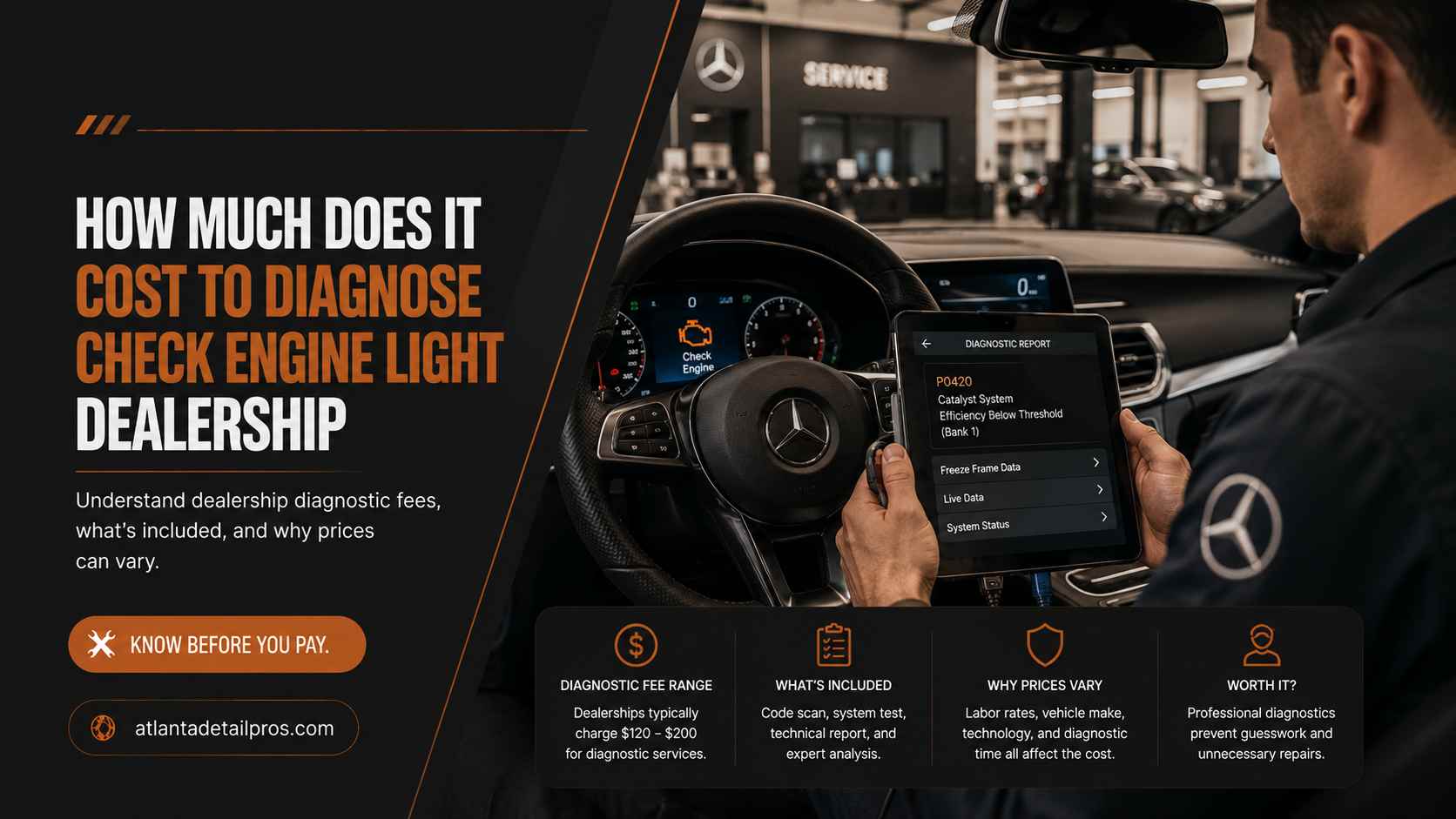
A check engine light diagnosis costs $100 to $180 at a dealership and $75 to $150 at an independent shop, with the diagnostic fee typically applied toward the repair cost if you authorize the work at the same location on the same visit.
The price difference between a dealer and an independent shop reflects labor rate differences, not the quality of the diagnosis: both use the same OBD-II protocol to read stored fault codes, and both require the same systematic investigation to determine the root cause behind the code. Understanding what the diagnostic fee actually pays for, and when a dealership diagnosis is genuinely superior to an independent shop, protects you from paying for a service that delivers less than it implies.
The single most important distinction in this category is the difference between a free OBD-II code read (available at any auto parts store) and a professional diagnosis. A code read retrieves the stored trouble code and costs nothing. A diagnosis identifies the root cause of that code, which often requires additional testing, component inspection, live data analysis, and in some cases a road test or specialized test equipment. A P0300 random misfire code, for example, can be caused by spark plugs, ignition coils, fuel injectors, vacuum leaks, compression loss, or fuel pressure issues. A code read tells you P0300: a diagnosis tells you it is a failed coil on cylinder 4. These are not the same service.
What a Professional Diagnosis Actually Includes
A professional check engine light diagnosis at a dealership or independent shop goes significantly beyond retrieving the stored fault code. Understanding the steps involved explains why the fee is justified and what you are paying for.
The technician connects a professional-grade scan tool that reads not only stored fault codes but also pending codes, freeze frame data (the operating conditions at the moment the code was set), and live sensor data streams. This data is interpreted against the manufacturer’s diagnostic procedure for that specific fault code, which prescribes specific tests: component resistance checks, voltage supply and ground verification, sensor plausibility tests, and actuator commands that confirm or rule out each possible cause systematically.
A dealership technician has access to the manufacturer’s factory scan tool (for example, Toyota TechStream, Ford IDS, or GM GDS2), which can access additional data channels and perform functions that aftermarket scan tools cannot replicate on every platform. This factory tool advantage is meaningful on complex systems, newer vehicles, and on any code that involves the body control module, transmission control module, or hybrid battery management system.
Dealership vs Independent Shop: What the Price Difference Reflects
The price gap between a dealership and an independent shop for a check engine light diagnosis is driven by the same factors as any other repair: hourly labor rate and tool investment.
A dealership charges $130 to $185 per hour. A diagnostic appointment that takes 1 to 1.5 hours of technician time at those rates costs $130 to $280, of which the quoted diagnostic fee is typically a partial recovery. Many dealers cap the diagnostic fee at $130 to $160 as a flat rate regardless of actual time spent.
An independent shop charges $90 to $130 per hour. The same 1-hour diagnostic at those rates costs $90 to $130, which most independent shops quote as a flat diagnostic fee of $80 to $150.
The quality of the diagnosis does not automatically correlate with the price. A skilled independent shop technician with factory-equivalent scan tool access and specific experience on your vehicle platform delivers a diagnosis equal to or better than a dealer technician who rotates across all makes. Conversely, a dealer technician with platform-specific training and factory tool access delivers advantages that matter specifically on newer vehicles with complex electronic systems.
When to Use a Dealership for the Diagnosis
A dealership diagnosis is worth the premium in specific situations. These are not vague generalizations: they are specific conditions where the dealer’s factory tool access or platform-specific knowledge produces a different and better outcome.
On vehicles under warranty, the dealer diagnosis is required for warranty coverage consideration. Taking a warranted vehicle to an independent shop for diagnosis and then presenting the result to the dealer often results in the dealer requiring their own diagnosis before authorizing warranty repair.
On complex hybrid and electric vehicle systems (Toyota Prius high-voltage battery, Ford Escape Hybrid, Chevrolet Volt), the factory scan tool accesses battery management data that most aftermarket tools cannot read at the same depth. A diagnosis of a hybrid battery fault code is more reliable with factory tool access.
On newer vehicles (less than 3 years old) with recent software updates, factory tools perform the correct post-repair module calibrations and software relearns that some aftermarket tools cannot. A check engine light caused by a sensor that needs a relearn procedure after replacement is best diagnosed and repaired at the dealer on these platforms.
On vehicles with open Technical Service Bulletins (TSBs) directly addressing the stored code, the dealer technician is most likely to know about and apply the TSB fix, which may involve a software update rather than a parts replacement.
When to Use an Independent Shop
An experienced independent shop with a capable scan tool is the appropriate choice for the majority of check engine light diagnoses on vehicles more than 3 years old, outside of warranty, and not involving hybrid high-voltage or complex module calibration scenarios.
The codes most commonly retrieved by check engine lights fall into predictable categories: oxygen sensor faults (P0130 to P0167), catalyst efficiency codes (P0420, P0430), evaporative emission system codes (P0440 to P0457), misfire codes (P0300 to P0308), and fuel system codes (P0087, P0171, P0174). All of these are diagnosable with a quality aftermarket professional scan tool, and a shop with experience on your specific vehicle platform is fully equipped to resolve them correctly.
Diagnostic Fee Comparison Table
Provider | Diagnostic Fee Range | Factory Tool Access | Applied to Repair |
|---|---|---|---|
Auto parts store code read | Free | No (code only) | Not applicable |
Dealership | $100 to $180 | Yes | Yes (usually) |
Independent shop | $75 to $150 | Partial (aftermarket tool) | Yes (usually) |
Specialty shop (European, diesel) | $100 to $180 | Varies | Yes (usually) |
“The dealer quoted me $145 to diagnose my check engine light. An independent shop 2 miles away quoted $95. I went to the independent shop first because the code was P0420 on my Camry, which is almost always a predictable diagnosis. The shop confirmed it was the downstream O2 sensor based on their live data test and fixed it for $380 total with the diagnostic fee applied. I would have paid the same at the dealer and gotten the exact same part.” : Ray Gutierrez, 2014 Toyota Camry owner
What to Do Before Paying for a Diagnosis
Before paying any shop’s diagnostic fee, take two steps that cost nothing and help you evaluate the diagnosis you receive.
First, get the code read for free at any major auto parts store (AutoZone, O’Reilly, Advance Auto). Write down the exact code number, not just the description. This takes 5 minutes and gives you the starting point for any conversation with a shop.
Second, search the exact code number along with your vehicle’s year, make, model, and engine for known common causes and TSBs. Many check engine light codes have a dominant, statistically most-common cause on specific platforms. A P0420 on a Toyota with an aging OEM downstream O2 sensor has a well-known first-check: the shop that immediately tests the downstream O2 sensor live data rather than guessing at the catalyst is demonstrating the right diagnostic sequence.
Common Check Engine Light Codes and Typical Diagnosis Cost
Code | Common Cause | Diagnostic Complexity | Typical Diagnosis Time |
|---|---|---|---|
P0420 / P0430 | Catalyst efficiency, O2 sensor, or failed cat | Moderate: live O2 data test required | 45 to 75 minutes |
P0171 / P0174 | Lean condition: vacuum leak, MAF, fuel delivery | High: multiple possible causes | 60 to 90 minutes |
P0300 to P0308 | Misfire: coil, plug, injector, compression | Moderate to high: coil swap test needed | 45 to 90 minutes |
P0440 to P0457 | EVAP system: cap, purge valve, leak | Moderate: smoke test often required | 60 to 90 minutes |
P0340 to P0345 | Camshaft position sensor | Low to moderate: sensor test | 30 to 60 minutes |
FAQs
Is the free code read at an auto parts store the same as a professional diagnosis?
No. A free code read retrieves the fault code stored in the ECU. A professional diagnosis identifies the root cause behind that code through systematic component testing, live data analysis, and comparison against the manufacturer’s diagnostic procedure. For straightforward codes with a single dominant cause, the gap between a code read and a full diagnosis is smaller. For complex codes with multiple possible causes (P0171, P0300), the gap is significant.
Can I negotiate the diagnostic fee?
Some shops apply the diagnostic fee as a credit toward the repair if you authorize the work at the same visit. Others refund a portion or all of the fee. Ask before the diagnosis begins whether the fee is applied to the repair. This is standard practice at most reputable shops and is worth confirming rather than assuming.
If the shop gives me a quote after the diagnosis, am I obligated to authorize the repair there?
No. You have paid for the diagnosis, which includes the information about what is wrong and what it will cost to fix. You can take that diagnosis to any other shop for a second opinion or a competing repair quote. The diagnostic fee compensates the shop for their technician’s time and does not obligate you to any subsequent repair there.
Why does the check engine light sometimes turn off by itself?
A check engine light that clears by itself indicates the fault condition has become intermittent. The code is stored in the ECU as a pending or historical code even if the light is off. An auto parts store scan or a shop’s scan tool will still retrieve the stored code. The underlying cause has not resolved: it has simply not met the threshold to re-illuminate the light on that drive cycle.
Is it worth diagnosing a check engine light if the car is running normally?
Yes. Many check engine light conditions that do not immediately affect drivability become more serious if ignored. An EVAP leak, a failing oxygen sensor, or an early catalyst efficiency code that is ignored can lead to failed emissions inspections, additional sensor and catalyst damage, and in some cases engine damage (a lean condition code that goes unaddressed can cause detonation damage over time).
Bottom Line
A check engine light diagnosis costs $100 to $180 at a dealership and $75 to $150 at an independent shop, with a free code read from an auto parts store as a zero-cost first step that tells you the code number before you commit to a paid diagnosis. The diagnostic fee is justified and necessary for any code with multiple possible causes: for simple, predictable codes on well-understood platforms, an experienced independent shop delivers the same result at a lower total cost.
Use a dealership when the vehicle is under warranty, when it involves hybrid or complex module systems, or when a TSB is relevant to the specific code. Use a quality independent shop for the vast majority of check engine light diagnoses on out-of-warranty vehicles more than 3 years old.