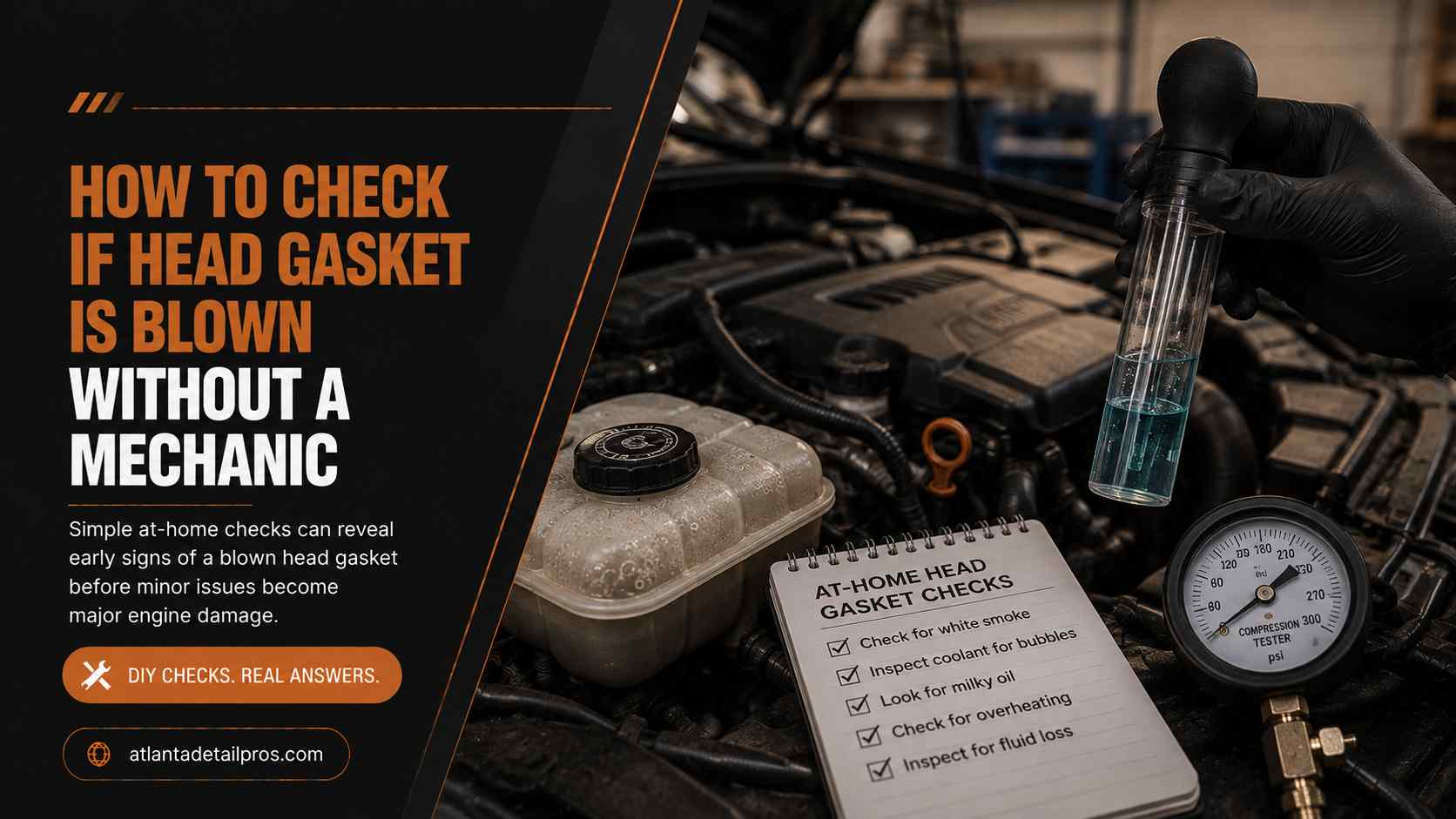
Yes, you can check for a blown head gasket at home without a mechanic using four tests: the combustion gas leak test, the oil dipstick and reservoir inspection, the compression test, and the cooling system pressure hold test.
No single test is definitive on its own, but two or more positive results from these tests make the diagnosis reliable enough to proceed with repair planning. The total cost of performing all four tests at home is under $40 for the combustion gas detection fluid, with the compression tester and cooling system pressure tester available free on loan from most major auto parts store chains.
A head gasket failure does not always announce itself with dramatic white smoke and immediate overheating. Many gasket failures begin as subtle leaks: a slowly dropping coolant level with no visible external source, a slight rough idle at cold start, or an oily film in the coolant reservoir. Knowing how to work through these diagnostic tests allows you to confirm or rule out a blown head gasket before spending money on a repair that may not be necessary, or before delaying a repair that will only become more expensive.
What a Head Gasket Actually Seals
The head gasket sits between the cylinder head and the engine block and simultaneously seals three separate circuits: the combustion chambers, the coolant water jackets, and the oil passages. A gasket can fail at any of these boundaries, and the location of the failure determines which symptoms appear.
A combustion-to-coolant failure allows hot combustion gas to enter the cooling system. A coolant-to-combustion failure allows coolant to enter the combustion chamber and be burned, producing white exhaust steam. A coolant-to-oil failure allows coolant to enter the oil passages, producing milky oil. An oil-to-combustion failure produces blue-gray smoke from burning oil.
Understanding which boundary has failed guides which tests matter most for your specific case.
Test It Yourself Without a Mechanic
Test 1: Combustion Gas Leak Detection
This is the most important home test and the most likely to give a definitive result. A combustion gas detection kit (also called a block test or block leak test) is available at auto parts stores for $15 to $25. The kit uses a pH-sensitive fluid that changes color in the presence of hydrocarbons from combustion gases.
Procedure
Allow the engine to warm to operating temperature. Remove the radiator cap or reservoir cap using a rag: turn slowly to the first stop before fully removing. Fill the test tool chamber with the detection fluid. With the engine idling, hold the tool’s intake tube over the reservoir or radiator opening without letting it contact the coolant. Draw several slow breaths of air from above the coolant through the tool. Observe the fluid color: blue means clean, yellow or green means combustion gases detected.
A positive result (color change) confirms combustion gas is entering the cooling system, which is definitive evidence of a head gasket or cracked head failure at the fire ring boundary.
Test 2: Oil and Coolant Cross-Contamination Inspection
Oil Dipstick Check
Pull the oil dipstick and inspect the oil. Normal engine oil is amber to dark brown and coats the dipstick as a uniform clear film. Coolant-contaminated oil appears as a creamy, frothy, or milky emulsion with a tan or gray color. Also remove the oil filler cap and inspect its underside: coolant contamination often produces a creamy sludge on the underside of the filler cap.
Coolant Reservoir Check
Inspect the inside of the coolant reservoir for an oily film, brown discoloration, or a visible layer of oil floating on the coolant surface. Any of these indicate oil or combustion contamination of the coolant circuit and correlate directly with head gasket failure.
Test 3: Cooling System Pressure Hold Test
Borrow a cooling system pressure tester from an auto parts store free loan program and attach it to the radiator filler neck or reservoir.
Procedure
With the engine cold, pump the system to the radiator cap’s rated pressure (stamped on the cap, typically 13 to 16 PSI). Monitor the gauge for 10 minutes. A system with no leaks holds pressure with minimal loss. If the pressure drops and you see no external leaks from hoses, connections, or the radiator, the pressure is escaping internally. Combined with other positive test results, internal pressure loss confirms a head gasket breach.
Test 4: Compression Test
A compression tester is also available on free loan programs at auto parts stores.
Procedure
Warm the engine to operating temperature then shut it off. Remove all spark plugs. Disable the ignition by pulling the fuel pump fuse or injector relay. Thread the compression tester into each spark plug hole in turn. Crank the engine for 4 to 5 seconds per cylinder and record the reading.
A head gasket failure between two adjacent cylinders produces low compression in those two cylinders. Readings across all cylinders should be within 10 to 15 percent of each other. Two adjacent low cylinders confirm a gasket failure between those combustion chambers.
Results Interpretation Table
Test Result Combination | Likelihood of Blown Head Gasket |
|---|---|
Combustion gas test positive only | High: confirm with pressure hold test |
Milky oil or oily coolant only | High: confirm source with combustion and compression test |
Pressure loss with no external leak only | Moderate: confirm with combustion gas test |
Two adjacent low cylinders on compression only | High: confirm with combustion gas test |
Two or more tests positive | Definitive: head gasket repair required |
All tests negative | Low: consider other causes of symptoms |
“I used the block test fluid and compression tester from the parts store loan program on my Outback before taking it anywhere. Both tests came back positive on cylinders 2 and 3. Took those results to three shops for estimates and got a clear diagnosis right away without paying a diagnostic fee. Saved about $150 in shop diagnosis costs.” : Nick Gallagher, 2008 Subaru Outback owner
Additional Symptom Indicators
White Exhaust Smoke
White smoke from the exhaust that persists beyond the first minute of cold-start warm-up indicates coolant entering the combustion chamber and being burned. Sweet-smelling persistent white smoke is the most recognizable external symptom of a head gasket failure at the combustion-to-coolant boundary.
Coolant Level Drops Without External Leaks
If you are consistently adding coolant to the reservoir and no external puddle ever appears under the vehicle, the coolant is going somewhere internal: either into the combustion chamber (burned as steam) or into the oil circuit (producing milky oil). Both destinations indicate a head gasket.
Bubbles in the Coolant Reservoir
With the engine idling and the reservoir cap removed, observe the coolant surface for rhythmic bubbling that appears in sync with engine speed. Bubbles from combustion gas intrusion have a steady cadence linked to firing events, as opposed to the gurgle of trapped air bleeding out after a coolant service, which appears irregularly and diminishes over a few minutes.
What to Do With the Results
If two or more tests are positive, the head gasket diagnosis is reliable and you can proceed with obtaining repair estimates from shops without paying a diagnostic fee. Bring your test results and ask for a repair estimate based on a confirmed head gasket failure. You will have a clearer picture of what you are facing and a stronger position to evaluate the repair cost against the vehicle’s overall value.
If the combustion test is positive but compression is even across all cylinders, the gasket is failing at the coolant-to-coolant or oil-to-coolant boundary rather than at the fire ring: still a head gasket job, just with a different internal failure pattern.
FAQs
How accurate is the home combustion gas test?
The combustion block test is highly accurate for detecting combustion gas intrusion into the cooling system. False positives can occur if the detection fluid contacts coolant directly (draw air from above the coolant, not through it) or if the vehicle runs on E85 fuel. False negatives can occur if the test is performed with a cold engine or if the breach is intermittent. Test with a warm engine and repeat if the first result is borderline.
Can a blown head gasket seal itself?
No. A gasket that has physically breached will not reseal through continued operation. Some bottled head gasket sealers can temporarily slow a minor breach, but they are not reliable for significant failures and should not be used as a substitute for repair.
Does a blown head gasket always cause the temperature gauge to go into the red?
No. Many head gasket failures, particularly internal ones where coolant enters the oil rather than the combustion chamber, do not cause immediate dramatic overheating. The coolant level drops gradually, the oil becomes contaminated, and the engine may run at normal temperature for weeks before the situation becomes critical.
Can I repair a blown head gasket myself?
Yes, but it is a significant job requiring torque specifications, cylinder head resurfacing if the head is warped, and correct head bolt procedure. For a DIYer with experience removing and reinstalling cylinder heads it is feasible. For most drivers this is shop work.
How much does a blown head gasket repair cost?
A 4-cylinder head gasket repair at an independent shop typically costs $800 to $1,500 parts and labor. A V6 or V8 repair typically costs $1,200 to $2,500. Add $200 to $500 if the cylinder head needs resurfacing. Add $500 to $1,500 if bearing damage has occurred from coolant in the oil.
Bottom Line
Four home tests confirm a blown head gasket with high reliability: the combustion gas block test, the oil and coolant contamination inspection, the cooling system pressure hold test, and the compression test. The combustion gas test alone is the single most valuable and produces a clear positive or negative result in under 10 minutes for $20 in supplies. Two or more positive results across the four tests give you a diagnosis as reliable as a shop’s initial assessment.
Perform these tests before paying a shop diagnostic fee. Arrive with your test results and ask for a repair estimate on a confirmed blown head gasket. You will have a clearer picture of what you are facing and a stronger position to evaluate the repair cost against the vehicle’s overall value.