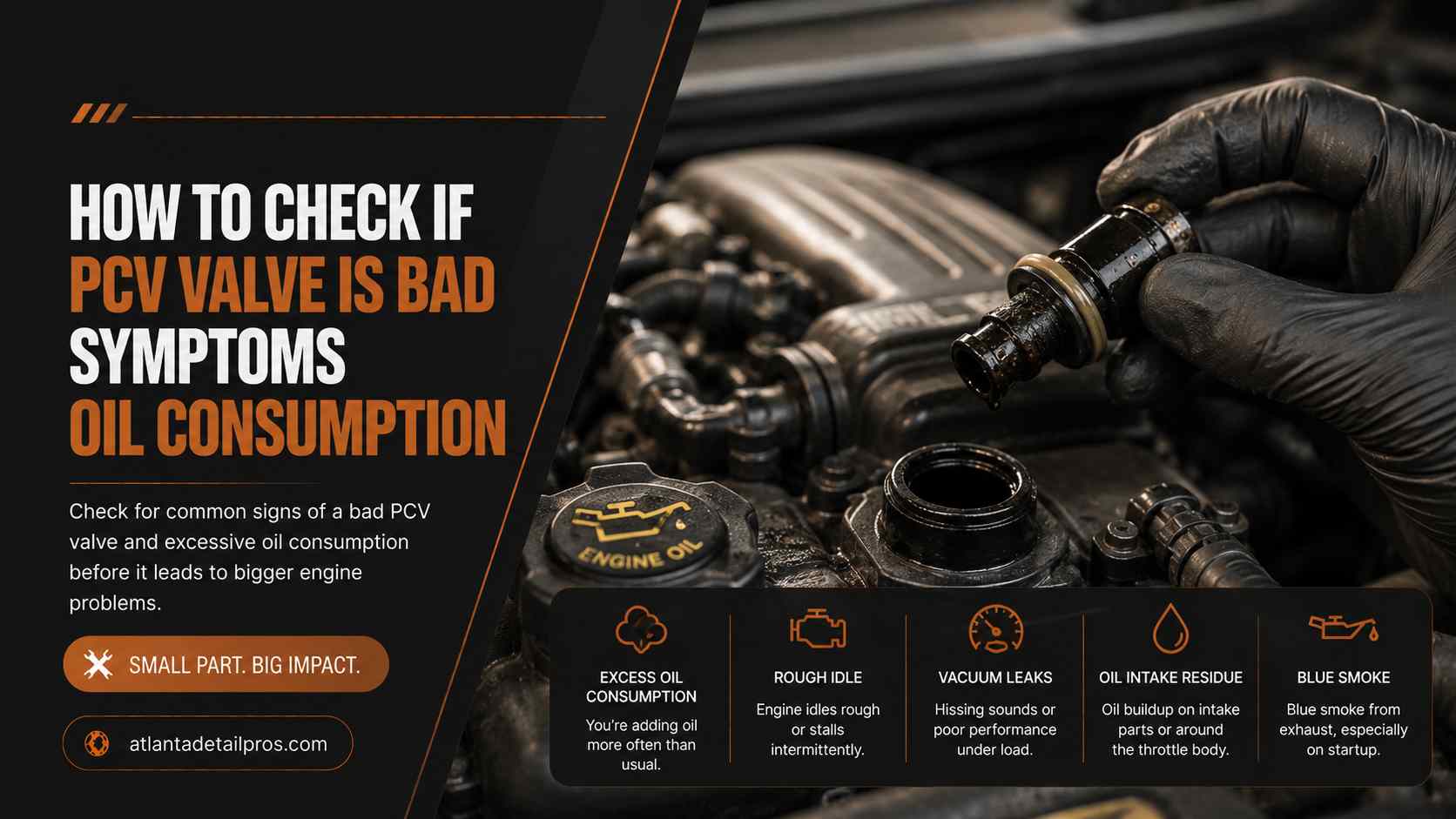
A bad PCV valve causes oil consumption by either sticking open (creating excessive crankcase vacuum that pulls oil mist past piston rings and valve stem seals into the combustion chamber) or sticking closed (allowing pressure to build in the crankcase that forces oil past gaskets and seals to the outside of the engine).
These are opposite failure modes that produce different symptoms, and knowing which one you have determines both the urgency and the correct diagnostic follow-up. The PCV (positive crankcase ventilation) valve is a $5 to $15 part that takes under five minutes to replace, making it the first thing to address when oil consumption is unexplained or when the crankcase is pressurized.
The PCV system routes crankcase blow-by gases (combustion gases that leak past piston rings into the crankcase during normal engine operation) back into the intake manifold to be burned rather than vented to the atmosphere. The PCV valve is the metering device that controls the flow rate of these gases. When it fails, the entire crankcase ventilation system is compromised, and the engine pays for it in oil consumption, seal failures, or both.
How the PCV System Works
Understanding the system flow makes the failure modes immediately obvious. The PCV valve connects the valve cover (crankcase) to the intake manifold. Engine vacuum draws crankcase gases through the PCV valve and into the intake. Fresh air enters the crankcase through the air filter via a breather tube on the opposite valve cover (on most V-engines) or through the air intake hose (on most 4-cylinder engines), completing the ventilation circuit.
The PCV valve contains a spring-loaded plunger that regulates flow based on manifold vacuum. At idle (high vacuum), the valve restricts flow to prevent excessive oil mist from being drawn into the intake. Under load (lower vacuum), the valve opens more to handle the increased blow-by that high-load combustion produces. A valve that is stuck open or closed at the wrong position for the operating condition is a failed valve.
What Happens When the PCV Valve Sticks Open
A stuck-open PCV valve allows excessive crankcase vacuum because the valve no longer restricts flow at idle when vacuum is high. The excessive vacuum draws an increased volume of oil mist from the crankcase through the intake manifold and into the combustion chambers, where it burns. Oil consumption from a stuck-open PCV valve is often gradual but measurable: one quart every 1,000 to 3,000 miles on a vehicle that previously consumed little or no oil between changes.
What Happens When the PCV Valve Sticks Closed
A stuck-closed PCV valve cannot route crankcase gases into the intake. Pressure builds in the crankcase as blow-by gases have no path to escape. This pressure pushes against every seal and gasket in the engine from the inside: the valve cover gaskets, the front and rear crankshaft seals, and the oil pan gasket. The result is external oil leaks that appear to come from multiple sources simultaneously. The oil level drops not because oil is being burned but because it is being forced out of the engine.
Symptom Identification Table
Symptom | Likely PCV Failure Mode | Secondary Indicator |
|---|---|---|
Oil consumption with no external leaks | Stuck open: oil drawn into intake | Blue-gray smoke at startup |
Multiple external oil leaks appearing simultaneously | Stuck closed: crankcase pressure | Dipstick tube blows out under load |
Rough idle that improves at higher RPM | Stuck open at idle: excess vacuum | Whistling from valve cover area |
Oil in air filter housing or intake hose | Stuck open: oil mist overload | Oily residue on MAF sensor |
Hissing or whistling near valve cover area | Valve stuck: abnormal flow noise | Check tube connections too |
Sludge buildup inside valve covers | Stuck closed (long-term): oil not ventilated | Thick black deposits on cap underside |
At-Home Tests for a Bad PCV Valve
These tests require no specialized tools and take under five minutes to complete. Perform them with the engine at operating temperature.
Test 1: The Rattle Test
Remove the PCV valve from the valve cover grommet. Shake the valve briskly back and forth near your ear. A healthy PCV valve contains a spring-loaded plunger that produces an audible rattle as the plunger moves freely inside the housing. A PCV valve that produces no rattle has a stuck plunger: either stuck open or stuck closed depending on the position. Replace immediately.
Test 2: Vacuum Pull Test
With the engine running at idle, place your thumb firmly over the open end of the PCV valve (the end that connects to the intake manifold hose, not the valve cover end). You should feel a strong, steady vacuum pulling your thumb against the valve opening. If you feel no vacuum, the valve is stuck closed or the intake hose connected to the valve has a blockage. If the vacuum is extremely strong and causes the engine to stumble when you cover the port, the valve may be stuck open and not restricting flow as designed at idle.
Test 3: Oil Filler Cap Test
With the engine running at idle, remove the oil filler cap from the valve cover. Hold a piece of paper over the opening. On a healthy engine with a functioning PCV system, the paper should be pulled slightly toward the opening (slight vacuum inside the crankcase). If the paper is pushed away from the opening, the crankcase is pressurized, indicating the PCV valve or its circuit is blocked.
Test 4: Inspect the Valve Visually
Remove the PCV valve and inspect the interior of the hose connection and the valve body itself. A valve coated in thick, gummy black sludge has been functioning in a low-ventilation environment for an extended period. Sludge inside the valve housing indicates it has been restricting flow. The hose between the PCV valve and the intake manifold should also be inspected: a cracked or clogged hose produces symptoms identical to a stuck-closed valve even if the valve itself is functioning.
“I was burning about a quart of oil every 1,500 miles on my Accord and couldn’t find any external leaks. Mechanic suggested the PCV valve as a first step before doing any ring or seal work. It was the original part at 140,000 miles. Replaced it for $8. Oil consumption dropped to nothing measurable between changes.” : Denise Yuen, 2012 Honda Accord owner
Oil Consumption: How Much Is the PCV Valve Responsible For?
The PCV system draws oil mist from the crankcase, not liquid oil. Under normal operation, a small amount of oil mist recirculated through the intake is expected and designed for. The quantity is generally too small to measurably affect oil level between changes.
When the PCV valve is stuck open, the excessive crankcase vacuum draws not just mist but progressively heavier oil droplets from around the PCV inlet port inside the valve cover. On high-mileage engines where the valve stem seals have softened, the additional vacuum pull from a stuck-open PCV accelerates oil passage past those seals dramatically. This is why a PCV valve failure on a 100,000-mile engine can produce oil consumption that appears suddenly rather than as a gradual increase: the PCV failure tips the balance for seals that were marginal.
Quantifying how much of the observed oil consumption is PCV-related versus ring-related is done by replacing the PCV valve first (cheapest and fastest step), driving a measured number of miles, and checking oil level again. If consumption improves measurably, the PCV valve was a significant contributor.
Additional Consequences of a Failed PCV Valve
When the PCV valve is not replaced at the first sign of failure, the downstream consequences compound. A stuck-open valve deposits progressively more oil in the intake manifold, on the throttle body, and on the MAF sensor. Oil deposits on the MAF sensor produce inaccurate airflow readings that affect fuel trim and idle quality. Oil deposits in the intake manifold carbon-coat the intake valves, particularly on port-injected engines.
A stuck-closed valve allows crankcase pressure to force moisture and acids (byproducts of combustion that enter the crankcase as blow-by) to remain in the oil rather than being ventilated out. This accelerates oil acidification and contributes to sludge formation inside the engine, particularly in engines that primarily see short-trip city driving where the oil never reaches full temperature.
Replacement Cost and Intervals
Item | Cost |
|---|---|
PCV valve (most domestic engines) | $5 to $20 DIY |
PCV valve (most import engines) | $8 to $30 DIY |
PCV valve hose (if cracked) | $15 to $45 DIY |
Shop labor for PCV valve replacement | $40 to $80 (if accessible) |
MAF sensor cleaning after PCV oil contamination | $15 to $25 DIY (MAF cleaner spray) |
Most manufacturers recommend inspecting the PCV valve at every 30,000-mile service interval and replacing it every 60,000 miles regardless of whether symptoms are present. A $10 proactive replacement every 60,000 miles prevents the accumulated consequences of a failed valve over years of operation.
FAQs
Can a bad PCV valve cause a check engine light?
Yes, in some cases. A stuck-open PCV valve that allows excessive crankcase vacuum can trigger a P0507 (idle control RPM high) or a lean condition code because the unmetered air entering the intake through the crankcase ventilation circuit is not accounted for by the MAF sensor. A stuck-closed valve can cause rich running codes if the crankcase pressure forces oil into the air intake in large enough quantities. Neither code directly identifies the PCV valve as the cause, which is why the physical tests above are important.
How do I know if it is the PCV valve or the piston rings causing oil consumption?
A PCV valve replacement is the correct first step because it is free diagnostic information: a $10 part that takes five minutes to replace. If consumption continues after replacement, a compression test and a leak-down test distinguish between ring wear (which allows blow-by into the crankcase from above the piston) and valve seal wear (which allows oil to drain down the valve stem from above the cylinder head). Both produce oil consumption but through different paths.
Can I clean a PCV valve instead of replacing it?
Soaking the PCV valve in carburetor cleaner can dissolve mild deposits and free a slightly stuck plunger in some cases. Given that a replacement valve costs $5 to $15, replacement is generally more practical than cleaning and ensures the spring tension is correct. A cleaned valve with a fatigued spring does not meter flow correctly even if the plunger moves freely.
Is the PCV hose as important as the valve?
Yes. The hose between the PCV valve and the intake manifold is a critical part of the ventilation circuit. Cracks or deterioration in this hose produce unmetered air entry into the intake that causes lean running and idle problems. Inspect the hose whenever the PCV valve is replaced and replace it if there is any cracking, softness, or oil saturation visible.
How does a bad PCV valve affect turbocharged engines?
On turbocharged engines, the crankcase ventilation system must handle blow-by that enters the crankcase at higher volume due to the increased cylinder pressures. A stuck-closed PCV valve on a turbocharged engine causes crankcase pressure to accumulate faster than on a naturally aspirated engine, and the resulting oil leaks from the front and rear seals can be severe. Many turbocharged engines use a catch can (external crankcase ventilation separator) as a supplement precisely because the PCV system is under greater demand.
Bottom Line
A bad PCV valve is one of the simplest, cheapest, and most overlooked causes of oil consumption and external oil leaks, and the diagnosis takes under five minutes with the rattle test and thumb-over-port vacuum test described above. Replace the valve (a $5 to $15 part) before pursuing more expensive diagnoses for unexplained oil consumption.
If consumption continues after PCV replacement, the next steps are a compression test to evaluate ring wear and a leak-down test to evaluate valve stem seals. Both are shop tests that cost $60 to $120 and provide definitive mechanical information about the engine’s internal condition. The PCV valve replacement eliminates the simplest and cheapest possibility first, which is always the correct diagnostic sequence.