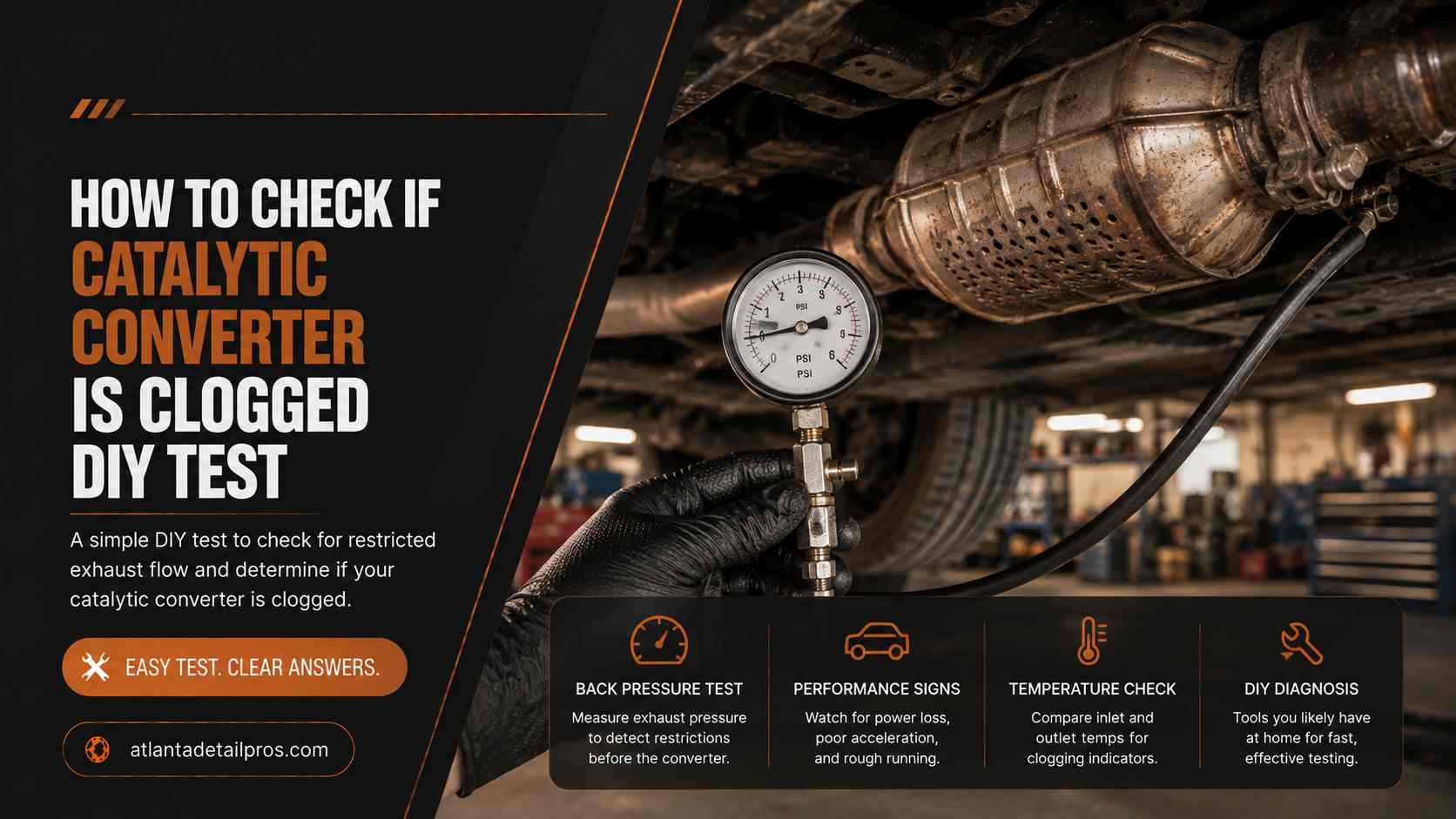
The most reliable DIY test for a clogged catalytic converter is a vacuum gauge test at idle and at 2,500 RPM: a healthy converter allows exhaust to flow freely and the vacuum reading holds steady or increases slightly at higher RPM, while a clogged converter creates backpressure that causes the vacuum reading to drop progressively as RPM rises.
A vacuum gauge costs $15 to $30 at any auto parts store and requires no prior mechanical experience to use. This test, combined with a temperature differential test using an infrared thermometer, provides a definitive at-home diagnosis without removing the converter or visiting a shop for a backpressure tap test.
A clogged catalytic converter is one of the most misdiagnosed conditions in automotive repair. Its symptoms, loss of power, poor fuel economy, rough idle, and a rotten egg smell, are shared with oxygen sensor failures, vacuum leaks, and rich-running fuel delivery problems. Testing the converter directly before replacing sensors or pursuing other diagnoses saves significant time and money.
How a Catalytic Converter Becomes Clogged
A catalytic converter contains a ceramic or metallic honeycomb substrate coated with platinum, palladium, and rhodium. Exhaust gases pass through thousands of small cells in this substrate, and the catalyst converts hydrocarbons, carbon monoxide, and NOx into water vapor, carbon dioxide, and nitrogen. When the converter clogs, it is almost always because the substrate has become physically blocked.
The blockage mechanism is almost always engine-related. A misfiring cylinder sends unburned fuel through the exhaust. That raw fuel ignites inside the converter, overheating the substrate past its design temperature and melting or fracturing the ceramic material. The melted substrate then blocks the cells, reducing exhaust flow progressively. This is why a clogged converter is almost always preceded by either a misfire or a rich-running condition that was not addressed promptly.
Primary Symptoms of a Clogged Catalytic Converter
Recognizing the specific symptom pattern of a clogged converter before testing helps you interpret your results more accurately.
Loss of Power Under Load
Exhaust flow restriction from a clogged converter creates backpressure that the engine must work against. Under light load and at idle, the backpressure is low enough that the engine performs nearly normally. Under acceleration and at highway speed, where exhaust volume is high, the restriction causes a significant power reduction. The engine may feel strong at low RPM and then fall flat or surge at higher RPM as backpressure builds.
Engine Dies After Brief Running
A severely clogged converter can trap enough backpressure to stall the engine within a few minutes of starting. The engine starts normally, runs for 30 to 90 seconds, then stalls as the converter fills with exhaust gas and effective flow drops to near zero. It may restart after sitting (as heat dissipates slightly) but stalls again quickly. This is the most severe presentation and indicates near-total blockage.
Rotten Egg or Sulfur Smell
A converter that is partially blocked and overheating produces a distinctive sulfur smell from excessive hydrogen sulfide in the exhaust. This smell is also produced by a converter that is simply processing a rich mixture, so the smell alone is not diagnostic. Combined with power loss and the test results below, it confirms the converter as the source.
Symptom Table: Clogged Converter vs. Oxygen Sensor Failure
Symptom | Clogged Converter | Failed O2 Sensor |
|---|---|---|
Power loss under load, normal idle | Yes: backpressure effect | Rarely |
Engine stalls after 30 to 90 seconds | Yes (severe cases only) | No |
Check engine light with P0420 or P0430 | Yes | Yes: also triggers P0420 |
Rotten egg smell | Yes | Sometimes (rich condition) |
Vacuum drops at higher RPM | Yes: definitive | No |
Rattling from underneath at startup | Yes: substrate broken loose | No |
Test It Yourself With These DIY Methods
DIY Test 1: Vacuum Gauge Test (Most Reliable)
This test exploits the relationship between exhaust backpressure and intake manifold vacuum. A clogged converter creates backpressure that the engine must overcome on every exhaust stroke, which reduces the effective vacuum in the intake manifold at higher RPM.
Connect the vacuum gauge to any intake manifold vacuum port (the brake booster line, PCV valve port, or intake manifold vacuum nipple all work). With the engine at operating temperature and idling, note the vacuum reading. A typical healthy engine shows 17 to 21 inches of mercury at idle.
Now slowly raise and hold RPM at 2,500 RPM for 30 seconds. Watch the gauge.
Vacuum Test Interpretation Table
Vacuum Behavior at 2,500 RPM | Interpretation |
|---|---|
Holds steady or increases slightly | Exhaust flowing freely: converter not clogged |
Drops 2 to 4 inches and stabilizes | Mild restriction: monitor, may be early clogging |
Drops progressively as RPM is held | Significant clogging: backpressure confirmed |
Drops sharply then recovers when RPM drops | Moderate to severe clogging: repair needed |
DIY Test 2: Infrared Temperature Differential Test
This test checks whether the converter is processing exhaust normally by measuring the temperature rise across it. A functioning converter generates heat as it oxidizes pollutants: the outlet should be hotter than the inlet after the engine is fully warm.
Using an infrared thermometer (also called a laser thermometer), measure the temperature of the converter housing at the inlet pipe (before the converter) and at the outlet pipe (after the converter) with the engine at operating temperature.
A functioning converter shows an outlet temperature 50 to 200 degrees Fahrenheit higher than the inlet. A clogged converter may show little to no temperature differential because exhaust is not flowing through it normally, or it may show an extremely high inlet temperature as heat backs up from the blockage.
“My Tacoma lost power on hills and the dealer wanted to replace the O2 sensor first. I did the vacuum test at home with a $20 gauge and the vacuum dropped from 19 inches to 12 inches and kept falling as I held 2,500 RPM. That told me it was the converter, not the sensor. Brought the test result to an independent shop and saved myself the O2 sensor replacement.” : Tim Grasso, 2009 Toyota Tacoma owner
DIY Test 3: Converter Rattle Check
Shake the converter by hand (when cold) or tap it firmly with a rubber mallet along its length. A broken substrate inside the converter produces a distinct rattling sound as the fractured ceramic pieces move inside the housing. A rattle confirms physical substrate damage and means the converter must be replaced regardless of whether flow restriction is yet severe enough to show on the vacuum test.
What the P0420 and P0430 Codes Mean
The P0420 (catalyst efficiency below threshold, Bank 1) and P0430 (Bank 2) codes are triggered by the downstream oxygen sensor detecting that the converter is not adequately reducing pollutants. These codes do not directly confirm a physical clog: a converter that is chemically exhausted (substrate coating worn out) triggers the same codes as a physically blocked converter. The vacuum test and temperature test distinguish physical blockage (clogged) from chemical exhaustion (worn out substrate). Both conditions require converter replacement, but understanding which failure mode is present helps confirm the diagnosis.
Repair Cost Table
Repair | Typical Cost Range |
|---|---|
Aftermarket catalytic converter replacement | $200 to $600 parts |
OEM catalytic converter replacement | $400 to $1,500 parts |
Shop labor for converter replacement | $100 to $300 |
Pre-converter oxygen sensor (if also failed) | $50 to $150 additional |
Misfire repair to prevent repeat failure | Varies by cause |
FAQs
Can a clogged catalytic converter be cleaned instead of replaced?
Catalytic converter cleaning products poured into the fuel tank claim to restore converter efficiency through chemical action during combustion. These products may marginally improve a converter with mild chemical inefficiency, but they do not restore a physically clogged or melted substrate. If the vacuum test shows progressive vacuum drop at 2,500 RPM, the physical blockage requires replacement.
Will a clogged catalytic converter fail an emissions test?
Yes. Both a physically clogged converter and a chemically exhausted one will fail an emissions test, either by triggering a P0420 or P0430 code (which is a direct emissions failure in most OBD-II based testing systems) or by producing exhaust readings above the allowable threshold for hydrocarbons and carbon monoxide.
What causes a catalytic converter to clog?
The most common cause is a misfiring cylinder that sends unburned fuel into the exhaust, where it ignites inside the converter and overheats the substrate. Rich running from a failed oxygen sensor, a stuck-open fuel injector, or a faulty mass airflow sensor also deposits excess hydrocarbons in the converter. Addressing the root cause before replacing the converter prevents premature failure of the new unit.
How long does a catalytic converter last?
Most catalytic converters are designed to last 100,000 miles or more under normal operating conditions. A converter that fails before that mileage almost always has an engine problem contributing to the failure. A replacement converter installed without correcting the root cause (misfire, rich running, or oil burning) will typically fail again within 20,000 to 50,000 miles.
Is it legal to drive with a clogged catalytic converter?
It is not illegal to drive a vehicle with a clogged converter in most jurisdictions, but the vehicle will not pass an emissions inspection, which is required for annual registration renewal in many states. A severely clogged converter that stalls the engine is also a safety hazard and should not be driven until repaired.
Bottom Line
The vacuum gauge test at 2,500 RPM is the definitive DIY test for a clogged catalytic converter: a vacuum reading that drops progressively as RPM is held confirms exhaust backpressure from a clogged converter. Combine this with the infrared temperature differential test and a physical rattle check to build a complete picture before committing to a replacement.
Before replacing the converter, identify and correct the root cause that clogged it. A converter installed on an engine that is still misfiring or running rich will fail again. The vacuum test, combined with a check for active misfire codes and a fuel trim inspection, ensures you replace the converter once rather than twice.