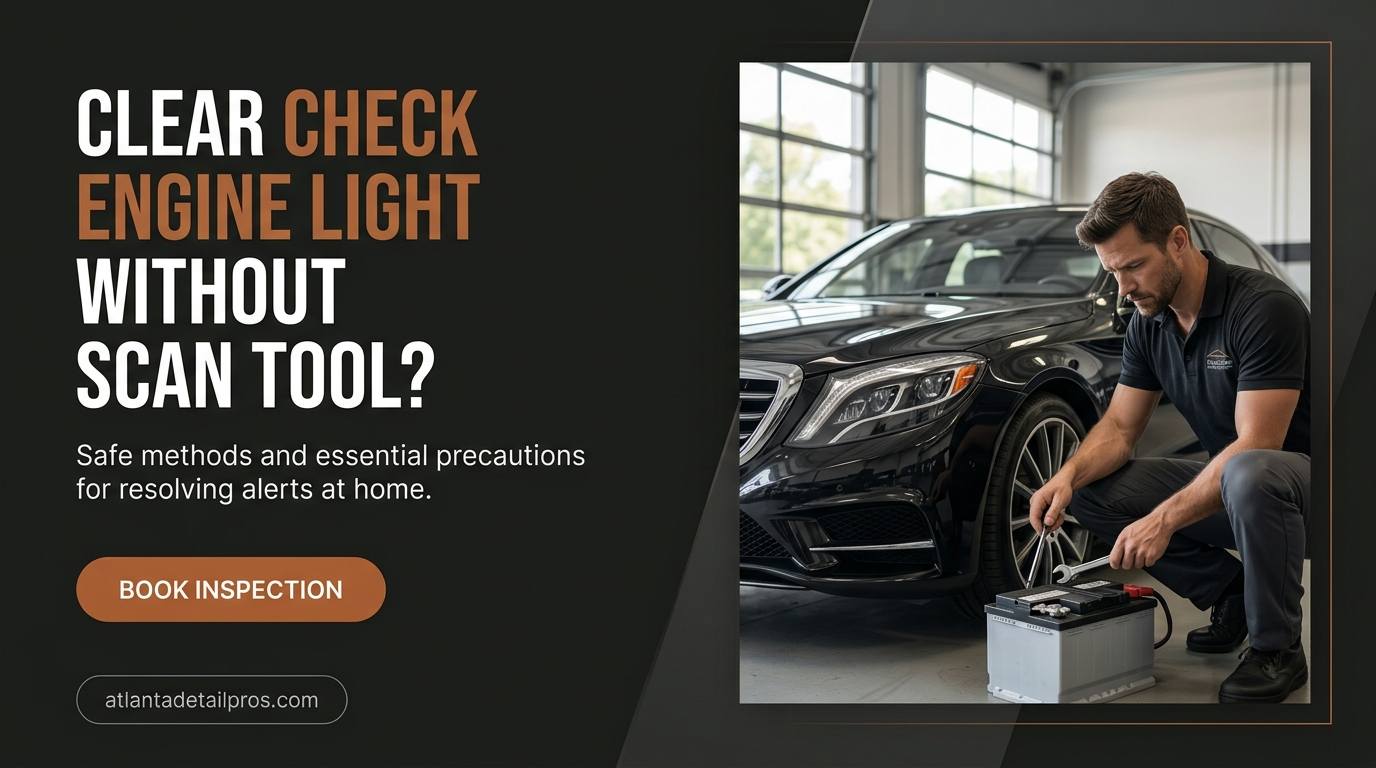
Clearing the check engine light without a scan tool is possible in specific situations, but most of the advice online skips the part that actually matters: the light will come back if the underlying problem is still there, and in some cases clearing it makes your situation worse rather than better. Understanding what the light stores and why it is on is more valuable than knowing how to turn it off.
This guide covers the two methods that actually work, explains which vehicles they work on and which they do not, and addresses the emissions test timing issue that catches most people off guard.
What the Check Engine Light Actually Stores and Why It Matters
The check engine light, technically called the malfunction indicator lamp or MIL, is triggered by the engine control unit when a sensor reading falls outside acceptable parameters. When this happens, the ECU stores a diagnostic trouble code (DTC) in its memory. The light stays on as long as the code is present, and it turns off on its own after a set number of successful drive cycles if the fault condition is no longer detected.
This distinction matters: there are two ways the light goes off. Either you clear it manually, or the ECU clears it automatically after confirming the problem is gone. Manual clearing erases the stored code but does not fix the underlying issue. If the fault condition persists, the code returns and the light comes back on, usually within a day or two. This is not a flaw in the clearing method. It is the system working correctly.
Method 1: Disconnecting the Negative Battery Cable to Reset the ECU
Disconnecting the battery is the most commonly cited no-tool method for clearing the check engine light. It works by cutting power to the ECU, which causes the volatile memory storing the fault codes to clear. This method has been reliable on vehicles manufactured before approximately 2000 and is increasingly unreliable on modern vehicles with non-volatile code storage.
The Procedure
1. Turn the ignition off and remove the key.
2. Locate the negative battery terminal (marked with a minus sign or black cable).
3. Loosen and remove the negative cable clamp from the terminal.
4. Wait at least 15 minutes. Some guides suggest 30 minutes for a more complete ECU power drain.
5. Reconnect the negative cable and start the engine.
What This Method Does and Does Not Do
On older vehicles, this clears all stored codes and resets the OBD readiness monitors to incomplete. On many modern vehicles (2010 and newer), the ECU stores codes in non-volatile memory that survives a battery disconnect. On these vehicles, disconnecting the battery clears the readiness monitors and some adaptive settings but may not clear the code. The light returns within a short drive.
Side effects of battery disconnection: you may lose radio presets, power window calibration, idle relearn settings, and automatic transmission shift points. The throttle body may need to relearn its idle position, which can cause rough idle for the first few minutes of driving.
Method 2: The Drive Cycle Reset That Clears the Code Naturally
The second method requires no tools and no disconnection. It relies on the ECU’s built-in self-clearing logic. Every OBD-II vehicle will clear a check engine code automatically after a certain number of consecutive drive cycles where the fault condition is not detected. This method only works if the underlying problem has actually been fixed.
How the Drive Cycle Reset Works
A drive cycle is a specific sequence of engine operating conditions: cold start, idle, highway speed, deceleration, and stopping. The ECU uses these conditions to run its diagnostic monitors. When a monitor runs successfully without detecting the fault, it marks that cycle as a pass. After two to three consecutive pass cycles for most codes, the ECU clears the code and the light goes off on its own.
How to Complete a Standard Drive Cycle
Start the engine cold (sat at least eight hours). Let it idle for two to three minutes. Drive at city speeds (25 to 40 mph) for five to ten minutes with several gentle stops. Drive at highway speed (55 to 60 mph) for five minutes with steady throttle. Decelerate without braking to a stop. Idle for two more minutes. Repeat this sequence for two to three consecutive trips if the light has not cleared after the first.
Why These Methods Fail on Modern Vehicles and What to Do Instead
Modern vehicles, particularly those from 2012 onward, increasingly store fault codes in non-volatile memory specifically to prevent clearing through battery disconnect. Manufacturers made this change to improve emissions compliance and diagnostic accuracy. The result is that the battery disconnect method has become progressively less reliable on newer cars.
If the battery disconnect did not clear your light and the drive cycle did not clear it either, the fault condition is still present and the code is being actively maintained by the ECU. In this situation, the only practical path forward is using a code reader to identify the specific code. Basic OBD-II readers start at $20 and many auto parts chains (AutoZone, O’Reilly, Advance Auto Parts) will read your codes for free while you wait.
Knowing the code costs nothing and gives you a specific starting point rather than guessing at the cause. A P0420 (catalyst efficiency) has a completely different set of fixes than a P0171 (system lean) or a P0340 (camshaft position sensor). Blindly replacing parts without the code is the most expensive path through this problem.
What Happens at an Emissions Test After Clearing the Light
This is the section most guides omit, and it catches the most people off guard. Clearing the check engine light shortly before an emissions test, even if the light stays off, often results in a failure or a rejection.
When the ECU’s codes are cleared, the OBD readiness monitors reset to incomplete. These monitors need to complete their diagnostic cycles before the emissions test equipment can confirm the vehicle passes. Most states require that all or most monitors show complete before the vehicle passes inspection. An inspector who sees multiple incomplete monitors will fail the vehicle or reject it for an insufficient test, even if no codes are stored.
The drive cycle method described above is the solution: drive the vehicle through several complete warm-up and cool-down cycles over two to three days to allow the monitors to complete. Do not clear the light and immediately drive to an emissions test. Give it at least 100 to 150 miles of normal mixed driving after a battery disconnect.
When You Should Never Clear the Check Engine Light Without Diagnosing It
Some check engine light codes carry safety implications that make clearing the light a genuinely bad idea without understanding the cause first. Clearing the light without diagnosis is an acceptable shortcut in limited circumstances: the code was triggered by a known one-time event (you ran out of gas, you forgot to tighten the gas cap), or you have already confirmed the repair was successful and the code is residual.
- A flashing check engine light means an active misfire that can damage the catalytic converter. Do not clear and continue driving. Find the misfire cause first.
- A check engine light accompanied by high temperature, rough running, or loss of power indicates a condition that can cause mechanical damage if driving continues.
- A code for the evaporative system or gas cap can be safely cleared and monitored. A code for engine misfires or oxygen sensor failure deserves diagnosis before clearing.
Frequently Asked Questions
Can I clear the check engine light by disconnecting the battery?
On vehicles manufactured before approximately 2005, yes, reliably. On newer vehicles, it clears the OBD readiness monitors but often not the stored code itself, which is retained in non-volatile memory. The light returns within a short drive if the underlying fault condition persists. On modern vehicles, a $20 OBD reader is a more reliable tool.
How many drive cycles does it take to clear the check engine light?
Most codes clear automatically after two to three consecutive successful drive cycles once the fault condition is no longer present. A drive cycle is a complete sequence of cold start, idle, mixed driving, and stopping. If the light does not clear after five cycles of normal driving, the fault condition is still present and clearing manually will only provide a temporary fix.
Will the check engine light go off on its own?
Yes, if the fault condition is resolved. The ECU continuously monitors for the triggering condition. When it does not detect the fault for a defined number of consecutive drive cycles (typically two to three), it clears the code and turns off the light automatically. This is the most reliable clearing method because it confirms the problem is actually gone.
Does clearing the check engine light delete codes?
Clearing erases the current stored codes and resets freeze frame data (the snapshot of sensor readings at the moment the code was triggered). It also resets OBD readiness monitors to incomplete. Mechanics can sometimes identify that codes were recently cleared because all monitors show incomplete simultaneously, which does not happen naturally.
The Bottom Line
The battery disconnect method works on older vehicles and is unreliable on modern ones. The drive cycle method works on any vehicle, but only if the underlying problem has been resolved. Neither method is a fix for the condition that triggered the light, and clearing the light before an emissions test without completing the readiness monitors risks a failed inspection.
The most useful thing you can do before deciding whether to clear the light is find out what the code is. It costs nothing at most auto parts stores and changes a guessing game into a specific diagnosis. From there, you can decide whether the repair is something you can do yourself, something that needs a shop, or whether the code is a minor nuisance that can be monitored.