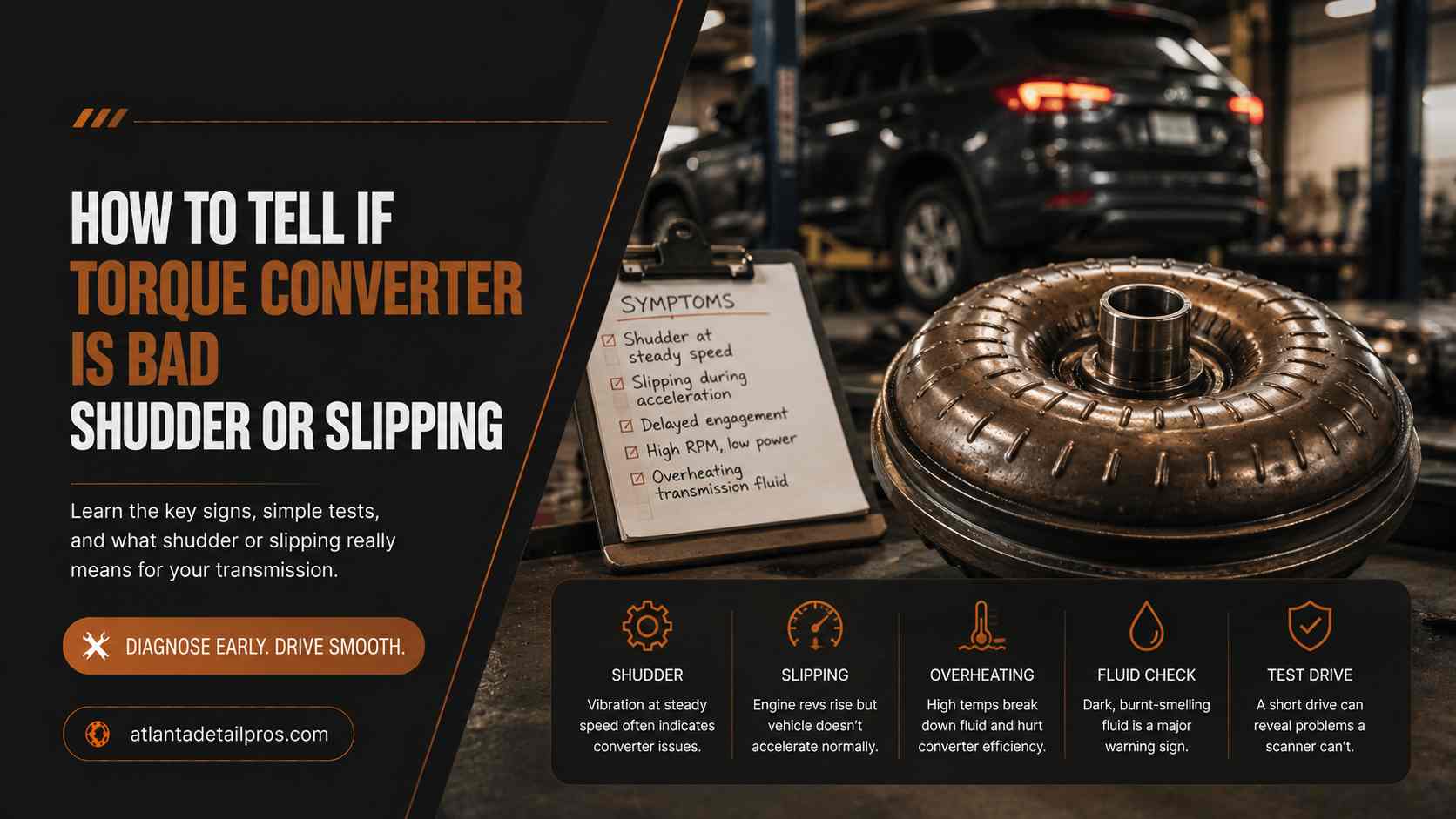
A bad torque converter produces two primary symptoms that most drivers experience before the transmission itself shows any problem: a shudder that feels like driving over rumble strips at light throttle between 30 and 50 mph (caused by the torque converter lock-up clutch failing to engage cleanly), and slipping that presents as RPM flare without a corresponding increase in vehicle speed (caused by low converter stall pressure or a worn stator clutch).
These two symptoms are mechanically distinct failures within the same component, and which one you are experiencing tells you exactly what has failed inside the converter and how urgently it needs to be addressed.
Torque converter problems are frequently misdiagnosed as transmission issues because the converter is housed inside the bell housing, integrated with the automatic transmission, and produces symptoms that feel nearly identical to clutch pack slipping or low fluid conditions. The critical distinction is when and how the symptom occurs: converter shudder appears at a specific speed range under light throttle, and converter slipping appears during initial acceleration when converter multiplication is highest.
What the Torque Converter Does and How It Fails
The torque converter is a fluid coupling between the engine and the transmission. It allows the engine to run while the vehicle is stopped (unlike a manual clutch) and multiplies torque during initial acceleration through a stator clutch mechanism. Above a specific speed threshold, the lock-up clutch inside the converter mechanically couples the engine directly to the transmission input shaft to eliminate fluid coupling losses at highway speed.
Each of these functions has a specific failure mode. Understanding which function has failed identifies the symptom you are experiencing.
Lock-Up Clutch Failure (Causes Shudder)
The lock-up clutch is a friction disc inside the torque converter that engages at highway cruise speed to create a direct mechanical link between the engine and the input shaft. The clutch disc uses friction material similar to a brake pad. When the friction material wears, glazes, or the hydraulic circuit that applies the clutch loses pressure, the clutch engages partially and slips intermittently rather than locking fully. This intermittent slip produces the shudder: a rapid, rhythmic vibration at 30 to 50 mph under light throttle, exactly when the ECU is commanding lock-up engagement.
Stator One-Way Clutch Failure (Causes Slipping During Acceleration)
The stator sits between the pump and turbine inside the converter. Its one-way clutch redirects fluid during the torque multiplication phase of acceleration. When the stator clutch fails and freewheels in both directions, the converter loses its torque multiplication ability. The engine RPM rises but the torque delivered to the transmission drops. The driver experiences this as the engine revving freely without the expected acceleration response: a slipping sensation distinctly different from the shudder.
Fluid Contamination (Causes Both Symptoms)
Degraded transmission fluid affects the torque converter’s internal fluid coupling, the lock-up clutch apply circuit, and the stator operation simultaneously. A failing torque converter on a vehicle with severely degraded ATF may exhibit both shudder and slipping at different points. Always check the ATF condition (color and smell on the dipstick) before attributing the symptoms to the converter rather than to fluid degradation.
Shudder vs. Slipping: How to Tell Them Apart
Distinguishing shudder from slipping is essential because they have different repair implications and different urgency levels.
Characteristics of Converter Shudder
The shudder occurs at a specific, repeatable speed window, almost always 30 to 50 mph, under light to moderate throttle. It feels like driving over a cattle grid or rumble strip: a rapid buzz or vibration through the seat and steering wheel. It disappears when you accelerate firmly (which causes the lock-up clutch to disengage) or when you decelerate below the trigger speed. It is worse when the transmission is cold and often improves after 10 to 15 minutes of driving as fluid warms. If you can make the shudder disappear by pressing the accelerator firmly, you are experiencing lock-up clutch shudder.
Characteristics of Converter Slipping
The slipping occurs during initial acceleration from a stop or from low speed. RPM rises normally or above normal, but the vehicle does not accelerate proportionally. The sensation is similar to a slipping manual clutch: the engine is running but the power is not getting to the wheels. Unlike transmission clutch pack slipping, converter stator slipping tends to be consistent from the moment of engagement rather than appearing only at a specific gear change point.
Symptom Comparison Table
Characteristic | Converter Shudder | Converter Slipping |
|---|---|---|
Speed range | 30 to 50 mph, light throttle | Low speed, initial acceleration |
Feel | Rapid vibration, like rumble strip | RPM flare without acceleration |
Goes away with firm throttle | Yes | No |
Worse when cold | Yes | Consistent regardless of temperature |
Likely internal cause | Lock-up clutch wear or glazing | Stator one-way clutch failure |
Fluid condition effect | Improves temporarily with fluid change | Little improvement from fluid alone |
At-Home Confirmation Tests
The following observations, performed during a normal drive, allow you to confirm which failure mode is present before visiting a shop.
Test for Shudder: The Light-Throttle Highway Test
Drive onto a highway and bring the vehicle to 40 mph. Maintain very light throttle, just enough to hold speed. If a shudder or vibration appears and disappears within a few MPH window, that is lock-up clutch shudder. Now press the accelerator firmly to approximately 50 percent throttle. The shudder should disappear immediately as the lock-up clutch disengages under the increased throttle demand. If the vibration disappears with firm throttle and returns at light throttle, the lock-up clutch is the confirmed source.
Test for Slipping: The Acceleration Response Test
From a complete stop, accelerate firmly (approximately 50 to 70 percent throttle). Watch the tachometer and observe vehicle acceleration simultaneously. Normal converter behavior: RPM rises with throttle and the vehicle accelerates proportionally. Stator slipping: RPM rises steeply but vehicle acceleration is noticeably lower than the RPM increase would suggest. The ratio of RPM rise to vehicle speed gain is the key observation.
Fluid Condition Check
Before any other diagnosis, pull the transmission dipstick (if equipped) and observe the ATF. Dark brown or black fluid with a burnt smell indicates that the fluid degradation itself may be causing the converter symptoms. Some cases of lock-up clutch shudder resolve with a fluid drain and refill because the friction modifier additives in fresh ATF restore the lock-up clutch’s ability to engage cleanly. If the fluid is this degraded, replace it before condemning the converter and retest.
“My Camry had that classic shudder between 40 and 45 mph under light throttle. Took it to a shop and they immediately said torque converter. I asked them to try a fluid service first since the fluid was dark. After the drain and refill the shudder was gone completely. Saved $1,200 on a converter replacement that turned out to be a fluid issue.” : Will Pemberton, 2015 Toyota Camry owner
Can a Fluid Change Fix Torque Converter Shudder?
A fluid change resolves lock-up clutch shudder in a significant number of cases, particularly on higher-mileage vehicles where the fluid has lost its friction modifier content. The friction modifier in ATF is what allows the lock-up clutch to engage smoothly without chatter. Depleted friction modifier allows the clutch to slip momentarily during engagement, producing the shudder.
If the fluid is at or past its service interval (30,000 to 60,000 miles for most vehicles), replace it before diagnosing the converter as mechanically failed. A fluid service costs $80 to $150 and eliminates one of the most common causes of shudder before you commit to a $800 to $2,500 converter replacement.
Repair Cost Table
Repair | Typical Cost Range (Shop) |
|---|---|
Transmission fluid drain and refill (not flush) | $80 to $150 |
Torque converter replacement (rebuilt converter) | $300 to $600 parts |
Total cost with transmission removal and reinstall | $800 to $2,000 |
Transmission rebuild with converter replacement | $1,800 to $4,000 |
FAQs
Can you drive with a shuddering torque converter?
A shudder from lock-up clutch wear is drivable in the short term as long as the transmission shifts normally and the fluid level is correct. The condition worsens progressively as the clutch friction material continues to degrade, and contamination from the worn material can damage the valve body and transmission fluid over time. Schedule the repair within a few weeks.
Does a bad torque converter damage the transmission?
Yes, over time. Lock-up clutch material that wears and contaminates the ATF circulates through the entire transmission, coating the valve body passages and potentially causing shift quality problems independently of the converter shudder. This is one reason to address a known converter problem before it progresses to the point where debris has circulated extensively.
How do I know if it is the torque converter or the transmission causing the slip?
Transmission clutch pack slipping typically occurs at specific gear changes (the slip appears at the moment the transmission shifts from 2nd to 3rd, for example) and tends to be consistent across temperature. Torque converter stator slipping is more consistent from initial acceleration and does not correspond to a specific gear change event. A shop can distinguish these definitively with a line pressure test and a stall speed test.
Can a bad torque converter cause a check engine light?
Yes, in some cases. Severe lock-up clutch slipping can trigger a torque converter clutch performance code (P0740, P0741, P0742, P0743, or P0744 depending on the failure mode). These codes appear when the ECU commands lock-up but detects that the engine speed and transmission input speed are not converging as expected. Not all torque converter failures trigger codes, particularly in the early stages of lock-up clutch wear.
Is a rebuilt torque converter as reliable as a new one?
A remanufactured torque converter from a reputable rebuilder is generally reliable for normal driving conditions. The quality of the rebuilder matters significantly: a reputable shop will use new friction material, new bearings, and pressure-test the converter before shipment. A reputable independent transmission shop typically sources rebuilt converters from known suppliers and warrants the part as part of the repair.
Bottom Line
A bad torque converter announces itself through shudder at 30 to 50 mph under light throttle (lock-up clutch failure) or RPM flare during initial acceleration without proportional vehicle movement (stator slipping).
The light-throttle highway test and acceleration response test confirm which failure mode is present before you visit a shop, saving diagnostic time and ensuring you get an accurate repair estimate.
Before authorizing converter replacement, perform a fluid service if the ATF is at or past its interval. A fluid change at $80 to $150 resolves shudder in a meaningful percentage of cases and costs a fraction of the $800 to $2,000 converter replacement. If shudder persists after a fluid service with fresh fluid and a new filter, the lock-up clutch has worn past the point where friction modifier can compensate.