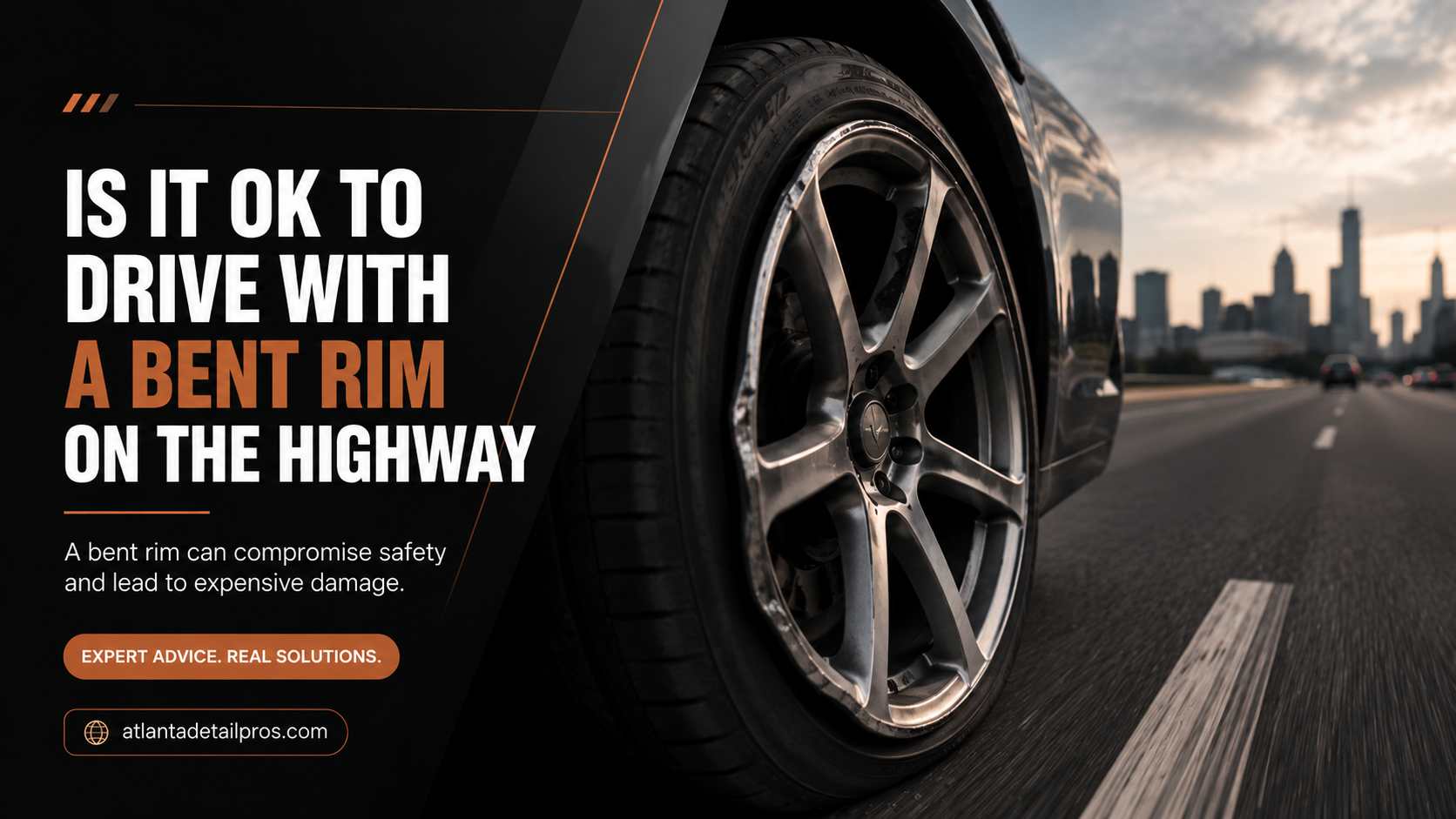
It is not safe to drive with a bent rim on the highway: the combination of highway speeds and a compromised wheel creates a structural failure risk that can cause sudden loss of vehicle control at 65 mph or higher, with no warning before the event.
Even a rim that feels manageable at 25 mph can vibrate violently, develop a dangerous wobble, or allow rapid tire deflation at highway speeds where the physical forces on the wheel are dramatically higher than at city speeds.
A bent rim is not a cosmetic issue you can defer until your next tire rotation. The wheel is a structural component of the vehicle’s suspension and steering system. When its geometry is compromised, it affects tire bead seal integrity, wheel bearing load distribution, and alignment geometry. All three failure modes are invisible to the driver until they reach a critical threshold, which on a highway happens at the worst possible speed and moment.
This guide explains the physics of why highway speeds amplify rim damage, how to assess severity at the roadside, and the difference between a rim that needs monitoring versus one that needs an immediate tow.
Understanding What a Bent Rim Actually Does to Your Vehicle
How Rim Bending Causes More Than a Rough Ride
When a rim bends, the circular profile that allows it to spin smoothly is compromised. Even a 0.5-inch deviation from true round creates a point-load impact with every rotation. At 65 mph, a standard tire and wheel assembly completes approximately 800 rotations per minute. That means 800 repetitive impact cycles per minute transmitted directly through the wheel bearing, hub, steering knuckle, and suspension components on every highway mile you drive.
The rim also forms the bead seal: the tight mechanical interface between the tire’s inner bead edge and the rim flange that keeps air from escaping. A bent flange breaks this seal intermittently as the wheel rotates, which produces a slow air leak at low speeds and an accelerated leak at high speeds due to the increased centrifugal forces pulling the tire bead away from the damaged flange section with every revolution.
At low speeds, tire pressure from inside the tire maintains adequate contact between the tire bead and the slightly imperfect rim surface. At highway speeds, the outward centrifugal force on the tire sidewall increases to the point where a compromised bead seal opens rather than stays compressed. The result is sudden deflation rather than a slow leak.
The Point Where a Bent Rim Becomes an Emergency
Not all rim damage is equal in risk. A minor curb scuff or surface cosmetic damage is different from a structural bend that has changed the rim’s cross-section geometry. The structural bend is the dangerous one, characterized by a detectable rhythmic vibration or wobble when driving, air loss that appeared after an impact event, or a visible deviation from round when viewing the wheel face-on.
The difference between a 30 mph wobble and a 65 mph wobble is not linear. The forces involved at highway speed are exponentially greater, which is why a rim that feels borderline on surface streets can fail suddenly when you enter a freeway.
Speed and Forces: Why the Highway Makes Rim Damage Exponentially Worse
Centrifugal Force and Tire Bead Separation
Centrifugal force on a rotating tire increases with the square of speed. A wheel spinning at 65 mph experiences more than four times the outward centrifugal force of the same wheel at 30 mph. This is why a bent rim that holds air acceptably in a parking lot or on a 25 mph residential street may rapidly lose air the moment highway speeds are reached.
The tire bead is held against the rim flange by air pressure from inside and by the rim flange geometry from outside. A bent flange provides an incomplete and inconsistent contact surface around its circumference. At low speeds, tire pressure alone maintains an adequate seal at the bend point. At highway speeds, the increased outward force on the tire sidewall and bead area overcomes the compromised seal at the bend, and the bead lifts away from the rim at that point with each rotation.
When the bead breaks completely, air escapes in seconds rather than minutes. The handling emergency this creates is identical to a traditional high-speed blowout: the vehicle pulls hard and suddenly to the affected side.
Wheel Bearing Damage From Rotational Imbalance
A bent rim creates a rotating imbalance that no amount of conventional balancing weights can fully correct, because the imbalance comes from the rim geometry changing at a specific point every 360 degrees of rotation rather than from a fixed-point excess of weight. Dynamic balancing adds weight to counteract a fixed heavy spot: it cannot counteract a continuously changing geometry.
This cyclic imbalance shock-loads the wheel bearing with each rotation. Wheel bearings are engineered for smooth, balanced radial loads under normal operating conditions. Cyclic shock loading from a bent rim can reduce wheel bearing service life from the normal 100,000-plus miles to as few as 500 to 2,000 miles of operation, depending on bend severity and speeds driven. A wheel bearing that fails at highway speed can seize and lock the affected wheel, creating a catastrophic understeer or directional-pull event with no warning.
Steering Feedback and Handling Precision Loss
A bent front rim directly corrupts steering feedback. The rhythmic vibration from the out-of-round wheel travels up the steering column and into the driver’s hands. More critically, the changing geometry of the bent rim affects the contact patch of the tire in subtle but real ways with every rotation. Braking stability is affected because the contact patch is not consistently round and flat against the road surface. Emergency maneuvers at highway speed depend on the tire and wheel assembly behaving predictably. A bent rim removes that predictability.
“I hit a pothole on the interstate doing about 70 and felt the steering pull but figured it was just a flat developing. I drove about 35 miles home on the highway. By the time I pulled into the driveway the rim had cracked all the way through from the bend point and the tire was completely flat. The mechanic told me I was fortunate it held together: if the rim had fractured on the highway at speed I would have lost the front-right wheel entirely. That turned into a $700 lesson.”: Todd Chambers, 2018 Ford Fusion 1.5T AWD
How to Assess Rim Damage Severity at the Scene
Step 1: Check the Tire Immediately After the Impact
Pull over safely after any significant impact that may have bent a rim. Inspect the tire visually for sidewall bulge, which indicates internal structural damage to the tire itself, and check whether the tire has gone soft. A tire that has deflated noticeably in the minutes immediately following an impact has either been punctured or has sustained a bead seal break from the rim damage. Neither condition is safe to drive on at any speed.
If the tire appears fully inflated and the vehicle drives straight at low speed without vibration, you can proceed to further assessment.
Step 2: Drive Slowly in a Straight Line
If the tire is confirmed to be holding pressure, drive slowly, under 15 mph, in a straight line for about 100 yards while you monitor for vibration through the steering wheel and seat. Any rhythmic vibration, pulsing, or wobble that was not present before the impact indicates the rim geometry has changed. Do not enter any road with a speed limit above 30 mph if this vibration is present.
Step 3: Inspect the Rim Face and Bead Flange
With the vehicle parked safely and the wheel in a position where you can see it clearly, look at the rim face-on. A visible flat spot or deviation from the circular profile confirms a structural bend. Inspect the inner bead flange, which is the lip where the tire sits: a bent, cracked, or deformed flange is the highest-risk finding and means the rim requires replacement before the vehicle moves under its own power.
Step 4: Install the Spare if Available
If your vehicle has a full-size spare tire and wheel in serviceable condition, install it before driving any significant distance. A temporary spare (the narrow spare often called a donut or space-saver) is rated for a maximum of 50 mph and 50 to 70 miles total distance. It is safer than a bent rim at city speeds, but it should not be used for sustained highway driving. Drive to the nearest shop at the temporary spare’s rated speed limit.
Rim Bend Severity Classification
| Damage Level | Visual Signs | Drive to Shop? | Highway Safe? | Recommended Action |
|---|---|---|---|---|
| Cosmetic scuff only | Surface marks, rim perfectly round | Green: Yes | Green: Yes | Monitor, repair when convenient |
| Slight bend (under 0.25 in deviation) | Very faint vibration above 50 mph, no air loss | Yellow: Yes, under 40 mph | Red: No | Drive to shop at low speed |
| Moderate bend (0.25 to 0.5 in) | Rhythmic vibration, slow air loss | Yellow: Short distance only | Red: No | Under 25 mph, direct route only |
| Severe bend (over 0.5 in) | Visible wobble, rapid or immediate air loss | Red: No | Red: No | Spare tire or tow |
| Cracked rim (any severity) | Visible crack, hissing air, rapid deflation | Red: No | Red: No | Tow immediately |
What Rim Failure Looks Like for the Driver at Speed
A driver approaching rim failure at highway speed typically experiences the following sequence, which can unfold over seconds rather than minutes:
Onset: A rhythmic thumping or vibration develops and intensifies with speed. The steering wheel may pulse in sync with wheel rotation frequency, which increases with vehicle speed.
Progression: Vibration intensity increases. The vehicle may track slightly toward the side of the affected wheel. Braking produces a detectable pull. The tire begins losing air at an accelerating rate as bead seal integrity degrades under load.
Critical point: Air pressure drops below the threshold that maintains the bead seat. The tire bead begins to unseat from the rim at the bend point with each rotation.
Failure event: The tire loses pressure rapidly. The vehicle pulls hard to the affected side. Overcorrection by the driver is the primary cause of loss-of-control accidents following blowouts. If the rim fractures under load rather than simply losing bead seal, the wheel can partially collapse, dropping that corner of the vehicle abruptly to the road surface.
At 65 mph, the vehicle travels approximately 95 feet per second. A driver has a fraction of a second before the vehicle has already changed direction significantly from the initial deflection event.
Repair vs. Replace: Rim Costs and Structural Limits
| Rim Material and Condition | Repair Option | Cost Range | Notes |
|---|---|---|---|
| Steel rim, minor bend (no cracks) | Cold-press or roll straightening | $50 to $100 | Generally reliable, check for cracks after |
| Aluminum alloy, minor bend (no cracks) | Heated hydraulic straightening | $100 to $200 | Micro-crack inspection required post-repair |
| Aluminum alloy, moderate bend | Professional straightening and structural test | $150 to $300 | Pressure test and visual inspection mandatory |
| Any rim with visible cracks | Replacement only | $150 to $600 per rim | Never repair a cracked rim |
| OEM forged or flow-formed rim | Specialized repair or OEM replacement | $300 to $1,500 and up | Used OEM replacements often available at lower cost |
Rim straightening restores geometry but does not restore the original crystalline grain structure of the metal around the bend point. The area that bent has experienced plastic deformation and is inherently weaker than the undamaged rim material at that point. A straightened rim is generally adequate for city and suburban driving at normal speeds: for sustained highway driving, the peace of mind and structural reliability of a replacement rim is worth the additional cost, particularly on front-axle wheels that are directly linked to steering response.
Frequently Asked Questions
Can a bent rim cause a tire blowout?
Yes, and it can happen in two ways. First, a bent rim flange breaks the tire bead seal, allowing air to escape rapidly, particularly at higher speeds when centrifugal force pulls the tire sidewall outward and opens the compromised seal. Second, a severely bent or cracked rim can fracture further under the load of highway driving, causing catastrophic and instantaneous deflation. Both scenarios at highway speed create a handling emergency equivalent to a traditional blowout and require the same emergency response: grip the wheel firmly, ease off the throttle gradually, and steer straight while allowing the vehicle to decelerate before pulling off the road.
How long can I drive on a slightly bent rim?
A very slight bend with under 0.25 inch deviation, no air loss, and only faint vibration above 50 mph can often be driven on for a short distance at speeds below 40 mph to reach a shop. Any bend significant enough to cause a rhythmic vibration or measurable air loss should not be driven more than a few miles and should not be taken onto a highway at any speed. The longer you drive on a bent rim, the more secondary damage accumulates to the tire’s internal structure, wheel bearing, and suspension bushings from the repetitive imbalance loading.
Will the TPMS warn me before a bead leak gets dangerous on the highway?
Tire pressure monitoring systems alert the driver when pressure drops approximately 25 percent below the recommended operating pressure. A bead leak from a bent rim that progresses slowly will eventually trigger the TPMS, but by the time the light illuminates, the tire is already significantly underinflated. At highway speeds, rapid bead separation from a bent rim can deflate a tire faster than the TPMS sampling rate can detect and alert, meaning the blowout event may occur before the warning light activates. Do not rely on TPMS as the primary safety check when rim damage is suspected.
Is it safe to drive to work on a bent rim if I stay on surface streets under 35 mph?
A minor bent rim with no air loss and only faint vibration can often be driven on surface streets at or below 35 mph for a limited period without immediate catastrophic risk. Keeping speed below 40 mph significantly reduces the centrifugal forces acting on the bead seal area. However, this is a short-term concession for reaching a repair facility, not an ongoing strategy. Every mile driven on a bent rim increases wear to the tire bead, the wheel bearing, and the bend area of the rim itself, narrowing the remaining safety margin.
How do I tell if my rim is cracked versus just bent?
A cracked rim often shows a visible hairline fracture on the rim face or barrel. It may produce a hissing sound at the crack location if the crack passes through to the air space. Running soapy water around the bead interface and the rim face while the tire is inflated will show consistent bubbling at any crack or bead break point. A bent rim without cracks holds air unless the bead seal is broken. A tire shop can confirm the difference with a visual inspection and a pressure hold test.
Can a bent rear rim be driven on at highway speed?
Rear rim bends are generally less immediately dangerous than front rim bends because the rear wheels are not directly linked to steering. However, a bent rear rim still creates the same bead seal risk, the same wheel bearing imbalance loading, and the same risk of sudden deflation at speed. Rear blowouts cause oversteer and tail-end instability, which is a different handling emergency than a front blowout but equally serious at highway speed. Do not drive any bent rim, front or rear, at highway speeds.
The Bottom Line
A bent rim on the highway is not a minor inconvenience to defer: it is a structural failure waiting for the right speed and conditions to complete. Highway speeds amplify every weakness in a compromised wheel, from bead seal integrity to bearing load distribution, in ways that city driving does not expose. The risk profile of a bent rim at 65 mph is categorically different from the same rim at 25 mph, and the consequences of failure at highway speed involve other drivers as well as your own vehicle.
The correct immediate response to a bent rim is to drive no faster than 35 to 40 mph until you reach a tire shop, and if the tire is losing air or the vibration is pronounced, to install the spare or call a tow. Rim straightening is a reasonable and cost-effective repair for minor bends without cracks: rim replacement is the correct answer for any bend that caused a bead seal failure, that is visible to the naked eye when looking at the wheel face-on, or that produced a rhythmic vibration during driving.
Do not let repair cost be the deciding factor between keeping a damaged rim and replacing it. A bent rim failure at highway speed puts every vehicle around you at risk, not just your own.