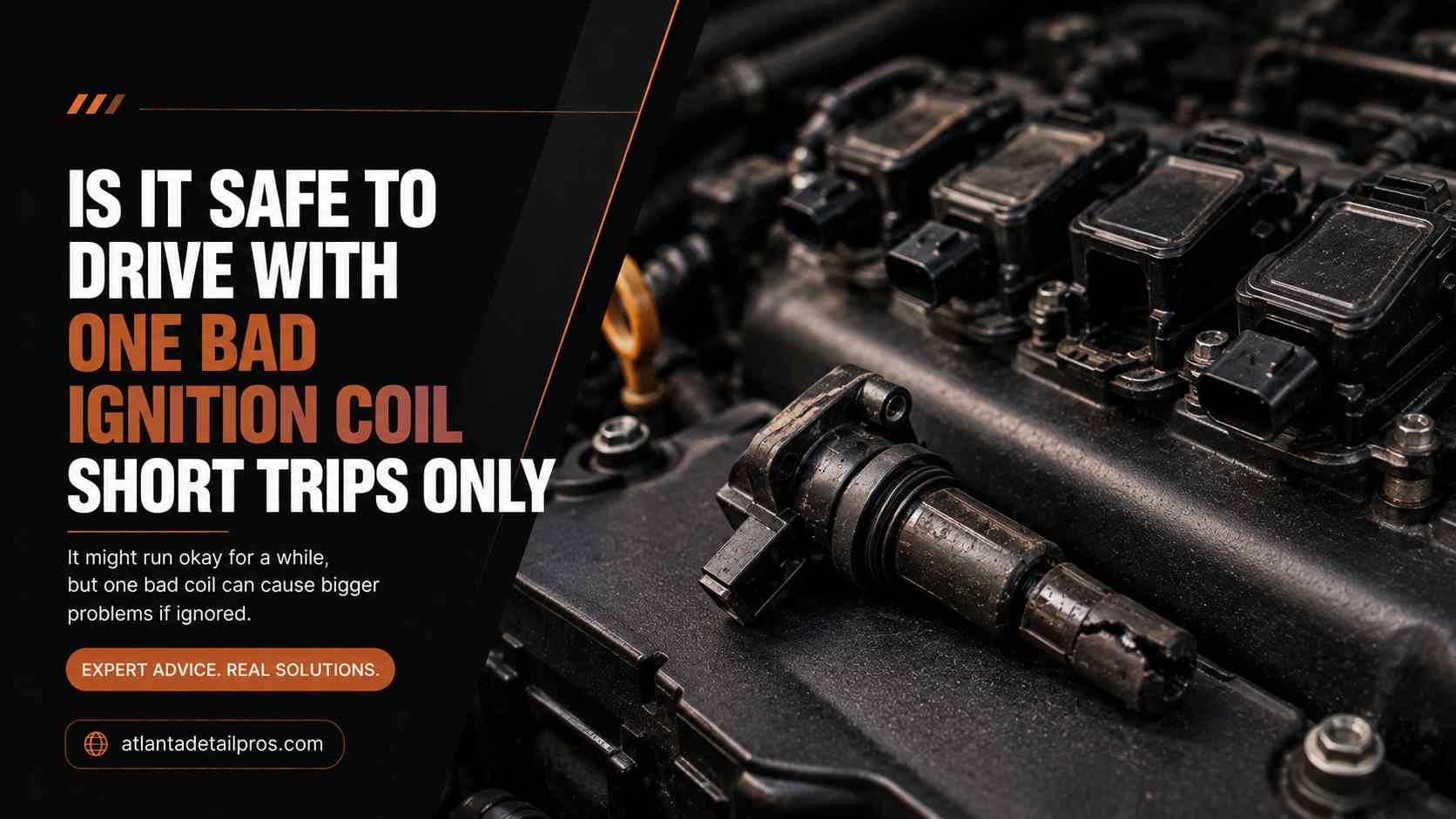
Driving with one bad ignition coil is possible for short trips of 5 miles or less at low RPM, but every mile driven in this condition risks destroying the catalytic converter from raw fuel passing through the misfiring cylinder, and the check engine light will be flashing rather than steady if the converter is in active danger.
A flashing check engine light during a coil misfire is a stop-driving signal, not a continue-carefully signal.
One failed ignition coil removes that cylinder from contributing to combustion. On a 4-cylinder engine, you have lost 25 percent of your power output. On a 6-cylinder, 17 percent. The engine will run roughly and feel sluggish, but the mechanical risk is lower than most drivers assume for very short-distance driving. The catalytic converter risk is not.
What a Bad Coil Does to the Engine and Exhaust System
The Misfire Mechanism
An ignition coil steps up battery voltage to 20,000 to 45,000 volts to fire the spark plug. When a coil fails, the spark plug in that cylinder either fires weakly or does not fire at all. The injector continues spraying fuel into that cylinder on schedule. That fuel does not burn: it passes through the cylinder as a liquid, enters the exhaust stream, and reaches the catalytic converter.
The catalytic converter oxidizes that raw fuel inside its substrate. The resulting exothermic reaction raises converter temperature well above its normal operating range of 800 to 1,600 degrees Fahrenheit. Sustained raw fuel loading can melt the ceramic substrate inside the converter, destroying it at a replacement cost of $400 to $2,200.
Flashing vs. Steady Check Engine Light
This distinction matters more than almost anything else in this situation. A steady check engine light with a misfire code means the ECU has detected the problem but the catalyst is not in immediate danger of damage. A flashing check engine light means the ECU has determined the misfire rate is severe enough to be actively destroying the catalytic converter at that moment. Pull over and stop the engine when the light flashes. Do not continue driving.
Cause Hierarchy: Coil vs. Plug vs. Injector
Before replacing a coil, verify it is the coil and not the spark plug or injector causing the misfire. A quick confirmation method: swap the coil from the misfiring cylinder to an adjacent cylinder. If the misfire code follows the coil to its new location, the coil is confirmed bad. If the misfire stays in the original cylinder, the spark plug or injector is the cause.
| Component | Swap Test Result | OBD Code Pattern | Repair Cost |
|---|---|---|---|
| Failed ignition coil | Misfire follows the swapped coil | P030X moves to new cylinder | $40 to $120 per coil |
| Failed spark plug | Misfire stays in original cylinder after coil swap | P030X stays in same cylinder | $60 to $200 per plug set |
| Failed injector | Misfire stays regardless of coil swap, fuel trim codes present | P030X plus P020X | $200 to $600 per injector |
Decision Framework: Short Trip or Tow?
| Engine Type | Misfire Severity | Check Engine Light | Drive Decision |
|---|---|---|---|
| 6-cyl or 8-cyl | Rough idle, drivable | Steady: illuminated | Yes: under 5 miles, low RPM, direct route |
| 4-cyl | Very rough, power loss | Steady: illuminated | Yes: under 3 miles, no highway |
| Any | Severe shaking | Flashing | No: pull over immediately |
| Any | Rough with burning smell | Flashing | No: stop engine, tow |
| Any | Post-flooding (raw fuel smell) | Any | No: oil may be contaminated |
“The Highlander started misfiring on the way home. The check engine light was steady so I figured I had some margin. I drove the last four miles home slowly. The next day the mechanic pulled a P0302 and confirmed a dead coil on cylinder two. No cat damage because I kept RPM low and the light stayed steady the whole time. Swapped the coil and a plug for $95 and it was done.”: Donna Fitch, 2015 Toyota Highlander 3.5L
Oil Dilution: The Hidden Secondary Risk on Longer Misfire Drives
Raw fuel that enters the cylinder and does not ignite has two exit paths. The first is through the exhaust valve into the exhaust stream (where it damages the catalytic converter as described). The second is past the piston rings and into the engine oil. Fuel that makes it past the rings dilutes the oil, reducing its viscosity and its ability to maintain an adequate lubricating film on bearing surfaces.
On a 4-cylinder engine, a single misfiring cylinder contributes roughly 25 percent of the total unburned fuel load to the oil dilution risk. Fuel dilution of engine oil becomes measurable after approximately 20 to 30 miles of misfire driving under load. By 50 to 100 miles, the oil may be significantly thinned. Thinned oil accelerates bearing wear and can cause oil pressure to drop toward the warning threshold on high-mileage engines with existing bearing clearances.
Change the engine oil after any misfire event that lasted more than 10 to 15 miles before being repaired, regardless of how recently the last oil change occurred. The cost of one additional oil change ($40 to $80) is negligible compared to the cost of bearing damage from operating on fuel-diluted oil.
Vehicle-Specific Coil Failure Patterns and Vulnerability
Some platforms experience coil failures at a predictable rate and mileage, which changes the risk calculus for the driver:
Ford 4.6L and 5.4L Modular V8 (1997 to 2014): Coil boot deterioration causes arcing to the valve cover rather than to the plug, producing misfires that clear temporarily after coil replacement but return. Ford coils on the 3-valve 5.4L are particularly prone to breaking off in the spark plug hole, complicating extraction. Replacement coils cost $20 to $40 each.
GM LS engines (4.8L, 5.3L, 6.0L): The individual coil-on-plug units are reliable but the spark plug wells on aluminum heads accumulate water from condensation, which causes arcing and misfire. Cleaning the wells with compressed air before coil installation prevents recurrence. Coils cost $15 to $35 each.
BMW N52, N54, N55 inline-6: Coil failures on these engines are well-documented between 60,000 and 100,000 miles. BMW coils and plugs should be replaced as a complete set rather than individually because the N54 is particularly prone to multiple simultaneous coil degradation. OEM BMW coils cost $30 to $60 each: aftermarket alternatives are widely available.
Toyota 3.5L 2GR-FE (Camry, Highlander, Sienna, RAV4): Coil failures are typically associated with oil entering the spark plug well from a failing valve cover gasket O-ring seal. Replacing the coil without addressing the oil intrusion results in coil failure recurrence within 5,000 to 10,000 miles. Always inspect the plug wells for oil before installing new coils.
Audi and Volkswagen 2.0T TSI (EA888 series): These engines have a documented history of coil failure between 50,000 and 80,000 miles. The OEM coil design has been superseded by an updated part number. Using the updated coil significantly extends service life.
Effects of Driving Distance on Secondary Damage
Miles 0 to 5, RPM under 2,500, steady check engine light: Risk to the catalytic converter is low if the raw fuel load is intermittent. The converter can handle brief unburned fuel episodes. Engine oil is not yet significantly diluted. The main risk is the converter beginning to over-temperature.
Miles 5 to 20, any RPM: Sustained raw fuel delivery to the converter begins degrading its substrate. Engine oil can absorb raw fuel through the cylinder walls, thinning it and reducing lubrication quality. The misfire may trigger the light to flash if the ECU detects escalating catalyst damage.
Miles 20 and beyond: Catalytic converter damage is likely. Engine oil dilution with raw fuel becomes measurable. On direct-injection engines, cylinder wash-down from unburned fuel also accelerates bore wear.
Vehicle-Specific Notes
Coil-on-plug (COP) systems, used on most post-2000 vehicles, allow individual coil replacement. Older distributorless ignition systems (DIS) use coil packs serving two cylinders: one failed coil pack affects two cylinders simultaneously and makes the vehicle significantly harder to drive. Identify your system before deciding.
High-mileage coil failures often occur in sets. If one coil has failed at 90,000 miles or above, the others are at similar wear. Replacing all coils at once while the intake is already disassembled costs marginally more in parts and saves future labor.
Repair Cost Ranges
| Repair | Independent Shop Cost Range |
|---|---|
| Single coil replacement | $80 to $200 (part and labor) |
| Full coil set replacement (4-cyl) | $200 to $450 |
| Full coil set (6-cyl or 8-cyl) | $300 to $750 |
| Spark plug set with coils | Add $60 to $180 |
| Catalytic converter replacement (if damaged) | $400 to $2,200 |
Frequently Asked Questions
What does a bad ignition coil feel like while driving?
A misfiring cylinder produces a distinct rough idle and hesitation during acceleration. On a 4-cylinder engine, the roughness is severe enough that the engine shakes noticeably and the vehicle barely pulls away from a stop. On a V6 or V8, it is more subtle but still detectable as an uneven power delivery and a rhythmic shudder at idle.
Will a bad ignition coil throw a check engine light?
Yes, always. The ECU monitors individual cylinder combustion through the crankshaft position sensor and oxygen sensors. A misfiring cylinder triggers a P030X code, where X is the cylinder number (P0301 for cylinder 1, P0302 for cylinder 2, and so on). If you have a rough idle without a check engine light, the cause is likely not a coil failure.
Can a bad ignition coil damage the engine itself?
Direct internal engine damage from a single failed coil is uncommon on short trips. The indirect risks are the catalytic converter and oil dilution from raw fuel passing through the cylinder. On turbocharged engines, raw fuel entering the exhaust manifold can also wash into the turbocharger housing. Extended driving on a misfire can cause bore scoring from fuel washing the cylinder wall lubrication away.
Can I drive a car with a cylinder misfire on the highway?
No. Highway driving requires sustained RPM in the 2,000 to 3,500 range, which continuously delivers raw fuel to the catalytic converter from the misfiring cylinder. The converter is significantly more likely to overheat and fail at highway RPM than at the low RPM of a slow surface-street drive to a shop. Limit any misfire driving to surface streets under 2,500 RPM.
How do I confirm it is the coil and not the spark plug?
Swap the suspect coil with the coil from an adjacent cylinder. Clear the codes and drive for a few minutes. If the misfire code (P030X) changes cylinder number to match where you moved the suspect coil, the coil is confirmed bad. If the code stays on the original cylinder, the spark plug or injector is the cause. This test takes 10 minutes and eliminates guesswork before buying parts.
The Bottom Line
One bad ignition coil does not leave you stranded, but it does give you a narrow and well-defined window to act: a steady check engine light and a direct route under 5 miles at low RPM. The moment the check engine light begins to flash, that window closes and the correct action is to pull over and arrange a tow.
The financial stakes are clear: a coil costs $40 to $120. A catalytic converter costs $400 to $2,200. No short trip is worth the risk of arriving at the shop with both a coil problem and a destroyed converter. Drive gently, directly, and at low RPM, and repair the coil the same day.
One final point worth making: if a vehicle with a known coil failure also has high mileage spark plugs (over 60,000 miles on standard plugs, over 100,000 miles on iridium or platinum), replace the plugs at the same time as the coils. A worn plug requires the coil to produce a higher voltage spike to fire the arc across the widened electrode gap, which accelerates coil failure in the remaining cylinders. Combining the plug and coil replacement into one service visit costs marginally more in parts and prevents a second shop visit within weeks when an adjacent coil fails under the added electrical stress.