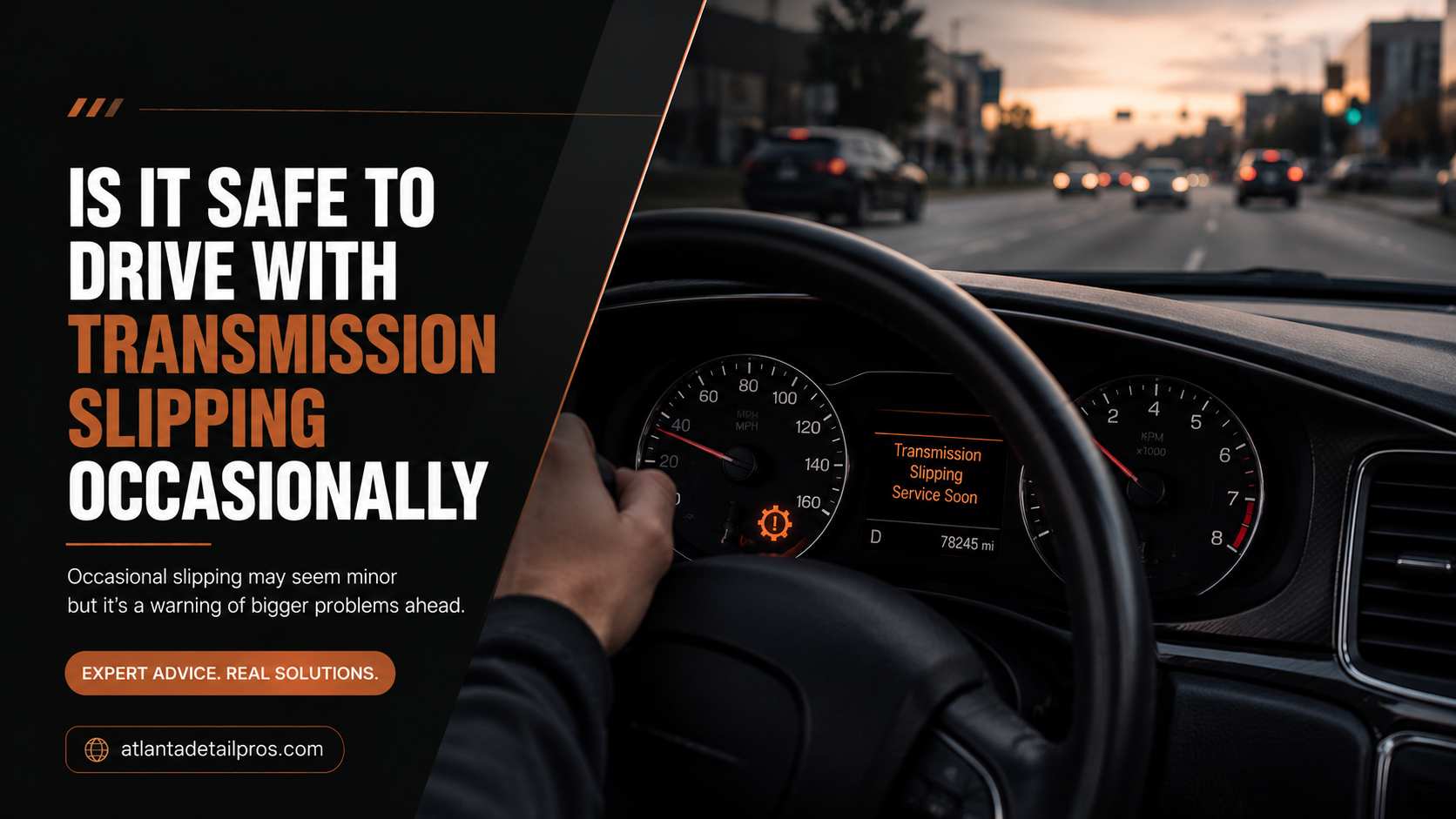
Occasional transmission slipping is not safe to drive through or ignore: even infrequent slip events mean the clutch packs, bands, or torque converter are failing to maintain a positive gear engagement, and each slip episode accelerates the internal damage that leads to complete transmission failure.
The word “occasional” gives many drivers false reassurance. In transmission failure progression, occasional becomes frequent, and frequent becomes stranded, typically within weeks to months of the first noticeable event.
Transmission slipping is one of the most misread warning signs in automotive ownership because the vehicle often drives perfectly between events. The engine feels strong. The ride is smooth. Then there is a momentary RPM flare without a corresponding increase in speed, or a brief hesitation between shifts, and then the vehicle normalizes. That normalization is not the transmission recovering. It is the clutch pack friction material wearing thinner each time the slip occurs, narrowing the window before the next event.
This guide explains what is physically happening during a slip event, the different causes in order of severity, a clear decision framework for how far you can continue driving, and the cost comparison that makes early intervention one of the most financially important decisions in automotive ownership.
What Transmission Slipping Actually Means Mechanically
Automatic Transmission Slip
In an automatic transmission, power flows from the engine through the torque converter into a planetary gear set. Clutch packs and bands selectively lock or release different gear set elements to achieve each drive ratio. When a clutch pack slips, it is failing to achieve full engagement: the friction material is not gripping the steel plates with enough force to lock them together under the torque load the engine is producing.
The RPM flare you feel during a slip is the engine revving freely because the transmission is not translating that rotational power into forward motion. During that brief slip period, the clutch pack surfaces slide against each other at high differential speed, generating heat and removing friction material. Each slip event removes more material. As the material thins, the clutch packs slip sooner and more easily under the same load. The event frequency accelerates.
The transmission fluid also degrades from the heat generated during each slip. Automatic transmission fluid (ATF) is simultaneously the hydraulic medium that actuates the clutch pack pistons and the lubricant and coolant for the entire transmission. Overheated ATF loses viscosity and its ability to maintain hydraulic pressure on the clutch pistons, which causes more slipping, which generates more heat. This thermal failure cycle is self-reinforcing and always accelerates toward complete failure once it begins.
Manual Transmission Slip
A slipping manual transmission almost always means a worn clutch disc. When the clutch pedal is released, the clutch disc (the friction-faced component between the flywheel and pressure plate) is clamped by spring force. If the friction material has worn thin, the disc cannot achieve full grip under peak torque load and slips.
Manual clutch slip is typically felt as a mismatch between engine RPM and vehicle speed during acceleration, particularly in higher gears where torque demand peaks. The sensation is the engine revving more than expected for the acceleration rate being produced. On a worn clutch disc, acceleration in third or fourth gear at moderate throttle may produce no noticeable slip, while a hard acceleration in the same gear triggers it clearly.
Causes of Transmission Slipping From Least to Most Severe
Low or Degraded Automatic Transmission Fluid
Low ATF level is the most benign and most immediately reversible cause of slipping. ATF provides the hydraulic pressure that actuates clutch pack engagement pistons. Low fluid means inadequate pressure, which means incomplete clutch engagement, which produces slip. If caught before internal heat damage has accumulated, a fluid top-off or complete service can eliminate the slipping entirely.
Degraded fluid that has never been serviced appears dark brown or black (normal ATF is red to pink) and smells burnt. Degraded fluid does not maintain adequate viscosity at operating temperature and cannot hold clutch pistons with sufficient force for full engagement. This cause is also reversible with a proper fluid service if mechanical wear has not yet advanced.
Failed Shift Solenoids
Transmission shift solenoids are electronically controlled valves that direct fluid pressure to specific clutch packs and bands to achieve each gear ratio. A failed solenoid cannot properly direct fluid, resulting in delayed shifts, missed gear engagements, or RPM flares between specific gear changes. Solenoid failures often produce a consistent pattern: the slip always occurs in the same gear or at the same speed range. They also reliably trigger the check engine light with P0750 through P0770 range codes.
Worn Clutch Packs or Bands
This is mechanical wear that accumulates over time and is not reversible without internal transmission work. The friction material on clutch packs and bands has a finite service life determined by mileage, operating temperatures, and fluid quality history. Vehicles with 150,000 miles and above, vehicles with towing history, and vehicles that have operated with degraded or extended-interval fluid all experience accelerated clutch pack wear. Once the friction material is worn through, slipping is progressive and the only repair is a rebuild.
Torque Converter Clutch Failure
The torque converter lock-up clutch engages at highway cruise speeds to eliminate fluid coupling slippage and improve fuel efficiency. A failing torque converter lock-up clutch produces a specific and recognizable shudder at highway speeds, typically in the 40 to 55 mph range, as the clutch slips during engagement or disengagement. The vehicle shudders noticeably in a defined speed range and then smooths out once the clutch fully engages or fully releases. This shudder signature is distinct from other slip patterns and narrows the diagnosis to the torque converter.
Decision Framework: How Long Can You Drive With a Slipping Transmission?
| Slip Pattern | Most Likely Cause | Urgency | Drive Decision |
|---|---|---|---|
| Occasional RPM flare, clears instantly, no check engine light | Low or marginal ATF | Yellow: Moderate | Check fluid immediately: shop within 3 days |
| Consistent slip in one gear only, check engine light on | Shift solenoid failure | Amber: High | Shop within 1 day: avoid the problem gear range |
| Slip under hard acceleration from a stop | First-gear clutch pack wear | Amber: High | Limit aggressive acceleration: shop within 3 days |
| Shudder at 40 to 55 mph highway cruise | Torque converter clutch | Amber: High | Shop within 1 week: avoid steady speeds in shudder range |
| Frequent slip across multiple gear ranges | Multiple clutch pack wear | Red: Critical | Tow or minimal driving: rebuild or replacement imminent |
| Slip with burning smell or dark fluid | Heat-damaged fluid and clutches | Red: Critical | Tow: continued operation risks complete failure |
| Slip with sluggish or absent reverse engagement | Advanced clutch destruction | Red: Critical | Tow immediately |
“My 4L60E started slipping in second gear about twice a week. I kept putting off the fluid service because it wasn’t doing it that often. Two months later the fluid was black and the second-gear clutch pack was burned through. What would have been a fluid service and solenoid check for maybe $350 to $400 turned into a full rebuild at $2,100. The math was brutal.”: Marcus Delgado, 2008 GMC Sierra 1500 5.3L
What Actually Happens as the Failure Progresses
Weeks 1 to 4 (occasional slip): RPM flares occur infrequently, typically under hard acceleration or in specific temperature or load conditions. Fluid may still be within serviceable color and viscosity. The clutch pack friction material is measurably thin but intervention at this stage can potentially avoid a full rebuild with targeted solenoid or fluid service.
Weeks 4 to 12 (increasing frequency): Slip events occur under lighter loads and in more conditions. The fluid has absorbed heat from each slip and is degrading faster. The torque converter may begin passing degraded fluid and debris through the transmission cooler. The check engine light typically illuminates during this stage.
Months 3 to 6 (frequent slip in multiple ranges): The transmission slips in two or more gear ranges. Reverse engagement becomes sluggish. Burned ATF odor is detectable through the cabin vents. At this stage a rebuild is the only path to repair, and the cost is substantially higher than it would have been at the first symptom.
Month 6 and beyond (functional failure): The transmission can no longer reliably hold gear engagement under normal driving loads. The vehicle may not move from a stop under moderate throttle or may lose drive engagement at highway speed. Engine replacement is not an option here: the transmission must be rebuilt or replaced.
Platform-Specific Slip Failure Patterns
Certain transmission families have well-documented failure modes that produce early slip symptoms on predictable mileage thresholds:
GM 4L60E and 4L65E (1993 to 2012 trucks and SUVs): Second-gear clutch pack failure is the most common slip symptom, typically appearing between 120,000 and 180,000 miles. The 1-2 shift solenoid is also a frequent culprit and can be replaced without a full rebuild if caught early.
Ford 6R80 (2009 to present F-150 and Mustang): Torque converter shudder at highway cruise is the most common early symptom, often appearing as early as 80,000 miles. A fluid flush with the correct Mercon LV fluid and a converter clutch solenoid inspection resolves many early cases.
Honda 5-speed automatics (BAXA, MAXA, BYBA series, 1999 to 2004): Second-gear clutch pack failure is so common that Honda issued extended warranty coverage on certain models. Early fluid changes with Honda ATF-Z1 or DW-1 fluid are the primary preventive measure.
Chrysler 45RFE and 545RFE (1999 to 2012 trucks): Solenoid pack failure is the most common slip cause and allows the transmission to be repaired without full disassembly when caught within the first symptom window.
Repair Cost Comparison: Early Versus Late Intervention
| Intervention Stage | Repair Type | Independent Shop Cost Range |
|---|---|---|
| Caught at first symptom: low fluid, no heat damage | ATF flush and refill | $100 to $200 |
| Caught at first symptom: solenoid failure | Solenoid replacement and fluid service | $300 to $650 |
| Moderate damage: one clutch pack worn | Targeted repair with partial disassembly | $800 to $1,500 |
| Advanced damage: multiple clutch packs burned | Full transmission rebuild | $1,800 to $3,500 |
| Complete failure: 4-speed automatic | Remanufactured transmission replacement | $2,500 to $4,500 |
| Complete failure: 6-speed or CVT | Remanufactured or new replacement | $3,500 to $7,000 |
The fluid service and solenoid replacement range represents the entire window where a slipping transmission can be corrected without major internal disassembly. That window closes within weeks of the first symptom if the vehicle continues to be driven with a slipping transmission.
Frequently Asked Questions
Can low transmission fluid cause slipping?
Yes. ATF is the hydraulic medium that actuates clutch pack pistons. Low fluid means inadequate hydraulic pressure and incomplete clutch engagement, which is exactly the mechanism of a slip event. Low ATF also overheats faster because there is less fluid volume to absorb and dissipate the heat generated by driving. Check the ATF level and condition as the mandatory first step when slipping is noticed. Many manufacturers do not provide a dipstick for automatic transmission fluid on newer vehicles: consult the owner’s manual for the correct check procedure.
Can a transmission fluid change fix slipping?
A fluid change can resolve slipping if the cause is degraded fluid that has lost viscosity, and if no significant clutch pack friction material has been lost yet. On a transmission where the friction material is already worn thin, fresh fluid may temporarily improve shift quality because it holds hydraulic pressure better, but it cannot restore worn material. Have the transmission inspected by a specialist who can determine whether the fluid change alone is the appropriate fix or whether internal work is needed.
What OBD codes appear with a slipping transmission?
Common codes associated with slipping include P0730 (incorrect gear ratio), P0731 through P0736 (specific gear incorrect ratio codes), P0740 (torque converter clutch circuit malfunction), P0750 through P0770 (shift solenoid circuit failures), and P0218 (transmission fluid over-temperature). Gear-ratio codes point to clutch pack or band issues. Solenoid codes indicate electrical failures. The over-temperature code confirms heat damage is already occurring and makes the case for urgent intervention.
Is it safe to drive a slipping transmission to work daily if I keep the fluid full?
No. Maintaining correct fluid level is important but does not prevent the mechanical wear that occurs during each slip event. Every slip removes clutch pack friction material regardless of fluid level. The slip frequency will increase over time as the remaining friction material continues to thin. Daily driving with a slipping transmission accelerates the deterioration rate significantly compared to minimal-use driving and shortens the repair window available at each cost tier.
Can I drive a slipping CVT transmission?
A slipping CVT is a more urgent condition than a slipping conventional automatic. CVTs transfer all power through a steel push-belt or chain running between two variable-diameter pulleys, and the belt depends on precise clamping pressure for all power transfer. A slipping CVT belt generates heat and metallic debris rapidly and can fail with very little additional warning. Any confirmed CVT slip warrants an immediate shop visit rather than a monitor-and-wait approach. CVT rebuilds and replacements are also among the most expensive transmission repairs, ranging from $3,500 to $8,000.
The Bottom Line
Occasional transmission slipping is not the transmission working through a temporary issue. Each slip event is a measurable material loss event on the clutch pack surfaces, and the pattern always progresses toward greater frequency and greater severity without intervention. There is no transmission failure mode that improves on its own.
The cost data tells the story plainly: a $100 to $200 fluid service or a $300 to $650 solenoid replacement done at the first symptom costs $1,500 to $4,000 less than the rebuild or replacement that follows after the clutch packs are burned through. No other maintenance decision in automotive ownership has a larger financial leverage point than acting on the earliest transmission slip symptoms.
If the transmission repair cost approaches or exceeds the vehicle’s market value, evaluate a cash-out sale to a junk buyer as a parallel option before committing to a transmission rebuild on an aging vehicle with other deferred maintenance.