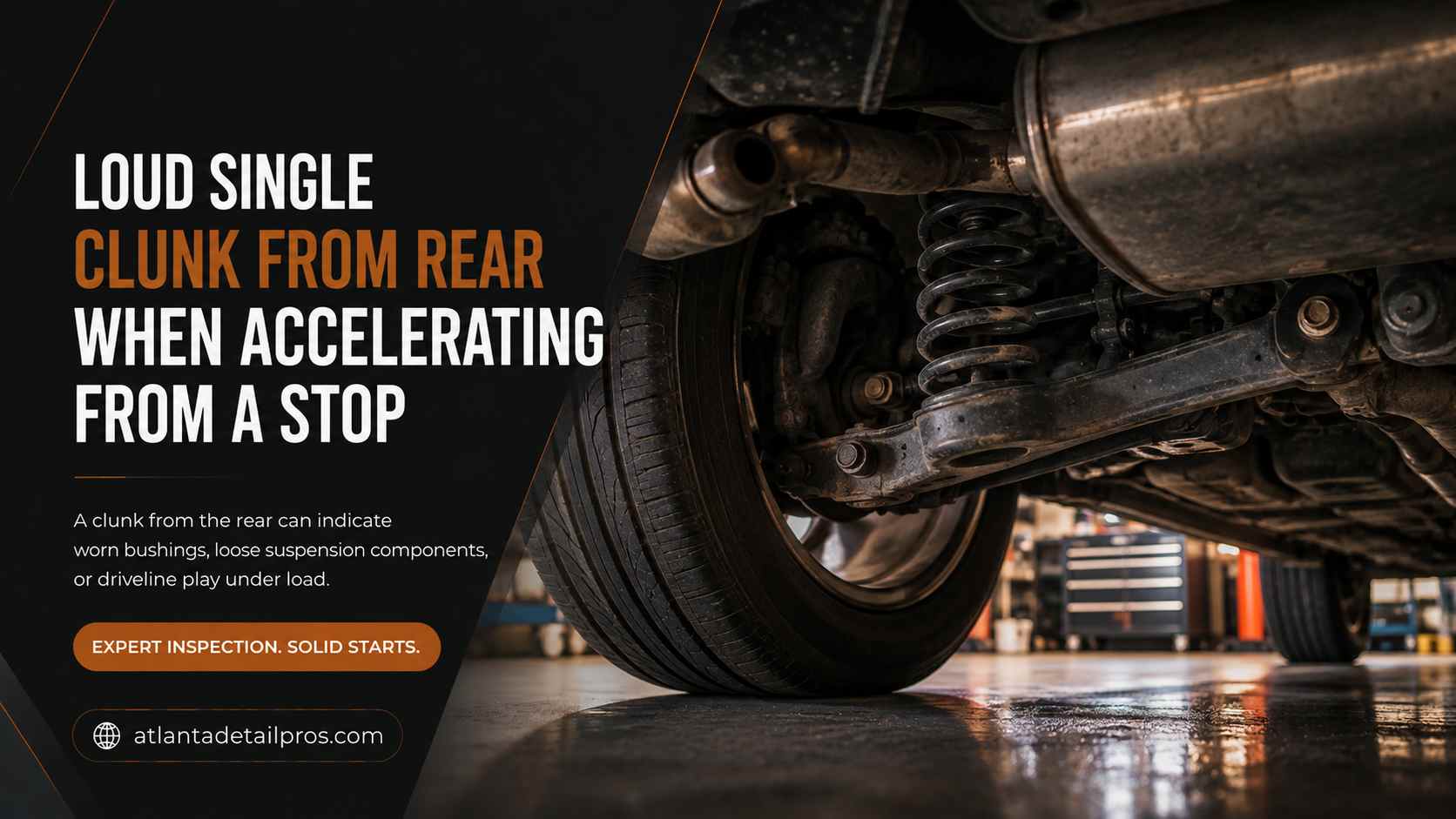
A loud single clunk from the rear of the vehicle when accelerating from a stop is most commonly caused by a worn universal joint (u-joint), a loose or failed differential mount, or a worn slip yoke: all of which produce one sharp impact noise when drivetrain slack is suddenly taken up as the transmission applies torque from a standstill.
The single-clunk characteristic: one sound, not a continuous rattle or repeated knocking: is the specific diagnostic detail that distinguishes this from ongoing suspension noise.
“The single clunk on acceleration from a stop is almost always a driveline slack issue. Something has play, and when the drivetrain transitions from zero torque to full torque, that slack gets taken up as a bang. It’s telling you exactly where the weakness is.” This guide covers every realistic cause of a single rear clunk on acceleration, how to distinguish them by behavior and location, and what each repair costs.
Why a Single Clunk Occurs Specifically When Accelerating From a Stop
The Drivetrain Slack Mechanism
When a vehicle is sitting still, the drivetrain components: driveshaft, u-joints, differential gears, axle shafts: are at rest with no torque load applied. When the driver accelerates from a stop, the transmission output shaft immediately begins applying torque through this entire system. If any component in this chain has play or wear, that play is taken up simultaneously and violently in a single event. The result is one loud clunk, not a repeated knock.
Why It Is Only a Single Clunk
The clunk occurs once because after the slack is taken up, the component is loaded and the torque is being transmitted. The component stays loaded throughout acceleration and does not clunk again until the next stop-and-go cycle.
The Most Likely Cause: Worn Universal Joint (U-Joint)
How U-Joint Wear Creates a Single Clunk
A u-joint cross bearing that has worn needle bearings in one or more of its four bearing cups develops rotational play in the axis of that cup. When the driveshaft transitions from being pushed by engine braking (deceleration) to being pulled by engine torque (acceleration), the play in the worn cup is traversed in a single sharp movement: the clunk. This specific clunk may also occur when lifting off the throttle at low speeds, because the same play is traversed in the opposite direction during the transition from drive to engine braking. If you notice a clunk both when accelerating from a stop and when coasting to a stop, u-joint play is the most likely cause.
How to Test for U-Joint Play
With the vehicle safely supported on jack stands with wheels off the ground, place one hand on the driveshaft just forward of the u-joint in question and the other hand just behind it. Attempt to rotate the two sections of the driveshaft independently. Any movement of one section before the other begins to move indicates u-joint play.
U-Joint Replacement Cost
$150 to $350 at an independent shop for a standard rear-wheel-drive u-joint. Non-serviceable u-joints requiring full driveshaft replacement: $300 to $700.
Differential Mount Failure
What the Differential Mount Does
On independent rear suspension vehicles, the differential is mounted to the chassis through rubber-cushioned brackets called differential mounts or bushings. These mounts hold the differential in position while isolating vibration. On solid rear axle vehicles, the axle is held to the chassis by leaf springs, control arms, and rubber bushings.
How Mount Failure Produces a Single Clunk
When a differential mount fails, the differential has excessive movement within its mounting bracket. When torque is applied during acceleration, the differential rotates in its bracket (torque reaction) until it contacts the metal limit of the mount. This contact produces a single, loud clunk that sounds like it comes from the center rear area.
Signs a Differential Mount Is the Cause
- The clunk comes from the center rear of the vehicle, not from a specific corner
- The vehicle may have a slight change in alignment or handling feel on uneven roads
- Inspection of the differential mount reveals torn, separated, or collapsed rubber
Differential Mount Replacement Cost
$200 to $500 depending on the vehicle and whether the differential must be partially lowered to access the mount.
Worn Slip Yoke or Driveshaft Spline Wear
The Slip Yoke’s Role
The slip yoke is the splined sleeve that connects the driveshaft to the transmission output shaft and allows the driveshaft to extend and retract as the suspension moves. Excess clearance between the slip yoke splines and the transmission output shaft splines creates rotational play that produces a clunk during the torque reversal from coasting to acceleration.
How to Identify Slip Yoke Play
On a vehicle safely supported with wheels off the ground, rotate the driveshaft and observe whether the transmission output shaft moves simultaneously. A slight delay before the output shaft turns when the driveshaft is rotated indicates slip yoke play. Slip yoke service cost: lubrication service if accessible: $50 to $100. Slip yoke and output shaft replacement if worn: $250 to $600.
Rear Axle and Axle Shaft Issues
Worn Spider Gears in the Differential
Spider gears (side gears and pinion gears inside the differential) can develop play from wear. When torque direction reverses from coasting to acceleration, worn spider gears produce a clunk as the backlash is taken up. This clunk comes from the center of the rear axle.
Axle Shaft C-Clip or Retainer Play
On semi-float rear axles (common on passenger cars and light trucks), axle shafts are retained by C-clips inside the differential. If these clips are worn or if the axle bearing has failed, the axle can shift position during torque reversal, producing a clunk. Rear axle differential service and inspection: $150 to $350 at an independent shop. Axle shaft replacement: $200 to $450 per side.
Other Causes Worth Checking For Loud Single Clunk From the Rear
Loose Exhaust Hanger
An exhaust hanger that has broken or softened allows the exhaust pipe to contact the chassis or body panels during acceleration when the drivetrain torques the engine in its mounts. This is a hollow, single clunk that sounds like a rear impact from inside the cabin. Quick check: with the engine off and cool, physically push and pull the exhaust pipe at different points and listen for contact with surrounding components.
Rear Shock Absorber Mount or Bump Stop
A worn rear shock absorber mount allows the shock to shift position during sudden acceleration loads. A deteriorated bump stop allows the suspension to contact the shock body or frame with a single clunk on sudden throttle application from a stop.
| Cause | Location of Sound | Clunk Also on Deceleration? | Repair Cost Range |
|---|---|---|---|
| Worn u-joint | Center driveshaft area | Yes: both acceleration and deceleration | $150 to $700 |
| Differential mount | Center rear | Usually acceleration only | $200 to $500 |
| Slip yoke wear | Center front of driveshaft | Yes: both | $50 to $600 |
| Spider gear backlash | Center rear axle | Yes: both | $150 to $400 (inspection + service) |
| Loose exhaust hanger | Varies; hollow sound | No: acceleration or deceleration | $30 to $150 |
| Rear shock mount | Corner of vehicle | Varies | $100 to $300 per side |
Frequently Asked Questions
What Causes a Single Clunk From the Rear When Accelerating From a Stop?
The most common causes are a worn u-joint with play in its cross-bearing, a failed differential mount that allows the differential to rotate in its bracket under torque, or a worn slip yoke with excess spline clearance. All produce a single impact noise when drivetrain slack is taken up at the moment of initial acceleration. The single-clunk pattern distinguishes this from ongoing suspension or bearing noise.
Is a Rear Clunk on Acceleration Dangerous?
A worn u-joint that is allowed to progress to complete failure can cause the driveshaft to drop, potentially at speed. This is the most serious consequence of ignoring this symptom. A failed differential mount or slip yoke is less immediately dangerous but worsens over time and can damage surrounding components. Schedule an inspection within two to four weeks.
How Do I Know if the Clunk Is From a U-Joint or the Differential?
A u-joint clunk typically occurs both when accelerating from a stop and when transitioning to coasting (engine braking), because the play is traversed in both torque directions. A differential mount clunk typically occurs primarily during acceleration from a stop, because the torque reaction in one direction is greater than in the other. The sound from a u-joint tends to come from along the driveshaft, while a differential mount clunk sounds like it comes from the center rear.
How Much Does It Cost to Fix a Rear Clunk on Acceleration?
Repair costs range from $50 to $100 for an exhaust hanger, $150 to $700 for u-joint work depending on whether the joint is serviceable or the whole driveshaft must be replaced, and $200 to $500 for differential mount replacement. A shop inspection specifically to identify the clunk source typically costs $80 to $150.
The Bottom Line
A loud single clunk from the rear on acceleration from a stop is a drivetrain slack problem: a component with play that gets taken up violently the moment torque is applied. The single-clunk characteristic, especially when it mirrors on deceleration, points almost directly to the u-joint or slip yoke. Differential mount failure produces a clunk that is more acceleration-specific. Have this inspected within two to four weeks. A failing u-joint that is caught at the clunk stage is a straightforward replacement. A u-joint that fails completely is a roadside emergency.