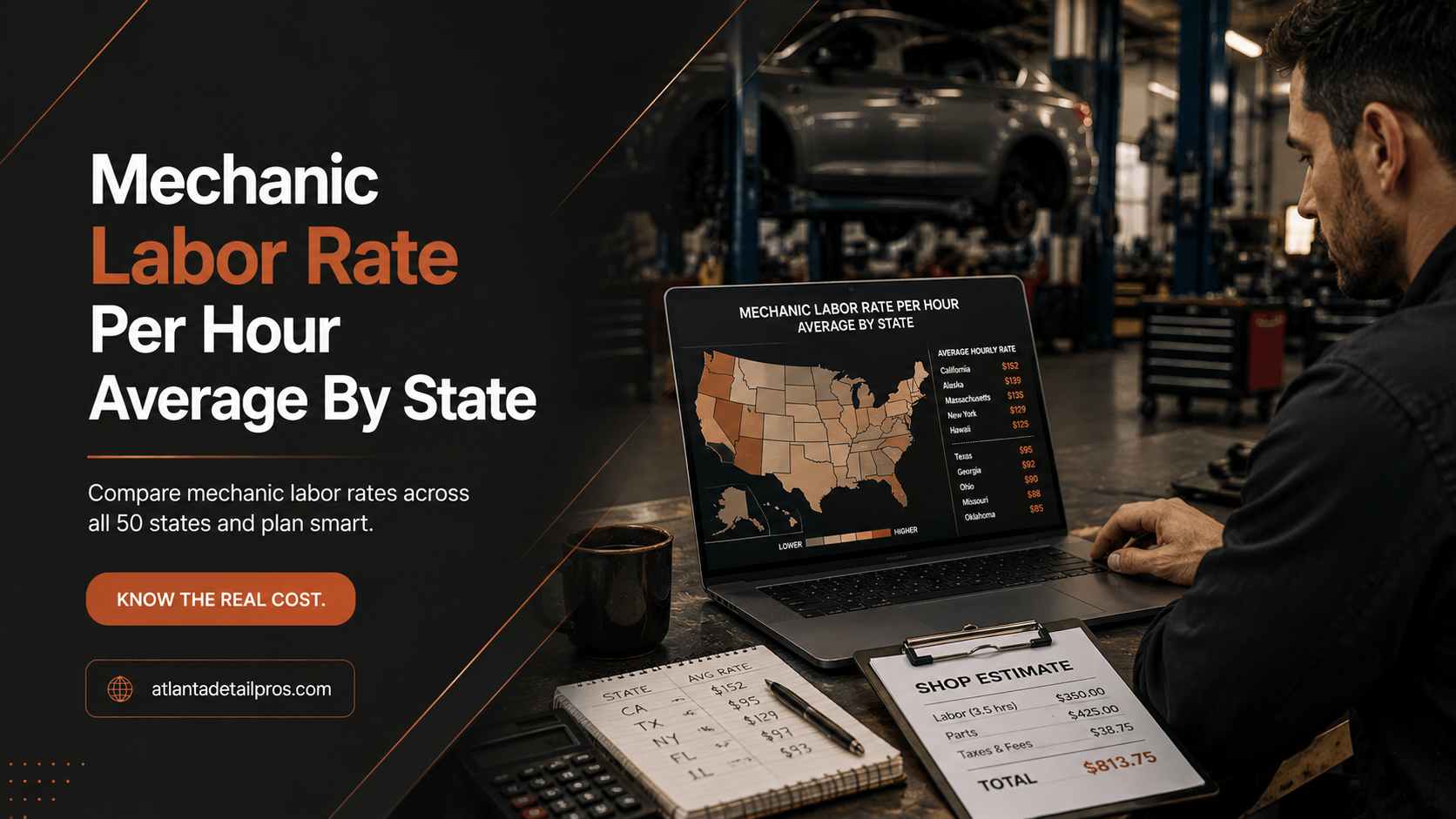
You handed the mechanic a car, and the invoice came back with two hours of labor at $145 per hour. Was that fair? The answer depends almost entirely on where you live, what kind of shop you visited, and what the job actually involved. Mechanic labor rates in the United States in 2026 range from $85 per hour at independent shops in lower-cost states to $275 per hour at dealers in major coastal cities. Understanding where that range comes from helps you know whether you were charged fairly and how to shop for better rates.
This guide covers the national average, the state-by-state breakdown by region, the difference between shop types, and what specifically drives labor rates up or down. It also covers the flat-rate system, which is how most shops actually calculate your bill regardless of the posted hourly rate.
The 2026 National Average Mechanic Labor Rate
The national average mechanic labor rate for independent shops in 2026 sits between $120 and $150 per hour, with most industry data pointing to approximately $140 per hour as the benchmark for a standard independent repair shop. This represents a meaningful increase from the 2022 to 2023 national average of $115 to $130 per hour, driven by increased technician wages, rising shop overhead costs, and the growing complexity of modern vehicle electronics requiring more expensive diagnostic equipment.
Dealerships charge more, typically $150 to $220 per hour depending on the brand and location. Specialty shops (European brands, performance, diesel, EV) often command $160 to $275 per hour. Mobile mechanics typically charge $80 to $130 per hour with lower overhead but limited equipment. The posted hourly rate and the effective rate on your invoice can differ because most shops use a flat-rate labor time guide rather than actual clock time.
Labor Rates by Region: What Your State Typically Charges
Regional differences in mechanic labor rates reflect the cost of doing business: local wages, real estate costs, state regulations, and market competition all factor in. The breakdown below covers representative ranges for independent shops across all four major regions. Dealer and specialty rates typically run $30 to $60 higher than the independent shop figures listed.
Northeast States: $130 to $175 per Hour
Connecticut, Massachusetts, New Jersey, and New York sit at the higher end of the national range due to high real estate costs, elevated minimum wage requirements, and the concentration of imported and luxury vehicles that require specialized tooling and training. Boston and New York metro shops frequently charge $160 to $175 per hour at independent shops and $200 to $230 at dealers. Maine, Vermont, and New Hampshire tend to run $125 to $145 per hour at independent shops.
Southeast States: $115 to $145 per Hour
Florida runs $125 to $155 per hour in major metro areas (Miami, Orlando, Tampa) and $105 to $125 in rural areas. Georgia, the Carolinas, and Tennessee fall in the $115 to $140 range at independent shops. Alabama and Mississippi historically show national survey averages above their regional counterparts, sometimes exceeding $150 per hour, which reflects differences in how repair time is calculated rather than necessarily higher consumer costs. Virginia and Maryland run $130 to $155 due to proximity to the Washington D.C. metro area.
Midwest States: $110 to $145 per Hour
Illinois, Michigan, and Minnesota run $120 to $145 per hour at independent shops, with metro areas (Chicago, Detroit, Minneapolis) at the higher end. Ohio, Indiana, and Wisconsin run $110 to $135 per hour. Smaller markets and rural shops in Kansas, Nebraska, Iowa, and Missouri often charge $95 to $120 per hour, making the Midwest one of the more affordable regions for repair labor. Missouri and Kansas City shops frequently offer rates 15 to 20 percent below what a comparable shop in Chicago would charge.
West and Southwest States: $125 to $200 per Hour
California leads the nation in independent shop labor rates, with shops in the Los Angeles, San Francisco, and San Diego metro areas regularly charging $155 to $200 per hour. California’s higher rate reflects the state’s strict labor laws, high minimum wages, environmental compliance costs for shops, and the high concentration of newer and more complex vehicles requiring specialized diagnostics. Oregon and Washington run $140 to $165 per hour. Nevada runs $130 to $155 per hour, with Las Vegas area shops on the higher end. Texas ranges considerably: Dallas and Houston shops charge $120 to $150 per hour, while rural Texas shops may charge $95 to $115.
Shop Type Makes a Bigger Difference Than Location
The type of shop you choose often matters more to your final bill than the state you live in. Three main categories set the range you should expect.
Dealerships: Highest Rates, Guaranteed OEM Parts
Dealership service departments charge $150 to $220 per hour nationally in 2026, with luxury brand dealers (BMW, Mercedes, Audi, Lexus) often reaching $225 to $275 per hour. The higher rate reflects factory-trained technicians, OEM diagnostic equipment, manufacturer-mandated service procedures, and proprietary tooling that independent shops do not have. For repairs under warranty, computer programming that requires factory access, or highly specialized model-specific work, the dealership rate is often justified. For routine repairs on common vehicles out of warranty, you are paying a significant premium.
Independent Shops: Best Value for Most Repairs
Quality independent shops run $90 to $160 per hour in most markets. For the large majority of automotive repairs on vehicles out of warranty, a reputable independent shop with ASE-certified technicians provides the same or better work at 20 to 40 percent less than a dealership. The key qualifier is reputation: look for shops with ASE certification, a track record in the community, transparent written estimates, and reviews that specifically mention honesty and accuracy of estimates.
Chain Shops and Quick-Service Centers: Variable
National chains (Firestone, Midas, Meineke, Pep Boys, Jiffy Lube) charge $90 to $140 per hour in most markets. The rates are competitive but work quality varies more between individual locations than it does at independent shops. Corporate oversight is less consistent than for a single-owner shop where the owner’s reputation depends on every job. For standard maintenance services, chains are competitive and convenient. For complex diagnostic or component repairs, a trusted independent shop is typically the better choice.
The Flat Rate System: Why Your Bill Is Not Simply Hours Times Rate
Most shops do not charge you for the actual time the mechanic spent on your car. They charge you according to a flat-rate labor guide, which is a published database of standardized labor times for every repair on every vehicle. The most widely used guides are Mitchell, ALLDATA, and Chilton. When a shop charges two hours of labor, it means the flat-rate guide lists that repair as a two-hour job, regardless of whether the mechanic completed it in 90 minutes or three hours.
What This Means for You as a Customer
The flat-rate system cuts both ways. If the mechanic finishes your repair faster than the guide time, you still pay the full guide time. If the repair takes longer due to unexpected complications, you may pay more than the original estimate. Always get a written estimate with the specific labor time listed before authorizing any repair. Ask the shop which labor guide they use and what labor time they are quoting for your specific repair. A two-hour job at $150 per hour means you should be paying $300 for labor. If the invoice shows $380, ask what the additional time represents.
What a Diagnostic Fee Covers and When to Accept It
Most shops charge a diagnostic fee of $85 to $150 for connecting your car to their diagnostic computer and interpreting the results. This is separate from the labor charge for the actual repair. Diagnostic fees are legitimate: quality diagnosis requires expensive equipment and trained interpretation. Many shops credit the diagnostic fee toward the repair if you choose to have the work done there. Always ask whether the diagnostic fee is credited before authorizing the initial scan.
Frequently Asked Questions
What is the average mechanic labor rate per hour in 2026?
The national average for independent auto repair shops in 2026 is approximately $120 to $150 per hour, with a benchmark near $140 per hour. Dealerships charge $150 to $220 per hour on average. High-cost states like California and New York see independent shop rates of $155 to $200 per hour. Lower-cost markets in the Midwest and rural Southeast run $95 to $130 per hour.
How do I know if a mechanic is overcharging me?
Get a written estimate before authorizing any work and confirm what labor time is being quoted for each repair. Cross-reference the labor time using publicly available estimates on RepairPal or AutoMD. If the shop is quoting significantly more labor time than industry guides suggest, ask for an explanation. Get a second opinion on any repair estimate above $500 before approving the work.
Are dealerships worth the higher labor rate?
For warranty repairs, recalls, software updates requiring factory access, and complex model-specific issues that require proprietary tools, yes. For routine out-of-warranty repairs on common vehicles, the 20 to 40 percent premium over a quality independent shop is rarely justified. The work quality at a reputable independent shop is typically equivalent for standard repairs.
The Bottom Line
Mechanic labor rates in 2026 range from $85 per hour at independent shops in rural Midwest markets to $275 per hour at luxury dealerships in California. The national benchmark for a quality independent shop is $120 to $150 per hour. Know your regional range, understand that most bills are based on flat-rate guide times rather than actual hours worked, and always get a written estimate with the specific labor time before authorizing repairs above $200.