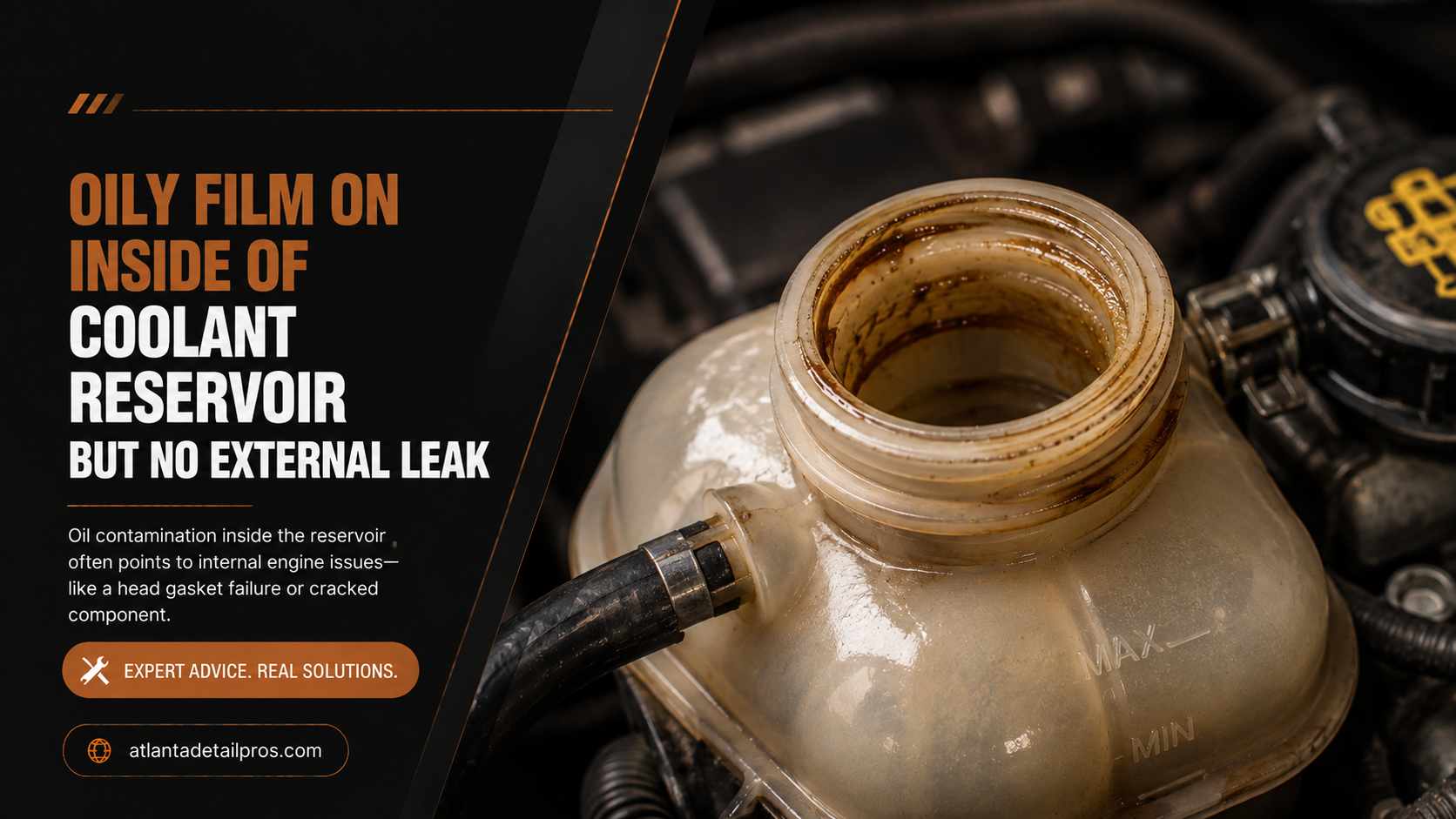
An oily film on the inside of the coolant reservoir with no visible external leak almost always means combustion gases or engine oil are entering the cooling system through a failing head gasket, and what you are seeing is the early warning stage of a failure that will progress to milky oil, coolant loss, and overheating if left unaddressed.
The reservoir is acting as a collection point for contamination that cannot escape the sealed cooling system any other way. Because the external symptom is absent, most drivers dismiss this finding as a minor oddity. It is not: it is one of the clearest early indicators that the boundary between the combustion chamber, oil passages, and coolant circuit is starting to break down.
An oily film in the reservoir with no external leak and no milky oil on the dipstick places you in the best possible position: the head gasket is failing but has not fully breached. Acting at this stage costs significantly less and avoids the bearing damage and block contamination that occurs once coolant fully enters the oil circuit.
What the Film Actually Is | Inside of Coolant Reservoir
The oily film inside the coolant reservoir is typically one of two things.
The first is combustion gas condensate. When a head gasket begins to fail at the fire ring, small amounts of combustion gas enter the coolant circuit under the pressure of each power stroke. These gases carry combustion byproducts including partially burned hydrocarbons that condense on the cooler surfaces of the reservoir and leave a dark, oily residue. The coolant itself may appear normal or slightly darkened.
The second is engine oil migrating from an oil passage through a small gasket breach into the water jacket. Oil is less dense than coolant and floats to the top of the reservoir, depositing a film on the reservoir walls as the coolant level rises and falls with thermal cycling.
Both sources indicate a head gasket that is compromised, and both will worsen over time.
How to Distinguish Oil Contamination from Normal Residue
Normal Residue
Coolant reservoirs accumulate a slight discoloration over time from silicate deposits in conventional green coolant and from normal oxidation of the plastic reservoir. This appears as uniform light tan or mineral staining. It does not wipe off as a greasy smear.
Oil Contamination
Oil contamination in the reservoir wipes off as a slick, greasy film. It may appear darker in the lower portions where oil collects. Dip a clean white rag into the reservoir: if it comes out with a greasy stain rather than a mineral stain, oil is present.
Combustion Gas Residue
Combustion gas deposits are darker and more uniform than oil film, appearing as a thin dark coating rather than a greasy smear. The combustion gas test using hydrocarbon-detecting fluid over the reservoir opening confirms this source.
Diagnostic Table: Oily Reservoir and What Else to Look For
Additional Finding | Most Likely Source | Next Step |
|---|---|---|
Coolant level slightly dropping, dipstick oil clean | Head gasket: coolant-to-combustion breach | Combustion gas test |
Dipstick showing faint froth | Head gasket: oil-to-coolant breach | Full diagnosis with compression and leak test |
Bubbles visible in coolant at idle | Combustion gas entering coolant circuit | Combustion gas test: do this first |
Coolant appears brown or tea-colored | Oil actively mixing with coolant | Immediate shop diagnosis |
No other symptoms, level stable, dipstick clean | Early-stage contamination | Combustion gas test within 1 week |
At-Home Tests to Confirm the Source
Combustion Block Test
Purchase a combustion leak detection kit from any auto parts store ($15 to $25). Remove the reservoir cap when the engine is cold, then start the engine and let it reach operating temperature. With the engine idling, hold the test tool chamber over the reservoir opening and draw air through the detection fluid. A color change from blue to yellow or green confirms combustion gases are present in the coolant. This is the single most important diagnostic step.
UV Dye Check for Oil
Add UV dye formulated for engine oil to the engine oil via the dipstick tube. Run the engine for 20 minutes then inspect the coolant reservoir with a UV lamp. If the oil dye is visible in the reservoir fluid or as a residue on the reservoir walls, the oil-to-coolant path through the gasket is confirmed.
Pressure Hold Test
A shop can perform a cooling system pressure test and observe whether pressure drops at a rate inconsistent with external leaks. Pressure that drops without any visible external leak suggests internal combustion-to-coolant communication and supports the gasket diagnosis.
Urgency Assessment
Reservoir Film Appearance | Other Symptoms | Urgency |
|---|---|---|
Light film, coolant level stable | None | Moderate: test within 1 week, do not delay further |
Moderate film, coolant dropping slightly | None | High: combustion test and shop inspection this week |
Heavy film, coolant clearly dropping | Rough idle or slight misfire | Very high: shop inspection immediately |
Brown or black emulsion visible in reservoir | Any additional symptoms | Do not drive: potential full gasket breach |
“I noticed the inside of my coolant reservoir looked greasy when I opened it for a routine inspection. No puddles anywhere, oil looked clean, car ran fine. Took it to a shop anyway and the block test came back positive for combustion gas in the coolant. Caught the head gasket at stage one and fixed it for $950. The mechanic said another month of driving would have turned it into a warp-and-resurfacing job.” : Anita Patel, 2010 Toyota Camry owner
Vehicle-Specific Notes
Subaru EJ-series engines (2000 to 2011 Forester, Outback, Legacy) have a documented external head gasket seepage pattern that frequently shows oily residue in the coolant reservoir before producing any external drip or milky oil. This is one of the earliest and most reliable indicators of the classic Subaru EJ head gasket failure.
GM 2.4L Ecotec engines (Equinox, Malibu, Regal) develop head gasket seepage at the oil passage perimeter that deposits a film in the coolant reservoir before full breach occurs. Many owners discover this at routine coolant inspections.
Toyota 1ZZ-FE and 2ZZ-GE engines (Corolla, Matrix, Celica) develop a head gasket failure mode that first shows as an oily reservoir film and slightly dropping coolant level. White smoke may not appear until the gasket has fully breached.
FAQs
Can an oily film in the coolant reservoir be caused by something other than the head gasket?
Yes. A failed oil cooler or oil cooler gasket can circulate oil into the coolant circuit and produce the same reservoir film. Some automatic transmission coolers are integrated into the radiator: a failure there produces ATF (typically red or pinkish) in the coolant circuit. Confirm whether the film smells of engine oil or transmission fluid to help narrow the source before assuming head gasket failure.
If the combustion gas test is negative, is the car safe to drive?
A negative combustion gas test with an oily film in the reservoir and no other symptoms is a borderline situation. The contamination has a source and that source is almost certainly internal. A negative combustion gas test may indicate the oil-to-coolant breach path is at an oil passage rather than the fire ring, which does not produce combustion gases in the coolant. Have a shop perform a pressure hold test and oil inspection to complete the diagnosis.
How urgent is this compared to other coolant problems?
An oily reservoir film without other symptoms is less urgent than active overheating or milky oil, but more urgent than a simple external hose leak. You have days to a few weeks to get a definitive diagnosis before the situation typically worsens to a more expensive stage. Do not delay beyond one week.
Can I use head gasket sealer as a temporary fix?
Bottled head gasket sealers can temporarily slow a minor internal breach, but they are not reliable for coolant-to-oil path failures and some formulations can clog small coolant passages. They are not a substitute for proper repair and should not be used as a long-term solution.
Bottom Line
An oily film inside the coolant reservoir with no external leak is an early internal head gasket breach, and the absence of dramatic symptoms does not mean the situation is stable or safe to ignore.
The contamination has a source and that source is actively getting worse. A combustion gas test confirms whether combustion gases are entering the coolant circuit. A compression test and oil dipstick check round out the picture.
Acting at the oily-film stage typically means a head gasket repair without cylinder head warping or bearing damage: the least expensive version of this repair. Waiting until the reservoir turns brown and the dipstick shows cream means adding cylinder head resurfacing and potentially bearing work to the bill. The urgency is real even when the symptoms are subtle.