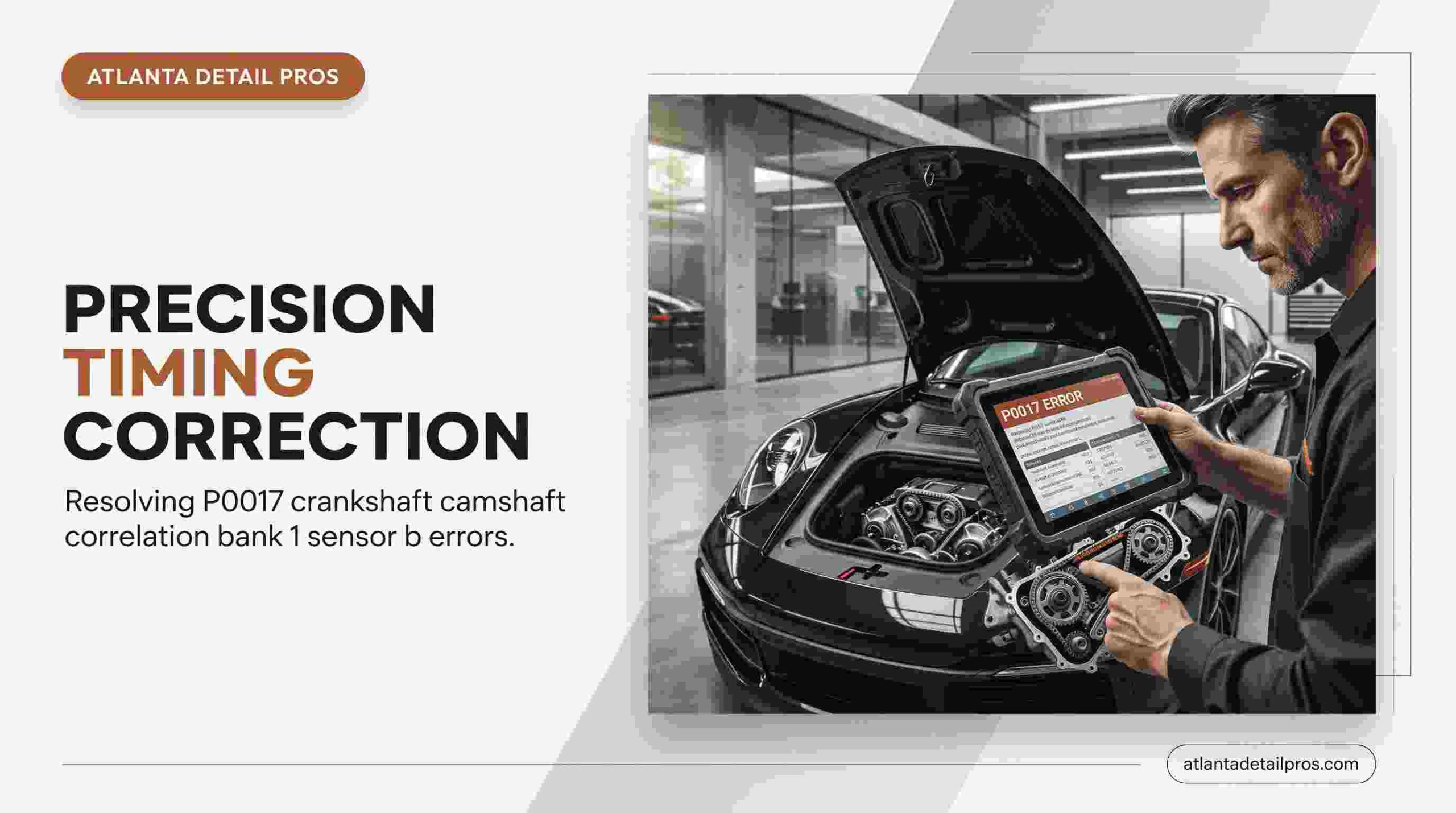
P0017 is one of the more serious OBD-II trouble codes because it indicates that the powertrain control module detected a mismatch between the crankshaft position and the Bank 1 camshaft position for Sensor B, which refers to the exhaust camshaft on Bank 1 on engines with variable valve timing (VVT). The crankshaft and camshaft positions must maintain a precise correlation for correct valve timing, ignition timing, and fuel injection timing. When the PCM measures a deviation beyond the acceptable tolerance between the crankshaft position sensor signal and the Bank 1 exhaust camshaft position sensor signal, it sets P0017 and illuminates the check engine light. The causes range from engine oil condition and VVT solenoid faults that are straightforward to repair to stretched or jumped timing chains that require significant engine work.
What the VVT System Does and Why Correlation Matters
Variable valve timing systems use oil pressure to advance or retard the camshaft position relative to the crankshaft by rotating a cam phaser (also called a VVT actuator or cam phaser) that connects the camshaft to the timing chain drive. The PCM commands the VVT solenoid to direct oil pressure to the phaser, adjusting the camshaft timing angle for optimal performance and efficiency across different engine loads and speeds. The PCM monitors the actual camshaft position through the camshaft position sensor and compares it against the commanded position derived from the crankshaft position sensor signal.
P0017 sets when the actual camshaft position deviates from where the crankshaft position indicates it should be. The Sensor B designation in P0017 (as opposed to P0016 which is Sensor A, the intake camshaft) indicates the fault is on the exhaust camshaft side of Bank 1. On engines with VVT only on the intake cam, only P0016 applies. On engines with VVT on both intake and exhaust cams (dual cam phasing), P0016 covers the intake cam and P0017 covers the exhaust cam.
Causes of P0017 in Order of Severity
Low or Degraded Engine Oil
The VVT system runs entirely on engine oil pressure. Low oil level, dirty oil with degraded viscosity, or the wrong oil viscosity for the engine all reduce the oil pressure available to the cam phaser and can prevent the phaser from reaching or holding its commanded position. P0017 as a first-time code on a vehicle with no prior history and low or dirty oil is frequently resolved by performing an oil change with the correct viscosity oil and clearing the code. This is the first diagnostic step and the least expensive potential solution.
Faulty VVT Solenoid or Control Valve
The VVT oil control solenoid (also called the cam phaser solenoid or VVT actuator) is an electrically controlled valve that directs oil pressure to the cam phaser. A solenoid that is clogged with varnish from degraded oil, stuck in one position, or electrically failed cannot modulate oil pressure to the phaser correctly, causing the camshaft to hold at one extreme position or to respond incorrectly to PCM commands. Solenoid testing involves checking the resistance of the solenoid coil, confirming the PCM is providing the correct control signal, and verifying oil passages are clear.
Failed or Stuck Cam Phaser (VVT Actuator)
The cam phaser itself can seize from varnish accumulation in its internal oil passages, particularly on engines with a history of extended oil change intervals or low oil level events. A seized phaser cannot rotate relative to the camshaft regardless of how much oil pressure the solenoid provides. Phaser failure typically produces P0017 that does not clear with oil changes or solenoid replacement.
Stretched or Jumped Timing Chain
A stretched timing chain that has reached the limit of the timing chain tensioner’s adjustment range allows the camshaft to lag behind the crankshaft position by a fixed amount that increases as the chain stretches further. A jumped timing chain that has skipped one or more teeth on the cam or crank sprocket produces an immediate and severe correlation error that typically causes the engine to run very roughly or not start at all. A stretched or jumped timing chain that causes P0017 without obvious running problems is still a mechanical emergency: continued driving risks the chain jumping a tooth under load, which can cause valve-to-piston contact and catastrophic engine damage on interference engines.
Diagnosing P0017
Check engine oil level and condition before any other diagnostic step. If the oil is low, dirty, or of the incorrect viscosity, change the oil, clear the code, and drive for several complete warm-up cycles to see whether P0017 returns. If P0017 resolves and does not return after a quality oil change, engine oil condition was the contributing factor.
If P0017 returns after an oil change, test the VVT solenoid electrically by measuring coil resistance with a multimeter (typically 6 to 12 ohms for a healthy solenoid) and by removing and inspecting the solenoid screen filter for varnish or debris that restricts oil flow to the solenoid. A clogged solenoid screen is a common and often overlooked cause of VVT faults on high-mileage engines with irregular oil changes.
If the solenoid tests correctly and P0017 persists, the diagnosis points toward the cam phaser or the timing chain. Timing chain stretch is audible as a rattling noise at cold start that diminishes as oil pressure builds, typically within 2 to 3 seconds of startup. A cold-start rattle combined with P0017 strongly suggests timing chain wear. Confirm with a timing chain inspection that requires removing the valve cover for access to the chain components.
P0017 Cause and Repair Cost Reference
Cause | Diagnosis Method | DIY Cost | Professional Cost |
|---|---|---|---|
Low or dirty engine oil | Oil level and condition check | $40 to $80 (oil change) | $80 to $150 (shop oil change) |
Clogged VVT solenoid screen | Remove and inspect solenoid filter | $10 to $30 (clean or new screen) | $50 to $150 labor |
Failed VVT solenoid | Resistance test, output command test | $30 to $100 (solenoid) | $120 to $300 parts and labor |
Failed cam phaser | Advanced scan data, oil pressure test | $100 to $400 (phaser) | $400 to $1,200 parts and labor |
Stretched timing chain | Cold-start rattle, scan data deviation | $200 to $600 (chain kit) | $800 to $2,500 parts and labor |
Jumped timing chain | Engine won’t start or runs very rough | $300 to $800 (chain kit) | $1,500 to $4,000+ if engine damaged |
Frequently Asked Questions About P0017
Is P0017 safe to ignore or drive with?
P0017 is one of the codes that warrants prompt diagnosis rather than deferred attention. If the cause is low or dirty oil, driving continues to stress the VVT system. If the cause is a stretched timing chain, continued driving risks the chain jumping a tooth and causing valve-to-piston contact on interference engines, which destroys pistons and valves in milliseconds. A cold-start timing chain rattle combined with P0017 should be treated as an instruction to get the vehicle to a shop immediately rather than drive it until convenient.
Will changing the oil fix P0017?
An oil change resolves P0017 when low oil level or degraded oil viscosity was reducing oil pressure to the VVT system. This is the least expensive and simplest potential fix and should always be the first step. However, if the timing chain is stretched, the cam phaser is seized, or the VVT solenoid has mechanically failed, an oil change alone will not resolve the code. Change the oil first, clear the code, and evaluate whether P0017 returns before proceeding with more expensive diagnoses.
What is the difference between P0016 and P0017?
P0016 indicates a correlation fault on Bank 1 Sensor A, which refers to the intake camshaft on Bank 1. P0017 indicates the same type of fault on Bank 1 Sensor B, the exhaust camshaft. On engines with only intake VVT, only P0016 applies. On engines with both intake and exhaust VVT, both codes can appear independently or together. When both P0016 and P0017 appear together, a timing chain fault that affects both camshaft positions is the more likely cause than individual phaser or solenoid faults on both cams simultaneously.
How much does timing chain replacement cost for P0017?
Timing chain replacement costs $800 to $2,500 at a professional shop for most passenger vehicles, covering the timing chain kit (chain, tensioners, guides, and sprockets), gaskets, and labor. Labor is the dominant cost component because accessing the timing chain requires significant engine disassembly including valve cover removal, front cover removal, and often coolant system drainage. Engines with known timing chain reliability problems, including many GM 3.6-liter V6 engines and some Ford EcoBoost engines, have established aftermarket timing chain kit solutions that shops experienced with these vehicles can install efficiently.
Can P0017 cause a no-start condition?
P0017 from a jumped timing chain can absolutely cause a no-start condition because the valve timing deviation is severe enough that compression and combustion cannot occur in the correct relationship to piston position. P0017 from less severe causes including solenoid faults, phaser faults, and moderate chain stretch typically allows the engine to start and run, often with reduced performance and rough idle. A no-start with P0017 in the fault memory should be treated as a timing chain emergency that requires towing to a shop rather than repeated starting attempts that could worsen internal engine damage.
Bottom Line
P0017 indicates a crankshaft-to-exhaust-camshaft correlation fault on Bank 1 that ranges in cause from simple oil condition issues to serious timing chain problems. Always begin with an oil change using the correct viscosity oil and clear the code before any other diagnostic step. If P0017 returns after fresh oil, test the VVT solenoid for clogging and electrical faults. If the solenoid is functional, evaluate the cam phaser and the timing chain for wear or seizure. A cold-start chain rattle with P0017 is a warning to stop driving and seek immediate professional diagnosis, as a jumped timing chain on an interference engine causes catastrophic internal engine damage.