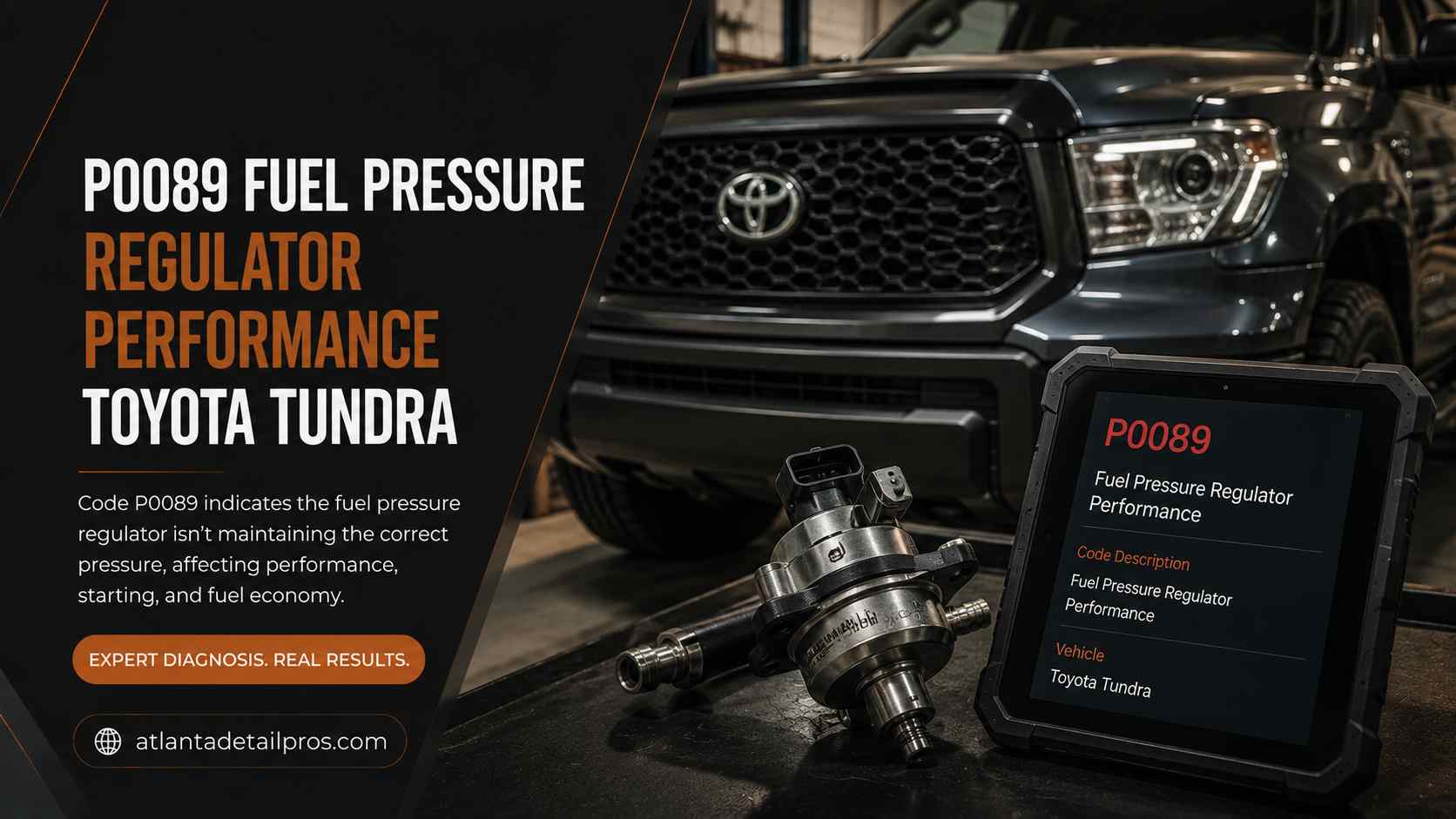
P0089 on a Toyota Tundra means the ECM has detected that actual fuel rail pressure is significantly different from the commanded fuel pressure: most commonly because the fuel pressure regulator inside the in-tank fuel pump module is failing, the fuel pump itself is losing volume output, or a fuel pressure sensor is providing inaccurate data to the ECM. On Tundra trucks with the 5.7L 3UR-FE or 4.6L 1UR-FE engine, this code typically means the fuel delivery system can no longer maintain the precise pressure the direct-injection or port-injection system requires.
“My 2012 Tundra 5.7 threw P0089 at around 187,000 miles. I figured it was the regulator but the shop told me the whole pump module was the issue: the pump was barely keeping up under hard acceleration. The fuel pressure would spike and dip. New pump module fixed it entirely.”: Carlos Medina, Tundra 5.7L owner
What P0089 Means on a Toyota Tundra
How the Tundra’s Fuel System Works
The Toyota Tundra uses a returnless fuel delivery system. Fuel is pressurized by an in-tank fuel pump module and delivered to the fuel rail where a pressure sensor continuously monitors actual rail pressure. The ECM commands a target pressure and monitors whether the actual pressure matches.
When the deviation between commanded and actual pressure exceeds the calibrated threshold for a specified period, P0089 is stored. Unlike older return-type fuel systems, the Tundra’s fuel pressure regulator is integrated into the fuel pump module assembly rather than mounted separately at the fuel rail. This means regulator failure and pump failure are often diagnosed and repaired together.
Related Codes That May Appear With P0089
- P0087: Fuel rail pressure too low (severe: actual pressure far below commanded)
- P0088: Fuel rail pressure too high
- P0191: Fuel rail pressure sensor circuit
- P0192 / P0193: Fuel rail pressure sensor voltage too low or too high
Diagnosing P0089 on a Toyota Tundra
Step 1: Check Fuel Trim Data With a Scan Tool
Long-Term Fuel Trim as a Diagnostic Window
Connect a scan tool and observe short-term and long-term fuel trim (STFT and LTFT) on both banks. On a Tundra with P0089:
- LTFT values above +10 percent on both banks suggest the engine is running lean due to insufficient fuel pressure: consistent with a fuel delivery volume problem
- LTFT values that are normal suggest the problem may be a sensor providing incorrect data rather than an actual pressure deficiency
Step 2: Monitor Live Fuel Rail Pressure Data
Using the Scan Tool to Read Actual vs. Commanded Pressure
On Tundra trucks equipped with a fuel rail pressure sensor, the scan tool can display both the commanded fuel pressure and the actual sensed pressure in real time. This comparison is the most direct diagnostic step:
- At idle (key on, engine running): actual pressure should match commanded within approximately 5 percent
- During hard acceleration: pressure should rise and maintain with throttle input; a pressure drop during acceleration indicates pump volume limitation
- After engine shutoff: pressure should hold for several minutes; a rapid pressure drop suggests a leaking check valve in the pump module
Step 3: Fuel Pressure Sensor Validation
How to Confirm the Sensor Is Accurate
A fuel rail pressure sensor that is providing incorrect voltage can generate P0089 without any actual fuel pressure problem. To validate the sensor: Method 1: Mechanical gauge comparison: connect a mechanical fuel pressure gauge to the fuel rail test port (if equipped on your Tundra generation) and compare the mechanical reading to the scan tool’s sensor reading during the same operating condition. A significant discrepancy indicates a faulty sensor. Method 2: Voltage at specification: the Tundra’s fuel pressure sensor should produce a voltage output that increases linearly with pressure. With the key on and engine off (KOEO), at rail static pressure, confirm the sensor output voltage is within the manufacturer’s specification. Fuel pressure sensor replacement cost: $80 to $180 for the sensor. Labor: $50 to $100. Total: $130 to $280.
Primary Causes of P0089 on Toyota Tundra
Cause 1: Failing In-Tank Fuel Pump Module (Most Common on High-Mileage Tundras)
Why the Pump Module Fails on High-Mileage Tundras
The 5.7L Tundra’s in-tank fuel pump is a high-volume unit that operates continuously whenever the engine runs. On trucks with 150,000 miles or more, the brushed motor inside the pump begins to wear and loses its ability to maintain volume output. The pressure regulator integrated into the module may still control pressure at light loads but cannot keep up during hard acceleration or at sustained high-demand conditions.
Signs of Pump Volume Limitation
- P0089 sets during or after hard acceleration, not at idle
- The truck hesitates or surges under heavy throttle load
- Fuel pressure data shows a pressure drop during high-demand conditions even when target pressure is achievable at idle Fuel pump module replacement cost on Toyota Tundra: OEM pump module from Toyota: $350 to $600. Quality aftermarket (Denso, Walbro): $200 to $400. Labor for in-tank pump replacement: 2 to 3 hours. Total: $400 to $900 at an independent shop.
Cause 2: Clogged Fuel Strainer or Sock
What the Fuel Strainer Does
The in-tank fuel pump draws fuel through a mesh strainer (fuel sock) that filters large particles before they reach the pump. Over time, this strainer can become clogged with sediment and debris, restricting fuel flow to the pump. A restricted strainer starves the pump of fuel volume, causing the same symptom pattern as a failing pump: pressure drops under load. The strainer is integral to the pump module on most Tundra configurations and is replaced along with the module. Attempting to clean and reuse a clogged strainer without replacing it is not recommended.
Cause 3: Fuel Pressure Regulator Failure (Integrated Unit)
How the Integrated Regulator Works on the Tundra
On Tundra’s returnless system, the fuel pressure regulator is inside the pump module assembly. It controls the maximum pressure the pump module delivers to the rail. When the regulator fails, it may allow pressure to rise above or fall below the target range, generating P0089 in either direction depending on the failure mode. Because the regulator is not serviceable separately from the pump module on most Tundra applications, diagnosing regulator failure specifically usually results in a full pump module replacement regardless.
| Cause | P0089 Pattern | Fuel Trim Pattern | Repair Cost |
|---|---|---|---|
| Failing fuel pump (volume loss) | Sets during hard acceleration | LTFT elevated on both banks | $400 to $900 |
| Fuel pressure sensor inaccuracy | Sets at various conditions | Fuel trims normal | $130 to $280 |
| Clogged fuel strainer | Sets under load | LTFT elevated | Replaced with pump module |
| Fuel pressure regulator failure | Sets at idle or under load | LTFT elevated or normal | Part of pump module replacement |
Frequently Asked Questions
What Does P0089 Mean on a Toyota Tundra?
P0089 means the ECM has detected a difference between the commanded fuel rail pressure and the actual sensed fuel rail pressure that exceeds the calibrated threshold. On Toyota Tundra, this most commonly indicates a failing fuel pump module (pump or integrated regulator) or a faulty fuel pressure sensor providing inaccurate data.
Can I Drive a Toyota Tundra With P0089?
P0089 often allows the truck to continue starting and running but with reduced performance, especially under heavy throttle. Sustained operation in this condition risks running the engine lean under high load, which can cause detonation and catalytic converter damage. Have it diagnosed within a week; avoid towing or heavy hauling until repaired.
How Much Does It Cost to Fix P0089 on a Toyota Tundra?
If the fuel pump module is the cause (most common on high-mileage Tundras), expect $400 to $900 at an independent shop. If only the fuel pressure sensor has failed, the cost is $130 to $280. A scan tool diagnosis session to confirm the specific cause before authorizing parts typically costs $80 to $150 at a shop.
Why Does P0089 Appear on My Tundra Only During Hard Acceleration?
A P0089 that sets only during hard acceleration and not at idle suggests the fuel pump can maintain pressure at light demand but cannot keep up at high volume demand: the signature of a pump that has lost output volume rather than a pressure regulator or sensor issue. This pattern is most common on high-mileage Tundras where pump motor brushes have worn.
The Bottom Line
P0089 on a Toyota Tundra requires scan tool diagnosis before any parts are replaced. Confirm whether actual fuel pressure is truly low or whether the sensor is providing inaccurate data: these two scenarios have different repair paths. For trucks over 150,000 miles showing pressure drops during acceleration, the fuel pump module is the primary suspect. For trucks where pressure data appears inconsistent at all operating conditions, sensor validation is the first step.