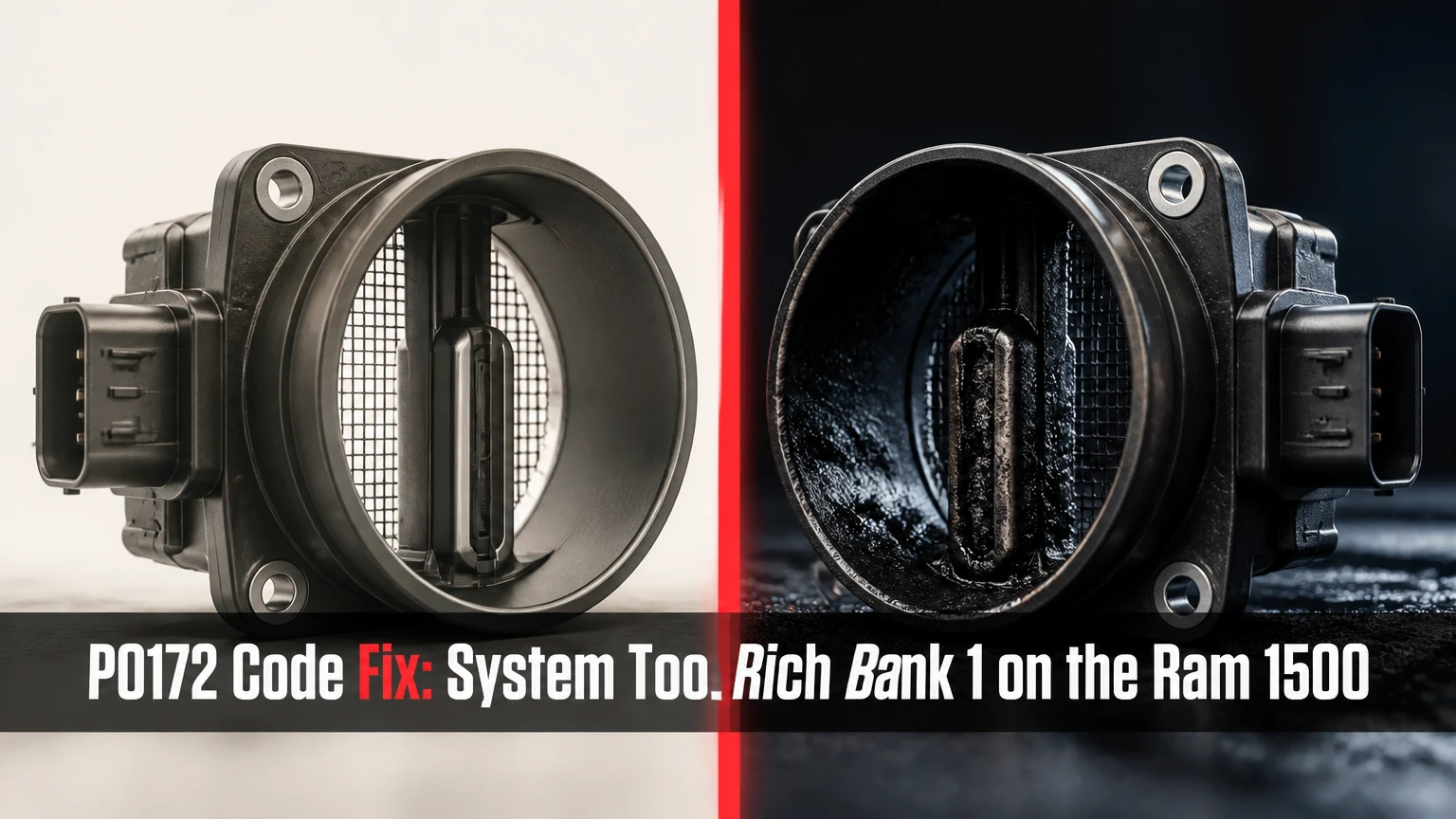
A P0172 code on a Ram 1500 indicates the ECM has detected a long-term rich fuel condition on Bank 1 (the driver-side bank on V-engines), and on the Ram 1500 specifically the most common causes are a stuck-open EVAP purge valve continuously drawing fuel vapor into the intake, a contaminated or failing mass airflow sensor underreporting actual airflow, or a leaking fuel injector delivering excess fuel to one or more cylinders.
The P0172 code sets when long-term fuel trim (LTFT) on Bank 1 reaches a negative correction of approximately -25 percent, meaning the ECM has been pulling fuel out for an extended period and still cannot reach the stoichiometric target of 14.7:1 air-fuel ratio.
Understanding P0172: What It Is and Is Not
P0172 does not mean the engine is on fire with raw fuel. It means the ECM sees the upstream oxygen sensor (Bank 1) reporting a consistently rich condition and has been commanding negative fuel trim corrections to compensate. The ECM can only adjust fuel delivery within a range (typically plus or minus 25 percent). When LTFT hits that limit and the mixture is still rich, P0172 sets.
Bank 1 on the Ram 1500 5.7L HEMI is the driver-side cylinder bank (cylinders 1, 3, 5, 7). Bank 1 on the 3.6L Pentastar is the front cylinder bank as mounted in the engine compartment. A rich condition on Bank 1 only (with Bank 2 reading normal) points toward causes specific to that bank: the Bank 1 upstream O2 sensor, Bank 1 injectors, or components that affect the entire engine but whose impact is reflected on whichever bank the ECM evaluates first.
A P0172 occurring alongside P0175 (Bank 2 too rich) suggests a system-wide cause: MAF sensor, EVAP purge valve, fuel pressure regulator, or PCV contamination.
Cause 1: EVAP Purge Valve Stuck Open (Most Common on Ram 1500 5.7L HEMI)
The evaporative emission control (EVAP) system stores fuel vapors from the fuel tank in a charcoal canister and purges them into the intake manifold to be burned under specific driving conditions. The purge valve controls when this purging occurs. At idle and during diagnostic conditions, the purge valve should be closed.
On the Ram 1500 5.7L HEMI, the EVAP purge valve is a known failure item, particularly on higher-mileage examples. When the valve sticks open or fails to fully close, fuel vapor from the charcoal canister flows continuously into the intake manifold regardless of operating conditions. This adds unmeasured fuel to the mixture that the MAF sensor never sees, causing the ECM to see a rich condition and set P0172 (and sometimes P0175 simultaneously if both banks are affected).
The diagnostic test: with the engine running at warm idle, locate the EVAP purge valve (on the 5.7L HEMI it sits in the engine valley near the throttle body area, connected to a vacuum hose and an electrical connector). Disconnect the vacuum hose from the purge valve inlet and cap it temporarily. If the rough idle improves or the LTFT fuel trim values move toward zero within a few minutes, the purge valve was pulling fuel vapor into the intake and is the cause.
A replacement EVAP purge valve for the Ram 1500 5.7L costs $20 to $60 for the part. Labor is minimal: the valve typically has two bolts or hose clamps and one electrical connector. Total repair: $80 to $150 at a shop.
Cause 2: Contaminated or Failing MAF Sensor
The mass airflow sensor measures the actual mass of air entering the engine and is the primary input for fuel delivery calculations. When the sensor element becomes contaminated with oil film, dust, or debris, it underreports the actual airflow. The ECM then delivers a fuel quantity appropriate for the lower reported airflow, but because actual airflow is higher, the resulting mixture is lean. The ECM sees a lean condition and increases fuel delivery. But wait: a lean response produces P0171 (lean bank 1), not P0172 (rich bank 1).
However, a MAF sensor can fail in two directions. A sensor that overreports airflow causes the ECM to deliver too much fuel and sets P0172. A sensor that is contaminated but intermittently overreporting (perhaps due to a dirty element vibrating in the airstream at certain frequencies) can cause a rich condition in a non-obvious pattern.
Cleaning is the first step: spray CRC MAF Sensor Cleaner specifically on the hot wire or film element inside the MAF housing, allow to dry completely before reinstalling. Do not use other solvents. If cleaning does not resolve the fuel trim issue within two drive cycles, the MAF sensor may need replacement.
Cause 3: Leaking Fuel Injector
A fuel injector that does not close fully (from a worn or deteriorated needle and seat, or from a stuck-open coil) drips fuel into the cylinder between injection events. This adds extra fuel that the ECM has not commanded and causes the O2 sensor to see a rich condition that the ECM cannot explain or fully compensate for through fuel trim adjustment.
On the Ram 1500 HEMI, the MDS (Multiple Displacement System) cylinders (1, 4, 6, 7) have solenoids that can partially affect injector function. An MDS valve that does not seat correctly can allow oil to leak into the cylinder, which the O2 sensor interprets as combustion products from a rich condition. This is a HEMI-specific mechanism that non-HEMI vehicles do not share.
Identifying a leaking injector: an injector balance test performed with a scan tool cycles each injector individually and measures the resulting RPM drop. An injector that shows a much higher RPM drop than others when disabled is delivering more than its commanded fuel quantity and is a suspect. Individual injector fuel trims shown on some scan tools directly identify which cylinder is running rich.
Cause 4: Upstream Oxygen Sensor Failure
The upstream O2 sensor (Bank 1, Sensor 1) is the primary feedback sensor the ECM uses to calculate fuel trim. If this sensor fails in the rich-reporting direction, it tells the ECM the mixture is rich when it may actually be correct or lean. The ECM responds by pulling fuel out (negative fuel trim) and eventually sets P0172 because it cannot pull enough fuel to satisfy the false rich signal.
An oxygen sensor biased rich can be confirmed by comparing its output voltage to a known-good sensor pattern. A properly functioning upstream O2 sensor on a warmed-up engine switches rapidly between approximately 0.1 volts (lean) and 0.9 volts (rich) at idle, at a rate of 5 to 8 switches per second. A sensor stuck above 0.5 to 0.6 volts continuously is reporting a rich condition regardless of actual mixture.
Cause 5: PCV System Oil Contamination
The positive crankcase ventilation (PCV) system routes crankcase blow-by gases back into the intake manifold. On high-mileage engines with worn piston rings, excessive blow-by carries engine oil vapor into the intake charge. This oil vapor is not measured by the MAF sensor and adds to the mixture, causing a rich condition. Oil-contaminated PCV flow also coats the MAF sensor, throttle body, and intake valves over time.
Check: remove the PCV valve and inspect the hose connecting to the intake manifold. Oil droplets visible inside the hose indicate excessive blow-by. Replace the PCV valve (inexpensive: $5 to $20) and clean the intake and MAF if contamination is present.
Cause Hierarchy for Ram 1500 P0172
Cause | Bank 1 or Both Banks? | Associated Codes | First Test | Repair Cost |
|---|---|---|---|---|
EVAP purge valve stuck open | Usually both (P0172 + P0175) | P0455, P0441 | Disconnect purge hose; check idle trim | $80 to $150 |
MAF sensor contaminated or failed | Both banks | P0100-P0103 | Clean MAF; monitor LTFT | $0 to $200 |
Leaking fuel injector | Bank 1 (driver side) only | Specific cylinder misfire P030X | Injector balance test | $150 to $600 |
Upstream O2 sensor failure (Bank 1) | Bank 1 only | P0131, P0136 | O2 voltage switching test | $60 to $200 |
MDS valve leaking (HEMI only) | Bank 1 or specific cylinder | Misfire codes | Cylinder contribution test | $100 to $400 |
PCV oil contamination | Both banks | None specific | Inspect PCV hose for oil | $5 to $100 |
“Three shops told me I needed a new catalytic converter for my P0172. I finally found a forum post about the EVAP purge valve on the HEMI and tried the vacuum hose disconnect test at home. The fuel trims went from minus 22 percent to minus 3 percent within two minutes of capping that hose. Twenty-eight dollar purge valve and the code never came back.” — Cody Baxter, 2019 Ram 1500 Classic 5.7L HEMI
Fuel Trim Interpretation for Diagnosis
Use a live data scanner to read Short-Term Fuel Trim (STFT) and Long-Term Fuel Trim (LTFT) on Bank 1 while the engine is warm at idle. For P0172: LTFT is likely at -20 percent or below. STFT may be oscillating between -15 and -25 percent as the ECM fights the rich condition.
Test 1: disconnect the EVAP purge valve electrical connector at warm idle. If LTFT moves from -22 to -5 within 2 minutes, the purge valve is the cause.
Test 2: if Test 1 shows no change, clean the MAF sensor, clear the code, and drive 100 miles. If P0172 returns with both banks affected, MAF is the suspect. If Bank 1 only, move to O2 sensor and injector testing.
Frequently Asked Questions
Can P0172 cause the Ram 1500 to fail emissions testing?
Yes. A P0172 causes the check engine light to illuminate and an active check engine light automatically fails any OBD-based emissions test regardless of the actual emissions level. Resolve the P0172 and drive the vehicle through at least two complete OBD readiness drive cycles before retesting to confirm all monitors are set.
Is it safe to drive the Ram 1500 with P0172 active?
A mild P0172 with fuel trim at -20 to -25 percent is driveable for a period without immediate mechanical damage. Sustained severe rich condition (above -25 percent) risks fouling spark plugs and oxygen sensors and can wash cylinder walls of oil if raw fuel is entering from a leaking injector. Address the cause within one to two weeks.
Could the wrong oil cause P0172 on the HEMI?
Using an oil that is too thin for the engine specification can increase oil consumption and PCV vapor load, but it is unlikely to directly cause a P0172. However, extended oil change intervals on a HEMI that causes MDS lifter issues (a known HEMI concern) can increase blow-by and PCV oil contamination over time, which does contribute to rich conditions.
How do I know if my EVAP purge valve is bad without disconnecting it?
Listen for a clicking or ticking sound from the purge valve at idle: a valve that is cycling when it should be closed produces an audible tick. Also, a stuck-open EVAP purge valve often makes the idle rough and slightly erratic because the unmeasured fuel vapor load varies with tank pressure and temperature. If the idle is rough specifically when the fuel tank is more than half full (more vapor pressure available), the purge valve is a strong suspect.
The Bottom Line
The EVAP purge valve is the highest-probability P0172 cause on the Ram 1500 5.7L HEMI and is confirmed with a 90-second field test that costs nothing. Perform the purge valve disconnect test before replacing any other component. If the purge valve is not the cause, use live fuel trim data to identify whether the rich condition is bank-specific (injector or O2 sensor) or system-wide (MAF or PCV). The $28 purge valve resolves this code on a large percentage of Ram 1500 5.7L HEMI diagnoses.