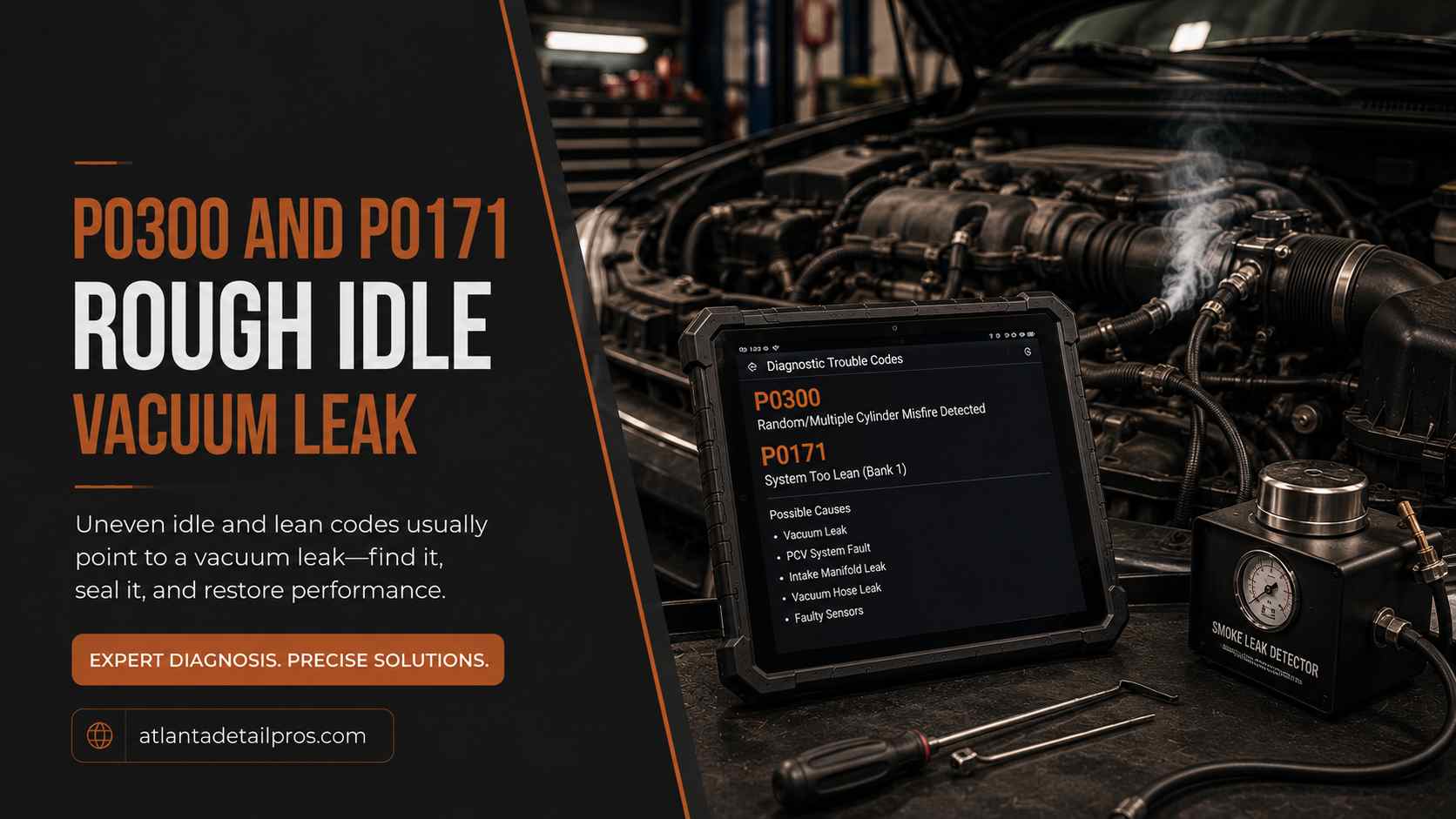
When your scan tool shows both P0300 (random misfire detected) and P0171 (system too lean, Bank 1) stored at the same time with a rough idle, you are not looking at two separate problems. You are almost certainly looking at one problem: a vacuum leak. The combination of these two codes together, specifically at idle, is one of the clearest diagnostic signatures in automotive repair, and understanding why they appear together points directly to the fix.
This guide explains the relationship between these codes, why a vacuum leak produces both simultaneously, how to use your fuel trim data to confirm it before spending a dollar, and the step-by-step process for finding and fixing the leak.
Why P0300 and P0171 Appear Together From a Single Vacuum Leak
Every piece of air that enters your engine is supposed to pass through the mass airflow (MAF) sensor so the ECM can measure it and inject the right amount of fuel to match. A vacuum leak creates an opening in the intake system downstream of the MAF sensor. Air slips through this gap undetected by the MAF. The ECM does not know about this extra air, so it does not add extra fuel to match it. The cylinder receives more air than expected with the same amount of fuel, creating a lean mixture.
Here is where both codes come from. The lean mixture from the vacuum leak makes the oxygen sensor on Bank 1 report an excess of oxygen, triggering P0171. Simultaneously, a lean mixture in a cylinder is harder to ignite and sustain. Some cylinders fire inconsistently, producing random misfires that trigger P0300. The ECM tries to compensate for the lean condition by adding fuel (positive fuel trim), but if the vacuum leak is large enough it cannot fully correct the imbalance. Rough idle follows because some cylinders are firing inconsistently.
Using Fuel Trim Data to Confirm the Vacuum Leak Before Touching Anything
The fastest and most reliable free tool you have before buying parts is your OBD-II scanner’s live fuel trim data. If you have P0300 and P0171 with rough idle, reading the Short Term Fuel Trim (STFT) and Long Term Fuel Trim (LTFT) on Bank 1 tells you exactly how confident to be in the vacuum leak diagnosis before doing anything else.
Reading Fuel Trims on Your Scanner
Connect your scanner and find the live data screen. Look for Short Term Fuel Trim Bank 1 (STFT B1) and Long Term Fuel Trim Bank 1 (LTFT B1). Healthy fuel trims read between -5% and +5%. Positive values mean the ECM is adding fuel to compensate for a lean condition.
The RPM Test That Confirms a Vacuum Leak vs a Fuel Problem
This is the diagnostic step that separates a vacuum leak from a fuel delivery problem. With the engine at idle, note your fuel trim values. Then increase RPM to 2,500 and hold steady for 30 seconds while watching the fuel trims again. Vacuum in the intake manifold is highest at idle and decreases at higher RPM. A vacuum leak has more effect at idle (high vacuum) than at higher RPM (lower vacuum).
If your fuel trims are high at idle (above +10%) and drop significantly at 2,500 RPM (below +5%), you have a vacuum leak. This is the most reliable pre-testing diagnostic available and costs nothing. If fuel trims are high at both idle and 2,500 RPM, the cause is more likely a fuel delivery problem (weak fuel pump, dirty injector, or low fuel pressure) rather than a vacuum leak.
Finding the Vacuum Leak: From Free to Definitive (P0300 and P0171)
Once fuel trim data confirms a vacuum leak, you need to find exactly where the air is entering. There is a hierarchy of methods from free and fast to definitive and thorough.
Method 1: The Visual Inspection (Free)
Start with a thorough visual inspection of the entire air intake path from the air filter housing to the throttle body, and every hose and connection at the throttle body and intake manifold. Look for cracked rubber in the large intake boot, loose hose clamps at each connection end, and any small vacuum hose that has pulled off its nipple. Common high-mileage failure points include the PCV hose connection at the valve cover, the brake booster vacuum hose at the intake manifold, and any small port vacuum hose at the throttle body.
Method 2: The Propane or Soapy Water Test (Low Cost)
The soapy water method works for accessible connection points. Spray a soapy water mixture along each hose connection and manifold joint with the engine idling. Bubbles forming at a connection confirm air being drawn in at that point. For deeper or less accessible leaks, a can of carburetor cleaner or brake cleaner can be carefully applied near suspected areas while watching for an RPM change, but this carries a fire risk near hot exhaust components. Use this method with extreme caution and never near the exhaust manifold.
Method 3: The Smoke Test (Definitive)
If visual inspection and spray testing fail to locate the leak but fuel trims still confirm one exists, a smoke test is the only reliable next step. A smoke machine forces low-pressure, non-toxic smoke into the sealed intake system. Any leak point shows smoke escaping, even a pinhole crack that is invisible to the naked eye. Shops charge $75 to $150 for this diagnostic service, or you can purchase a basic smoke machine for $80 to $150 for ongoing DIY use.
The Most Common Vacuum Leak Locations That Cause P0300 Plus P0171
Certain leak points are far more common than others, depending on engine age and mileage. Knowing where to look first saves significant diagnostic time.
Intake Boot or Air Duct
The large corrugated rubber or plastic duct between the air filter housing and the throttle body is a common failure point on vehicles over 80,000 miles. The underside of the boot can split or develop a crack that is invisible during a top-down inspection. Flex the boot firmly and look for cracks that open under pressure.
PCV System Hoses
The PCV valve and its associated hoses are consistently among the most common vacuum leak sources that produce P0300 and P0171 together. The rubber hose from the valve cover to the intake manifold or throttle body cracks with age. The PCV valve grommet in the valve cover can deteriorate and loosen. These leaks are often large enough to push fuel trims above +20% at idle.
Intake Manifold Gaskets
On higher-mileage engines and on specific platforms known for manifold gasket deterioration, the gasket between the intake manifold and cylinder head can fail. This type of leak is harder to find without a smoke test because the manifold surface is not easily accessible for spray testing. Combined P0300 and P0171 codes with high fuel trims that do not respond to all obvious hose fixes point toward the manifold gaskets.
Throttle Body Gasket or O-Ring
The seal between the throttle body and the intake manifold flange can deteriorate. Soapy water sprayed along the throttle body base with the engine idling will show bubbles at the seam if this gasket is leaking.
Leak Location | How to Find It | Fuel Trim Response | Repair |
|---|---|---|---|
Intake boot crack | Flex boot; look at underside for splits | High at idle, drops at 2,500 RPM | Replace intake boot |
PCV hose or grommet | Visually inspect PCV hose; feel for stiffness | Often very high at idle; large leak | Replace PCV hose; check valve |
Throttle body gasket | Soapy water along throttle body base | Moderate high trim at idle | Replace gasket or O-ring |
Intake manifold gasket | Smoke test; spray test at manifold flange | High trim, not fixed by hose repairs | Replace manifold gaskets |
Frequently Asked Questions
Why do P0300 and P0171 appear together?
A vacuum leak introduces unmetered air downstream of the MAF sensor. This extra air causes the fuel mixture to run lean, triggering P0171 as the oxygen sensor reports excess oxygen in the exhaust. The lean mixture is harder to ignite consistently, causing random misfires that trigger P0300. Both codes come from the same source: too much air relative to fuel.
How do I know if rough idle is from a vacuum leak or something else?
The fuel trim RPM test is the most reliable free diagnostic. Check fuel trims at idle and at 2,500 RPM. If trims are high at idle and significantly lower at higher RPM, a vacuum leak is confirmed. If trims are equally high at both speeds, the cause is more likely a MAF sensor or fuel delivery issue rather than a vacuum leak.
Can I fix a vacuum leak myself?
Yes, in many cases. A cracked PCV hose, a loose hose clamp, or a cracked intake boot are all accessible DIY repairs. The part cost is $5 to $30 for most hoses. An intake manifold gasket replacement is a more involved repair requiring engine intake disassembly and is a moderate DIY job. Only the smoke test equipment requires a tool investment.
The Bottom Line
P0300 plus P0171 with rough idle is a vacuum leak until proven otherwise. Confirm it with the fuel trim RPM test before buying any parts. If trims are high at idle and drop at 2,500 RPM, start your visual inspection at the PCV hose, the intake boot underside, and the throttle body gasket area. Those three locations resolve the majority of cases. If they come up clean, a $75 to $150 smoke test at a shop finds the rest.