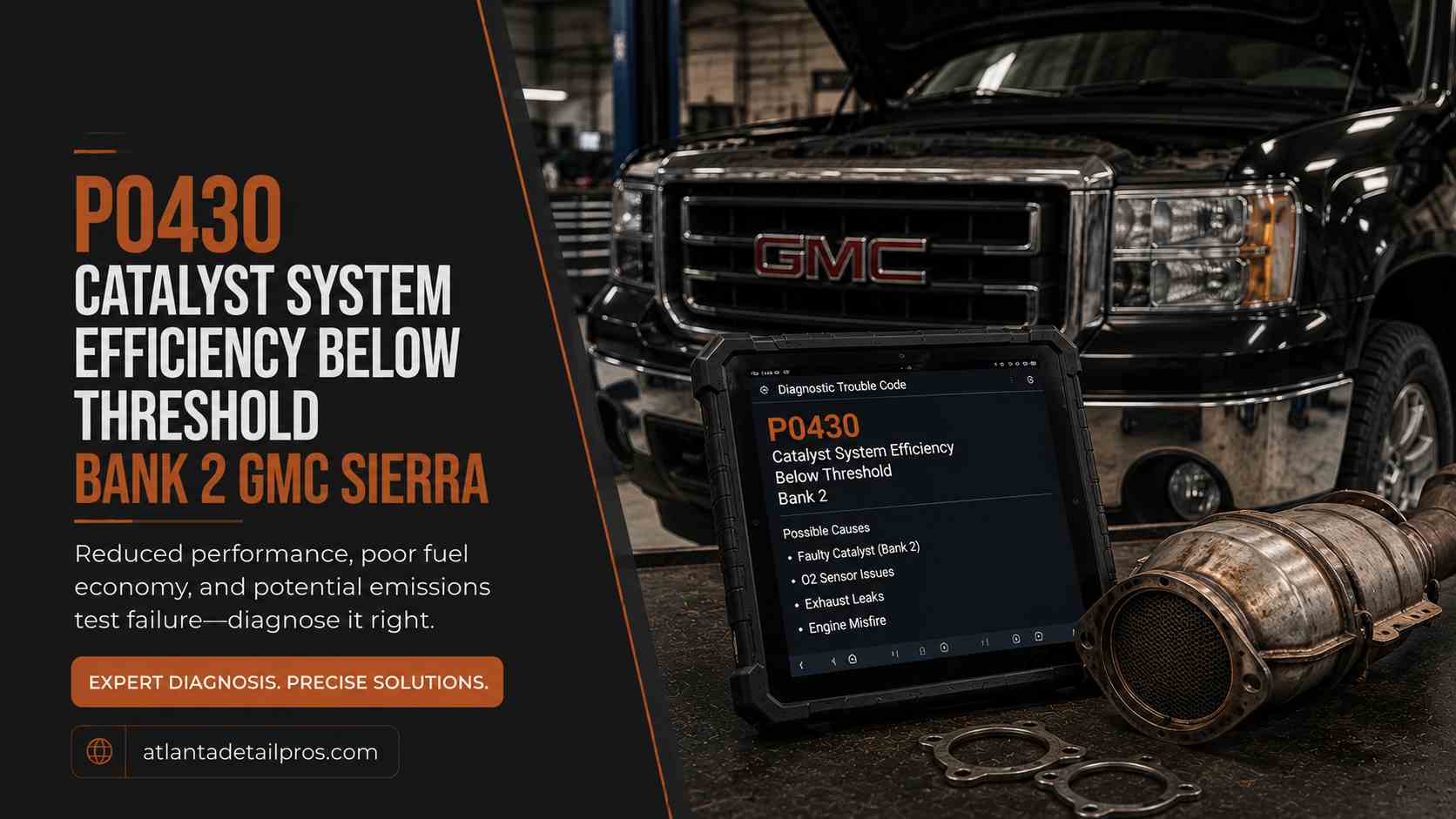
Your GMC Sierra is showing P0430, and the first thing to clarify is which side of your truck this code refers to. Bank 2 on the Sierra V8 is the passenger side of the engine, and the catalytic converter on that side is what the ECM is flagging as inefficient. P0430 is the Bank 2 equivalent of P0420, and everything that applies to diagnosing P0420 applies here, just on the right side.
The most expensive mistake you can make with this code is buying a new catalytic converter without confirming it is the actual problem. On the GMC Sierra, a failed downstream oxygen sensor on Bank 2, an exhaust leak near that sensor, or residual damage from a misfire that has since been repaired can all trigger P0430 without the converter being the cause. This guide walks through everything you need to know before any money changes hands.
Understanding P0430: What Bank 2 Means on the Sierra V8
The 4.8L, 5.3L, and 6.2L V8 engines in the GMC Sierra are divided into two cylinder banks. Bank 1 contains cylinder 1 and is on the driver side. Bank 2 contains cylinder 2 and is on the passenger side. Each bank has its own catalytic converter (or in some configurations a combined converter downstream), and each bank’s converter efficiency is monitored by a pair of oxygen sensors: an upstream (pre-cat) sensor that monitors the incoming exhaust, and a downstream (post-cat) sensor that monitors the converter’s output.
P0430 is stored when the ECM sees the Bank 2 downstream sensor beginning to mirror the upstream sensor activity, indicating the converter is no longer processing exhaust gases efficiently. This comparison between sensor signals is the only thing P0430 is based on. If the downstream sensor itself is faulty, or if an exhaust leak is introducing false oxygen readings near the sensor, P0430 can be stored with a perfectly functional converter.
Start With the Exhaust Leak Check on Bank 2
Before touching the oxygen sensors or considering converter replacement, inspect the Bank 2 exhaust system for leaks. An exhaust leak located between the engine and the Bank 2 downstream sensor introduces ambient air (rich in oxygen) into the exhaust stream. The downstream sensor reads this extra oxygen and interprets it as the converter failing to process exhaust gases. The result is P0430 with a perfectly good converter.
Where to Look for Exhaust Leaks on the Passenger Side
On the GMC Sierra, inspect the passenger-side exhaust manifold gasket where the manifold meets the cylinder head. This gasket is a documented failure point on the 5.3L engine. Look for carbon tracking or black soot around any manifold bolt or gasket joint. Also inspect the flex pipe section if your Sierra has one, the Y-pipe collector where both banks join, and any clamp connections in the Bank 2 downpipe. A hissing or ticking sound from the passenger side exhaust on a cold start is the acoustic signature of an exhaust leak.
Test the Bank 2 Downstream Oxygen Sensor Before Buying a Converter
The downstream oxygen sensor is the measurement device that triggers P0430. If this sensor is lazy, slow-responding, or sending incorrect voltage, the ECM sees an efficiency problem that does not exist. Testing this sensor before replacing the converter is how you avoid a $600 to $2,000 mistake on the Sierra.
How to Read the Downstream O2 Sensor on a Scan Tool
With the engine fully warmed to operating temperature, monitor live data from the Bank 2 downstream O2 sensor. Label on your scanner: it will appear as O2 Sensor Bank 2 Sensor 2 or Rear O2 B2S2. A healthy downstream sensor should show a relatively stable voltage between 0.5V and 0.7V once the catalytic converter is fully warmed. The signal should be much less active than the upstream sensor (B2S1), which switches rapidly between 0.1V and 0.9V. If the downstream sensor begins mirroring the upstream sensor activity, that confirms converter efficiency loss. If the downstream sensor shows stuck-low (near 0V), stuck-high (near 1V), or erratic random readings, the sensor is failed and should be replaced before condemning the converter.
Replacing the Bank 2 Downstream O2 Sensor
The downstream sensor on Bank 2 is accessible from underneath the Sierra, located in the exhaust pipe after the passenger-side catalytic converter. Use an O2 sensor socket (a socket with a side slot for the wire). Apply penetrating oil the night before if the truck has significant mileage. Always use a quality sensor: Bosch, Denso, or NGK for the Sierra. Cheap aftermarket sensors frequently produce P0430 immediately after installation because their calibration does not match the Sierra ECM expectations. Replacement runs $50 to $150 in parts and 30 to 60 minutes of labor.
Check for Any Misfire History That Damaged the Converter
Misfires are the most common cause of premature catalytic converter failure. Unburned fuel from a misfiring cylinder enters the converter and ignites inside the substrate at temperatures far above the converter’s design limits. Even a misfire that was caught and repaired months ago can have left the Bank 2 converter substrate damaged. If your Sierra had any P0300 to P0308 misfire codes in its history before P0430 appeared, the converter may be damaged from that event.
Check the freeze frame data stored with P0430: if the fuel trims were significantly positive or if any misfire codes were previously stored, the converter damage is likely real and replacement becomes the correct next step. Fix any active misfires or fuel system issues before replacing the converter, or the new one will fail under the same conditions.
When the Converter Actually Needs Replacement
After confirming no exhaust leaks, testing the downstream sensor as healthy, and checking that no active misfires or fuel system problems are contributing, a converter that still shows P0430 through complete sensor monitoring cycles has genuinely failed. On the GMC Sierra, the passenger-side catalytic converter is part of the exhaust manifold pipe assembly on most configurations.
OEM vs Aftermarket: This Matters on the Sierra
If you live in California or a state that follows CARB emissions standards, you must use a CARB-compliant catalytic converter. Installing a non-CARB-compliant aftermarket converter in these states is illegal and will cause P0430 to return because many budget converters do not meet the efficiency threshold the Sierra ECM requires. In non-CARB states, quality aftermarket converters from Walker, MagnaFlow, or Bosal are acceptable. Avoid no-brand universal-fit converters: they frequently fail the efficiency test and trigger the code within weeks.
Check This First | How to Test | Fix | Cost |
|---|---|---|---|
Exhaust leak on Bank 2 | Listen for hissing at cold start; look for soot at manifold joints | Replace exhaust manifold gasket or repair leak | $100-$400 |
Bank 2 downstream O2 sensor | Live data: should be stable 0.5-0.7V; not mirroring upstream | Replace B2S2 sensor if failed or lazy | $50-$150 |
Misfire history or active codes | Check freeze frame data and code history | Fix misfires; clear and retest converter | Varies |
Catalytic converter failed | Downstream mirrors upstream after other causes ruled out | Replace with CARB-compliant unit if applicable | $300-$1,200 |
Frequently Asked Questions
What is Bank 2 on a GMC Sierra?
On all GMC Sierra V8 engines, Bank 2 is the passenger side. Bank 1 is the driver side (the side containing cylinder number 1). P0430 refers to the catalytic converter efficiency on the passenger-side exhaust system.
Is P0430 the same as P0420?
Yes, functionally. P0420 indicates catalyst efficiency below threshold on Bank 1 (driver side). P0430 indicates the same condition on Bank 2 (passenger side). The diagnosis and repair procedure is identical; the difference is which side of the engine is affected.
Can I drive my Sierra with P0430?
Yes for short periods. P0430 does not affect engine performance or safety directly. The check engine light will cause an emissions test failure. If the code is accompanied by any misfire codes, limit driving immediately as the ongoing misfire is actively damaging the converter further.
The Bottom Line
P0430 on the GMC Sierra is a code that rewards methodical diagnosis. Check the passenger-side exhaust for leaks first. Test the Bank 2 downstream O2 sensor before ordering a converter. Confirm no active misfires or fuel system codes are contributing. Work through these steps and most P0430 cases resolve without ever buying a catalytic converter.