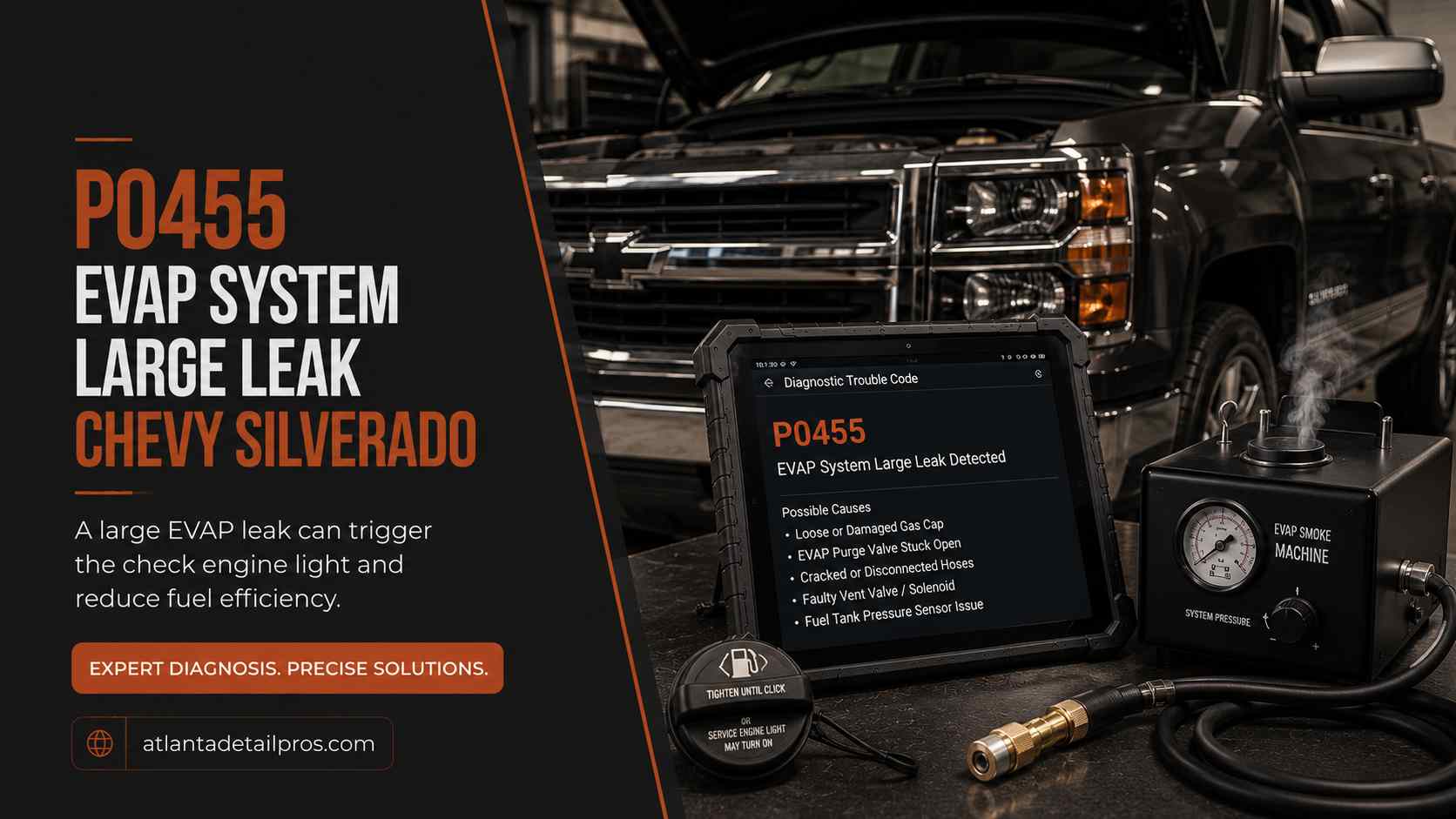
P0455 on your Chevy Silverado says the EVAP system has a large leak, and the first thing you should do is check your gas cap. Right now. Before reading further, walk out to the truck, remove the gas cap, inspect the rubber seal on the underside, reinstall it until you feel and hear it click, and drive for one complete drive cycle. You would be surprised how often that is the whole fix.
P0455 means the evaporative emission control system has detected a pressure drop during its self-test that exceeds the threshold for a large leak, defined as a hole larger than approximately 1mm. Unlike P0442 (small leak) which requires a smoke machine to find reliably, P0455 usually has a visible, findable cause because the leak is large enough to either be a disconnected component, a clearly faulty valve, or a badly deteriorated gas cap seal. This guide walks through the complete diagnosis in the right order for the Silverado specifically.
Understanding What P0455 Tells You That P0442 Does Not
The size distinction between P0455 and P0442 matters for diagnosis. A large leak means something has failed significantly: not a pinhole in a hose but a disconnected fitting, a failed valve, a cracked canister, or a gas cap that is not sealing at all. The EVAP system on the Silverado is a sealed network that routes fuel vapors from the gas tank through a charcoal canister and into the intake manifold during normal operation. Every part of that sealed loop needs to hold pressure, and P0455 means somewhere in that loop a large gap has opened.
The good news is that large leaks are easier to find than small ones. The bad news is that on the Silverado, certain components fail at predictable mileage points, and knowing which ones helps you go directly to the most likely cause rather than checking everything.
How to fix P0455 EVAP System Large Leak on Chevy Silverado
Here you will find the step by step guideline below.
Step 1: The Gas Cap (Free Fix, Check It First Every Time)
The gas cap accounts for more than 50 percent of P0455 codes on all vehicles including the Silverado, according to technician repair data. This is because the gas cap rubber seal hardens and cracks with age and heat cycling, and because even a correctly-functioning cap improperly reinstalled can fail the EVAP pressure test.
Inspecting the Gas Cap
Remove the gas cap and flip it over. Inspect the rubber O-ring seal on the underside. A healthy seal is soft, uniform in thickness, and free of cracks. A seal that is flat, cracked, hardened, or has debris embedded in it cannot form an airtight seal against the filler neck. Hold the cap up to light and look for any visible gaps in the seal material.
Replacing the Silverado Gas Cap
Use only an ACDelco OEM cap for the Silverado. Aftermarket caps, including name-brand ones from well-known retailers, frequently cause repeat P0455 codes on Silverado trucks because their seal profiles or internal venting pressures do not match the GM EVAP system specifications precisely. The ACDelco cap costs $20 to $30 and is the only one that will definitively rule out the cap as the cause. After installing a new OEM cap, clear the code and drive through two complete drive cycles before evaluating whether P0455 returns.
Never overtighten the gas cap. Turn it clockwise until you hear and feel one or two clicks, then stop. Over-tightening can warp the seal or damage the filler neck sealing surface, which creates a problem worse than the original cap failure.
Step 2: The EVAP Vent Solenoid Near the Spare Tire
This is the Silverado-specific component most responsible for P0455 after the gas cap, and it is the one most general P0455 guides fail to address. The EVAP canister vent solenoid on the Silverado is located underneath the truck near the spare tire carrier. Its exposed location makes it one of the most failure-prone EVAP components on the truck because it is constantly exposed to road debris, mud, water, and salt.
What the Vent Solenoid Does and Why It Fails
The vent solenoid allows fresh air into the EVAP system during normal refueling and vents the system after the EVAP purge cycle. When the ECM runs the EVAP pressure test, it commands the vent solenoid closed and applies vacuum to check for pressure drops. A vent solenoid that is stuck open from debris contamination or corrosion cannot close when commanded, allowing continuous air to enter the system. The EVAP pressure test reads this as a large leak.
Testing and Replacing the Vent Solenoid
With a scan tool that can command EVAP components, command the vent solenoid closed and observe whether the EVAP system holds vacuum. Without a capable scan tool, the solenoid can be tested by removing it and applying 12V directly to its terminals: a healthy solenoid clicks audibly when powered. If no click, the solenoid is electrically failed. If it clicks but the code persists, it may be mechanically stuck open or cracked in the housing. The vent solenoid for the Silverado is an ACDelco 214-2149 or Dorman 911-030, costing $25 to $60. GM issued a TSB recommending a relocation kit for some Silverado models to move the solenoid to a less exposed location, preventing repeat failures.
Step 3: The EVAP Purge Valve
The EVAP purge solenoid is located in the engine bay, typically near the intake manifold. It controls the flow of fuel vapors from the charcoal canister into the intake manifold during normal engine operation. When it fails by sticking in the open position, it creates a path for air to continuously enter the intake from the EVAP system, which the ECM reads as a large leak during the pressure test.
The Hard-Start After Refueling Symptom
A stuck-open purge valve has a distinctive symptom alongside P0455: the engine cranks for several seconds before starting immediately after you refuel. This happens because the stuck-open purge valve allows fuel vapors to saturate the intake while the truck is parked. When you restart, the engine is flooded with vapor and takes longer than normal to catch. If your Silverado cranks a second or two longer after filling the gas tank, the purge valve is the prime suspect alongside P0455.
Testing the Purge Valve
Remove the purge valve from the intake manifold. Disconnect the two vacuum/vapor hoses. With the valve at room temperature and unpowered (connector disconnected), blow through one port of the valve. A healthy normally-closed purge valve should not allow air through when unpowered. If you can blow through it freely, the valve is stuck open. The purge valve replacement costs $25 to $50 for an ACDelco unit and takes 15 minutes to install.
Step 4: The Smoke Test for Everything Else
If the gas cap, vent solenoid, and purge valve all check out and P0455 persists, the remaining possible causes (cracked charcoal canister, damaged filler neck, cracked EVAP hose) require a smoke test to locate efficiently. On the Silverado these leaks are particularly common after impacts on unpaved roads where road debris can crack the plastic canister housing, or in northern states where filler neck corrosion is an ongoing problem.
How the Smoke Test Works on the Silverado
A technician connects a smoke machine to the EVAP service port (usually under the hood near the engine) or a disconnected vapor line. The vent solenoid is commanded closed using a scan tool. Smoke fills the entire sealed EVAP system: the fuel tank, all vapor lines, the canister, and all valves. Any leak point shows smoke escaping visibly. For a large leak like P0455, the smoke will pour out immediately at the leak point. A cracked canister near the spare tire, a compromised filler neck-to-fuel tank joint, or a cracked EVAP hose shows clearly. Most shops charge $75 to $150 for this service.
Specific TSBs Worth Knowing for the Silverado
GM issued TSB 15-NA-019 covering 2014 and 2015 Silverado models for a known failure of the fuel tank filler vent hose, which can develop a fracture causing P0455. If you have a 2014 or 2015 Silverado with P0455 and have already confirmed the cap, vent solenoid, and purge valve are good, check this hose specifically. The part number is 22802073 for the replacement vent hose assembly.
Check in Order | How to Confirm | Fix | Cost |
|---|---|---|---|
Gas cap seal | Inspect O-ring; is it cracked, flat, or hard? | ACDelco OEM cap only | $20-$30 |
Vent solenoid near spare tire | Command closed with scan tool; or 12V click test | ACDelco 214-2149 or Dorman 911-030 | $25-$60 |
Purge valve stuck open | Blow-through test when unpowered; hard start after refueling? | ACDelco purge valve replacement | $25-$50 |
EVAP hoses or filler neck | Visual inspection; smoke test | Replace damaged hose or filler neck assembly | $10-$200 |
Charcoal canister cracked | Smoke test shows canister leaking | Replace charcoal canister | $100-$300 |
Frequently Asked Questions
What does P0455 mean on a Chevy Silverado?
P0455 means the EVAP (evaporative emission control) system has detected a large leak, defined as a gap larger than approximately 1mm. The system is designed to capture and reuse fuel vapors from the gas tank. When the ECM tests this sealed system and finds it cannot hold pressure, it stores P0455. On the Silverado, the most common cause is a worn gas cap seal, followed by a failed EVAP vent solenoid near the spare tire.
Can I drive my Silverado with P0455?
Yes. P0455 does not affect engine performance or vehicle safety. You will fail an emissions test with this code, and the system is releasing fuel vapors into the atmosphere rather than burning them. Tighten or replace the gas cap immediately since that is the free first step. Address the remaining causes within a few weeks.
What is the difference between P0455 and P0442?
P0455 is a large EVAP leak (greater than 1mm). P0442 is a small leak (0.020 to 0.060 inches, or roughly 0.5mm to 1.5mm). Large leaks from P0455 usually have a findable, obvious cause like a failed gas cap, a stuck vent valve, or a disconnected hose. Small leaks from P0442 often require a smoke test to locate reliably because the hole is too small to find visually.
Why does my Silverado crank longer after getting gas?
A hard start immediately after refueling, where the engine cranks for 2 to 5 seconds before catching, is a classic symptom of a stuck-open EVAP purge valve. The purge valve in the open position allows fuel vapors to flood the intake while the truck is parked at the fuel pump. When you try to restart, the engine is over-rich from the vapor accumulation and takes longer to fire. Replace the purge valve if you have both P0455 and the post-refueling crank issue.
The Bottom Line
P0455 on the Chevy Silverado has a clear and affordable diagnostic path. Replace the gas cap with an OEM ACDelco unit first: it costs $25 and resolves more than half of all P0455 cases. Test the vent solenoid near the spare tire next, as it is the most truck-specific common failure. Check the purge valve if you have the hard-start-after-refueling symptom. If all three check out, get a smoke test done. The entire sequence from cap to smoke test costs $75 to $200 in most scenarios, well below what some shops charge just for the diagnostic.