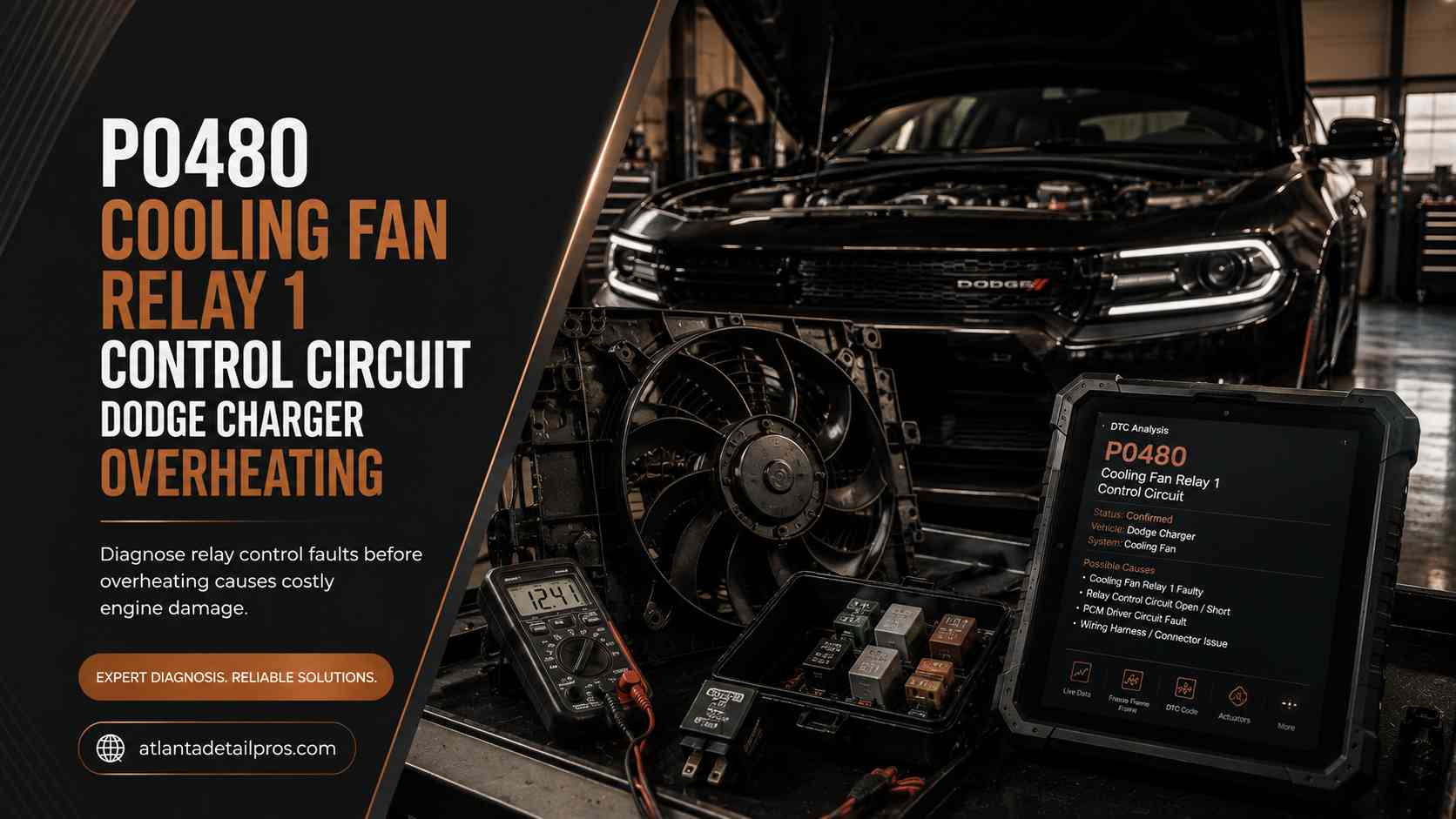
P0480 on a Dodge Charger means the PCM has detected a malfunction in the control circuit for cooling fan relay 1: which controls the primary electric cooling fan: and on Charger models this most commonly results from a failed fan control module, a burned-out cooling fan motor, a blown fuse in the fan circuit, or a PCM driver output fault, with the critical consequence being that without the cooling fan functioning the engine will overheat at low speeds and at idle where ram airflow through the radiator is insufficient.
The P0480 code and overheating condition frequently appear together on the Dodge Charger because the loss of cooling fan operation at a traffic light or during slow city driving allows coolant temperature to climb rapidly.
“My 2014 Charger R/T started overheating at red lights and showed P0480. I assumed it was the relay but on this car there’s no simple relay: it’s a fan control module on the radiator shroud. The module was $95 from the dealer and took me 45 minutes to replace. Fixed the overheating immediately. My advice: don’t let a shop tell you it’s the PCM until they’ve eliminated the fan module first.”: Derek Fontaine, 2014 Charger R/T owner
What P0480 Means on the Dodge Charger
Understanding the Cooling Fan Control System on Modern Chargers
P0480 is defined as “Cooling Fan 1 Relay Control Circuit” malfunction, but on the 2011 to present Dodge Charger (and Challenger), the cooling system does not use a simple relay in the traditional sense. Instead, it uses an integrated fan control module (FCM): sometimes called the fan speed controller: that is mounted directly on the cooling fan shroud assembly.
The PCM sends a pulse-width modulated (PWM) signal to this module commanding a specific fan speed from 0 to 100 percent. The module interprets the signal and controls the fan motor accordingly. P0480 is stored when the PCM’s commanded output to the fan control circuit does not result in the expected feedback signal: indicating the module is not responding, the fan motor has failed, or the circuit has an open or short.
Older Charger Models (2006 to 2010): Traditional Relay Configuration
On 2006 to 2010 Chargers with the 2.7L, 3.5L, or early 5.7L HEMI, a more traditional relay-based cooling fan system was used. P0480 on these earlier models is more likely to be an actual relay failure rather than a module issue. The relay is typically located in the power distribution center (PDC) under the hood.
Why P0480 Causes Overheating on the Dodge Charger
The Dodge Charger’s front-mounted radiator depends on two sources of airflow: ram air from forward vehicle motion, and the electric cooling fan that pulls air through the radiator when the vehicle is stationary or moving slowly. At highway speed (above 45 to 50 MPH), ram airflow is typically sufficient to cool the radiator without the fan running.
However, at idle, in traffic, or in slow city driving, the cooling fan is the primary mechanism for maintaining coolant temperature. A non-functioning fan allows coolant temperature to climb from the normal 195 to 210°F range toward the 230 to 240°F overheating threshold within 5 to 10 minutes of stationary operation.
Diagnosing P0480 on the Dodge Charger
Step 1: Verify the Cooling Fan Is Not Running
Direct Observation Test
With the engine at operating temperature (temperature gauge in the normal range), turn on the air conditioning. On a properly functioning Charger, activating the AC should cause the cooling fan to run at a moderate to high speed within a few seconds because the AC condenser requires airflow.
If the fan does not spin when AC is engaged: the fan or its control circuit has failed. This confirms the P0480 is causing an actual loss of fan operation, not just a false code. If the fan does spin with AC on: the fan motor itself is functional. The issue may be in the PCM’s ability to control the fan through the normal cooling temperature-based circuit rather than the AC-triggered circuit.
Step 2: Check Fuses in the Fan Circuit
Cooling Fan Fuse Locations on Dodge Charger
The cooling fan circuit is protected by one or more fuses in the power distribution center (PDC) under the hood. On 2011 to present Chargers, consult the PDC cover map for the cooling fan fuse. Common fuse numbers and amperage ratings vary by model year:
- A blown fuse is visible as a broken element inside the fuse body when inspected with a flashlight, or confirmed with a multimeter measuring voltage on both sides of the fuse with the circuit powered If the cooling fan fuse is blown: replace the fuse with the exact amperage rating specified. If the replacement fuse blows again immediately, there is a short circuit in the fan wiring or motor that must be located before another fuse can hold.
Step 3: Fan Control Module Testing and Replacement
How to Test the Fan Control Module
The fan control module on 2011+ Chargers can be tested with a multimeter and a known-good 12V power source: Method 1: Power and ground test at module connector:
- With the ignition on, verify 12V battery power is present at the module’s power supply terminal
- Verify ground continuity at the module’s ground terminal
- Absence of either confirms a wiring issue upstream of the module rather than a failed module Method 2: Direct fan motor test:
- Disconnect the fan control module and apply 12V directly to the fan motor terminals (positive and negative)
- If the fan spins: the motor is functional; the module is the suspect
- If the fan does not spin with direct power: the fan motor itself has failed Fan control module replacement cost on Dodge Charger:
- Aftermarket fan control module: $50 to $120
- OEM Mopar unit: $90 to $200
- Labor: 30 to 60 minutes (the module is on the fan shroud and requires partial disassembly of the cooling package on some Charger configurations)
- Total at an independent shop: $120 to $350
Step 4: Cooling Fan Motor Inspection
Signs the Fan Motor Has Failed
- Fan does not spin even when the module tests correctly and direct 12V is applied to the motor
- Fan spins but very slowly or with grinding sounds indicating bearing wear
- Burning smell from the fan area after overheating events (motor windings may have burned) Cooling fan assembly replacement cost (fan, motor, shroud as a complete assembly): $150 to $400 for the assembly. Labor: 1 to 2 hours. Total at an independent shop: $250 to $600.
The Overheating Emergency: What to Do Immediately With P0480
Protecting the Engine When the Fan Is Not Working
If the Charger is overheating with P0480 active, follow these steps to prevent catastrophic engine damage:
Immediate Actions
- Turn on the heater at maximum heat: the cabin heater core acts as a secondary radiator and transfers heat from the coolant to the cabin air, reducing coolant temperature by 5 to 15°F in most cases
- Do not turn off the engine while overheating: shutting off an overheating engine traps hot coolant without circulating it; keep the engine running and the water pump circulating
- Pull over safely if the temperature gauge reaches the red zone: do not continue driving into the overheating zone: engine damage from a blown head gasket begins at sustained temperatures above 230°F
- Allow the engine to cool completely before adding coolant: opening the radiator cap or overflow reservoir on a hot, pressurized system causes explosive coolant release and severe burn risk
Common P0480 Scenarios on Dodge Charger by Symptom
| Symptom | Most Likely Cause | Diagnosis Step |
|---|---|---|
| Fan never runs; overheating at idle; P0480 | Fan control module failure | Check fuses; test module power and ground; direct motor test |
| Fan runs only on AC; overheats in traffic | PCM cooling temperature output fault | Test PCM’s PWM signal output to module; may indicate PCM issue |
| Fuse keeps blowing with P0480 | Fan motor short circuit | Disconnect motor and test for short to ground |
| Fan runs erratically; P0480 intermittent | Failing fan control module | Replace module; clean and reseat connector |
| No power to module connector | Wiring fault or blown main fuse | Check main fan fuse; trace wiring to PDC |
Frequently Asked Questions
What Does P0480 Mean on a Dodge Charger?
P0480 means the PCM has detected a fault in the Cooling Fan Relay 1 control circuit. On 2011 to present Dodge Chargers, this points to the integrated fan control module on the radiator shroud rather than a traditional relay. The most common cause is a failed fan control module, though a blown fuse, failed fan motor, or wiring fault can also trigger this code.
Why Is My Dodge Charger Overheating at Idle With P0480?
The cooling fan is not operating to pull air through the radiator when the vehicle is stationary. Without forward vehicle motion to create ram airflow, the non-functioning fan allows coolant temperature to climb at idle and in slow traffic. The engine relies on the electric fan for all radiator cooling below approximately 45 MPH.
Is There a Simple Relay for the Cooling Fan on the 2011+ Dodge Charger?
No. Unlike older vehicles that used a simple electromechanical relay, the 2011 to present Charger uses a pulse-width modulated fan control module that varies fan speed between 0 and 100 percent based on the PCM’s signal. There is no single relay to swap. The module is mounted on the fan shroud assembly and must be tested and replaced as a unit.
How Much Does It Cost to Fix P0480 on a Dodge Charger?
Fan control module replacement: $120 to $350 at an independent shop. If the fan motor has also failed (common if overheating has damaged it): add $150 to $400 for the fan assembly. Fuse replacement: $1 to $5 plus the time to identify why the fuse blew. Wiring repair if a harness fault is found: $100 to $300.
Can I Drive a Dodge Charger With P0480?
Only at highway speeds above 45 MPH where ram airflow provides sufficient cooling without the fan. Any driving in traffic, at idle, or in slow city conditions risks overheating. If the temperature gauge rises above normal range, pull over, turn on the heater, and allow the engine to cool. Do not continue driving into the red zone. Have the cooling fan system repaired before any additional city driving.
What Happens if I Ignore P0480 on My Dodge Charger?
Continued driving with a non-functioning cooling fan in city conditions will eventually overheat the engine. Overheating causes head gasket failure, warped cylinder heads, and in severe cases cracked engine blocks: repairs that cost $1,500 to $6,000. A $120 to $350 fan module replacement is the immediate intervention that prevents this outcome.
The Bottom Line
P0480 on the Dodge Charger is a cooling system emergency that requires prompt action, not a code to monitor for a few weeks. Without the cooling fan, the engine overheats at idle and in city traffic within minutes: a situation that can destroy a head gasket or warp a cylinder head in a single event.
The diagnosis follows a simple path: verify the fan is not running, check the fuse, test the module’s power and ground, and confirm whether the motor runs with direct power. Derek Fontaine’s experience above is typical: the fan control module is almost always the component, and replacing it takes under an hour. The PCM is rarely involved and should be the last suspect, not the first.